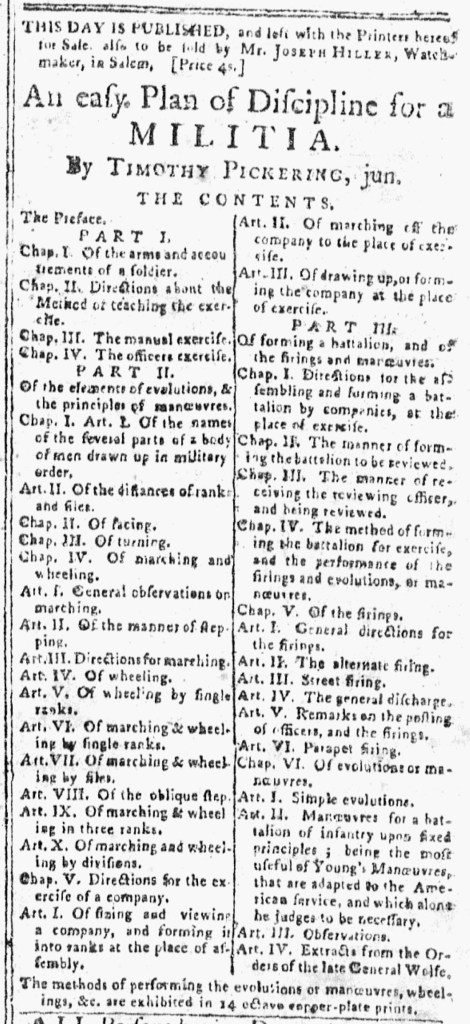
What was advertised in a revolutionary American newspaper 250 years ago today?
New-England Chronicle (July 27, 1775).
“An easy Plan of Discipline for a MILITIA. By TIMOTHY PICKERING.”
As the imperial crisis intensified when the Coercive Acts went into effect in 1774, the Massachusetts Provincial Congress recommended publication of a manual for training militia throughout the colony, The Manual Exercise as Ordered by His Majesty in 1764: Together with Plans and Explanations of the Method Generally Practis’d at Reviews and Field-Days. Over the next several months, several printers in New England published their own editions. Advertisements for The Manual Exercise appeared frequently in newspapers throughout the region. Printers beyond New England followed their lead. After the battles at Lexington and Concord, advertisements for other military manuals proliferated, including advertisements for Thomas Hanson’s Prussian Evolutions in Actual Engagements published by subscription in Philadelphia.
Samuel Hall and Ebenezer Hall, printers of the New-England Chronicle, published and advertised yet another military manual, An Easy Plan of Discipline for a Militia by Timothy Pickering, Jr. An advertisement for the work appeared in the July 27, 1775, edition of their newspaper. The Halls indicated that they had copies available at their printing office in Cambridge, where they had only recently moved from Salem and renamed and continued publishing the Essex Gazette. In addition, Joseph Hiller, a watchmaker in Salem, also sold the manual. The advertisement consisted primarily of an extensive list of the contents, demonstrating to prospective customers what they could expect to find in the volume, followed by a short note that the “methods of performing the evolutions or manœuvres, wheelings, &c. are exhibited in 14 octavo copper-plate prints.” The illustrations were an important addition that would aid readers in understanding the various maneuvers described in the book.
In addition to the advertisement the Halls inserted in the New-England Chronicle, Pickering pursued another means of marketing the book. He sent a copy directly to George Washington with a request that he consider “recommending or permitting its use among the officers & soldiers under your command.” Pickering flattered the commander of the Continental Army following his appointment to the post by the Second Continental Congress, declaring that the army had been “committed to your excellency’s care & direction” “to the joy of every American.” Pickering asserted his own “duty & inclination” inspired him to compose the manual and present it to the general for his consideration. He deemed it a “service [to] my country” that he hoped “may well prove advantageous in an army hastily assembled.” Washington did indeed take note. According to the American Revolution Institute, “Washington promoted the use of several published works, including Timothy Pickering’s An Easy Plan of Discipline for a Militia and Thomas Hanson’s The Prussian Evolutions” during the early years of the Revolutionary War. In 1779, Baron von Steuben’s Regulations for the Order and Discipline of the Troops of the United States became the first official manual of the Continental Army. Until then, Pickering’s manual was a popular choice for training American soldiers.
What was advertised in a revolutionary American newspaper 250 years ago today?
Pennsylvania Journal (July 19, 1775).
“PROPOSALS, For printing … The PRUSSIAN EVOLUTIONS In actual Engagements.”
The July 19, 1775 editions of the Pennsylvania Gazette and the Pennsylvania Journal carried “PROPOSALS, For printing by SUBSCRIPTION, The PRUSSIAN EVOLUTIONS In actual Engagements” by Thomas Hanson. A synopsis indicated that the book included “all the different Evolutions and Manoeuvres in firing standing, advancing and retreating, which were exhibited before his present Majesty, May 8, 1769, and before John Duke of Argyle … in 1771; with some additions since that time, explained with thirty folio copper-plates.” Three bonus images accompanied by descriptions depicted surveying, fortifications, and a gun and mortar.
The advertisement noted that the proposals “were first published May 3, 1775, by THOMAS HANSON, Adjutant for the Second Battalion.” That means that Hanson proposed and marketed the work very shortly after receiving news of the battles at Lexington and Concord. Such projects, however, took time. “It is expected,” Hanson stated, that the “said work will be completed in three or four weeks from this date” or sometime in the middle of August. To entice readers to reserve copies in advance, Hanson also promised that the “Subscribers names will be inserted, and those that choose to subscribe must do it speedily, otherwise their names will not be in the book.” Prospective subscribers had an opportunity to demonstrate their support for the American cause and appear in the company of fellow Patriots, just as genteel advocates for improvements in architecture had their names listed in a recently published American edition of Abraham Swan’s British Architect.
Several prominent residents of Philadelphia lent their support to the work by collecting subscriptions on behalf of Hanson, including “John Dickinson, Esq; Thomas Mifflin, Esq; Daniel Roberdeau, John Cox, jun.[,] Samuel Meredith, and John Wilcocks, Merchants,” Benjamin Towne, printer of the Pennsylvania Evening Post; William Hall, David Hall, and William Sellers, printers of the Pennsylvania Gazette; William Bradford and Thomas Bradford, printers of the Pennsylvania Journal; Robert Bell, printer and bookseller; and Thomas Nevell, “at the sign of the Carpenter’s-Hall” (who simultaneously collected subscriptions for The Gentleman and Cabinet-Maker’s Assistant and an American edition of Swan’s Collection of Designs in Architecture).
George Washington had already joined the ranks of the subscribers to Prussian Evolutions by the time Hanson’s proposals ran in the Pennsylvania Gazette and the Pennsylvania Journal on July 19. According to historians at Mount Vernon, Washington purchased eight copies of Hanson’s manual, “one of the earliest for the instruction of American officers,” on May 20 and “likely distribute[d] the copies among militia officers and other key figures preparing for the growing conflict. Indeed, “His Excellency George Washington” appeared among the “LIST OF SUBSCRIBERS NAMES” inserted immediately after the “DEDICATION, TO THE PRESERVERS of LIBERTY,” with a notation that he ordered eight copies. Other subscribers included “The Honourable John Adams,” “The Honourable Benjamin Franklin,” “The Hon. John Hancock,” “His Excellency Richard Henry Lee,” “The Hon. Peyton Randolph,” and “His Excellency Philip Schuyler.” Washington was not alone in subscribing for multiple copies. Captain Moore Furman subscribed for five, Lieutenant Colonel Abraham Hunt for six, Captain Joseph Moulder for two, Lieutenant John Patton for two, and Colonel Daniel Roberdeau for four. The “Merchants” who collected subscriptions also appeared on the list, identified by their military ranks: “Col. John Dickinson, Esq,” “Quarter Master General, Thomas Mifflin,” “Major, John Cox,” “Major, Samuel Meridith,” and “Capt. John Wilcocks.” Subscribers certainly found themselves in good company!
“A TRACT of six hundred acres, including about two hundred of cleared land.”
George Washington possessed a “TRACT of six hundred acres … lying on the north side of Rappahannock river, opposite to the lower end of Fredericksburg” that he wished to sell, rent, or exchange “for back lands in any of the northern counties” of Virginia in the fall of 1772. To that end, he ran advertisements in the Virginia Gazette published by Alexander Purdie and John Dixon and the Virginia Gazette published by William, calling on interested parties to “enquire of Col. Lewis in Fredericksburg” or himself in Fairfax.
Thick black lines appeared on either side of Washington’s advertisement in the November 19 edition of Rind’s Virginia Gazette, but those lines had nothing to do with the advertisement itself. Instead, those lines adorned all four pages of that issue, separating columns of news and advertising on each page. Readers recognized them as mourning borders, a common practice among eighteenth-century printers upon the deaths of prominent and influential people. When readers first glimpsed the front page of the newspaper, they would have known that it contained news about the death of someone important. In addition to the black borders between the columns, Rind also inserted thick black borders into the masthead. Similar borders helped readers find news of the death of “the Honourable WILLIAM NELSON, Esquire, President of his Majesty’s Council of Virginia” when they turned to the second page. Those borders ran above and below the announcement of Nelson’s death. In contrast, a shorter item about the death of William Templeman, a merchant in Fredericksburg, did not feature mourning borders above and below, only to the sides like the rest of the contents of that edition. Many readers in Williamsburg, the capital of the colony and the site of the printing office, would have heard the news before receiving the newspaper, but for readers at a distance the mourning borders immediately alerted them to peruse the issue for a certain kind of news.
In that issue of the Virginia Gazette, the news of Nelson’s death had an impact on the appearance of Washington’s real estate notice and every other advertisement. Even readers who had previously heard the news could not read any of the notices without encountering a reminder of that significant event.
Last night I attended the penultimate presentation in the American Antiquarian Society’s Spring 2016 Public Programs series, T.H. Breen’s examination of “George Washington’s Journey to the Nation,” a lecture cosponsored by the Franklin M. Loew Lecture Series at Becker College. Breen recently published George Washington’s Journey: The President Forges a New Nation (2016). I have not yet had a chance to read this book; I offer here a review and reactions to the lecture presented in Antiquarian Hall.
In his opening remarks, Breen commented that he particularly enjoys making presentations about his books because doing so gives him opportunities to share “all the wonderful aspects of the book.” Public lectures allow him to set the record straight in the wake of reviewers who misinterpret or miss the point of his work. What follows here may or may not miss the point, in Breen’s estimation, but it does seek to engage with the narrative he presented.
In researching George Washington’s Journey, Breen set out to trace a series of trips that the nation’s first president undertook during the first two years of his first term in office, journeys to all thirteen of the original states, from Georgia to the Maine frontier (then still part of Massachusetts), between 1789 and 1791. Washington made these journeys, Breen contended, as a means of bringing the federal government to “the people.” To a greater degree than other founders, according to Breen, Washington realized that the new republic would succeed or fail based on the attitudes of the people, the masses that were still organizing their thoughts about the meaning of the Revolution and attempting to figure out what they wanted the new nation to be. Washington realized that common men had replaced the quiet deference that existed before the Revolution with new modes of interacting in everyday life and raucous participation in local politics. All too often the focus was too local, privileging the needs of the individual states over the nation as a whole. More than once Breen reminded the audience that Washington favored a stronger federal government as a means of strengthening the nation, an aspect of the drafting, ratification, and implementation of the Constitution that all too many of the devotees of the founders seem unaware. Republican government was an experiment, one that Washington (as well as others in the founding generation) feared could fail. Washington worried for the economic stability and military security of the new nation. This made his journeys to the states – to the people – imperative. He understood “that the threads that bound the American people to a single political identity were fragile and untested.” To knit those threads together, he took the federal government to the people, in the form of his own person, to help those overly fixated on local interests realize that the nation amounted to more than the sum of its parts.
Breen made convincing arguments about the purpose and effects of Washington’s journeys, but I couldn’t help but feel that he overstated his case. A significant undercurrent that ran throughout his lecture could be summed up by the subtitle of his book: The President Forges a New Nation. (Yes, I understand that publishers, rather than the historians who write the books, often craft the titles in order to appeal to broad audiences. That being said, Breen’s presentation embraced the general sentiment of that subtitle.) Breen told a story in which the fate of the nation depended on a single individual, suggesting that without Washington’s itinerary through cities, towns, and villages in each of the states that the people in those separate states would not have coalesced as a unified nation. I question to what extent the president alone forged the new nation. I do not disagree that Washington’s journeys played an important role in knitting together geographically distant constituencies that had their own interests. I’ll incorporate this aspect of Washington’s presidency into the coursework and classroom discussion the next time I teach my course on the Era of the American Revolution and the Constitution.
Yet Washington did not singlehandedly unify the new nation. A variety of people, events, and factors also played significant parts in the process, including merchants, shopkeepers, artisans, authors, artists, and printers who promoted patriotic and nationalist consumer and visual cultures in the 1780s and 1790s. I do not object to acknowledging the purpose of Washington’s journeys throughout the nation, but I am cautious when doing so skates right up to hagiographical depictions of the first president by suggesting the survival and success of the republican experiment could be traced back exclusively to a single cause, one insightful leader who engaged with and made himself accessible to the people.
Breen stated that the Washington who made these journeys was a Washington that most people, even the most ardent fans of the first president, probably do not know. When considering the constellation of founders that served in Washington’s administration, the president sometimes recedes into the background. He was genial, but not usually depicted as a particularly daring risk taker or bold innovator when considered in the company of his more intellectual peers, especially Jefferson and Hamilton. Not as comfortable interacting with others in social situations as those men, Washington often seemed awkward in comparison and lacking their charm, despite his general amiability. The Washington who made himself accessible to the people, who made a point of traveling to visit them in their own towns, who insisted on staying in public inns (Washington slept here!) rather than secluding himself in the homes of the local elite and powerful, who interacted with men, women, and children throughout the nation, is a Washington perhaps unfamiliar to most Americans. Washington was a man among the people, not just a man of the people.
Yes, this may be a new Washington that historians and the public may not have previously encountered, but the overall tone of Breen’s presentation – all the superlatives concerning the first president and his intentions for undertaking his journeys – does little to shift general perceptions of Washington. Overall, Breen seemed to reify Washington as exceptional and extraordinary. Certainly it must be possible to recognize Washington as the gifted and effective leader that he was, to honor his achievements and contributions to the nation, without implying that his actions were the only (or even the most important) factor in unifying the new nation. Breen tells an important and powerful story, but it is a story that would benefit from more context. It needs to be situated within other narratives and interpretations of the politics and culture of the first decades of the new American republic.