September 27

What was advertised in a revolutionary American newspaper 250 years ago today?
Essex Journal (September 27, 1776).

“Just Published … An easy PLAN of DISCIPLINE for a MILITIA … The Second Edition.”

John Mycall, the printer of the Essex Journal and New-Hampshire Packet, hawked copies of the second edition of Timothy Pickering’s “easy PLAN of DISCIPLINE for a MILITIA” in the fall of 1776.  As was common in many early American newspapers, the first page of the Essex Journal carried both news and advertisements.  In the September 27 edition, an update from London filled the first two columns and overflowed into the third on the first page. Advertisements completed that final column … and Mycall placed his advertisement for Pickering’s popular military manual first among those advertisements, increasing the chances that readers would take note of it.  His advertisement also reminded prospective customers that Pickering’s Easy Plan of Discipline had been “Ordered by Authority to be practised by all the Militia in the State of Massachusetts Bay,” simultaneously an endorsement and an edict to be followed.

Mycall announced that the second edition was “Just Published, And to be SOLD at the Printing Office.”  That did not mean, however, that he printed a Newburyport edition.  Eighteenth-century readers knew to separate the phrases “Just published” and “to be SOLD.”  The former merely meant that a book or pamphlet was available for sale (as opposed to being in the press) but did not necessarily refer to the advertiser.  Printers and booksellers frequently sold items “Just Published” by others.  In this instance, Mycall sold copies of a second edition of Pickering’s Easy Plan of Discipline published by Samuel Hall in Boston.  In June, Hall informed readers of the Continental Journal that the “second Edition … is now in the Press.”  On September 19, he ran a new advertisement in the Continental Journal, this time announcing that the military manual was now available at his printing office in School Street.  Hall apparently sent copies to Mycall to stock at his printing office in Newburyport.  The advertisement in the Essex Journal appeared just a week later.  The second edition that Mycall sold in Newburyport was hot off Hall’s presses in Boston.
September 19

What was advertised in a revolutionary American newspaper 250 years ago today?

Continental Journal (September 19, 1776).

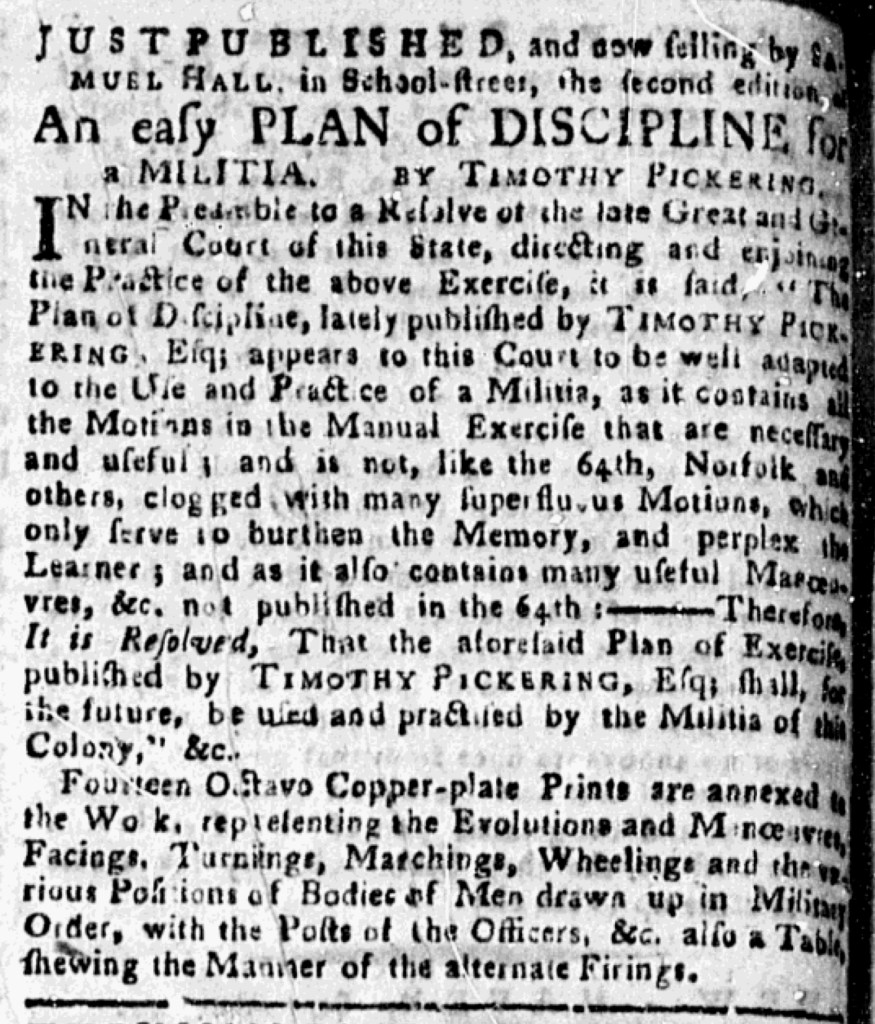
“The second edition of An easy PLAN of DISCIPLE for a MILITIA.”

In June 1776, Samuel Hall advertised that the “second Edition of Col. Pickering’s PLAN of DISCIPLINE,” a popular military manual by Timothy Pickering first published in the summer of 1775, “is now in the Press” and would be published soon.  In his initial advertisement for the second edition, Hall noted that “by Order of the General Assembly, all the Militia of this Colony are directed and enjoined to practise” Pickering’s Easy Plan of Discipline for a Militia.  The companies from towns throughout Massachusetts would benefit from the directions in the manual and the uniformity of consulting a common source for their instruction.

When Hall advertised that he “JUST PUBLISHED” the second edition in September 1776, he included a blurb from the “Preamble to a Resolve of the late Great and General Court of this State, directing and enjoining the Practice of [Pickering’s] Exercise,” deploying it as an endorsement for the manual he now sold at his printing office on School Street in Boston.  “The Plan of Discipline,” the preamble stated, “appears to this Court to be well adapted to the Use and Practice of a Militia, as it contains all the Motions in the Motions in the Manual Exercise that are necessary and useful.”  Unlike other manuals, Pickering’s Easy Plan of Discipline for a Militia was not “clogged with many superfluous Motions, which only serve to burthen the Memory, and perplex the Learner.”  Furthermore, Pickering’s manual “contains many useful Manœuvres … not published” in other manuals.”  The General Court made clear its determination that Pickering’s manual was superior to others.  George Washington, commander-in-chief of the Continental Army, apparently agreed.  Pickering’s Easy Plan of Discipline for a Militia was one of his preferred manuals before Baron von Stueben’s Regulations for the Order and Discipline of the Troops of the United States became first official manual of the Continental Army in 1779.  Hall also included the resolution itself in his advertisement for the second edition: “It is Resolved, That the aforesaid Plan of Exercise, published by TIMOTHY PICKERING, Esq; shall, for the future, be used and practised by the Militia of this Colony.”

In case such an endorsement was not enough to make a sale, Hall highlighted the “Fourteen Octavo Copper-plate Prints … annexed to the Work.”  They depicted “the Evolutions and Manœuvres, Facings, Turnings, Marchings, Wheelings and the various Positions of Bodies of Men drawn up in Military Order.”  The manual also featured “a Table, shewing the Manner of the alternate Firings.”  The Continental Army’s siege of Boston dislodged British forces in March 1776, but the war continued.  Hall presented a new edition of Pickering’s manual to officers and soldiers to aid them in continuing to fight for the American cause and defend their families, homes, and communities.

June 20

What was advertised in a revolutionary American newspaper 250 years ago today?

Continental Journal (June 20, 1776).

“Col. Pickering’s PLAN of DISCIPLINE, which … all the Militia of this Colony are directed and enjoined to practise.”

When he transferred the New-England Chronicle to Edward E. Powars and Nathaniel Willis in June 1776, Samuel Hall informed the public that “PRINTING in general will be continued at the Subscriber’s Office in School-street [in Boston], and performed with accuracy and dispatch.”  Although he would no longer publish a newspaper, Hall continued to earn his livelihood through job printing and other projects.  One of those projects was a second edition of Timothy Pickering’s Easy Plan of Discipline for a Militia.  Hall and his brother, Ebenezer, published and advertised the first edition nearly a year earlier.  As the war continued, the American army needed more copies military manuals, including Pickering’s manual.

On June 20, Hall inserted advertisements in both the Continental Journal and the New-England Chronicle, the only newspapers published in Boston at the time.  “The second Edition of Col. Pickering’s PLAN of DISCIPLINE, which by Order of the General Assembly, all the Militia of this Colony are directed and enjoined to practise,” Hall announced, “is not in the Press, and will be published, in about three Weeks.”  The advance notice gave interested parties an opportunity to reserve copies.  That, in turn, helped Hall determine how many copies to print.  After all, he did not publish the manual solely as a service.  He aimed to generate revenue with the venture.  He did not want an excessive number of surplus copies to eat into profits.

That an “Order of the General Assembly” directed the colony’s militia to consult Pickering’s military manual no doubt helped sales.  Yet Pickering received yet another important endorsement for his Easy Plan of Discipline for a Militia.  He sent a copy to George Washington following his appointment as commander-in-chief of the Continental Army by the Second Continental Congress.  In turn, according to the American Revolution Institute, “Washington promoted the use of several published works, including Timothy Pickering’s An Easy Plan of Discipline for a Militia and Thomas Hanson’s The Prussian Evolutions” in the years before the Baron von Stueben’s Regulations for the Order and Discipline of the Troops of the United States became the first official manual of the Continental Army in 1779.  With such support, Hall could feel confident that a second edition of Pickering’s military manual would meet with success.

July 27

What was advertised in a revolutionary American newspaper 250 years ago today?

New-England Chronicle (July 27, 1775).

“An easy Plan of Discipline for a MILITIA. By TIMOTHY PICKERING.”

As the imperial crisis intensified when the Coercive Acts went into effect in 1774, the Massachusetts Provincial Congress recommended publication of a manual for training militia throughout the colony, The Manual Exercise as Ordered by His Majesty in 1764: Together with Plans and Explanations of the Method Generally Practis’d at Reviews and Field-Days.  Over the next several months, several printers in New England published their own editions.  Advertisements for The Manual Exercise appeared frequently in newspapers throughout the region.  Printers beyond New England followed their lead.  After the battles at Lexington and Concord, advertisements for other military manuals proliferated, including advertisements for Thomas Hanson’s Prussian Evolutions in Actual Engagements published by subscription in Philadelphia.

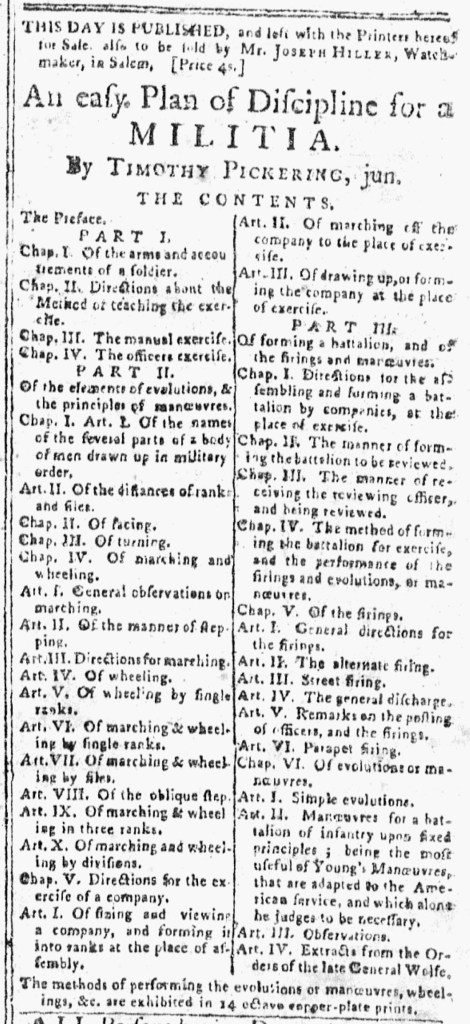
Samuel Hall and Ebenezer Hall, printers of the New-England Chronicle, published and advertised yet another military manual, An Easy Plan of Discipline for a Militia by Timothy Pickering, Jr.  An advertisement for the work appeared in the July 27, 1775, edition of their newspaper.  The Halls indicated that they had copies available at their printing office in Cambridge, where they had only recently moved from Salem and renamed and continued publishing the Essex Gazette. In addition, Joseph Hiller, a watchmaker in Salem, also sold the manual.  The advertisement consisted primarily of an extensive list of the contents, demonstrating to prospective customers what they could expect to find in the volume, followed by a short note that the “methods of performing the evolutions or manœuvres, wheelings, &c. are exhibited in 14 octavo copper-plate prints.”  The illustrations were an important addition that would aid readers in understanding the various maneuvers described in the book.

In addition to the advertisement the Halls inserted in the New-England Chronicle, Pickering pursued another means of marketing the book.  He sent a copy directly to George Washington with a request that he consider “recommending or permitting its use among the officers & soldiers under your command.”  Pickering flattered the commander of the Continental Army following his appointment to the post by the Second Continental Congress, declaring that the army had been “committed to your excellency’s care & direction” “to the joy of every American.”  Pickering asserted his own “duty & inclination” inspired him to compose the manual and present it to the general for his consideration.  He deemed it a “service [to] my country” that he hoped “may well prove advantageous in an army hastily assembled.”  Washington did indeed take note.  According to the American Revolution Institute, “Washington promoted the use of several published works, including Timothy Pickering’s An Easy Plan of Discipline for a Militia and Thomas Hanson’s The Prussian Evolutions” during the early years of the Revolutionary War.  In 1779, Baron von Steuben’s Regulations for the Order and Discipline of the Troops of the United States became the first official manual of the Continental Army.  Until then, Pickering’s manual was a popular choice for training American soldiers.