
What was advertised in a colonial American newspaper 250 years ago today?
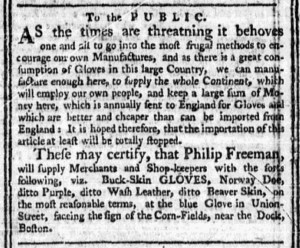
“It is hoped therefore, that the importation of this article at least will be totally stopped.”
Current events informed Philip Freeman’s marketing strategy as he attempted to sell gloves in the summer of 1774. As colonizers from New England to Georgia discussed how to respond to Parliament closing Boston Harbor and other legislation passed following the Boston Tea Party, many proposed a new round of nonimportation agreements. American merchants previously participated in boycotts to protest the Stamp Act and duties on several commodities imposed in the Townshend Acts, believing that disruptions to commerce served as an effective political tool. Parliament relented, repealing the Stamp Act and duties on glass, lead, paint, and paper (but doubled down on tea with a new Tea Act in 1773). A variety of other factors, including petitions and popular protests, played a role, so nonimportation agreements may not have had as much of an influence as intended. Still, colonizers believed that boycotting goods imported from Britain effectively achieved their political goals.
Freeman believed that was the case and encouraged prospective customers of its veracity. “As times are threatning,” he declared, “it behoves one and all to go into the most frugal methods to encourage our own Manufactures.” He recognized “a great consumption of Gloves in this large Country,” yet proposed that “we can manufacture enough here, to supply the whole Continent.” Such industry would have multiple benefits: it “will employ our own people, and keep a large sum of Money here, which is annually sent to England for Gloves.” Furthermore, Freeman asserted that the gloves he made “are better and cheaper than can be imported from England.” Not willing to wait for any sort of official nonimportation agreement enacted in Boston or throughout the colony or in cooperation with other colonies, Freeman implored that “the importation of this article at least will be totally stopped.” In common cause, Freeman and his competitors in the colonies could meet demand without having to resort to imported gloves. He did not direct his advertisement to consumers but rather the “Merchants and Shop-keepers” that he could supply with several different kinds of gloves “on the most reasonable terms.” Working in concert, Freeman envisioned that glovemakers, retailers, and consumers could participate in politics via the decisions they made about production, consumption, and importing goods, starting immediately and informally with gloves and perhaps extending to other items through formal agreements as colonizers continued to organize in opposition to the Boston Port Act.