October 27

What was advertised in a colonial American newspaper 250 years ago today?
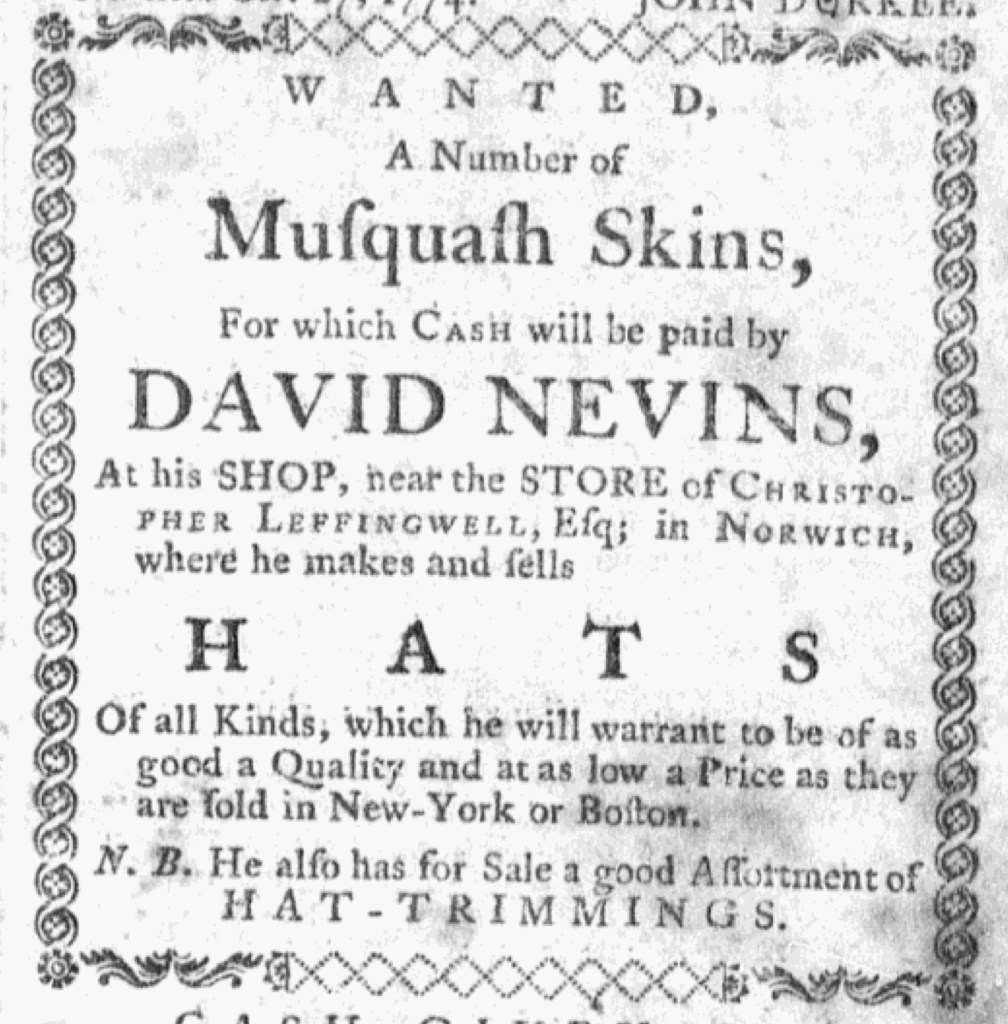
Norwich Packet (October 27, 1774).

“HATS … of as good a Quality and at as low a Price as they are sold in New-York and Boston.”

The use of decorative type as a border certainly distinguished David Nevins’s advertisement from other content in the October 27, 1774, edition of the Norwich Packet.  It appeared in the final column on the third page along with several other advertisements.  News items filled the facing page as well as the first two columns of that page, each of them in relatively small type compared to some of the fonts in the advertisements.  The compositor used printing ornaments to separate those news items, but nothing as extensive as the border that surrounded Nevins’s advertisement.

Some of the advertisements featured larger fonts to draw attention to consumer goods and services and their purveyors and providers, including “THOMAS COIT” and “Drugs and Medicines” in one, “FLAX SEED, SMALL FURRS, BEES-WAX” in another, and “PUBLIC VENDUE” in a third.  The same was true in Nevins’s advertisement, with his name, “Musquash Skins,” and “HATS” each centered and in larger fonts.  Yet Nevins did not deploy those fonts alone in his effort to draw the attention of readers.  He must have submitted a request for the decorative border along with the copy for his advertisement when he contacted the printing office.

Even with that visual advantage, Nevins also devised copy intended to sell the hats that he produced at his shop.  In addition to hats made of musquash or muskrat pelts, he promoted others “Of all Kinds” that customers could depend on being “of as good a Quality and at as low a Price as they are sold in New-York and Boston.”  Norwich was a small town compared to those major urban ports, yet that did not mean that consumers had to settle for second best or inflated prices. Nevins consistently mad that point in his advertisements.  In February, he “warranted” his hats “to be of the best Quality, and as cheap and fashionable as can be purchased in Boston and New-York” in an advertisement in the Connecticut Gazette.

Other advertisers who placed notices in the Norwich Packet may or may not have made requests about the design elements.  In writing the copy, they may have assumed that the compositor would select certain words to capitalize, center, and print in larger font without providing instructions to do so.  After all, that was a common feature of advertisements in that newspaper.  Nevins, on the other hand, almost certainly stated that he wished to enhance his advertisement with a decorative border to aid in highlighting the appeals he made in his copy.

February 18

What was advertised in a colonial American newspaper 250 years ago today?

Connecticut Gazette (February 18, 1774).

“HATS … both Bever and Castor.”

Ellie Chaclas, a student in my Revolutionary America class, and I worked together in selecting today’s advertisement.  Ellie has an interest in the history of fashion, completing her capstone research project on the politics of fashion during the era of the American Revolution.  She was drawn to this advertisement for “HATS, Manufactured by … DAVID NEVINS” that ran on the front page of the February 18, 1774, edition of the Connecticut Gazette.  Ellie noted that Nevins marketed the hats that he made as “warranted to be of the best Quality” as well as “as cheap and as fashionable as can be purchased in Boston and New-York.”  Nevins “Manufactured” hats in Norwich and marketed them to readers of a newspaper published in New London, reaching prospective customers in towns throughout Connecticut.  Colonizers did not have to live in urban ports like Boston and New York to participate in the consumer revolution of the eighteenth century.

Ellie also noted that Nevins made “Bever” or beaver hats but did not immediately recognize what he meant by “Castor.”  That gave us an opportunity to consult a resource that we frequently used in our class, the Oxford English Dictionary.  That yielded this definition: “a hat, originally either of beaver’s fur, or intended to be taken as such; in the end of the 17th and beginning of 18th cent. distinguished from ‘beaver’, and said to be of rabbit’s fur.”  We also discovered that “Bever” did not refer only to the material for “Manufactur[ing]” hats but in the eighteenth century was the name commonly used for a style of hat: “a hat made of beaver’s fur, or some imitation of it; formerly worn by both sexes, but chiefly by men.”  This underscored our conversations in class about eighteenth-century consumers speaking a language that they shared across the colonies yet much of their vocabulary no longer resonates with modern consumers.  To understand their experiences, we had to learn how to “translate” eighteenth-century English.

In addition, Ellie noted that even though the advertisement mentioned Boston and New York, Nevins likely had connections, even if indirect ones, with Detroit and the Great Lakes region and the trade in beaver fur.  As a class, we read and discussed Tiya Miles’s Dawn of Detroit: A Chronicle of Slavery and Freedom in the City of the Straits, shifting our examination of the era of the Revolution from the thirteen colonies on the Atlantic coast to the interior of the continent.  Miles’s book helped Ellie and her classmates (and their professor!) achieve a more complete understanding of the scope of Indigenous and African slavery in the Great Lakes region.  While not visible in Nevins’s advertisement, enslaved people likely played a part of in processing and transporting the fur he used in making his hats.

June 18

What was advertised in a colonial American newspaper 250 years ago today?

Massachusetts Spy (June 18, 1772).

“HATS manufactured and sold by the advertiser.”

Of the five newspapers published in Boston in the summer of 1772, the Massachusetts Spy had the most elaborate masthead, but it also had featured the fewest innovations in design for the rest of the contents, including advertisements.  For instance, a decorative border enclosed Jolley Allen’s advertisement when it appeared in each of the other newspapers, but that distinctive format was not incorporated into Allen’s notice when he submitted identical copy to the Massachusetts Spy.

That did not prevent Martin Bicker from attempting to draw more attention to his advertisement with an image of his merchandise in the upper left corner.  Bicker advertised that he “manufactured and sold” hats.  A woodcut depicting a tricorne hat, a popular style at the time, alerted readers to the contents of the advertisement before they read it.  Bicker did not provide many details about his hats, but he did declare that he “hopes he has given such satisfaction to his customers as will induce them to continue their favours.”  In other words, he invited repeat business and recommendations via word of mouth.

New-York Journal (June 18, 1772).

The same day that Bicker’s advertisement ran in the Massachusetts Spy, Nesbitt Deane once again inserted his advertisement for hats in the New-York Journal.  Both the appeals he made to customers and the image that accompanied the notice were more sophisticated.  Deane trumpeted that he made hats “to exceed in Fineness, Cut, Colour and Cock.”  In addition, he devised a means “to turn rain, and prevent the Sweat of the Head damaging the crown.”  Prospective customers would not find that feature in other hats, Deane asserted, because he invented “a Method peculiar to himself. He also gave a discount to retailers who bought in volume, offering “Encouragement to those who buy to sell again.”  Like Bicker, Deane acknowledged his existing customers and asked them to promote his hats.  “Such Gentry and others, who have experienced his Ability, ’tis hoped will recommend.”  The image at the top of Deane’s advertisement included both a tricorne hat and a banner with his name.  Rococo flourishes further enhanced that image.

Bicker did not deploy as many appeals as Deane in his effort to entice consumers to purchase his hats, but including an image in his advertisement distinguished it from most others in the Massachusetts Spy.  Relatively few advertisements published in the eighteenth-century newspapers featured images of any sort.  Did including images give advertisers an advantage?  Deane apparently thought so.  By the time Bicker placed his notice, Deane had been running his advertisement for nearly a year.  He likely would not have inserted it in the New-York Journal so many times if he did not believe he received a return on his investment.

August 29

What was advertised in a colonial American newspaper 250 years ago today?

New-York Journal (August 29, 1771).

“HATS MANUFACTURED by … NESBITT DEANE.”

For many weeks in the summer of 1771, Nesbitt Deane took to the pages of the New-York Journal to advertise hats he made and sold “Aside the Coffee-House Bridge.”  His hats had several qualities he expected consumers would appreciate, including exceptional “Fineness, Cut, Colour and Cock.”  These were not ordinary hats that prospective customers could acquire in just any shop, Deane confided, but instead “MANUFACTURED … by a Method peculiar to himself, to turn rain, and prevent the Sweat of the Head damaging the crown.”  Such promises may have enticed some readers to visit his shop to examine his hats for themselves to see what distinguished them from others available in the bustling port city.  Deane also called on “Such Gentry and others, who have experienced his Ability” by purchasing and donning his hats to recommend them to others.

Eventually, the hatter determined that he might attract more attention and incite greater demand if an image accompanied his advertisement.  Without revising the copy, he doubled the length of his notice, beginning on August 29, with a woodcut depicting a tricorne hat.  A banner bearing Deane’s name, adorned with rococo flourishes completed the image.  Such finery likely prompted the “Gentry and others” among readers of the New-York Journal of the engraved images on trade cards and billheads that circulated in London and, to a lesser extent, the largest cities in the colonies.  Another advertiser, Gerardus Duyckinck, had been enclosing the copy of his advertisements within a baroque cartouche for several years.  His most recent advertisement, perhaps an inspiration for Deane, appeared once again in the August 29 edition.

The sophistication inherent in Deane’s image testified to the “Fineness” of his hats, but it also meant that he invested more in his marketing efforts.  In addition to commissioning a woodcut unique to his business, he also paid for twice as much space in the New-York Journal each time his advertisement appeared.  The compositor’s notation at the end, “95 –,” indicated that the notice with the woodcut first appeared in issue 1495 but Deane had not selected an end date.  Neither had he done so for his first advertisement composed entirely of text.  In both instances, the hatter committed to more than the standard four weeks that the printer set as a minimum.  Between the indefinite duration of his notices and enhancing them with a striking image, Deane demonstrated his belief that more and better advertising would produce results.

July 18

What was advertised in a colonial American newspaper 250 years ago today?

New-York Journal (July 18, 1771).

“86—.”

For several weeks in 1771, Nesbitt Deane promoted “HATS, MANUFACTURED by the Advertiser” in the New-York Journal.  His advertisements concluded with “86—,” a notation intended for the compositor rather than readers.  Most advertisements in the New-York Journal included two numbers, the first corresponding to the issue in which the advertisement first appeared and the other indicating the final issue for the advertisement.  That allowed the compositor to quickly determine whether an advertisement belonged in the next issue when arranging notices and other content on the page in advance of going to press.

George Ball’s advertisement for “A Neat Assortment of CHINA, GLASS, STONE and DELPH WARES” in the same column as Nesbitt’s advertisement for hats in the July 18 edition, for instance, concluded with “88 91.”  That signaled to the compositor that Ball’s advertisement first appeared in “NUMB. 1488” on July 11 and would continue through “NUMB. 1491” on August 1.  That was the standard run, four issues, for many advertisements.  According to the colophon, John Holt, the printer, charged “Five Shillings, four Weeks, and One Shilling for each Week after.”  Many advertisers tended to pay for the minimum number of issues and then discontinued their notices.  Others, like Jacobus Vanzandt and Son, arranged for their advertisements to appear for longer durations.  Their notice for imported textiles, garments, and housewares in the column next to Nesbitt’s notice concluded with “79 87,” indicating that they specified that it should run for nine weeks.

Deane apparently did not select an end date when he initially placed his advertisement in “NUMB. 1486” on June 27.  Instead, he opted to let it run indefinitely until he decided to remove it.  The dash instead of a second number communicated to the compositor to continue inserting the advertisement until instructed otherwise, while the “86” aided in keeping the books.  The printer did not need to consult previous editions when calculating how much Deane owed when he eventually stopped running his advertisement.  Many, but not all, printers included similar notations in advertisements that appeared in American newspapers in the eighteenth and early nineteenth centuries.

March 23

GUEST CURATOR:  Elizabeth Curley

What was advertised in a colonial newspaper 250 years ago this week?

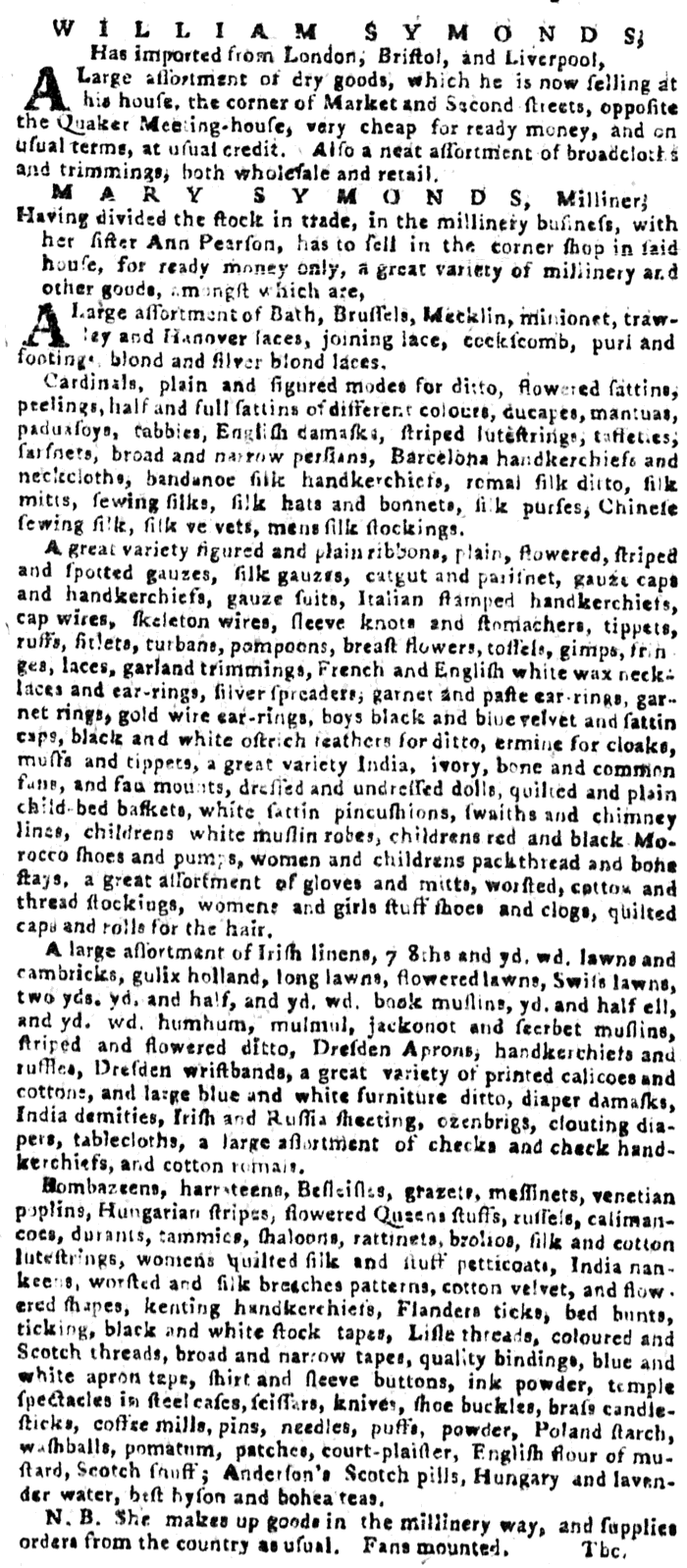
Mar 23 - 3:20:1766 Pennsylvania Gazette
Pennsylvania Gazette (March 20, 1766).

“She makes up goods in the millinery way.”

Mary Symonds owned a corner shop and placed a very lengthy advertisement in the Pennsylvania Gazette.   Symonds was a milliner, which is “a person who designs, makes, trims, or sells women’s hats.”

Symonds describes the different materials and trimmings she sold, such as “a great variety of printed calicoes and cottons” and “A great variety of figured and plain ribbons” along with “sattins of different colours.” Unfortunately, I could not identify a lot of descriptive words, but I could tell that all those paragraphs were different trimmings, fabrics, and their descriptions.

In the 1760s all types of people – from the rich to the poor – wore hats. The difference, however, was the material and how much detail was put into them. Hats could be extremely detailed, depending on how much money the colonist could pay. Milliners could add ribbons and other trimmings like the ones in Symonds’ advertisement if customers so chose. Like today, how people dressed was a status symbol that was very important to American colonists. Whether her customers had enough money to wear a different hat every day or wore the same hat every day, they could keep Symonds in business for years to come.

I was curious about how hats in America and England looked in the 1760s. These paintings all show women with hats during the period.

Mar 23 - Copley Portrait of Mary Clarke
John Singleton Copley, Portrait of Mary Clarke, Mrs. Samuel Barrett (Boston, Massachusetts, ca. 1765-1770).

**********

Mar 23 - Boucher Portrait of Madame Bergeret
Francois Boucher, Madame Bergeret (French, possibly 1766).

**********

Mar 23 - Collett - High Life
John Collett, High Life Below Stairs (London, England, 1763).

**********

ADDITIONAL COMMENTARY:  Carl Robert Keyes

There’s so much going on in this advertisement that it’s hard to know where to begin. Indeed, an entire chapter or more could be devoted to teasing out the various aspects of this advertisement. As Elizabeth notes, average readers today do not recognize the various kinds of textiles and trimming that Symonds listed. Material culture specialists, on the other hand, have written entire books about the quality and characteristics, production and consumption, and social and cultural meanings of these fabrics and accoutrements.

Mary Symonds operated her shop in the same location as William Symonds, but this advertisement suggests that they operated their businesses independently of each other. Although William’s business appeared first in the advertisement, Mary’s list of wares comprised a significantly lengthier section. Mary also noted that she had once been in partnership with “her sister Ann Pearson,” a milliner who ran her own advertisements in Philadelphia’s newspapers. The two sisters ran a series of advertisements in previous weeks announcing that they were dissolving their partnership and dividing the merchandise in anticipation of running separate shops. Such advertisements help to demonstrate that some colonial women operated businesses independently or in partnership with other women. Male relations, including William Symonds, did not necessarily oversee women who acted as retailers.

There’s another reason I was excited when Elizabeth selected this advertisement. I’ve identified only a handful of eighteenth-century trade cards and billheads distributed by women. Mary Symonds is the only female advertiser from Philadelphia with a trade card still extant (as part of the Cadwalader Collection at the Historical Society of Pennsylvania). Her trade card, listed a broad range of millinery supplies similar to what appeared in her newspaper advertisements, circulated in 1770 and perhaps even earlier. It included a border and her name in a rococo-style cartouche. Overall, it was less ornate than some of the trade cards distributed by male advertisers, but it was the most impressive trade card known to have been used by a female advertiser. It appears that Symonds took pride in her business and invested in it accordingly.

Mar 23 - Mary Symonds Trade Card
Trade card (with receipted bill on reverse) distributed  by Mary Symonds in 1770 (Historical Society of Pennsylvania:  Cadwalader Collection, Series II: General John Cadwalader Papers, Box 5: Incoming Correspondence: Pa-Sy, Item 19: Su-Sy).

The copy at the HSP has been dated to 1770 because a receipted bill appears on the reverse. On five different occasions in October and November 1770, somebody – probably Symonds herself – recorded more than a dozen purchases made by “Mrs. Cadwalader” (including “White Gloves,” a “Lace Cap,” and several yards of satin and muslin) amounting to more than £20. This receipted bill indicates that Symonds “Recevd the Contents in full” on November 22, 1770.