What was advertised in a revolutionary American newspaper 250 years ago today?

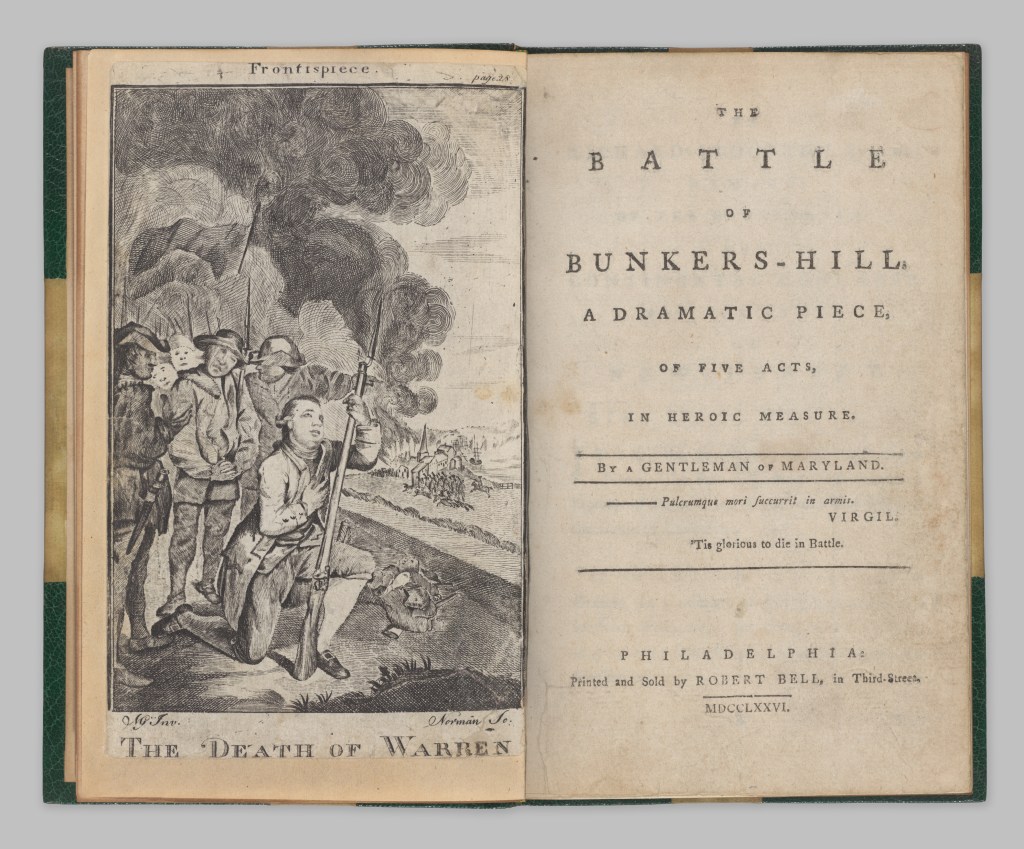
“THE BATTLE of BUNKERS-HILL. A dramatic piece of five acts, in heroic measure.”
In the fall of 1776, Robert Bell printed, advertised, and sold “THE BATTLE of BUNKERS-HILL. A dramatic piece of five acts, in heroic measure. By a Gentleman of Maryland.” His advertisement in the November 7 edition of the Pennsylvania Evening Post featured a quotation from Virgil’s Aeneid, “Pulchrumque mori succurrit in armis,” along with a translation for readers who did not happen to know Latin, “‘Tis glorious to die in battle.” Both the quotation and the translation also appeared on the title page of the play. Most prospective customers were likely familiar with the Battle of Bunker’s Hill that occurred on June 17, 1775, during the siege of Boston. Although the British won, they took such heavy losses at the hands of the Americans that they did not launch other attacks during the siege. In that regard, the battle was an American victory, but one that came at cost. General Joseph Warren, a patriot leader who only a few months earlier delivered the annual oration commemorating the Boston Massacre, was killed during the battle.
Bell’s advertisement did not go into such detail, perhaps because the printer expected that many prospective customers already knew the most significant details. He expected that a “dramatic piece” would arouse both their curiosity and their patriotism, encouraging them to purchase the play. Scholars have supplied some of the details that Bell did not include in his advertisement. Curators at the Metropolitan Museum of Art, for instance, explain that “the headmaster of Maryland’s Somerset Academy,” Hugh Henry Brackenridge, “responded [to the battle] with a play for his students to perform.” Bell printed the play and distributed it more widely to American readers. When he did so, he included a frontispiece, “The Death of Warren,” that depicted the general on bended knee with his right hand over his chest and his left hand on his rifle for support. Concerned soldiers appeared on the left of the mortally wounded general and a fallen comrade, another American casualty, laid on the ground on the right. John Norman, who had produced other patriotic images, engraved the scene, though Bell did not promote it in his advertisement. Instead, he announced that he stocked “all the new publications of the Military Art” as well as “a considerable variety of books in Navigation, and other branches of the Mathematics.”
Brackenridge demonstrated his patriotism by writing the play and then resigning from his position to join the Continental Army as a chaplain. Bell, like many other printers, artists, and booksellers presented consumers with an opportunity to show their patriotism by buying and reading the play. Such commemoration and commodification of the events associated with the American Revolution began before the war and continued during the war.