
What was advertised in a revolutionary American newspaper 250 years ago today?
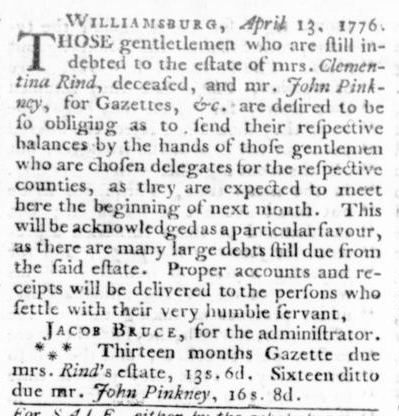
“Thirteen months Gazette due mrs. Rind’s estate, 13s. 6d.”
Most early American printers extended generous credit to newspaper subscribers, sometimes allowing them to fall years behind in making payment. They frequently placed notices calling on subscribers to settle accounts in their own newspapers. A notice in Alexander Purdie’s Virginia Gazette in the spring of 1776, however, requested that subscribers to a newspaper that ceased publication submit what they owed.
That newspaper had also been known as the Virginia Gazette. William Rind commenced publishing Rind’s Virginia Gazette in Williamsburg on May 16, 1766. He changed the name to Virginia Gazette in the fall of 1766. Following his death in August 1773, his widow, Clementina Rind, published the newspaper for just over a year until her own death in September 1774. John Pinkney then printed the newspaper, according to the colophon, “for the benefit of Clementina Rind’s estate” or, later, “for the benefit of Clementina Rind’s children.” He became the sole publisher in April 1775. Pinkney’s Virginia Gazette folded in the winter of 1776. The issue for February 3, 1776, is the last known edition. At the time, it was one of three newspapers named Virginia Gazette printed in Williamsburg.
The notice that ran in Purdie’s Virginia Gazette called on the “gentlemen who are still indebted to the estate of mrs. Clementina Rind, deceased, and mr. John Pinkney, for Gazettes … to send their respective balances” to “the administrator.” For their convenience, they could dispatch them via “those gentlemen who are chosen delegates for their respective counties” who planned to travel to Williamsburg for meetings in May 1776. A note at the end of the advertisements reminded subscribers that “Thirteen months Gazette due mrs. Rind’s estate” amounted to thirteen shillings and six pence and “Sixteen [months of the Virginia Gazette] due mr. John Pinkney” amounted to sixteen shillings and eight pence. Those periods matched the amount of time that Clementina Rind printed the Virginia Gazette and then John Pinkney printed it, indicating that some subscribers had not paid for years, even when asked to settle with Rind’s estate. Other newspaper printers experienced similar difficulties in collecting subscription fees, prompting some to threaten legal action in their notices. In this instance, the administrator instead noted the “large debts still due from the said estate.”