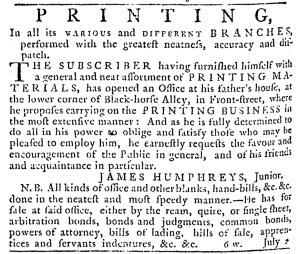
What was advertised in a colonial American newspaper 250 years ago today?

“A SECOND PUBLICATION OF THE UNIVERSAL ALMANACK, For the Year 1773.”
Nearly six weeks into the new year, James Humphreys, Jr., commenced advertising a “SECOND PUBLICATION OF THE UNIVERSAL ALMANACK, For the Year 1773” with astronomical calculations “performed with the greatest exactness and truth” by David Rittenhouse. Humphreys had advertised the first printing of the almanac more than three months earlier with notices in the November 9, 1772, edition of the Pennsylvania Packet and the November 11, 1772, edition of the Pennsylvania Gazette. Those advertisements featured identical copy, though the compositors devised very different formats.
When Humphreys advertised the second publication in Pennsylvania Gazette on February 17, 1773, he used a slightly truncated version of the original advertisement. (Perhaps the compositor took advantage of type already set from the previous run of the notice.) Two days earlier, however, a much shorter version, one without a list of the contents, appeared in the Pennsylvania Packet. In the next issue, published on February 22, Humphrey’s advertisement once again included the contents of the almanac, doubling the length of the notice. That represented some expense for Humphreys, though John Dunlap, printer of the Pennsylvania Packet, may have given him a discount on advertising since he also sold the almanac. Unlike the notice that ran in the Pennsylvania Gazette, one that listed only Humphreys, the advertisement in the Pennsylvania Packet stated that the almanac was “SOLD by JAMES HUMPHREYS junr. at his Printing-office, … and by John Dunlap.”
No matter the particulars of his arrangement with Dunlap, Humphreys took a chance on a second publication of the almanac so far into the year. Other printers advertised surplus copies of almanacs that had not yet sold, hoping to achieve better returns on their investments for items that became more and more obsolete with each passing day. Perhaps the initial publication did well enough that Humphreys considered printing a small number for the second publication worth the risk. Perhaps he believed that the calculations by “that ingenious master of mathematics, Mr. DAVID RITTENHOUSE,” well known in Philadelphia, would recommend the almanac above all others. In his first round of advertising, he asserted that “it is the only almanac published of his calculating.” Perhaps Humphreys thought the other contents, a variety of poems, recipes, short essays, and even directions for “guarding against smutty crops of wheat,” were interesting enough to prospective customers that they would want to consult and enjoy them throughout the remainder of the year. Perhaps he did not produce a second publication at all, but instead claimed he did in an effort to make the almanac appear popular and sell leftover copies of the first publication that he passed off as a subsequent printing. Advertising a second publication of an almanac so far into the year was unusual, whatever Humphrey’s inspiration in doing so.