February 11

What was advertised in a colonial American newspaper 250 years ago today?
Supplement to the Pennsylvania Ledger (February 11, 1775).

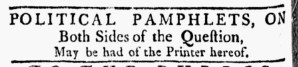
“POLITICAL PAMPHLETS … on Both Sides of the Question.”

As the imperial crisis intensified in late 1774 and early 1775, most American newspapers became increasingly partisan, even those that claimed that they did not take a side in the contest between Patriots and Parliament.  Printers sometimes ran advertisements for pamphlets that did not align with the principles most often espoused in their publications, but few made a point of declaring that they did so.  James Rivington, printer of Rivington’s New-York Gazetteer and a noted Loyalist, took the most strident approach in a series of advertisements for “POLITICAL PUBLICATIONSwritten on the Whig and the Tory Side of the Question.”  Sporting headlines like “The American Contest” and “The American Controversy,” those advertisements listed several pamphlets, many of them written in response to others also advertised.

Yet Rivington was not alone.  In the supplement that accompanied the third issue of the new Pennsylvania Ledger, James Humphreys, Jr., the printer, inserted a short notice that announced, “Most of the POLITICAL PAMPHLETS That have been published, on Both Sides of the Question, May be had of the Printer hereof.”  On the first page, he once again ran the proposals for the newspaper, stating that he established a “Free and Impartial News Paper, open to All, and Influenced by None.”  Despite that assertion, “[i]t was supposed that Humhreys’s paper would be in the British interest,” according to Isaiah Thomas in his History of Printing in America (1810).[1]  He further explained that “in times more tranquil than those in which it appeared, [Humphreys] might have succeeded in his plan” to “conduct his paper with political impartiality.”[2]

When it came to marketing strategies for political pamphlets, printers associated with supporting the Tory “Side” took the more evenhanded approach of drawing attention to their commitment to selling and disseminating work on “Both Sides of the Question.”  In Rivington’s case, doing so was a matter of generating revenue as much as operating an impartial press and bookstore.  For Humphreys, on the other hand, doing so seemed to fall in line with the commitment he made in his proposals for the Pennsylvania Ledger.  Even taking those motivations into account, both printers may have considered it necessary to profess that they sold pamphlets on “Both Sides” to justify how many titles they sold that argued from the Tory perspective.

**********

[1] Isaiah Thomas, The History of Printing in America: With a Biography of Printers and an Account of Newspapers (1810; New York: Weathervane Books, 1970), 399.

[2] Thomas, History of Printing, 439.

February 4

What was advertised in a colonial American newspaper 250 years ago today?

Pennsylvania Ledger (February 4, 1775).

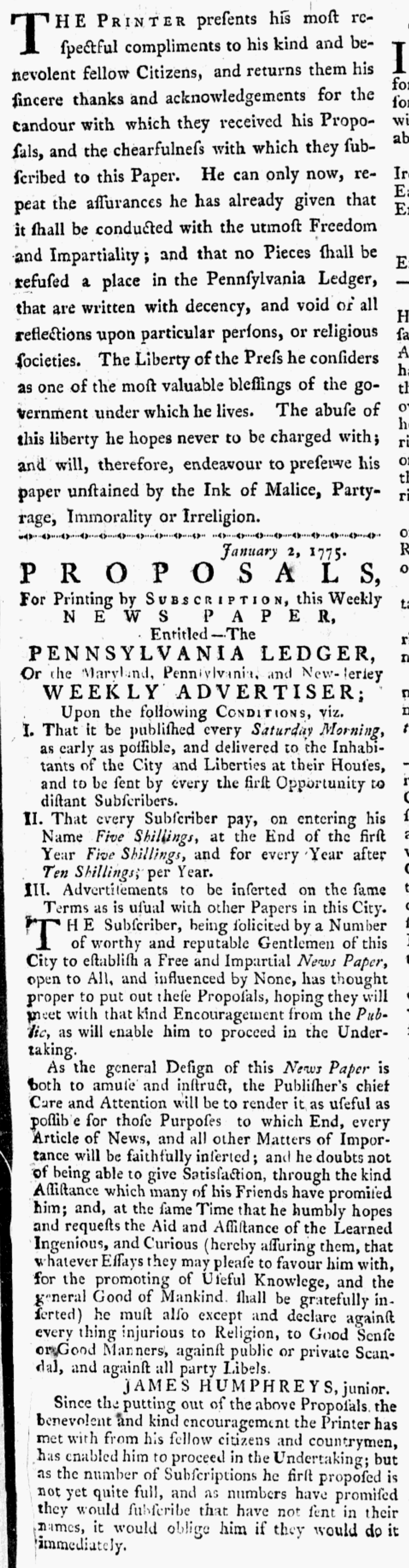
“Numbers have promised they would subscribe that have not sent in their names.”

The second issue of the Pennsylvania Ledger began with the same notice from the printer, James Humphreys, Jr., that appeared as the first item in the first column on the first page of the inaugural issue a week earlier.  He apparently considered it worth running again, especially since the new publication had not yet achieved as wide a circulation as he hoped.  Humphreys’s message to “his kind and benevolent fellow Citizens” thus bore repeating to reach as many readers (and prospective subscribers) as possible as copies of Philadelphia’s newest newspaper found their way into coffeehouses and taverns or passed from hand to hand.

In that address, the printer “repeat[ed] the assurances he has already given” in proposals for the newspaper “that it shall be conducted with the utmost Freedom and Impartiality; and that no Pieces shall be refused a place in the Pennsylvania Ledger, that are written with decency, and void of all reflections upon particular persons, or religious societies.”  Printers often asserted that their publications would represent multiple perspectives when they addressed the public in the decade before the Revolutionary War, though many did not follow through on that promise.  Some privileged their own political views while others responded to what they perceived to be the overwhelming sense (or the most vocal voices) in the communities where they operated their printing presses.  In his subscription proposals, Humphreys promoted a “FREE and IMPARTIAL” newspaper.  In his monumental History of Printing in America (1810), Isaiah Thomas acknowledged that Humphreys purported to publish an impartial newspaper, yet “[i]t was supposed that Humphrey’s paper would be in the British interest” and the Pennsylvania Evening Post, founded by Benjamin Towne at the same time, “took the opposite ground.”[1]  In his address, Humphreys proclaimed that he considered “Liberty of the Press … one of the most valuable blessings of the government under which he lives,” though his ideas about what constituted “Liberty of the Press” may have differed from that of other colonizers.  As the imperial crisis intensified, more and more newspapers became associated with either Patriots or Loyalists.

Still, Humphreys wanted to make a go of it with the Pennsylvania Ledger.  In that second issue, he inserted the proposals immediately below his address to the public, filling the remainder of the column.  He explained in even more detail that “the general Design of this News Paper is both to amuse and instruct” so “every Article of News, and all other Matters of Importance will be faithfully inserted.”  In billing his newspaper as “Free and Impartial,” Humphreys may have intended to make a point that readers should expect to encounter pieces representing a variety of views, but, as Thomas suggested, many were suspicious of Humphreys’s intentions when it came to disseminating content from the Tory perspective.  That could have contributed to a note that the printer added to the proposals.  He claimed that he received enough “encouragement … to proceed in the Undertaking,” but “numbers have promised they would subscribe that have not sent in their names.”  As they learned more about the positions the Pennsylvania Ledger would likely take, some prospective subscribers apparently decided they did not wish to support the newspaper.

**********

[1] Isaiah Thomas, The History of Printing in America: With a Biography of Printers and an Account of Newspapers (1810; New York: Weathervane Books, 1970), 399.

January 28

What was advertised in a colonial American newspaper 250 years ago today?

Pennsylvania Ledger (January 28, 1775).

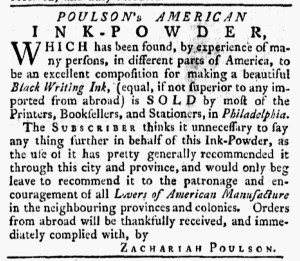
POULSON’s AMERICAN INK-POWDER.”

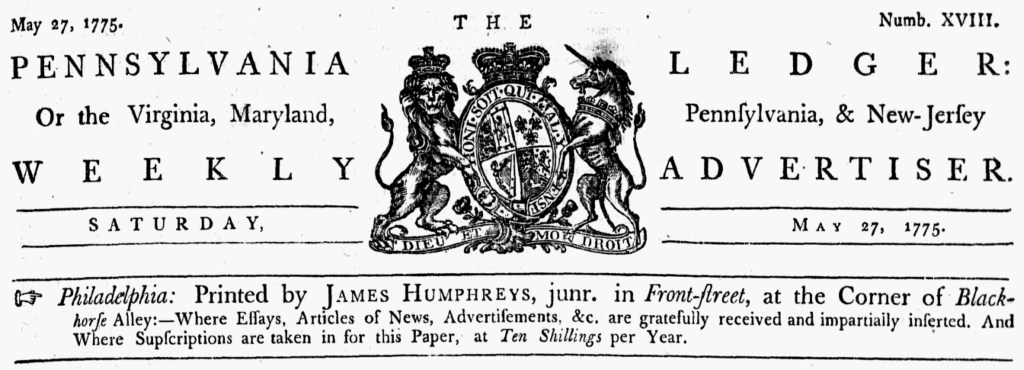
Just four days after Benjamin Towne launched the Pennsylvania Evening Post, James Humphreys, Jr., commenced publication of the Pennsylvania Ledger on January 28, 1775.  In less than a week, the number of English-language newspapers printed in Philadelphia increased from three to five, rivaling the number that came off the presses in Boston.  No other city in the colonies had as many newspapers.  Humphreys incorporated the colophon into the masthead, advising that he ran his printing office “in Front-street, at the Corner of Black-horse Alley:– Where Essays, Articles of News, Advertisements, &c. are gratefully received and impartially inserted.”

Unlike the first issue of the Pennsylvania Evening Post, the inaugural edition of the Pennsylvania Ledger carried advertisements.  Humphreys placed some of them, one hawking “POLITICAL PAMPHLETS … on Both Sides of the Question,” another promoting an assortment of books he sold, and a final one seeking “an APPRENTICE to the Printing Business.”  Nine other advertisers placed notices, all of them for consumer goods and services.  They took a chance that the new newspaper had sufficient circulation to merit their investment in advertising in its pages.

Among those advertisers, Zachariah Poulson marketed “POULSON’s AMERICAN INK-POWDER.”  He asserted that “most of the Printers, Bookseller, and Stationers, in Philadelphia” stocked that product.  Customers just needed to request it.  With the deteriorating political situation in mind, especially the boycott of imported goods outlined in the Continental Association, Poulson called on “all Lovers of American Manufacture” in Pennsylvania and “in the neighbouring provinces and colonies” to choose his ink powder over any other.

Detail from Edward Pole’s Advertisement in the Pennsylvania Ledger (January 28, 1775).

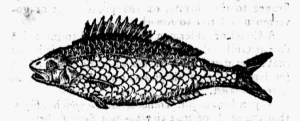
Edward Pole inserted the lengthiest advertisement (except for Humphreys’s notice cataloging the books he sold).  It filled half a column, the first portion devoted to the merchandise available “at his GROCERY STORE, in Market-street” and the rest to “FISHING TACKLE of all sorts,” “FISHING RODS of various sorts and sizes,” and other fishing equipment.  In advertisements in several newspapers published in Philadelphia (and, later, with ornate trade cards that he distributed), Pole regularly marketed himself as a sporting goods retailer.  For the first issue of the Pennsylvania Ledger, he adorned his advertisement with a woodcut depicting a fish that previously appeared in his notices in Dunlap’s Pennsylvania Packet in May and June 1774.

Humphreys provided residents of Philadelphia and other towns greater access to news and editorials with the Pennsylvania Ledger, but that was not all.  The publication of yet another newspaper in Philadelphia increased the circulation of advertising in the city and region, disseminating messages to consumers far and wide.  Not long after Humphreys published that first issue, advertisers took to the pages of the Pennsylvania Ledger to publish notices for a variety of purposes, supplementing the information the editor selected for inclusion.

January 25

What was advertised in a colonial American newspaper 250 years ago today?

Pennsylvania Ledger (January 25, 1775).

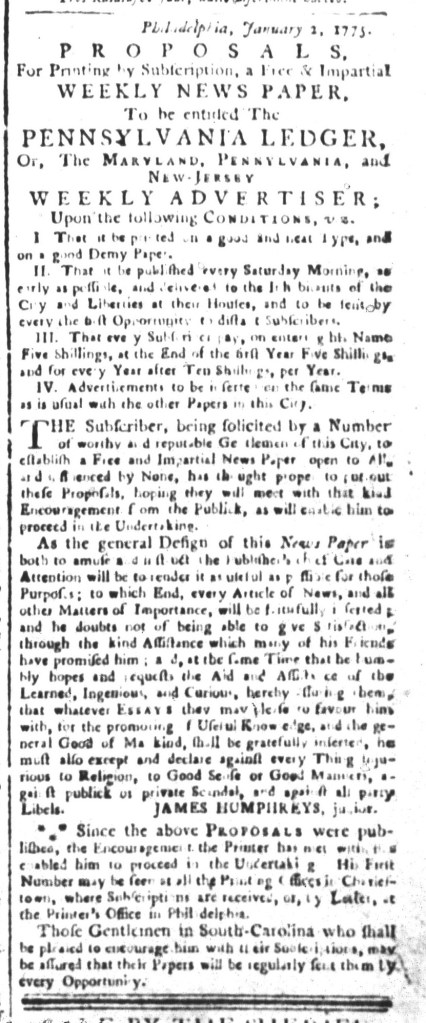
“PROPOSALS For Printing by Subscription, a FREE and IMPARTIAL WEEKLY NEWS-PAPER.”

As the imperial crisis intensified, the number of newspapers published in Philadelphia, the largest city in the colonies, grew significantly.  Throughout the early 1770s, readers had access to Dunlap’s Pennsylvania Packet, the Pennsylvania Gazette, and the Pennsylvania Journal.  Until February 1774, the Pennsylvania Chronicle had also circulated in Philadelphia.  Less than a year after that newspaper folded, Benjamin Towne commenced publication of the Pennsylvania Evening Post, the first tri-weekly newspaper attempted in that city, on January 24, 1775, and James Humphrey, Jr., distributed the first issue of the Pennsylvania Ledger four days later.  Enoch Story and Daniel Humphreys also advertised plans for another newspaper, the Pennsylvania Mercury.  They published their inaugural issue in April 1775, two weeks before the battles at Lexington and Concord.

On January 25, the Pennsylvania Journal carried the proposals for both the Pennsylvania Ledger and the Pennsylvania Mercury, placing them side by side on the final page.  As was customary, the printers gave an overview of why they wished to publish their newspapers, explained what subscribers could expect among the contents, and listed the conditions for subscribing.  Among the various purposes the Pennsylvania Mercury would serve, Story and Humphreys included, “To communicate advertisements of every kind.”  The printers of both proposed newspapers sought advertisements, an essential revenue stream for any printer publishing a newspaper.  After noting the prices for subscriptions to the Pennsylvania Ledger, Humphreys indicated, “Advertisements to be inserted on the same terms as is usual with the other papers in this city.”  For the Pennsylvania Mercury, Story and Humphreys declared, “The Rates of the Paper and Advertisements will be the same with those now printed in this City.”  Dunlap’s Pennsylvania Packet and the Pennsylvania Journal both gave the price for subscriptions – “Ten Shillings per Annum” – in their colophons, but none of the newspapers then printed in Philadelphia regularly published what they charged for advertising.  Apparently, according to the proposals for the Pennsylvania Ledger and the Pennsylvania Mercury, none offered better deals than others.

Story and Humphreys did give a bit more attention to advertising in their proposals.  “All Advertisements,” they promised, “shall be inserted in order as they come in, and shall appear in a fair and conspicuous manner.”  They did not mean that paid notices would literally appear one after the other in the order received at the printing office but rather that a compositor would set type in that order and integrate them into the layout of the newspaper without privileging any later arrivals over those submitted sooner.  After all, newspaper printers sometimes inserted notes that advertisements had been omitted due to lack of space.  Story and Humphreys signaled that they would not take anything into consideration beyond the order that advertisers delivered their notices when delaying publication of some.  They also acknowledged that compositors arranged content to make pieces of different lengths complete columns and fill pages.  During that process, they would not privilege any advertisements over others, displaying each “in a fair and conspicuous manner.”  With such appeals, Story and Humphreys solicited the trust of prospective advertisers who wanted a good return on the money they invested in disseminating information in the Pennsylvania Mercury.

Neither of these proposals for new newspapers discussed advertising extensively, but each did seek advertisers along with subscribers.  Whatever goals they expressed for circulating news as the political situation deteriorated, the viability of pursuing their ideals of publishing “improving, instructive and entertaining” information depended in large part on recruiting advertisers as well as enlisting subscribers.

February 17

What was advertised in a colonial American newspaper 250 years ago today?

Pennsylvania Gazette (February 17, 1773).

“A SECOND PUBLICATION OF THE UNIVERSAL ALMANACK, For the Year 1773.”

Nearly six weeks into the new year, James Humphreys, Jr., commenced advertising a “SECOND PUBLICATION OF THE UNIVERSAL ALMANACK, For the Year 1773” with astronomical calculations “performed with the greatest exactness and truth” by David Rittenhouse.  Humphreys had advertised the first printing of the almanac more than three months earlier with notices in the November 9, 1772, edition of the Pennsylvania Packet and the November 11, 1772, edition of the Pennsylvania Gazette.  Those advertisements featured identical copy, though the compositors devised very different formats.

When Humphreys advertised the second publication in Pennsylvania Gazette on February 17, 1773, he used a slightly truncated version of the original advertisement.  (Perhaps the compositor took advantage of type already set from the previous run of the notice.)  Two days earlier, however, a much shorter version, one without a list of the contents, appeared in the Pennsylvania Packet.  In the next issue, published on February 22, Humphrey’s advertisement once again included the contents of the almanac, doubling the length of the notice.  That represented some expense for Humphreys, though John Dunlap, printer of the Pennsylvania Packet, may have given him a discount on advertising since he also sold the almanac.  Unlike the notice that ran in the Pennsylvania Gazette, one that listed only Humphreys, the advertisement in the Pennsylvania Packet stated that the almanac was “SOLD by JAMES HUMPHREYS junr. at his Printing-office, … and by John Dunlap.”

No matter the particulars of his arrangement with Dunlap, Humphreys took a chance on a second publication of the almanac so far into the year.  Other printers advertised surplus copies of almanacs that had not yet sold, hoping to achieve better returns on their investments for items that became more and more obsolete with each passing day.  Perhaps the initial publication did well enough that Humphreys considered printing a small number for the second publication worth the risk.  Perhaps he believed that the calculations by “that ingenious master of mathematics, Mr. DAVID RITTENHOUSE,” well known in Philadelphia, would recommend the almanac above all others.  In his first round of advertising, he asserted that “it is the only almanac published of his calculating.”  Perhaps Humphreys thought the other contents, a variety of poems, recipes, short essays, and even directions for “guarding against smutty crops of wheat,” were interesting enough to prospective customers that they would want to consult and enjoy them throughout the remainder of the year.  Perhaps he did not produce a second publication at all, but instead claimed he did in an effort to make the almanac appear popular and sell leftover copies of the first publication that he passed off as a subsequent printing.  Advertising a second publication of an almanac so far into the year was unusual, whatever Humphrey’s inspiration in doing so.

September 2

What was advertised in a colonial American newspaper 250 years ago today?

Pennsylvania Journal (September 2, 1772).

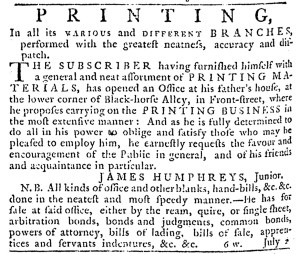
“All kinds of office and other blanks, hand-bills, &c. &c.”

When James Humphrey, Jr., opened a printing shop in Philadelphia in the summer of 1772, he placed advertisements in the Pennsylvania Journal to inform the public that he sought orders for “PRINTING, In all its VARIOUS and DIFFERENT BRANCHES.”  Perhaps he received a discount for notices he placed in that newspaper, despite being a competitor for job printing, having apprenticed to William Bradford, one of the partners who printed the Pennsylvania Journal.  Humphreys stated that he “earnestly requests the favour and encouragement of the Public in general, and of his friends and acquaintance in particular.”  That encouragement likely commenced with a mentor who had a thriving business and could afford to help his former apprentice establish his own printing office.  Humphreys eventually published the Pennsylvania Ledger from January 1775 through November 1776 with a brief revival when the British occupied Philadelphia, but he focused on books and job printing when he first entered the business.

In particular, he solicited orders for “All kinds of office and other blanks, [and] hand-bills.”  Throughout the colonies, printers produced and sold a variety of blanks, printed forms that facilitated common commercial and legal transactions.  Humphreys listed some of the blanks available at his printing office, including “arbitration bonds, bonds and judgments, common bonds, powers of attorney, bills of lading, bills of sale, [and] apprentices and servants indentures.”  Concluding the list with “&c.” (an abbreviation for et cetera) signaled that he had others on hand to sell “either by the ream, quire, or single sheet.”  Some colonizers purchased blanks in volume, making them an even more lucrative revenue stream for printers.  Humphreys also declared that he printed handbills “in the neatest and most speedy manner.”  When they advertised, printers often included handbills among the items they produced, suggesting that many more advertisements circulated in eighteenth-century America, especially in urban centers, than survive in research libraries, historical societies, and private collections.  Such ephemera may have been much more numerous and visible than bibliographies of early American imprints suggest.  Newspaper advertisements like the one that Humphreys inserted in the Pennsylvania Journal in 1772 hint at a vibrant culture of advertising during the era of the American Revolution.