
What was advertised in a revolutionary American newspaper 250 years ago today?
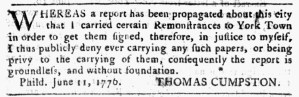
“I thus publicly deny ever carrying any such papers, or being privy to the carrying of them.”
As the printer and editor of the Pennsylvania Evening Post, Benjamin Towne made decisions about the news that appeared in his newspaper. In the June 11, 1776, edition, for instance, he selected an open letter “To Mr. JAMES RANKIN, one of the Representatives for the country of York, in the province of Pennsylvania” from “A FREEMAN,” updates from Watertown, Massachusetts; New London, Connecticut; and New York, and local news from Philadelphia. Yet that was not all the news that appeared in that issue of the Pennsylvania Evening Post. Advertisers also played a role in choosing which news to disseminate, paying for the opportunity to do so. Hamilton and Leiper announced the dissolution of their partnership in yet another newspaper, Captain Thomas Houston alerted the public about four men who “DESERTED … from on board the Provincial armed galley Warren,” and “Dr. L. BUTTE, Surgeon-Dentist,” advised the public of his new location on Chestnut Street.
Thomas Cumpston also placed an advertisement with the intention of spreading news that was especially important to him. “WHEREAS a report has been propagated about this city,” he declared, “that I carried certain Remonstrances to York Town in order to get them signed, therefore in justice to myself, I thus publicly deny ever carrying such papers, or being privy to the carrying of them.” To make it clear, he asserted that “the report is groundless, and without foundation.” The open letter to Rankin from “A FREEMAN” that filled the entire first page and spilled over onto the second concerned the circulation of the “certain Remonstrances” that Cumpston supposedly carried to York to gather signatures,” though “A FREEMAN” did not mention Cumpston. That letter was a response to Rankin’s own open letter “To the WORTHY INHABITANTS of YORK COUNTY” in the June 8 edition of the Pennsylvania Evening Post. It also filled the entire first page and overflowed to the second page. Rankin stated that he had been “injuriously treated by a Resolve of your County Committee, published in the several newspapers.”
The controversy revolved around Rankin’s reaction to the a resolution passed by the Second Continental Congress on May 15, 1776, a resolution that the “Assemblies and Conventions of the United Colonies, where no Government sufficient to the Exigencies of their affairs hath been hitherto established, … adopt such Government as shall in the Opinion of the Representatives of the People best conduce to the happiness and Safety of their Constituents in particular and America in General.” In other words, each colony should establish its own government. Tories and moderates took a different approach to this resolution than Patriots did. In Pennsylvania, that resulted in both a “Remonstrance,” favored by Tories, and a “Protest,” favored by Patriots, circulating; “A FREEMAN” accused Rankin of embracing the former and ignoring the latter even though Rankin claimed that he wished to be guided by the views of all his constituents. Rankin insisted that he acted from “love for the charter constitution of Pennsylvania” when he took into account “a Remonstrance … sign[ed] by multitudes of the most respectable names in the city of Philadelphia, and the neighbouring counties, in opposition to the doctrines in the Protest.” The “Remonstrance” argued that “public service has been, and might still be, carried on as vigorously by the Assembly of this province as by any other public body on the continent.” Therefore, it was not necessary to create a new government.
Cumpston wanted no part of that controversy, at least not as an agent who circulated “certain Remonstrances … in order to get them signed.” His advertisement served as a supplement to the news as he attempted to shape the narrative as far as his own actions were concerned. Towne, the printer and editor, may not have had any interest in how the story that appeared on the first page of his newspaper had an impact on one resident of Philadelphia, but he did aim to generate revenue by selling advertising space. Cumpston inserted a paid notice as a means of publishing news and rehabilitating his reputation as political debates in Pennsylvania intensified.