What was advertised in a revolutionary American newspaper 250 years ago today?
New-York Gazette and Weekly Mercury (January 12, 1776).
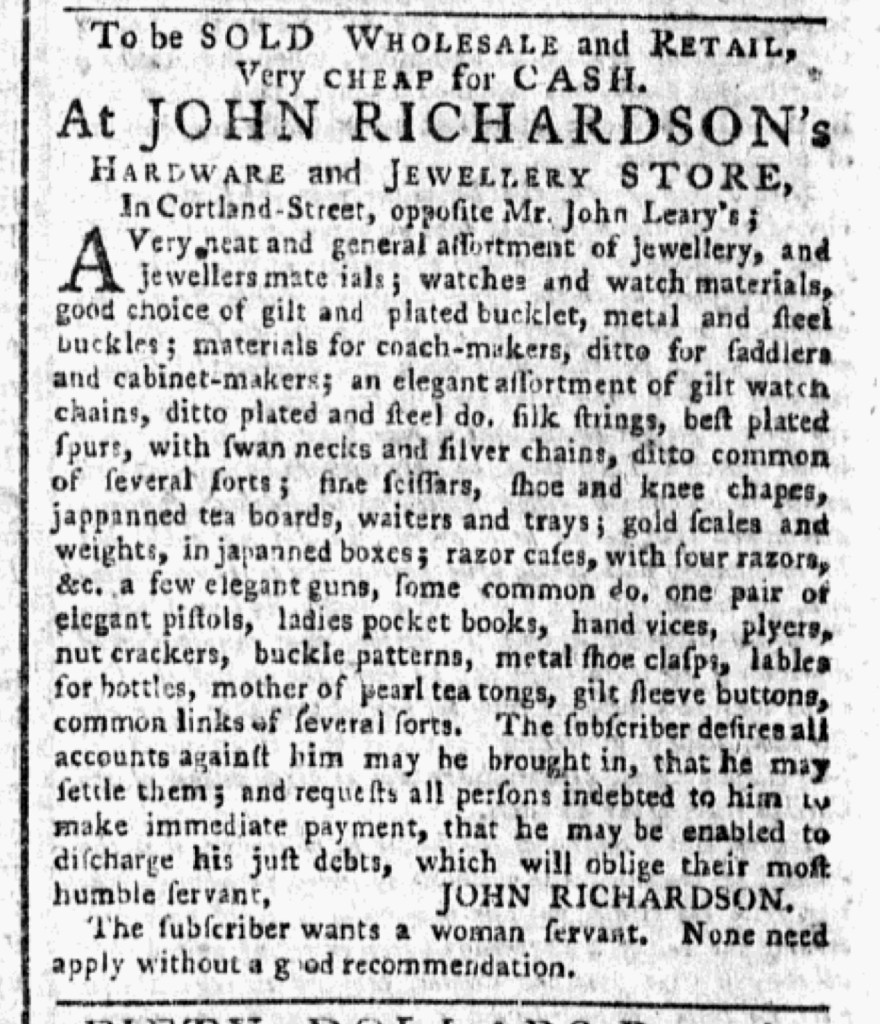
“JOHN RICHARDSON’s HARDWARE and JEWELLERY STORE.”
John Richardson ran an advertisement for his “HARDWARE and JEWELLERY STORE” in the February 12, 1776, edition of the New-York Gazette and Weekly Mercury. He was not alone in his marketing efforts. Richard Sause also placed an advertisement for a “JEWELLERY, CUTLERY, HARD-WARE, and HABERDASHERY STORE.” Both emphasized consumer choice as a marketing strategy, but they deployed very different formats in demonstrating the choices they offered to customers.
The bulk of Richardson’s advertisement consisted of a dense paragraph of text that listed his inventory, including a “neat and general assortment of jewellery, and jewellers materials; watches and watch materials, good choice of gilt and plated buckles, metal and steel buckles; materials for coach-makers, ditto for saddlers and cabinet-makers; … ladies pocket books, hand vices, plyers, nut crackers, buckle patterns, metal shoe clasps, lables for bottles, mother of pearl tea tongs, [and] gilt sleeve buttons.” It was an array of merchandise that Richardson invited readers to imagine and, hopefully, examine for themselves.
Sause listed even more items in his advertisement, yet that was not the only reason that it occupied more than twice as much space on the page. Rather than cram everything together in a single paragraph, Sause opted to list small collections of items – one, two, or three at a time – together yet on separate lines. Those lists sometimes overflowed onto indented second and subsequent lines; the indentations provided a visual cue that further distinguished the wares that Sause promoted. For instance, the entry for “Gold lace, tinsel and com- / mon watch braids” did not run into the next entry for “Silver corals, and a variety of / fashionable silver buckles.” Sause also divided his advertisement into two columns (just as he had done in a previous advertisement), making it even more visually distinctive.
Although Richardson and Sause sold similar merchandise and both made appeals to consumer choice, they made different decisions about how to present their goods to prospective customers in the public prints. Richardson may have opted for economy by purchasing less space in the New-York Gazette and Weekly Mercury, while Sause, drawing on experience, could have considered it worth the investment to take up more space in the newspaper.
What was advertised in a revolutionary American newspaper 250 years ago today?
New-York Gazette and Weekly Mercury (May 22, 1775).
“Shop-keepers and traders, who are under disadvantages by reason of the non-importation.”
The Continental Association, a nonimportation agreement devised by the First Continental Congress in response to the Coercive Acts, created an opportunity for Jeremiah Andrews, a jeweler in New York, to market his services in the spring of 1775. In the May 22 edition of the New-York Gazette and Weekly Mercury, he announced that he “CONTINU[ED] his business still in the same place” and “thinks it proper to acquaint shop-keepers and traders, who are under disadvantages by reason of the non-importation, that he is willing chearfully to bear his part.” How would Andrews help them with that burden? By supplying retailers with items that they could not import while the Continental Association remained in effect!
He explained that he could “make every article … pertaining to his branch,” jewelry, “as cheap as they could be imported from London, and materials as good.” Andrews expected that he offered an attractive alternative. After all, he used quality materials in crafting his jewelry and set prices comparable to those previously charged for imported items. His appeals resonated with various articles of the Continental Association, including the eighth article that called for “promot[ing] Agriculture, Arts, and the Manufactures of this Country” and the ninth article that prohibited “tak[ing] Advantage of the Scarcity of Goods” by increasing prices for those “Goods or Merchandise” available for sale.
Andrews also informed both retailers and the public that “he hath a great variety of patterns of the newest fashions, which he received from London since his last advertisement.” Assessing the situation, he realized that consumers still valued connections to the largest and most cosmopolitan city in the empire. The Continental Association made importing textiles, accessories (including jewelry), housewares, and other goods from there off limits, but it did not proscribe replicating the styles currently in fashion. Andrews presented retailers and consumers with a means of keeping up with the latest trends for jewelry without sacrificing support for the American cause. After all, most colonizers still valued being part of the British Empire, despite the imperial crisis and the battles between regulars and colonial militia in Massachusetts in April and the ongoing siege of Boston. They thought of themselves as British and hoped for a redress of grievances. Andrews provided a means for minimizing the disruptions that consumers experienced, his way “chearfully to bear his part” while expanding his business.
What was advertised in a colonial American newspaper 250 years ago today?
South-Carolina Gazette and Country Journal (November 8, 1774).
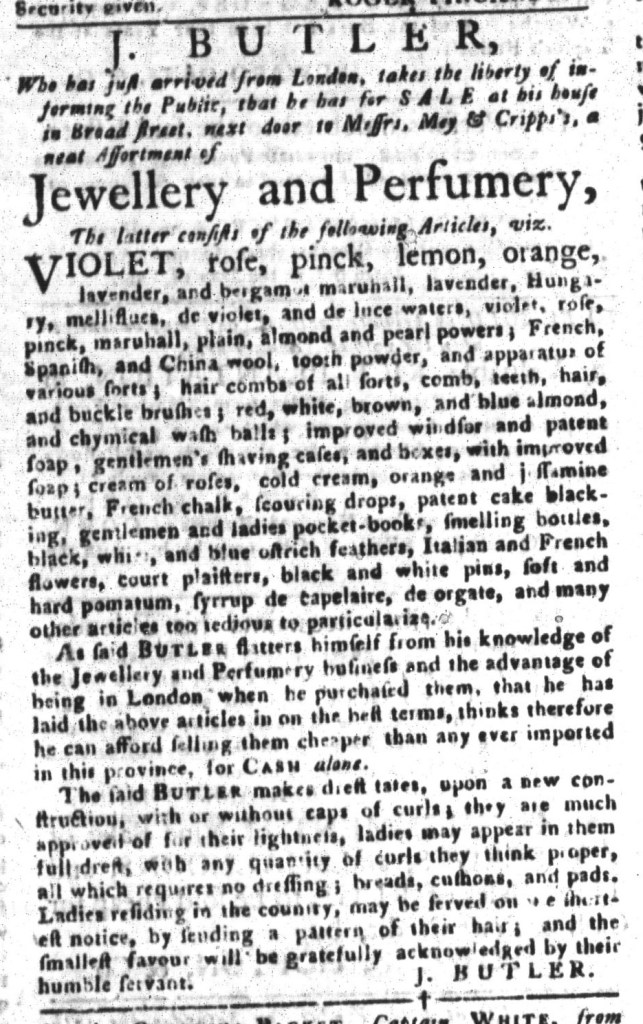
“He can afford selling them cheaper than any ever imported in this province.”
J. Butler’s advertisement in the November 8, 1774, edition of the South-Carolina Gazette and Country Journal proclaimed that he sold “Jewellery and Perfumery” at a shop he operated at his house on Broad Street in Charleston. Among the perfumery, he provided “VIOLET, rose, pinck, lemon, orange, lavender, and bergamot.” In addition, he listed a variety of personal hygiene products and cosmetics that he stocked, including “tooth powder, … hair combs of all sorts, … gentlemen’s shaving cases and boxes, with improved soap, … cold cream, [and] soft and hard pomatum.” If that was not enough to attract consumers looking to pamper themselves, Butler also proclaimed that he carried “many other articles too tedious to particularize.” Readers could cure their curiosity with a visit to Butler’s shop.
As further encouragement, he emphasized that he had “just arrived from London.” Rather than accept merchandise shipped to him without first examining it himself, Butler had carefully examined and thoughtfully selected the wares he now advertised. He considered that an “advantage,” especially in combination with “his knowledge of the Jewellery and Perfumery business,” that allowed him to acquire his inventory “on the best terms.” In turn, he passed along the savings to his customers, asserting that “therefore he can afford selling [the above articles] cheaper than any ever imported in this province.” According to Butler, he not only offered the best prices at that moment, but the best bargains for “Jewellery and Perfumery” ever seen in South Carolina thanks to savvy negotiations with suppliers when he was in London.
Butler was not alone in suggesting that his personal oversight in obtaining his wares accrued benefits to his customers. Elsewhere in the same issue, Henry Calwell ran a short advertisement that announced he “just arrived from the Northward” and sold a “Large Quantity of Cheese, Chocolate, Potatoes, Onions,” and other groceries. He added a note that “the Chocolate he warrants to be good, as he saw it made himself.” Both Butler and Calwell sought to convince consumers that their personal connections to their merchandise should make those items more appealing.
What was advertised in a colonial American newspaper 250 years ago this week?
New-York Journal (December 24, 1772).
“Sprigs, which more beauteous makes the fair; / And lockets, various, for the hair.”
Isaac Heron, a watchmaker, operated a shop at the Sign of the Arched Dial in New York in the 1760s and 1770s. When he decided to promote his services in the public prints in the early 1770s, he published a lively advertisement, one that interspersed commentary and poetry, in the December 24, 1772, edition of the New-York Journal. Heron may have taken note of the notices placed by his competitors, especially John Simnet and James Yeoman, over the past six months or so. Often creative beyond the standard appeals that appeared in many other advertisements and sometimes descending into rancorous feuds with each other, Simnet and Yeoman made their newspaper notices memorable for readers. After observing how those rival watchmakers described their services and characterized their competitors, Heron likely determined that he needed to write copy that did not pale in comparison. He composed more innovative copy than appeared in one of his earlier advertisements.
For instance, he offered low prices and a guarantee when it came to repairing watches. Heron declared that he “charges as low … as his neighbors,” other watchmakers, by setting his rates “as near the London prices as possible.” In what might have been a rebuke to Simnet and Yeoman, Heron stated, “To say more, would neither be prudent nor honest.” In terms of a guarantee, he pledged that “As usual, he warrants their performance” for a year. Like other watchmakers who offered similar guarantees, he clarified “accidents and mismanagement of [watches he repaired] excepted.” Unlike other watchmakers, he elaborated in verse: “Should the all-sustaining hand, him drop, / His movements all, springs, wheels, hands must stop! / Then, like the tale of ‘a bear and fiddle,’ / This bargain—‘breaks off in the middle.’”
In addition to selling and repairing watches, Heron also sold jewelry. He inserted a rhyming couplet to conclude the list of merchandise he lighted to prospective customers. A paragraph that included “Ladies elegant steel watch-chains, mens [chains,] seals, trinkets, glasses, strings, and keys by the dozen, … Elegant broach-jewels for their honest breasts; sword-knots, sundries, &c.” concluded with “Sprigs, which more beauteous makes the fair; / And lockets, various, for the hair.” Neither Simnet nor Yeoman advertised these additional items. They focused exclusively on their skill and experience as watchmakers. In terms of both goods and presentation, Heron devised an advertisement that distinguished his services from his competitors.
What was advertised in a colonial American newspaper 250 years ago today?
New-London Gazette (July 17, 1772).
“Articles of JEWELLERY.”
John B. Brimmer stocked an array of goods at his store in Norwich Landing, Connecticut, in the summer of 1772. In an advertisement in the New-London Gazette on July 17, he promoted a “great Variety of English and Hard Ware Goods,” but claimed to have “too great a Variety to be enumerated in an Advertisement.” That differed from his marketing efforts the previous summer, but perhaps Brimmer determined that he did not wish to incur the expense of inserting lengthy lists of his goods in the newspaper. He did list a couple of dozen items in a dense paragraph that included “best London Pewter,” “Brass Kettles,” “Iron Tea-Kettles,” concluding with “&c. &c. &c.” In repeating the abbreviation for et ceterathree times, he suggested to prospective customers that they would discover much more when they visited his store.
Brimmer also informed the public that he carried many “Articles of JEWELLERY.” Those items he did choose to enumerate, listing “Cypher Drops,” “Brilliants for Rings,” “Cyphers for Buttons,” “Brilliant Drops,” and “Sparks and Garnets.” To draw attention to this merchandise, Brimmer arranged it in two columns with only item on each line. Decorative type separated the two columns, giving the advertisement a unique visual component compared to any other notice in that issue of the New-London Gazette. Only the “POETS CORNER,” a weekly feature at the top of the final page, featured anything similar, lines of decorative type appearing both above and below its headline.
Like most eighteenth-century advertisers, Brimmer relied on the copy to do most of the work in marketing his goods. He made appeals to consumer choice, invoking the word “variety” more than once, and promised low prices. However, he also introduced a bit of graphic design to engage readers of the New-London Gazette. The decorative type enhanced the visibility of his advertisement, distinguishing it from others.
What was advertised in a colonial American newspaper 250 years ago today?
Georgia Gazette (June 7, 1769).
“SOLOMON SOLOMONS … A fmall Affortment of JEWELERY.”
Earlier this week NPR commentator Cokie Roberts caused quite a hullabaloo when she suggested that historians had significantly inflated the frequency of advertisements for abortion providers that appeared in nineteenth-century newspapers. Roberts stated, “There are many articles by abortion rights proponents who claim the procedure was so common that newspapers advertised providers. Look, I did a search of nineteenth-century newspapers and couldn’t find them.”[1] Historians quickly responded via Twitter, with Dr. Lauren MacIvor Thompson, a specialist in the history of medicine, public health, and the law, in the forefront with a tweet thread that corrected the record.
In addition to addressing content, historians representing various other fields within the discipline addressed the flaws in Roberts’s methodology. Roberts, a pundit rather than a trained historian, apparently did not realize that the absence of results generated by keyword searches does not mean that the historical evidence was not there. Like many of my colleagues, I pointed out two relevant issues. Both are so fundamental that I discuss them with undergraduate students in introductory and upper-level history courses on the first day that we begin working with databases of historical newspapers.
First, keyword searches have many shortcomings, especially because OCR (optical character recognition) is so imperfect. I explain to my students that computers are often, for lack of a better word, stupid. They do not always recognize or make sense of visual images (photographs or digital scans of historical sources) as effectively as people do. Computer software lacks the necessary creativity and flexibility. This is especially true when working with eighteenth-century printed sources that use the long “s” that looks like an “f” to twenty-first-century eyes. What human readers recognize as “Assortment,” for instance, looks like “Affortment” via OCR. (See Solomon Solomons’s advertisement from the June 7, 1769, edition of the Georgia Gazette.) Yet the long “s” is not the only pitfall for OCR. If the original printed words were not clear or subsequent remediation (photographs, microfilm, digital scans) was poorly done, then OCR has no chance of decoding the words on the page.
Second, when doing historical research it is necessary to think like the people from the period, especially to use the words they would have used rather than impose modern terminology. Context matters. Roberts, lacking an historian’s understanding of the period she investigated, apparently did not choose her keywords carefully or appropriately. When I train my undergraduate students to serve as guest curators for the Slavery Adverts 250 Project, I underscore that they must look for words beyond just “slave” (and that they have to examine every advertisement because keyword searches will exclude MANY advertisements that belong in the project). In addition to “slave,” they must also keep their eyes open for “negro,” “mulatto,” and “wench,” some of the words most often used to describe enslaved men, women, and children even when the word “slave” did not appear in an advertisement.
To demonstrate the shortcomings of keyword searches, I like to provide a practical example of an advertisement that I know exists yet a keyword search will not produce. Consider an advertisement from the June 7, 1769, edition of the Georgia Gazette. I previously downloaded the entire issue via Readex’s America’s Historical Newspapers database. I know that it contains an advertisement for jewelry placed by Solomon Solomons. Say that I want to know the extent of Solomons’s advertising campaign in 1769. Doing a keyword search with his last name would be a good place to start. To make the search as efficient as possible, I set several parameters. I limit the date under consideration to 1769. I restrict the newspapers to be searched to the Georgia Gazette. Then I enter “Solomons” as the keyword. This yields only two results: Solomons’s advertisement when it appeared in the May 24 and May 31 editions, but not the June 7 edition. This certainly tells me more about the frequency that Solomons advertised, but it did not yield an advertisement that I already knew existed! The digitized image of the advertisement is fairly clear (especially compared to many others), yet it appears that just enough ink bled through from the other side of the page to trick the OCR into overlooking this advertisement when doing a keyword search for “Solomons.”
This particular instance is not as “fraught,” to invoke Roberts’s term, as advertisements placed by abortion providers in the nineteenth century, but it is a practical example of how technology cannot substitute for historical expertise and appropriate methodologies for conducting research with primary sources. As many other historians have done in recent days, I encourage reporters and pundits to call on trained historians rather than make misleading assertions based on incomplete understandings of the past and shoddy research methods.
**********
[1] This quotation comes from Thompson’s tweet thread. NPR has updated the original audio and transcript to excise Robert’s incorrect and misleading assertions.
What was advertised in a colonial American newspaper 250 years ago today?
Postscript to the Boston Weekly News-Letter (April 20, 1769).
“LOST … A Stone Sleeve Button with a red Cypher set in Gold.”
On April 20, 1769, the Postscript to the Boston Weekly News-Letter contained this advertisement for a lost “Stone Sleeve Button with a red Cypher set in Gold, and with a gold Chain.” I was interested in this piece of jewelry. According to Thomas Hamilton Ormsbee, “Although carelessness, loss by theft, and general wear and tear have taken a heavy toll on colonial jewelry so that comparatively small amount is still extant, portraits of well-to-do citizens and their families from Puritan-founded New England to South Carolina and newspaper advertisements of colonial goldsmiths show that jewelry of all sorts was in high favor. In fact, it was a natural accessory to the elaborate satin and brocaded costumes affected by both men and women of substance and social standing.” Who made the jewelry that colonists owned? “Some of this jewelry was imported; much was made by the various gold and silversmiths of the colonies.”
**********
ADDITIONAL COMMENTARY: Carl Robert Keyes
For the purposes of this project, Matt selected an especially interesting source to support his analysis of today’s featured advertisement. In a “Flashback” article published online in March 2009, Collectors Weeklyrepublished Thomas Hamilton Ormsbee’s two-part series on “Colonial Americans and Their Jewelry” originally published in the March and April 1941 issues of American Collector magazine. As the twenty-first-century editors explain, “This article discusses the various types of fine jewelry that was popular among 18th-century Americans, using advertisements written by jewelers and notices written by Americans who had lost previous pieces as examples.” The advertisements for the lost “Stone Sleeve Button with a red Cypher set in Gold, and with a gold Chain” falls in the latter category. Matt selected an article that demonstrates how multiple advertisements can provide a revealing overview of the history of a particular product in early America when considered collectively.
That article also references other sorts of advertisements from eighteenth-century newspapers. Ormsbee declares that items created and sold by jewelers, goldsmiths, and silversmiths were “evidently as tempting to the ‘have-nots’ of that time as [they are] today, for news items about robberies were fairly numerous.” He then tells the story of a Boston goldsmith who inserted an advertisement in the March 21, 1765, edition of the Boston News-Letter to list the jewelry stolen from his shop and offer a reward. The Boston-Gazette later reported that the thief had been caught and punished with “40 stripes at the public Whipping Post,” but did not indicate whether the goldsmith recovered his merchandise. Although the anonymous colonist who placed today’s featured advertisement described the jewelry as “LOST” rather than stolen, he or she did worry that anyone who found it might attempt to sell it rather than return it to its rightful owner. “If offer’d to Sale,” the advertiser pleaded, “it is desired it may be stop’d.” In other words, confiscate the jewelry and inform the printer to contact the advertiser that the lost jewelry had been recovered.
Ormsbee’s two-part series about eighteenth-century advertisements for jewelry is a lively read that includes images of both jewelry and portraits of colonists wearing their precious possessions. Alas, the article does not include images of the advertisements, privileging images of material culture over the print culture that provides important context for understanding the significance of jewelry in colonial American commerce and culture.
What was advertised in a colonial newspaper 250 years ago this week?
New-York Mercury (March 3, 1766).
“Making or mending any Kind of Diamond or enameled Work.”
Charles Oliver Bruff’s advertisement offers a wide variety of popular jewelry to be made and mended. Jewelry made between 1714 and 1847 comes from the Georgian Era. It is important to note that jewelry was not made the same way it is today. According to the International Gem Society, the process was far more labor-intensive. Gold and metal ingots needed to be rolled into thin sheets before they could be formed into the popular styles of the time.
Bruff chose to market a variety of popular merchandise, but one that is specifically interesting is pinchbeck buckles. Pinchbeck was a material commonly used that looks like gold but is much more affordable. Oliver’s choice to advertise this along with more expensive jewelry is interesting because it shows that he was trying to appeal to people of many different economic backgrounds. Jewelry was primarily a luxury of the elite society, but Oliver’s advertisement alludes to the inclusion of customers from other economic statuses.
**********
ADDITIONAL COMMENTARY: Carl Robert Keyes
Of all the possible items in Bruff’s advertisement that Trevor chose to investigate, he selected pinchbeck buckles. That, in turn, led me to a fascinating discovery when I clicked the hyperlink to a dictionary definition of “pinchbeck” that he included to accompany his commentary for today. The first entry refers explicitly to “the Jewellery Way” (as Bruff put it): “an alloy of copper and zinc used especially to imitate gold in jewelry.”
A second entry, however, indicates that “pinchbeck” could also mean “something counterfeit or spurious.” It seems unlikely that Bruff intended to suggest that his buckles should be considered inferior in any way, but colonial consumers would have known that pinchbeck buckles were made of something other than gold (especially since Bruff promised to sell them “cheap by the dozen”).
A variety of scholars – including those who study consumer culture, material culture, manners, and reputation – have argued that assessing the dress and comportment of others became a cultural preoccupation in the eighteenth century. Especially as greater numbers of people of diverse statuses possessed an increasing array of goods as the consumer revolution progressed, colonists attempted to distinguish the truly genteel from those who merely simulated gentility. Colonists carefully observed each other to see if inner character matched an individual’s outward appearance.
In that context, pinchbeck buckles potentially presented a bit of a conundrum. What did it say about someone who wore accoutrements that looked like gold all while knowing that the appearance of the more costly metal misrepresented the true nature of the alloy that was actually used? Could that be interpreted as a reflection on one’s own character? Social mobility was fraught with such dilemmas in the eighteenth century.