October 31

What was advertised in a revolutionary American newspaper 250 years ago today?
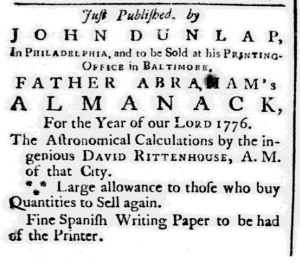
Dunlap’s Maryland Gazette (October 31, 1775).

“Large allowance to those who buy Quantities to Sell again.”

When John Dunlap published “FATHER ABRAHAM’S ALMANACK, For the Year of our LORD 1776,” in the fall of 1775, he set about advertising the handy reference manual.  He gave the advertisement a privileged place in the September 11, 1775, edition of Dunlap’s Pennsylvania Packet, the newspaper he printed in Philadelphia.  It ran immediately below the lists of ships arriving and departing from the customs house, increasing the chances that readers interested more in news than advertisements would see it.  Unlike other printers who hawked almanacs, Dunlap did not provide an extensive description of the contents to entice prospective customers, though he did indicate that “the ingenious DAVID RITTENHOUSE … of this city” prepared the “Astronomical Calculations.”  The printer believed that the astronomer’s reputation would help sell copies of the almanac.

He also ran advertisements in Dunlap’s Maryland Gazette, the newspaper he printed in Baltimore.  One of those notices appeared in the October 31 edition, again highlighting Rittenhouse’s role in making the “Astronomical Calculations.”  This advertisement did not include additional information about the contents, but it did include an appeal to retails that did not appear in the first iteration of the advertisement in Dunlap’s Pennsylvania Packet on September 11 nor in the most recent insertion on October 30.  Dunlap promised a “Large allowance to those who buy Quantities to Sell again.”  In other words, he offered discounts for purchasing in volume to make the almanac attractive to booksellers, shopkeepers, and peddlers.  Did Dunlap offer the same deal at his printing office in Philadelphia yet not advertise it in the public prints?  Other printers advertised discounts for buying almanacs by the dozen or by the hundred frequently enough to suggest that it was a common practice.  Given that Philadelphia had far more printers than Baltimore, many of them publishing one or more almanacs of their own, Dunlap may have carefully managed the discounts, offering one rate in one city and another rate in the other.  That did not necessarily matter to retailers who saw his advertisement in Dunlap’s Maryland Gazette.  His printing office in Baltimore, opened less than a year earlier, gave them easier access to almanacs than in the past.  The “Large allowance” was a bonus to convince them to take advantage of the convenience rather than order almanacs from other printers in Philadelphia or Annapolis.
August 29

What was advertised in a revolutionary American newspaper 250 years ago today?

Dunlap’s Maryland Gazette (August 29, 1775).

“The Papers taken out by evil minded persons, who had no manner of right to them.”

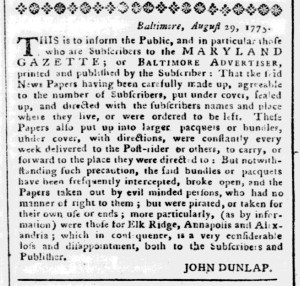
Something went wrong.  John Dunlap, the printer of Dunlap’s Maryland Gazette, had a system for delivering his newspaper to subscribers who lived outside of Baltimore, but “evil minded persons” interfered with it.  In particular, disruptions occurred in Annapolis and Elk Ridge, both in Maryland, and Alexandria, Virginia.  That prompted Dunlap to run a notice in the August 29, 1775, edition, placing it immediately after local news and first among the advertisements to increase the likelihood that readers would see it.

The exasperated printer went into great detail about his delivery infrastructure, hoping to convince “the Public, and in particular those who are Subscribers” that he made every effort to follow through on his obligation to deliver the newspaper.  The correct number of copies had been “carefully made up, agreeable to the number of Subscribers, put under covers, sealed up, and directed with the subscribers names and place where they live, or were ordered to be left.”  Then, those newspapers were “also put up into larger pacquets or bundles, under cover, with directions” and “constantly every week delivered to the Post-rider or other, to carry, or forward to the place they were directed to.”  Despite such careful attention and “notwithstanding such precaution, the said bundles or pacquets have been frequently intercepted, broke open, and the Papers taken out by evil minded persons, who had no manner of right to them.”  Dunlap called this “a very considerable loss and disappointment, both to the Subscribers and Publisher.”  Advertisers may have also been frustrated upon learning that the notices they paid to insert in Dunlap’s Maryland Gazette did not circulate as widely as they expected.  The printer likely realized that could have an impact on revenue as well.

Dunlap declared that the missing newspapers “were pirated, or taken for their own use or ends” by the thieves.  Despite the consequences for subscribers, advertisers, and the printer, the motivation for taking the newspapers may not have been completely nefarious.  In the wake of recent events – the battles at Lexington and Concord, the Battle of Bunker Hill, the Second Continental Congress meeting in Philadelphia, colonial assemblies holding their own meetings, George Washington assuming command of the Continental Army as it besieged Boston – colonizers were eager for news.  Some may have resorted to unsavory means of getting the latest updates, taking newspapers that did not belong to them.  That did not justify what they did, but it does testify to the role of the early American press in disseminating information about the imperial crisis and the Revolutionary War.  Some colonizers became better informed because of the theft, while subscribers to Dunlap’s Maryland Gazette had to seek out other newspapers or rely on conversations and correspondence to learn the latest updates.

August 8

What was advertised in a revolutionary American newspaper 250 years ago today?

Dunlap’s Maryland Gazette (August 8, 1775).

“A SERMON, PREACHED … the DAY recommended by the Honorable CONTINENTAL CONGRESS for A GENERAL FAST.”

On July 20, 1775, the “DAY recommended by the Honorable CONTINENTAL CONGRESS for A GENERAL FAST Throughout the TWELVE UNITED COLONIES of NORTH-AMERICA,” Thomas Coombe delivered a sermon to “the Congregations of CHIRST CHURCH and ST. PETER’s” in Philadelphia.[1]  Less than three weeks later, John Dunlap advertised a local edition of the sermon “PUBLISHED BY REQUEST” and sold in Baltimore in Dunlap’s Maryland Gazette.  He also printed a Philadelphia edition of the sermon, which apparently sold well enough to convince him to publish a second edition.  Solomon Southwick, printer of the Newport Mercury, produced yet another edition, as did James Magee in Belfast, Ireland.

According to researchers at the William Reese Company, a prominent antiquarian rare book dealer specializing in American, Coombe “was an Anglican minister and Loyalist in Philadelphia, and formerly the Chaplain for the Marquis of Rockingham.”  Both the advertisement and the title page noted the latter credential.  The sermon “calls for restraint amongst the citizenry of Philadelphia in the wake of the opening battles of the American Revolution.”  After the colonies declared independence, Coombe was imprisoned for his political stance, but “allowed to return to England in 1779.”  Publishing and disseminating this sermon, like various other sermons advertised during the summer of 1775, allowed the public greater access to discussions about how to respond to the imperial crisis after hostilities commenced in Massachusetts.  Colonizers read newspapers that carried reports about current events and editorials, examined pamphlets that outlined perspectives drawn from political philosophy ancient and modern, and participated in town meetings and everyday conversations about the deteriorating relationship between the colonies and Britain.  Sermons that circulated in print gave them even greater access to public discourse.  Just as they read news about events they had not witnessed when they perused newspapers, they became members of a congregation or audience when then read sermons printed and sold by early American printers.

Dunlap did something savvy in marketing the Baltimore edition of Coombe’s sermon.  He devoted the entire first page of the August 8, 1775, edition of Dunlap’s Maryland Gazette to the first portion of the sermon.  It spilled over onto the second page, along with a note: “To be Concluded in our next.)”  The printer gave readers a taste of the sermon.  Those who could not wait a week for the next issue or who wanted a copy in a single pamphlet could purchase the sermon at Dunlap’s printing office.  Those who did wait for the August 15 edition of the newspaper were disappointed.  The first page featured a portion of “The SPEECH of EDMUND BURKE, Esq; on moving his Resolutions for Conciliation with the Colonies, March 22, 1775,” along with a familiar note, “[To be Continued.]”  The remainder of Coombe’s sermon did not appear in that issue, nor in the Postscript, additional pages, that supplemented it.  Dunlap did continue Burke’s speech in the August 22 edition, but he neglected to provide the remainder of Coombe’s sermon.  The advertisement for the sermon, however, did appear on August 15 and August 22, enticing readers who wanted to finish what they had started.

**********

[1] Why twelve “UNITED COLONIES” instead of thirteen?  Georgia had not yet sent delegates to the Second Continental Congress.

February 10

Who was the subject of an advertisement in a colonial American newspaper 250 years ago today?

Pennsylvania Journal (February 10, 1773).

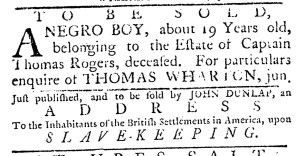
“TO BE SOLD, A NEGRO BOY.”

“Just published … an ADDRESS … upon SLAVE-KEEPING.”

When John Dunlap published An Address to the Inhabitants of the British Settlements in America, upon Slave-keeping in 1773, he advertised widely.  He promoted the pamphlet in his own newspaper, the Pennsylvania Packet, before taking it to press, hoping to incite interest and demand among prospective customers.  Before and after publication, he inserted advertisements in other newspapers as well.  For instance, he ran a brief advertisement in the February 10 edition of the Pennsylvania Journal.  Consisting of only four lines, it advised readers that the pamphlet was “Just published, and to be sold by JOHN DUNLAP.”

Printing a pamphlet that critiqued slavery did not prevent Dunlap from generating revenues from newspaper advertisements that perpetuated the slave trade.  On January 18, for instance, he ran a lengthy advertisement about the pamphlet, one that included an excerpt from the conclusion, and several notices offering enslaved people for sale or promising rewards for the capture and return of enslaved people who liberated themselves by running away from their enslavers.

Similarly, William Bradford and Thomas Bradford, printers of the Pennsylvania Journal, ran the advertisement for the pamphlet and advertisements about enslaved people.  Two advertisements in the February 10 edition, one for a “NEGRO woman eighteen years old, and six months gone with child” and another for a “NEGRO MAN, About 27 years old,” instructed prospective enslavers to “Enquire of the printers” for more information.  The Bradfords acted as slave brokers in addition to disseminating those advertisements.  Dunlap’s advertisement for the Address … upon Slave-keeping appeared immediately below an advertisement about a “NEGRO BOY, about 19 Years old,” for sale as part of the estate of Thomas Rogers.  Did the Bradfords recognize the dissonance inherent in the two advertisements?  Did a compositor exercise some editorial discretion in placing one advertisement after another, making a point to both the printers and readers?

Whatever the case, the Pennsylvania Journal gave much more space to perpetuating slavery on that day, made all the more noteworthy by the news item that filled the first two pages of that edition.  The Bradfords reprinted the response to Governor Thomas Hutchinson’s speech from a committee appointed by the Massachusetts assembly, a response that vigorously defended the liberties of English colonizers.  That response, first published by Isaiah Thomas as an extraordinary issue of the Massachusetts Spy, made its way from newspapers to newspaper, first in New England and then in other regions.  Each of those newspapers also ran advertisements that perpetuated slavery, demonstrating the limits of how many colonizers conceived of liberty.  The Address … upon Slave-Keeping presented a more expansive view.  Despite the excerpt that Dunlap published in his own newspaper, however, that pamphlet did not have such extensive coverage.

January 18

What was advertised in a colonial American newspaper 250 years ago today?

Pennsylvania Packet (January 18, 1773).

“AN ADDRESS TO THE INHABITANTS OF THE BRITISH SETTLEMENTS IN AMERICA, UPON SLAVE-KEEPING.”

In January 1773, John Dunlap, printer of the Pennsylvania Packet, announced that An Address to the Inhabitants of the British Settlements in America, upon Slave-Keeping, a work attributed to Benjamin Rush, was “Just published” and available for sale.  Dunlap leveraged his access to the press to give the announcement special prominence in his newspaper, treating it as an editorial rather than an advertisement.

Consider how Dunlap organized the contents of the January 18, 1773, edition of the Pennsylvania Packet and the supplement that accompanied it.  In the standard issue, news items and editorials appeared on the first two pages, followed by advertising on the last two pages.  Similarly, the two-page supplement began with two columns of news and the remainder of the content consisted of advertising.  Dunlap’s announcement masqueraded as an editorial that ran in the first column of the second page and overflowed into the next column, followed by news from London, Newport, New York, and Philadelphia.  The printer inserted an excerpt from the pamphlet, hoping to entice readers to want more and purchase their own copies.  In giving prospective customers an overview of the essay, Dunlap noted that the “Author of the above Address after having showed the inconsistency of Slave-keeping with the principles of humanity – justice – good policy and religion; concludes as follows.”  After reading that conclusion, prospective customers could acquire the pamphlet and examine the various arguments about humanity, justice, good policy, and religion for themselves.  In treating this announcement as an editorial or news item, Dunlap adopted a strategy sometimes deployed by other printers to promote books and pamphlets they published.

Whatever the conclusions reached in the Address … upon Slave-Keeping, Dunlap apparently did not find them sufficiently convincing to alter his policies concerning the kinds of advertising that he printed in the Pennsylvania Packet.  Two advertisements about enslaved people appeared on the facing page, one offering a “HEALTHY country bred NEGRO LAD” for sale and the other seeking to hire a “SMART, active WHITE or NEGRO BOY … to wait on table and go on errands.”  Candidates for that position included enslaved youths who did the work while their enslavers received the wages.  An advertisement in the supplement described a “Negro Fellow named LONDON” who liberated himself by running away from his enslaver in Baltimore and offered a reward for his capture and return.  Even as Dunlap treated the conclusion of the Address … upon Slave-Keeping as an editorial intended to arouse interest in a pamphlet he sold, he generated revenue by printing and disseminating advertisements that perpetuated slavery.

August 26

What was advertised in a colonial American newspaper 250 years ago today?

Pennsylvania Gazette (August 26, 1772).

“Beautifully printed on a fine American Paper, and with elegant Types.”

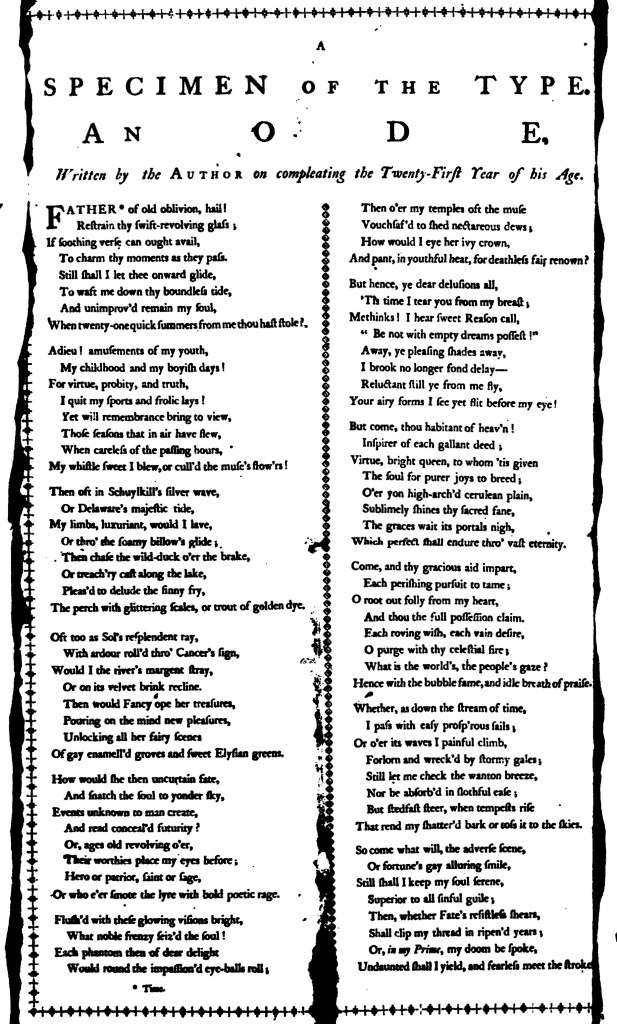
In the summer of 1772, John Dunlap informed the public that he “JUST PUBLISHED … POEMS on SEVERAL OCCASIONS, with some other COMPOSITIONS; by NATHANIEL EVANS.”  He called on subscribers who previously reserved copies to collect them from his printing office on Market Street in Philadelphia while also encouraging others “who design to become Purchasers … as there are but few Copies thrown off above those subscribed for.”  In addition to promoting the author as a former “Missionary (appointed by the Society for propogating the Gospel) for Gloucester County, in New-Jersey; and Chaplain to the Lord Viscount Kilmorey, of the Kingdom ofIreland,” Dunlap asserted that the book was “Beautifully printed on a fine American Paper, and with elegant Types.”

That short advertisement in the Pennsylvania Gazette reiterated several of the appeals that Dunlap previously deployed in marketing the book.  He distributed a broadsheet subscription notice that gave prospective buyers a chance to examine both the paper and the type.  At the beginning of a lengthy description of the project on one side, Dunlap declared that the book would be “printed on the same Pennsylvania manufactured Paper as this Advertisement, and the same Type as the Poem annexed.”  During the imperial crisis, many colonizers express their appreciation for domestic manufactures, items produced in the colonies, making “Pennsylvania manufactured Paper” an attractive alternative to imported paper.  The printer devoted the other side of the broadsheet to “AN ODE, Written by the AUTHOR on compleating the Twenty-First Year of his Age” that doubled as a “A SPECIMEN OF THE TYPE.”  That preview of the content simultaneously allowed buyers to see what they could expect in terms of the material qualities of the book.

An excerpt from the “PREFACE,” including a history of collecting and preparing the poems for publication following the death of the author, appeared on the other side of the broadsheet.  Dunlap appended a note that “the List of Subscribers will be committed to the press,” instructing “all who are desirous of encouraging this Publication, and who may not yet have subscribed [to] send their names.”  He also advised “those who have taken subscriptions of others” to send their lists as quickly as possible so he could include all subscribers in the list and print enough copies to match the advance orders.  In the newspaper advertisement, Dunlap promised that non-subscribers who bought any of the surplus copies would have their name “printed in the List of Subscribers to the 2d Edition.”  They would eventually be recognized among the ranks of those who supported the project.

Dunlap did not rely solely on newspaper advertisements in marketing his edition of Evans’s Poems.  Instead, he printed and distributed a broadsheet subscription notice that incorporated excerpts to entice prospective subscribers.  He also promised public recognition in the form of a printed subscription list.  Unlike newspaper advertisements, the broadsheet utilized the paper and the type for the project, allowing prospective customers to assess the material conditions of the proposed book when they decided if they wished to subscribe.  Although newspaper notices accounted for most advertising in eighteenth century America, entrepreneurs circulated many other kinds of marketing media, including trade cards, catalogs, and subscription notices with excerpts and type specimens.

John Dunlap, Type Specimen from Subscription Notice (Philadelphia, 1772). Courtesy Historical Society of Pennsylvania.

December 4

What was advertised in a colonial American newspaper 250 years ago this week?

Pennsylvania Packet (December 2, 1771).

“To be Sold on the cheapest Terms.”

When John Dunlap commenced publication of the Pennsylvania Packet in the fall of 1771, he quickly gained advertisers.  From the very first issue, he distributed two-page supplements because the standard four-page issue could not contain all of the notices submitted to his printing office.  Many merchants and shopkeepers who placed advertisements in the Pennsylvania Packet replicated a style more common in newspapers published in Boston and New York rather than those that appeared in the Pennsylvania Chronicle, the Pennsylvania Gazette, and the Pennsylvania Journal.  A substantial number of advertisements in Dunlap’s newspaper featured extensive lists, naming dozens or even hundreds of items and occupying a significant amount of space.  Perpendicular lines ran down the center of each, creating two columns within those advertisements.  Rather than dense paragraphs of text, one or two items ran on each line, making it easier for readers to navigate the contents.  Many of these catalogs of merchandise extended half a column or more.  Philip Benezet’s advertisement filled an entire column.

Why did notices with this particular format appear in great numbers in the Pennsylvania Packet in the fall of 1771 but not in other newspapers published in Philadelphia?  Did price play a role?  Dunlap included the costs for subscriptions and advertising in the proposals he distributed prior to launching his newspaper.  “The Price to Subscribers will be Ten Shillings per year,” he stated.  In addition, “Advertisements, of a moderate length, will be inserted at Three Shillings each for one week, and One Shilling for each continuance.”  Benezet’s advertisement certainly was not “a moderate length.”  In such instances, Dunlap asserted that he published “those of greater length at such proportionable prices as may be reasonable.”  David Hall and William Sellers did not include the price for subscriptions or advertisements in the colophon for the Pennsylvania Gazette, but William Bradford and Thomas Bradford indicated that “Persons may be supplied with” the Pennsylvania Packetat Ten Shillings a Year.”  William Goddard also charged ten shilling for an annual subscription to the Pennsylvania Chronicle.  None of the printers, however, included prices for advertising in the colophons of their newspapers.

Dunlap set the same rate for subscriptions as his competitors, but did he attempt to undercut them when it came to advertising?  If so, was that strategy only temporary, intended to come to an end once he felt his newspaper had been firmly established?  His proposals included other savvy marketing strategies.  He listed local agents in more than a dozen towns, from Boston in New England to Charleston in South Carolina, demonstrating that he planned for wide dissemination of the Pennsylvania Packet.  He also distributed the first issue “gratis” in hopes of cultivating interest and leveraging commitments from prospective subscribers.  Dunlap may or may not have charged lower rates for advertising as a means of jumpstarting his newspaper, but doing so was certainly within the realm of possibility in Philadelphia’s competitive media market.

November 4

Who was the subject of an advertisement in a colonial American newspaper 250 years ago today?

Pennsylvania Packet (November 4, 1771).

“WANTED, A NEGRO BOY … apply to the Printer.”

Two issues.  It took only two issues for John Dunlap, the printer of the Pennsylvania Packet, to become a slave broker.  Dunlap published the inaugural issue of his newspaper on October 28, 1771.  It overflowed with advertising.  So many advertisers submitted notices to the printing office that Dunlap published a two-page supplement and inserted a note that other advertisements arrived too late for publication that week but would appear in the next edition.  Most advertisements in that first issue promoted consumer goods and services.

The following week, however, Dunlap ran another sort of advertisement that regularly appeared in newspapers from New England to Georgia:  a notice in which an unnamed advertiser sought to purchase an enslaved person.  “WANTED,” the advertisement proclaimed, “A NEGRO BOY, from fourteen to twenty years of age, that can be well recommended.”  In running that advertisement, John Dunlap and the Pennsylvania Packet helped to perpetuate slavery and the slave trade.  Yet Dunlap did more than provide space in his newspaper in exchange for advertising fees that made his new publication a viable venture.  The advertisement instructed that “Any person who has such to dispose of, may hear of a Purchaser by applying to the Printer.”  Dunlap brokered the sale by supplying additional information to readers who responded to the advertisement.

That was a common practice throughout the eighteenth century.  In “Enquire of the Printer: Newspaper Advertising and the Moral Economy of the North American Slave Trade, 1704-1807,” Jordan E. Taylor analyzes a “dataset of more than 2,100 unique eighteenth-century North American ‘enquire of the printer’ newspaper slave advertisements appearing from 1704 through 1807.”[1]  Most of those advertisements ran for multiple weeks, making them even more ubiquitous before the eyes of readers and profitable for printers.  Dunlap, then, was not an outlier among printers during the era of the American Revolution.  Instead, he very quickly adopted a widespread practice.  Not exclusively a broker of information, the printer also served as a broker of enslaved men, women, and children.

**********

[1] Jordan E. Taylor, “Enquire of the Printer: Newspaper Advertising and the Moral Economy of the North American Slave Trade, 1704-1807,” Early American Studies: An Interdisciplinary Journal 18, no. 3 (Summer 2020): 290.

November 1

What was advertised in a colonial American newspaper 250 years ago today?

New-London Gazette (November 1, 1771).

“Subscriptions are taken in by T. GREEN.”

When John Dunlap distributed subscription proposals in advance of publishing the Pennsylvania Packet, he expressed his intention to disseminate the new newspaper widely.  He lined up local agents from a variety of occupations in towns in Pennsylvania and far beyond.  They included “James Wilson, Esq; Attorney at Law, Carlisle,” Pennsylvania, “Richard Thomas, Esq; Sheriff, Charlestown,” Maryland, “Rev. William Dunlap, King and Queen county, Virginia.”  He also enlisted booksellers Noel and Hazard in New York as well as printers in the major port cities.  Some of them published their own newspapers, yet they assisted a fellow printer in another town launch his own publication.  They likely received complimentary copies of the Pennsylvania Packet, part of an exchange network that allowed printers to liberally reprint content from one newspaper to another.  From Cape May, Massachusetts, to Charleston, South Carolina, local agents stood ready to receive subscriptions to the Pennsylvania Packet.  Beyond the continent, “Messrs. Esmand and Walker, Printers in Bridgetown, Barbados” also accepted subscriptions on Dunlap’s behalf.

In addition to that extensive list, the proposals ended with a note that “many other Gentlemen, whose names will be particularized in our first Number” also served as local agents in other towns.  Timothy Green, printer of the New-London Gazette was one of those local agents.  His newspaper carried the same subscription proposals for the Pennsylvania Packet that ran in the Pennsylvania Chronicle, though Green trimmed the list of local agents.  The final line simply stated, “Subscriptions are taken in by T. GREEN.”  When it came to local subscribers, Green probably did not worry too much about the Pennsylvania Packet competing with the New-London Gazette.  Given the time required to deliver it from Philadelphia to Connecticut, its contents supplemented rather than replaced the “freshest ADVICES, both FOREIGN and DOMESTICK” that the masthead of the New-London Gazette promised.  In addition, Green’s newspaper exclusively carried certain content, including local advertisements, legal notices, and shipping news from the custom house.  Colonial printers served as editors, selecting items from multiple newspapers to reprint, but some readers also acted as their own editors through consulting several newspapers on their own, deciding for themselves which “ADVICES” they considered most important.  When they served as local agents for newspapers published in other towns, printers like Green facilitated that process.

October 28

What was advertised in a colonial American newspaper 250 years ago today?

Pennsylvania Packet (October 28, 1771).

“A GENERAL ASSORTMENT of EUROPEAN and EAST INDIA GOODS.”

In “PROPOSALS FOR PRINTING BY SUBSCRIPTION, A WEEKLY NEWS-PAPER, ENTITLED, THE PENNSYLVANIA PACKET, AND GENERAL ADVERTISER,” dated October 8, 1771, John Dunlap declared that the newspaper would commence publication on Monday, November 25 “or sooner, if sufficient encouragement should offer.”  That “encouragement” included acquiring both subscribers and advertisers whose fees would support the new enterprise.

Even though printers already published several newspapers – the Pennsylvania Chronicle, the Pennsylvania Gazette, the Pennsylvania Journal, and the Wochentliche Pennsylvanische Staatsbote – in Philadelphia, Dunlap garnered the attention he needed to launch the Pennsylvania Packet much earlier than expected, four weeks ahead of schedule.  On Monday, October 28, he distributed the first issue.  In a note “TO THE PUBLIC” on the front page, he extended “his most hearty thanks … for the generous encouragement … whereby he is enabled to issue this new publication in about half the time he proposed.”

The front page also included three advertisements, a brief notice in which Lennox and Turnbull promoted their “GENERAL ASSORTMENT of EUROPEAN and EAST INDIA GOODS,” a lengthy list cataloging the “large and neat Assortment of MERCHANDIZE” sold by John Biddle and Clement Biddle, and a testimonial about Enoch Story’s services as a broker and auctioneer signed by several prominent merchants.  The testimonial, dated May 16, 1771, previously ran in newspapers published in Philadelphia and Annapolis.

Those notices were just a few of many that appeared in the first issue of the Pennsylvania Packet.  Dunlap devoted half of a column on the third page to the shipping news from the customs house and then filled the rest of the page with advertisements.  The fourth page consisted entirely of advertisements and the colophon running across the bottom.  Dunlap even distributed a two-page supplement.  Essays appeared on the front and advertisements, mostly from Dunlap and other printers, on the back.  Dunlap even inserted a brief note to alert readers that “Some Advertisements which came too late, are deferred till next week, when they shall be carefully regarded.”

Many newspapers carried minimal advertising when they first launched.  Advertisers waited to see what kind of reception a publication received before investing in advertising.  They wanted to make sure newspapers had sufficient circulation to justify the expense.  How did Dunlap acquire so many advertisers so quickly?  Some may have responded to the pledge he made in the proposals when he stated that the “first Number shall be given gratis” to prospective subscribers.  Some advertisers may have believed that would yield sufficient circulation to merit placing their notices in the inaugural issue and then assessing whether they wished to continue.  If that was the case, Dunlap and his advertisers mutually benefitted.  The number of advertisements made the new Pennsylvania Packet look like a robust endeavor, one worthy of more subscribers.