
What was advertised in a revolutionary American newspaper 250 years ago today?
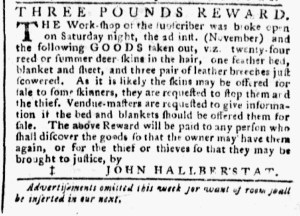
“THE Work-shop of the subscriber was broke open on Saturday night.”
It was bad luck for John Hallberstat, a leather dresser, that someone broke into his workshop in Philadelphia and stole a variety of goods during the night of Saturday, November 2, 1776. Losing no time, he arranged for advertisements to appear in the next newspapers published in the city. That meant Dunlap’s Pennsylvania Packet and the Pennsylvania Evening Post, both printed and distributed on Tuesdays. The Pennsylvania Gazette and the Pennsylvania Journal would not come out until Wednesday and the Pennsylvania Ledger not until Saturday. Hallberstat needed to move quickly to increase the chances that newspaper advertisements would help him recover the stolen items.
In notices with nearly identical copy, Hallberstat described the stolen goods: “twenty-four reed or summer deer skins in the hair, one feather bed, blanket and sheet, and three pairs of leather breeches just scowered.” Most victims of theft or burglary who ran newspaper advertisements called on all readers to assist in identifying the perpetrators and returning the stolen goods. Hallberstat, however, made a plea directly to those he thought the culprits most likely to approach to sell the items from his workshop. “As it is likely the skins may be offered for sale to some skinners,” he declared, “they are requested to stop them and the thief.” Similarly, “Vendue-master” or auctioneers “are requested to give information if the bed and blankets should be offered them for sale.” Skinners and vendue masters could collude with the thief or thieves to their own advantage. In case doing the right thing was not sufficient motivation for assisting Hallberstat, he offered “THREE POUNDS REWARD … to any person who shall discover the goods so that the owner may have them again, or for the thief or thieves so that they may be brought to justice.”
Hallberstat was fortunate that his advertisement ran in Dunlap’s Pennsylvania Packet at all on November 5. It appeared as (almost) the last item at the bottom of the last column on the third page. That would have been the final type set in place for that issue since printers tended to print the first and fourth pages on one side of the broadsheet first and finished with the second and third pages on the other side. Only a brief note from the printer followed Hallberstat’s notice: “Advertisements omitted this week for want of room shall be inserted in our next.” The printer selected some advertisements to exclude. Given the urgency of Hallberstat’s advertisement, the printer may have made sure to give it a place in the November 5 edition. That increased the chances that Hallberstat might recover the stolen goods. Waiting to published the advertisement in the next issue on November 12 made it even less likely that it would yield the result that Hallberstat sought.