July 6

What was advertised in a revolutionary American newspaper 250 years ago today?
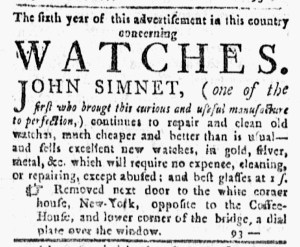
New-York Journal (July 6, 1775).

“Removed next door to the white corner house … a dial plate over the window.”

John Simnet, a cantankerous watchmaker who frequently advertised in New York’s newspapers in the early 1770s, once again took to the pages of the New-York Journal in the summer of 1775.  In this notice, he announced that he “continues to repair and clean old watches … and sells new watches.”  He took a neutral tone in that notice compared to the derogatory declarations he sometimes made about his competitors in other advertisements.  Simnet did state that he cleaned and repaired watches “much cheaper and better than is usual,” comparing the price and quality of his services to those offered by other watchmakers, but he did not denounce any competitors by name or launch into a diatribe about the general incompetence of those who followed an occupation he often claimed as solely his own.  He also described himself as “one of the first who brought this curious and useful manufacture to perfection,” but limited that comment to promoting his own work rather than denigrating other watchmakers.

Perhaps Simnet was more interested in drawing attention to his new location.  He moved from a shop “at the Dial, next Beekman’s Slip, in Queen Street” to a shop “next door to the white corner house, New-York, opposite to the Coffee-House, and lower corner of the bridge.”  Detailed directions were necessary.  Neither New York nor any other town had standardized street numbers in the 1770s, though some of the largest port cities would begin assigning them by the end of the century.  Sinnet resorted to landmarks to direct customers to his shop.  Like many other entrepreneurs, he also marked his location with a device that represented his business, “a dial plate over the window.”  It may have been the same “Dial” that had adorned his previous location.  If Simnet did transfer the “dial plate” from one shop to another, he maintained a consistent visual image for customers and others to associate with his business.  Other entrepreneurs who placed advertisements in the July 6, 1775, edition of the New-York Journal also used images to mark their locations, including James Wallace, a lacemaker and tailor “At the SIGN of the HOOD,” and William Pearson, a clock- and watchmaker “At the Dial, in HANOVER-SQUARE.”  That a competitor displayed a dial made Simnet’s elaborate directions imperative.  He did not want prospective customers stopping by another shop by mistake.

May 7

What was advertised in a revolutionary American newspaper 250 years ago this week?

Rivington’s New-York Gazetteer (May 4, 1775).

“Repairing or cleaning WATCHES … entirely free from the old Fleecing Method.”

John Simnet’s notices became a fixture among the advertisements that appeared in New York’s newspapers in the first half of the 1770s.  The watchmaker migrated from England to Portsmouth, New Hampshire, in the late 1760s.  He spent about eighteen months there before moving to New York.  During his time in New England, he published a series of cranky notices that more often than not engaged in a feud with a competitor, Nathaniel Sheaff Griffith.  When Sinnet arrived in New York, he continued with the cantankerous advertisements, sometimes commenting on rival watchmakers in general and occasionally singling out a new competitor for the same sort of abuse he previously heaped on Griffith. Such behavior certainly made Simnet fun for the Adverts 250 Project to cover a couple of centuries later!

As the imperial crisis intensified in 1774, Simnet refrained from doing anything too outrageous in the public prints, but after fighting began at Lexington and Concord he demonstrated that he still had that spark.  Most advertisers, including his fellow watchmakers, usually promoted their own goods and services without mentioning their competitors.  Even when they proclaimed that they offered the best quality or the lowest prices, they did not intentionally denigrate their competitors.  Simnet, on the other hand, relished doing so.  In an advertisement in the May 4, 1775, edition of Rivington’s New-York Gazetteer, he mocked “what others think moderate or reasonable Terms,” suggesting that his peers who repaired and cleaned watches charged exorbitant rates for services poorly rendered.  Such work required yearly maintenance.  Simnet offered a superior alternative, cleaning and repairing watches such that they “perform much truer” and “retain their original Beauty much longer.”  Clients who availed themselves of his services liberated themselves from “the old Fleecing Method of paying by the Year.”  The watchmaker made clear that he believed his competitors cheated their customers, either by design or through a lack of competence.  When it came to having their watches repaired or cleaned, prospective customers did not “need be at an considerable Expence” if they entrusted the work to Simnet, watchmaker “From Clerkenwell, London,” rather than any of his inept competitors whose training and experience all took place in the colonies.

June 12

What was advertised in a colonial American newspaper 250 years ago this week?

Rivington’s New-York Gazetteer (June 9, 1774).

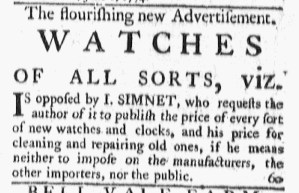
“The flourishing new Advertisement … IS opposed by I. SIMNET.”

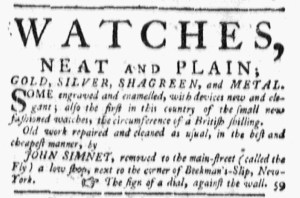
The cantankerous John Simnet once again picked a fight in the public prints in the summer of 1774, having previously engaged in similar behavior targeting competitors in Portsmouth in the late 1760s and New York in the early 1770s.  The watchmaker did not seem content simply promoting his own skill and merchandise, as he did in an advertisement for “WATCHES, NEAT AND PLAIN; GOLD, SILVER, SHAGREEN, and METAL” that first ran in the June 2, 1774, edition of Rivington’s New-York Gazetteer and appeared again a week later.  In that notice, Simnet emphasized a novelty available at his shop, “the first in this country of the small new fashioned watches, the circumference of a British shilling.”

Rivington’s New-York Gazetteer (May 26, 1774).

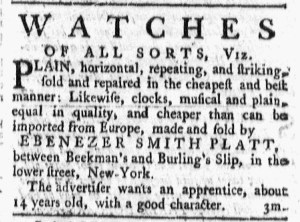
Yet Simnet did not believe that was not enough to distinguish him from his competitors. Instead, he placed a second advertisement in Rivington’s New-York Gazetteer on June 9, that one deriding “The flourishing new Advertisement” with a headline for “WATCHES OF ALL SORTS, viz.” that went on to list “PLAIN, horizontal, repeating, and striking.”  Ebenezer Smith Platt had been running that advertisement in Rivington’s New-York Gazetteer, though Sinmet’s comment about “The flourishing new Advertisement” suggests that his competitor may have distributed handbills or broadsides as well.  The part that really upset Simnet seems to have been Platt’s assertion that he made and sold watches and clocks “equal in quality, and cheaper than can be imported from Europe.”  Even though artisans throughout the colonies, including clock- and watchmakers, often made such appeals, Simnet acted as though they applied solely to him and his business.

Rivington’s New-York Gazetteer (June 9, 1774).

To that end, he quoted the headline of Platt’s advertisement and then trumpeted that he “IS opposed” to the claims made in it.  Simnet went on to demand, though he framed it as a request, that “the author of it” (he did not mention Platt by name) “publish the price of every sort of new watches and clocks, and his price for cleaning and repairing old ones, if he means neither to impose on the manufacturers, the other importers, nor the public.”  On occasion, Simnet had published the prices he charged for cleaning and repairs, though in his current advertisement he merely stated, “Old work repaired and cleaned as usual, in the best and cheapest manner.”  He sought to hold Platt to a higher standard than he met, suggesting that he did so in service to “the public” that might have otherwise been duped by Platt.  In an era when most advertisers promoted their own goods and services without engaging directly with their competitors, Simnet regularly took to the newspapers to demean others who followed his trade, especially those who ran their own advertisements.  He apparently considered such means effective … or at least derived some form of satisfaction from such conduct.

March 27

What was advertised in a colonial American newspaper 250 years ago this week?

New-York Journal (March 24, 1774).

“WATCHES … no Expence for cleaning them.”

John Simnet, a watchmaker, was a prolific advertiser in New York’s newspapers in the early 1770s.  In late March 1774, he placed a new advertisement in the New-York Journal, with a headline that proclaimed, “The Sixth Year of this Advertisement in this Country.”  Simnet referred to the fact that he migrated to the colonies from London, though he first set up shop in New Hampshire.  He advertised there for about a year and a half, frequently engaging in feuds with a competitor, before relocating to New York.  Perhaps prospective customers in and near Portsmouth had not appreciated his abrasive style, though the curmudgeon did not seem to learn his lesson if that was the case.  After settling in New York, he frequently picked fights with local watchmakers, their arguments witnessed by newspaper readers as they perused the advertisements.  Over the years, the colorful Simnet has become a favorite for the Adverts 250 Project, one of the colonial advertisers most often featured thanks to his lively notices.  In March 1774, Simnet had indeed commenced his “Sixth Year” of running advertisements in the colonies.

When he did so, he advanced a marketing strategy he frequently deployed.  Simnet offered an ancillary service for free to his clients who paid for other services: “those Gentlemen, &c. who have employed the Advertiser to Repair their WATCHES, ARE now at no Expence for cleaning them.”  In other words, he did not charge customers for routine cleaning of watches that he previously repaired.  That kept the watches in good running order, which further testified to Simnet’s skills and justified hiring him for other work.  The watchmaker declared that “it will be his endeavour to prove, Watches which are tolerably good, will perform 20 Years without Expence.”  Prospective clients could take their watches to his competitors who did not invest the same care in their work, causing them to have to pay for additional repairs over time, or they could entrust their watches to Simnet with confidence that he would assist them in averting further expense.  His clients could avoid paying for “mending Work” on their watches (and simultaneously safeguard Simnet’s reputation) if they presented their watches for cleaning “at least once a Year.”  Putting a little effort into such routine maintenance, offered for free, made the clients and the watchmakers partners in the enterprise, encouraging customer loyalty.

November 25

What was advertised in a colonial American newspaper 250 years ago today?

Rivington’s New-York Gazetteer (November 25, 1773).

“WATCHES justly valued for those who are about to buy, or swop elsewhere.”

John Simnet, who billed himself as the “only regular London watch-maker here,” regularly advertised in the newspapers published in New York.  As November 1773 came to a close, he inserted notices in the New-York Gazette and Weekly Mercury, the New-York Journal, and Rivington’s New-York Gazetteer.  Over the years, he gained a reputation for his cantankerous advertisements in which he feuded with his competitors.  Such aggressive strategies did not account for the only appeals that the watchmaker made to the public.  In many of his advertisements, he listed his prices, demonstrating the deals available at his workshop to prospective clients who did some comparison shopping.  Simnet asserted, for instance, that he performed “every particular in repairing [watches] at HALF the price charg’d by others.”  Furthermore, he “will keep them in proper order in future, gratis,” a valuable service for his customers.  He also did appraisals: “WATCHES justly valued for those who are about to buy, or swop elsewhere.”

Those appeals, along with his colorful personality, helped to distinguish Simnet’s advertisements from those placed by other watchmakers.  In the November 25 edition of Rivington’s New-York Gazetteer, another aspect of his advertisement attracted attention.  The watchmaker joined the ranks of advertisers who decided to have a decorative border enclose his notice.  In recent months, that became a style associated with New York’s newest newspaper.  Simnet ran the same copy that appeared in the New-York Journal on the same day and a few days earlier in the November 22 edition of the New-York Gazette and Weekly Mercury, but only his notice in Rivington’s New-York Gazetteer featured a border.  Simnet joined six other advertisers who opted for that visual element to enhance their notices and attract the attention of readers.  Like most other advertisers, he devised the copy on his own, but entrusted the format to the compositors in each printing office.  In this case, however, he apparently made a request to incorporate a border after observing so many other advertisements in that newspaper receive that treatment.  Considering how much Simnet craved attention, arguably even more than most advertisers, readers familiar with his reputation and his previous notices may have been surprised that it took him so long to run an advertisement with a visual element gaining in popularity.

October 18

What was advertised in a colonial American newspaper 250 years ago today?

New-York Gazette and Weekly Mercury (October 18, 1773).

“Every particular in repairing at HALF the price charg’d by others.”

John Simnet regularly advertised his services as a watchmaker in newspapers published in New York in the early 1770s.  Several of his competitors also ran advertisements, but Simnet placed notices so frequently that he achieved a much greater level of visibility in the public prints than other watchmakers in the city.  In the early 1770s, only Thomas Hilldrup’s notices in several newspapers published in Connecticut rivaled the dissemination of Simnet’s notices, a development that may have prompted Simnet to advertise in the Connecticut Courant.  Simnet’s advertisements were often so lively (or so cantankerous) that the Adverts 250 Project has traced his marketing efforts, especially his feuds with other watchmakers, for nearly five years, beginning with his first advertisements in the New-Hampshire Gazette in 1769 and continuing with his notices in New York after he relocated in 1770.  Considering how much money he invested in marketing, the watchmaker apparently believed that his advertisements yielded results.

Supplement to the New-York Gazette and Weekly Mercury (October 18, 1773).

For instance, Simnet ran two advertisements in the October 18, 1773, edition of the New-York Gazette and Weekly Mercury, one in the standard issue and one in the advertising supplement.  The one in the supplement had been running for quite some time, but the one in the standard issue was new.  The watchmaker deployed some of the same appeals in both advertisements, especially underscoring that he undertook “every particular in repairing [watches] at HALF the price charg’d by others, and will keep them in proper order in future, gratis.”  Simnet believed that the combination of bargain prices and additional services at no charge cultivated and secured relationships with customers.  Perhaps he even discovered during his conversations with clients that was indeed the case, a rudimentary form of research into the effectiveness of his marketing strategies.  Simnet also listed his prices for cleaning watches to make comparison shopping easier for prospective clients.  In the new advertisement, he once again incorporated a claim that he frequently made about his status as the “only regular London watch-maker” in New York.  He received his training in London and had decades of experience as a watchmaker there.  Simnet often implied that made his skills superior to competitors who only had experience working in the colonies; on occasion, he explicitly stated that was the case.  Compared to some of his notices, the two advertisements in the October 18 edition of the New-York Gazette and Weekly Mercury were rather placid.  For the moment, Simnet did not seek to benefit from creating controversy.  Instead, he used multiple advertisements to keep his name and his services in front of the eyes of prospective customers as they perused the newspaper.

July 1

What was advertised in a colonial American newspaper 250 years ago today?

Supplement to the New-York Journal (July 1, 1773).

“Advice to the cautious, who are about to buy, swop, and little jobs to the wise for nothing.”

On July 1, 1773, watchmaker John Simnet placed a new advertisement in Rivington’s New-York Gazetteer.  On that day, another of his advertisements appeared in the New-York Journal for the tenth time.  While not uncommon for merchants, shopkeepers, and artisans to advertise in more than one newspaper simultaneously, they usually submitted identical notices to each printing office.  Prospective customers usually encountered the same advertisement no matter which publication they happened to read.

Simnet’s advertisements in the two newspapers were not that much different.  In each, he informed the public that he recently “removed” to a new location.  He also proclaimed that he charged “half the price” of his competitors when it came to cleaning and repairing watches, in addition to offering a service plan in which he would “keep them in order at his own trouble, without expence (except abused).”  In other words, as long as clients treated their watches well, Simnet provided small repairs free of charge.  The watchmaker, a frequent advertiser, had been promoting these aspects of his business for quite some time, even before one of his current advertisements first ran in the New-York Journal on April 29.

Rivington’s New-York Gazetteer (July 1, 1773).

He made additional appeals in his new advertisement in Rivington’s New-York Gazetteer.  In particular, he offered “advice to the cautious, who are about to buy, swop, and little jobs to the wise for nothing.”  With the exception of small jobs undertaken gratis, these services had not previously been part of Simnet’s marketing efforts in the public prints.  The description he deployed closely replicated the language that Thomas Hilldrup, a watchmaker in Hartford, used in advertisements that ran in all three newspapers published in Connecticut.  In those notices, Hilldrup declared that he offered “advice to those who are about to buy, sell or exchange, and any other jobbs that take up but little time gratis.” Simnet almost certainly saw those advertisements, especially considering that he advertised in the Connecticut Courant for the first time in January 1773.  He had been active in the greater New York market for more than two years, after relocating from Portsmouth, New Hampshire, but had not considered it necessary to advertise in any of the newspapers published in Connecticut until Hilldrup arrived in the colony in the fall of 1772 and then devised an extensive advertising campaign over the next several months.

One other aspect of Simnet’s new notice merits attention, especially considering that he placed it in a newspaper that served Connecticut, New Jersey, the Hudson River, and Quebec.  Simnet asserted that he was the “ONLY regular Watchmaker here, of the London Company,” a claim that he frequently made in other advertisements as a means of denigrating his competitors.  In addition, he had a long history of picking fights and engaging in public feuds in his newspaper advertisements, first in Portsmouth and then in New York.  It comes as little surprise that he would appropriate the marketing strategies of a competitor while simultaneously contending that he possessed superior skill and training, especially in a newspaper that he anticipated that competitor was likely to read.  The cantankerous watchmaker often seemed as interested in taunting his competitors as attracting clients to his shop.

January 26

What was advertised in a colonial American newspaper 250 years ago today?

Connecticut Courant (January 26, 1773).

“WATCHES … every Particular in repairing at HALF PRICE.”

For the past four years the Adverts 250 Project has traced newspaper advertisements placed by watchmaker John Simnet, first in Portsmouth in the New-Hampshire Gazette for a year and a half in 1769 and early 1770 and then in newspapers published in New York.  In both locations, the cantankerous artisan engaged in public feuds with his competitors and sometimes ran notices that mocked and denigrated them.

At the end of January 1773, Simnet decided to insert an advertisement for his shop in New York in the Connecticut Courant, published in Hartford.  That put him in competition with Thomas Hilldrup, who had been advertising in the Connecticut Courant for months, Enos Doolittle, who had been advertising in that newspaper for six weeks, and other watchmakers in Hartford and other towns in Connecticut.  It was an unusual choice for an artisan in New York to extend their advertising efforts to newspapers in neighboring colonies, especially when they had the option to run notices in multiple newspapers in New York.  Did Simnet believe that he would gain clients in Hartford?  Perhaps he thought his promotions – “every Particular in repairing at HALF PRICE” and “no future Expence, either for cleaning or mending” – would indeed convince faraway readers to send their watches to him when they needed maintenance.

New-York Journal (January 21, 1773).

Even if those offers caught the attention of prospective customers in Connecticut, the final lines of Simnet’s advertisement likely confused them.  The advertisement previously ran in the New-York Journal for eight weeks, starting on December 3, 1772.  In the most recent edition, published on January 21, 1773, Simnet added a short poem that addressed “Rhyming Pivot, of York, / With Head, light as Cork.”  The “Rhyming Pivot” may have been Isaac Heron, a nearby neighbor and competitor, who included short verses in his advertisement that ran in the New-York Journal for several weeks, starting on December 24.  At the conclusion of Heron’s notice, he asked “brethren of the Pivot,” fellow watchmakers, to confiscate certain watches that had gone missing from his shop if clients brought them to their shops “for repair or sale.”  Simnet, easily agitated, apparently did not like that another watchmaker dared to try to generate business via notices in the public prints.  He responded with his own poem that described his competitor’s merit as “a Joke or a Song” and declared that he belonged on Grub Street in London, known for authors who often lacked talent and the printers and booksellers who peddled works of dubious quality.

The poem may have resonated with readers of the New-York Journal who were familiar with Heron’s advertisement (and may have also witnessed Simnet’s feud with James Yeoman several months earlier), but readers of the Connecticut Courant had no context for understanding it.  Why did Simnet choose to have his updated advertisement reproduced in its entirety rather than the original version, without the poem, that ran for so many weeks in New York.  The ornery watchmaker was usually very calculated in his decisions about marketing.  What made him decide that advertising in the Connecticut Courant was a good investment?  Even if he considered it worth the costs, why did he include a poem that would have confounded prospective clients?

December 3

What was advertised in a colonial American newspaper 250 years ago today?

New-York Journal (December 3, 1772).

“Every Particular in repairing at HALF the PRICE charged by any other.”

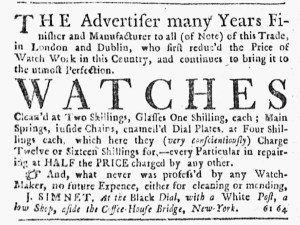
In early December 1772, watchmaker John Simnet inserted a new advertisement in the New-York Journal.  Simnet had a long history of advertising, first in New Hampshire and then in New York.  He sometimes promoted the services he provided, but other times denigrated the skill and character of one competitor or another.  This time he opted to compare his prices and ancillary services to those offered by other watchmakers, but he did not launch any attacks against particular rivals.

Simnet incorporated superlatives into his advertisement.  He mentioned his origins, declaring that he had been “many Years [a] Finisher and Manufacturer to all (of Note) of this Trade, in London and Dublin.”  In other words, he previously worked in only the best workshops in those cities before migrating to the colonies.  Upon his arrival he became the “first [who] reduc’d the Price of Watch Work in this Country,” suggesting that others charged far too much for the mending and cleaning services they provided.  Simnet also proclaimed that he “continues to bring it to the utmost Perfection,” leaving it to readers to determine if “it” meant prices alone or the entire watchmaking trade.

To entice prospective clients to avail themselves of his services, Siment listed his prices.  He charged two shillings to clean watches and one to clean watch glasses.  He replaced “Main Springs, inside Chains, [and] enamell’d Dial Plates, at Four Shillings each,” compared to others in the colonies who “(very conscientiously) Charge Twelve or Sixteen Shillings.”  He accused the industry of purposely charging three or four times what the prices should have been for replacing certain parts.  As for other fixing other parts of watches, Simnet asserted that he asked “HALF the Price charged by any other.”

If those prices were not enough to get clients into his shop, the watchmaker offered ancillary services for free.  He promised “no future Expence, wither for cleaning or mending” for any watches purchased from him.  Deploying one more superlative, Simnet proclaimed that such a deal “never was profess’d by any Watch-Maker” in the colonies.  Simnet had a high opinion of himself and the work undertaken in his shop.  He hoped that his confidence would convince prospective clients to choose him over his competitors, though he also compared prices and provided supplementary services as part of his sales pitch.

August 27

What was advertised in a colonial American newspaper 250 years ago today?

New-York Journal (August 27, 1772).

“May have them clean’d again immediately without expence.”

As fall approached in 1772, watchmaker John Simnet marked the second anniversary of his arrival in New York by distributing a new advertisement in the newspapers published in that city.  Readers should have been familiar with Simnet and his feud with rival watchmaker John Yeoman.  The two exchanged barbs in their newspaper notices over the course of several months.  Before moving to New York, Simnet had similarly participated in a war of words with a competitor, Nathaniel Sheaff Griffith, in the pages of the New-Hampshire Gazette.  In both Portsmouth and New York, Simnet acquired a reputation for acerbic commentary about his competitors.

He took a different approach, however, when marking two years in New York.  His most recent advertisement opened with an imitation of Yeoman’s advertisement intended to denigrate the other watchmaker.  The new advertisement simply declared, “WATCHES COMPLETELY repair’d, in every particular article, at HALF the price charg’d by any other.”  While he made reference to the prices of his competitors in general, Simnet did not deploy any insults aimed directly at Yeoman.  Instead, he focused on his credentials, his prices, and ancillary services intended to cultivate relationships with clients.  As usual, he trumpeted his experience and origins as a “WATCH-FINISHER, and Manufacturer, of London.”  He gave a list of prices for cleaning, replacing parts, and mending watches so prospective customers could assess for themselves whether he offered bargains compared to his competitors.  He also noted that since two years passed “since the author advertised here, some of the watches he has repair’d may become dirty.”  Simnet presented a special deal to his first customers who helped him get established in the city, inviting them to have their watches “clean’d again immediately without expence.”  He likely believed that this free service would generate more business.

Despite taking a different tone in this new advertisement, Simnet did not suspend his attacks on Yeoman.  His “ingenious Artificer” advertisement and his new notice both appeared in the August 27 edition of the New-York Journal.  That may have been an oversight, either on the part of Simnet or the compositor, since only the new advertisement found its way into the newspapers the following week.  Even without both advertisements running simultaneously, readers likely remembered Simnet’s cantankerous personality and feud with Yeoman when they encountered the new advertisement that focused solely on promoting Simnet’s positive attributes.