September 17

What was advertised in a colonial American newspaper 250 years ago today?

New-Hampshire Gazette (September 17, 1773).

It is hoped will induce all Book-buyers to look at those cheap Editions, before they lay out their Money elsewhere.”

Colonial newspapers circulated throughout entire regions rather than just the towns where they were published and nearby villages.  In the 1770s, many bore the names of a colony, such as the New-York Journal or the Pennsylvania Packet, as a testament to their dissemination far beyond the busy urban ports of New York and Philadelphia.  More elaborate titles, such as the South-Carolina Gazette and Country Journal and Rivington’s New-York Gazetteer; or the Connecticut, New-Jersey, Hudson’s-River, and Quebec Weekly Advertiser, also suggested the reach of those newspapers.  Accordingly, advertising in colonial newspapers was not exclusively local to the town of publication.  Instead, newspapers ran advertisements from purveyors of goods and services throughout the regions they served, though the vast majority did originate in the place of publication.  Readers would not have been surprised, for instance, to see an advertisement from Lancaster, Pennsylvania; Baltimore, Maryland; Wilmington, Delaware; or Trenton, New Jersey, in any of the several newspapers published in Philadelphia.

Advertisements that originated on the other side of the Atlantic, however, rarely appeared in colonial newspapers.  Merchants, shopkeepers, and artisans certainly hawked imported goods in the public prints, but they assumed responsibility for their own marketing.  The producers of those goods usually did not participate in advertising to American consumers.  That made J. Donaldson’s advertisement in the New-Hampshire Gazette and other newspapers published in New England all the more noteworthy.  Donaldson promoted “NEW BOOKS” that he sold at “the only Shop for cheap Books” in London.  To demonstrate the bargains, he devised columns for “Donaldson’s Prices,” the titles of books he sold, and “London Prices.”  An edition of “Mr. Pope’s Works, with all his Notes” in six volumes typically sold for eighteen shillings, but Donaldson charged only fourteen shillings.  Similarly, Milton’s Paradise Lostsold for three shillings and six pence, but Donaldson’s customers saved a shilling.  He charged only two shillings and six pence for the same book.

In total, the bookseller listed twenty-six titles that amounted to more than £27 if purchased at “London Prices” but just over £14 at “Donaldson’s Prices,” approximately half the price.  Donaldson prefaced his list with an explanation that “many People are not acquainted with the Prices Books are commonly sold for” so “by reading what follows, they will see it their Interest to buy at his Shop.”  Below the list, he further elaborated that “By the above Comparison of Prices, it is evidence that you can buy of J DONALDSON for Fourteen Pounds and Six Pence, the same Articles which the London Booksellers charge at Twenty-seven Pounds two Shillings and six Pence.”  Donaldson calculated the savings: “in this small Parcel, Thirteen Pounds and two shillings are saved.”  He considered that argument enough to “induce all Book-buyers to look at those cheap Editions, before they lay out their Money elsewhere.”  Although Donaldson may have welcomed orders from individual consumers in the colonies, he more likely hoped to attract the attention of printers and booksellers looking to import quantities of books.  American printers produced a limited number of titles; printers, booksellers, and others who stocked books in their shops imported the vast majority of books.  Donaldson offered them a means of acquiring their inventory at lower prices and increasing sales by passing along the savings to their own customers.
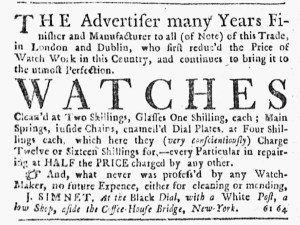
December 3

What was advertised in a colonial American newspaper 250 years ago today?

New-York Journal (December 3, 1772).

“Every Particular in repairing at HALF the PRICE charged by any other.”

In early December 1772, watchmaker John Simnet inserted a new advertisement in the New-York Journal.  Simnet had a long history of advertising, first in New Hampshire and then in New York.  He sometimes promoted the services he provided, but other times denigrated the skill and character of one competitor or another.  This time he opted to compare his prices and ancillary services to those offered by other watchmakers, but he did not launch any attacks against particular rivals.

Simnet incorporated superlatives into his advertisement.  He mentioned his origins, declaring that he had been “many Years [a] Finisher and Manufacturer to all (of Note) of this Trade, in London and Dublin.”  In other words, he previously worked in only the best workshops in those cities before migrating to the colonies.  Upon his arrival he became the “first [who] reduc’d the Price of Watch Work in this Country,” suggesting that others charged far too much for the mending and cleaning services they provided.  Simnet also proclaimed that he “continues to bring it to the utmost Perfection,” leaving it to readers to determine if “it” meant prices alone or the entire watchmaking trade.

To entice prospective clients to avail themselves of his services, Siment listed his prices.  He charged two shillings to clean watches and one to clean watch glasses.  He replaced “Main Springs, inside Chains, [and] enamell’d Dial Plates, at Four Shillings each,” compared to others in the colonies who “(very conscientiously) Charge Twelve or Sixteen Shillings.”  He accused the industry of purposely charging three or four times what the prices should have been for replacing certain parts.  As for other fixing other parts of watches, Simnet asserted that he asked “HALF the Price charged by any other.”

If those prices were not enough to get clients into his shop, the watchmaker offered ancillary services for free.  He promised “no future Expence, wither for cleaning or mending” for any watches purchased from him.  Deploying one more superlative, Simnet proclaimed that such a deal “never was profess’d by any Watch-Maker” in the colonies.  Simnet had a high opinion of himself and the work undertaken in his shop.  He hoped that his confidence would convince prospective clients to choose him over his competitors, though he also compared prices and provided supplementary services as part of his sales pitch.

May 21

What was advertised in a colonial American newspaper 250 years ago today?

Essex Gazette (May 21, 1771).

“All as cheap as they can be bought in Boston.”

From New Hampshire to Georgia, purveyors of consumer goods frequently made appeals to price in their newspaper advertisements.  They often made general statements, like Francis Grant did in an advertisement in the May 21, 1771, edition of the Essex Gazette.  He described his prices for a “good Assortment of English and West-India GOODS” as “cheap.”  Similarly, John Appleton declared that he sold his merchandise “on the most reasonable Terms.”  John Appleton made a stronger case for his prices, asserting that he sold imported foods “At the very lowest Rates.”  Even so, he deployed rather generic language.

Other advertisers, however, attempted to attract customers by making bolder and more specific promises about their prices.  William Vans advertised a “Beautiful Assortment of Paper Hangings” (or wallpaper) as well as a “great Variety of English, West-India and Grocery GOODS.”  He pledged that he set prices “as cheap as any Store in Town.”  Yet merchants and shopkeepers in Salem did not compete for customers only among themselves but also with their counterparts in nearby Boston.  That being the case, Jonathan Nutting sold “Painters Colours” and window glass “as cheap as they can be bought in Boston.”  Nathaniel Sparhawk stocked all sorts of merchandise, listing dozens of items in his advertisement.  Like Nutting, he proclaimed that he was “determined to sell as low as can be bought in Boston.”  George Deblois expressed a similar sentiment in an advertisement enumerating just as many goods.  He trumpeted that his prices were “as cheap … as can be bought in this town, or any other town in the province.”  Consumers did not need to look to Boston or anywhere else for better bargains than they could find in Salem.

Making an appeal to price became a standard part of newspaper advertisements for consumer goods in the eighteenth century.  Almost every advertisement in the May 21, 1771, edition of the Essex Gazette included some mention of low prices, suggesting that both advertisers and prospective customers expected such appeals incorporated into marketing efforts.  Yet many advertisers did not merely declare low prices by rote.  Instead, they devised more sophisticated appeals, such as comparing their prices to their competitors in town and beyond.  Those merchants and shopkeepers acknowledged that consumers looked for the best deals.  In turn, they promised their customers would find those deals at their shops, stores, and warehouses.