December 12

What was advertised in a revolutionary American newspaper 250 years ago today?
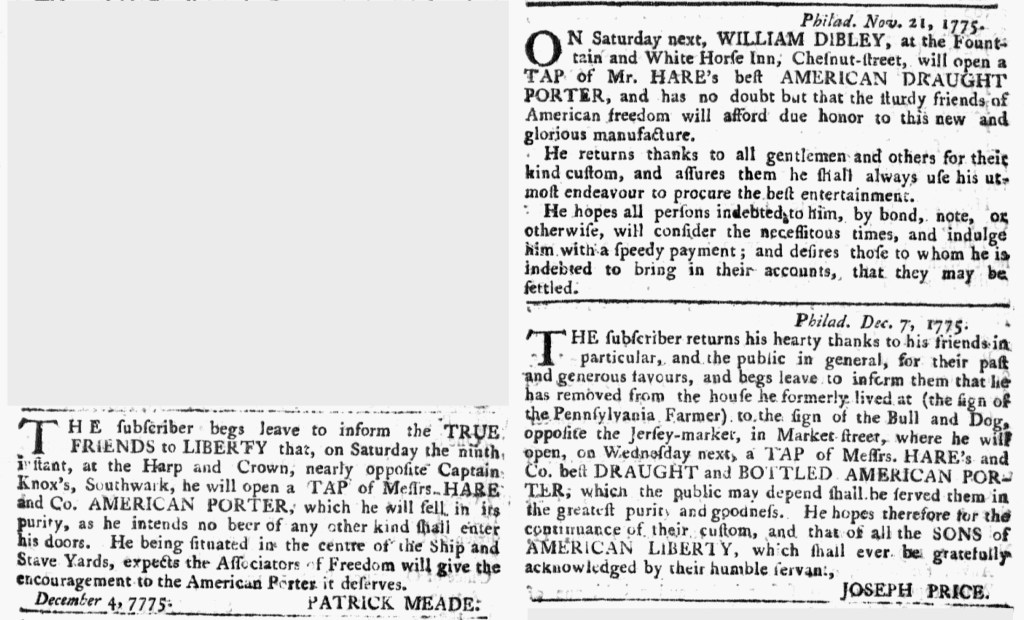
Pennsylvania Evening Post (December 12, 1775).

“HARE’s and Co. best DRAUGHT and BOTTLED AMERICAN PORTER.”

In December 1775, Philadelphia tavernkeeper Joseph Price ran an advertisement to express his gratitude to “his friends in particular, and the public in general,” while simultaneously alerting them that he had moved to a new location.  They could now find him at “the sign of the Bull and Dog” on Market Street rather than at “the sign of the Pennsylvania Farmer.”  To entice readers to visit his new location, he announced that “he will open … a TAP of Messrs. HARE’s and Co. best DRAUGHT and BOTTLED AMERICAN PORTER, which the public may depend shall be served them in the greatest purity and goodness.”

Price was not the only tavernkeeper promoting Hare and Company’s American porter, nor was he the only one associating that beer with support for the American cause.  He proclaimed that he “hopes … all the SONS of AMERICAN LIBERTY” would affirm their commitment by choosing Hare and Company’s American porter.  Price joined two other tavernkeepers who already promoted that brew.  All three of them placed advertisements in the December 12, 1775, edition of the Pennsylvania Evening Post.  William Dibley’s advertisement ran immediately above Price’s notice.  He confidently declared that he “has no doubt but that the sturdy friends of American freedom will afford due honor to this new and glorious manufacture.”  Immediately to the left of Price’s advertisement, Patrick Meade stated that he “expects the Associators of Freedom will give the encouragement to the American Porter it deserves.”  Readers who did not know much about Hare and Company’s American porter encountered endorsement after endorsement, encouraging them to take note of a beer that local tavernkeepers promoted over any others.  Tavernkeepers usually did not mention which brewers supplied their beer, making these advertisements even more noteworthy.  For their part, Hare and Company did not need to do any advertising of their own when they had such eager advocates for their American porter encouraging the public to demonstrate their political principles through the choices they made when they placed their orders at taverns in Philadelphia and nearby Southwark.
June 8

What was advertised in a colonial American newspaper 250 years ago today?

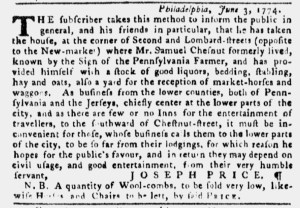
Pennsylvania Gazette (June 8, 1774).

“There are few or no Inns for the entertainment of travellers, to the southward of Chestnut-street.”

Location!  Location!!  Location!!!  That was the appeal that Joseph Price made when he advertised that he now operated the inn “known by the Sign of the Pennsylvania Farmer” at the corner of Second and Lombard Streets in Philadelphia.  In an advertisement in the June 8, 1774, edition of the Pennsylvania Gazette, he described the location as ideal for colonizers “from the lower counties, both of Pennsylvania and the Jerseys,” heading to market in the bustling city.  Price noted that the business conducted by those visitors “chiefly center[s] at the lower parts of the city,” yet “there are few or no Inns for the entertainment of travellers, to the southward of Chestnut-street.”  The innkeeper insisted that “it must be inconvenient for those, whose business calls them to the lower parts of the city, to be so far from their lodgings.”  Fortunately, they could choose to stay at the Sign of the Pennsylvania Farmer, putting them as close as possible to the market.

Price did not rely on location alone to convince visitors to Philadelphia to lodge there.  He also promoted other amenities that guests could expect, including “a stock of good liquors, bedding, stabling, [and] hay and oats.”  Guests would experience a comfortable stay, whether socializing over drinks or resting in their rooms, while the staff cared for their horses.  In addition to the stables, Price also had a “yard for the reception of market-horses and wagons.”  His guests did not need to go to the trouble of making separate arrangements for their reception at another establishment.  All in all, Price facilitated visits to the city, especially for farmers heading to market from towns to the south.  His marketing strategies anticipated those aimed at modern business travelers, emphasizing the proximity of his inn to the places they conducted business as well as accommodations, such as the yard for parking their wagons, provided specifically to meet their needs.  In addition, a trip to the city did not have to be all business without comforts.  Guests at the Sign of the Pennsylvania Farmer could indulge in the “good liquors” without having to venture elsewhere and then sleep well in the comfortable bedding.  For those who stayed at Price’s inn, a journey undertaken for business also had its pleasures.