November 8

What was advertised in a colonial American newspaper 250 years ago today?
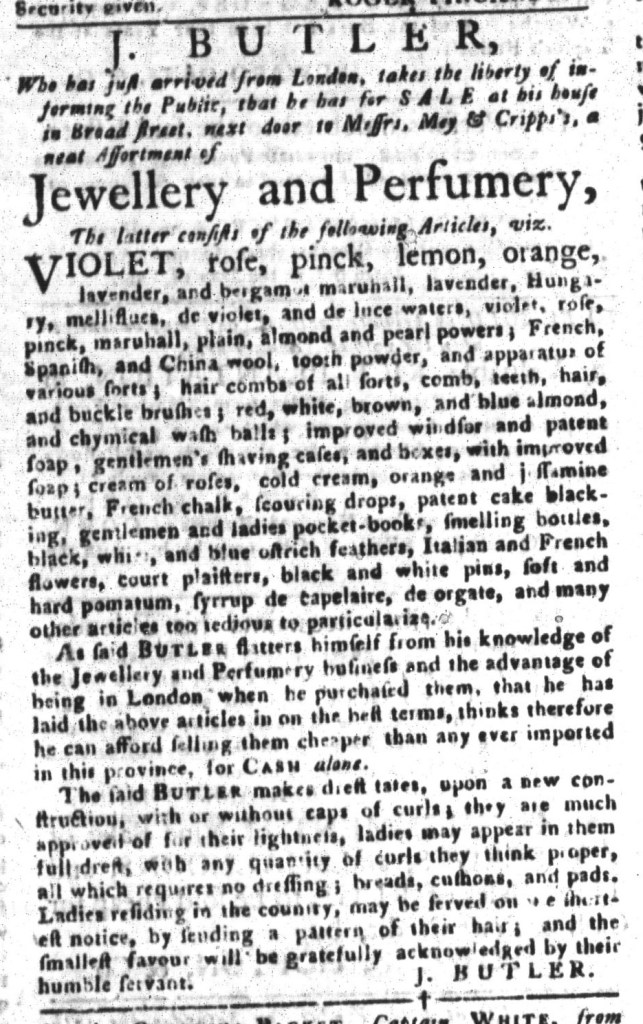
South-Carolina Gazette and Country Journal (November 8, 1774).

“He can afford selling them cheaper than any ever imported in this province.”

J. Butler’s advertisement in the November 8, 1774, edition of the South-Carolina Gazette and Country Journal proclaimed that he sold “Jewellery and Perfumery” at a shop he operated at his house on Broad Street in Charleston. Among the perfumery, he provided “VIOLET, rose, pinck, lemon, orange, lavender, and bergamot.” In addition, he listed a variety of personal hygiene products and cosmetics that he stocked, including “tooth powder, … hair combs of all sorts, … gentlemen’s shaving cases and boxes, with improved soap, … cold cream, [and] soft and hard pomatum.”  If that was not enough to attract consumers looking to pamper themselves, Butler also proclaimed that he carried “many other articles too tedious to particularize.”  Readers could cure their curiosity with a visit to Butler’s shop.

As further encouragement, he emphasized that he had “just arrived from London.”  Rather than accept merchandise shipped to him without first examining it himself, Butler had carefully examined and thoughtfully selected the wares he now advertised.  He considered that an “advantage,” especially in combination with “his knowledge of the Jewellery and Perfumery business,” that allowed him to acquire his inventory “on the best terms.”  In turn, he passed along the savings to his customers, asserting that “therefore he can afford selling [the above articles] cheaper than any ever imported in this province.”  According to Butler, he not only offered the best prices at that moment, but the best bargains for “Jewellery and Perfumery” ever seen in South Carolina thanks to savvy negotiations with suppliers when he was in London.

Butler was not alone in suggesting that his personal oversight in obtaining his wares accrued benefits to his customers.  Elsewhere in the same issue, Henry Calwell ran a short advertisement that announced he “just arrived from the Northward” and sold a “Large Quantity of Cheese, Chocolate, Potatoes, Onions,” and other groceries.  He added a note that “the Chocolate he warrants to be good, as he saw it made himself.”  Both Butler and Calwell sought to convince consumers that their personal connections to their merchandise should make those items more appealing.

June 11

What was advertised in a colonial American newspaper 250 years ago today?

New-Hampshire Gazette (June 11, 1773).

“They are determined to sell as low for Cash as can be bought in any Part of the Province.”

George Bell and Company sold a variety of goods at their shop in Newmarket.  In an advertisement in the June 11, 1773, edition of the New-Hampshire Gazette, Bell and Company promoted a “large and general Assortment of English, India and Scotch Goods” recently imported into the colony.  To entice prospective customers, they listed some of those items, including textiles (“Calicoes, Crapes, Taffity’s, Cambricks, and Lawns, flower’d and plain”), “a fine Assortment of Ribbons of the newest Patterns,” and a “fine Assortment of crockery and hard Ware.”  Bell and Company could have published an even more extensive catalog of their inventory, but they instead confided that they stocked “many other Articles, too tedious to mention” … but not too tedious for consumers to browse in their shop.

In addition to emphasizing such an array of choices, Bell and Company made an appeal to price, asserting that they “are determined to sell as low for Cash as can be bought in any Part of the Province.”  Located in Newmarket, a bit to the west of Portsmouth, they sought to assure prospective customers, especially those in the countryside, that they did not need to visit the colony’s primary port to get the best bargains.  Although Bell and Company may have assumed some additional expenses in transporting the imported goods to Newmarket compared to their competitors in Portsmouth, they aimed to convince consumers that they absorbed those costs rather than passing them along to their customers.  Their proclamation also served as an invitation to haggle over the prices to give Bell and Company opportunities to match the deals offered at shops in Portsmouth and elsewhere in the colony.  They did not explicitly state that they matched prices, but declaring that they “are determined to sell as low … as can be bought in any Part of Province” suggested that they would at least consider adjusting their prices if customers alerted them to better deals.

As was often the case in newspaper advertisements placed by colonial merchants and shopkeepers, appeals to low prices and consumer choice appeared in combination in Bell and Company’s advertisement.  They gave prospective customers multiple reasons to visit their shop as part of their shopping experience.

February 13

What was advertised in a colonial American newspaper 250 years ago today?

Providence Gazette (February 13, 1773).

“Gibbs makes plated Buckles in the newest Fashions, warranted tough and good.”

John Carter, printer of the Providence Gazette, limited the number of advertisements in the February 6, 1773, edition in order to make room for political news from Massachusetts.  A week later, the final page of his newspaper once again consisted entirely of advertising.  Other advertisements appeared on the first and third pages as well.  Collectively, paid notices accounted for nearly half the space in the February 13 edition.

Those advertisements included one from John Gibbs.  The notice ran for the first time, perhaps delayed by a week when Carter made the editorial decision to focus on the politics of the imperial crisis in the previous issue.  Whatever the particulars of the timing, Gibbs, wished to inform prospective customers that he opened a new shop “where he carries on the Goldsmith’s and Jeweller’s Business, in all their various Branches.”  In other words, he possessed the skill to undertake any sort of order he received.

In addition to promoting his abilities, Gibbs made other appeals commonly deployed by artisans in their newspaper advertisements.  He promised exemplary public service, stating that “Ladies and Gentlemen that please to favour him with their Custom, may depend on being served with Fidelity and Dispatch.”  He also promised low prices, declaring that he charged “as low Rates as any can work for in this Colony, or elsewhere.”  According to Gibbs, those were not just reasonable prices but the lowest prices that consumers would find in Rhode Island or anywhere else.  He also emphasized current trends and quality.  In a nota bene, he exclaimed that he “makes plated Buckles in the newest Fashions, warranted tough and good.”

Gibbs purchased a square of advertising, yet in that small amount of space in the Providence Gazette he incorporated multiple appeals intended to entice prospective customers to visit his shop and give him their business.  He demonstrated his familiarity with advertising culture by including so many appeals commonly used in notices published by goldsmiths, jewelers, and other artisans during the era of the American Revolution.  Given the prevalence of newspaper advertising in the second half of the eighteenth century, both Gibbs and readers recognized the standard elements of such advertisements.

May 1

What was advertised in a colonial American newspaper 250 years ago today?

Massachusetts Gazette and Boston Post-Boy (May 1, 1771).

“Lower Terms than can be at any Shop or Store in the Province.”

Although “Sadler and Jockey Cap-Maker” Richard Sharwin signed his entire name at the end of his advertisement in the April 29, 1771, edition of the Massachusetts Gazette and Boston Post-Boy, he deployed the mononym “SHARWIN” as a headline to draw attention.  The mononym suggested that consumers should already be familiar with his reputation, but he also declared that he was “From LONDON” to further underscore his importance for readers who were not familiar with his work.  Sharwin proclaimed that he made a variety of items, “the several Materials and Workmanship the best of their Kind.”  From “hunting Sadles with Hogskin seat” to “Pelm and Snaffle Bridles with Silver plated Bits” to “Velvet Jockey Caps,” the items he produced in his shop were “as Neat as can be Imported.”  Sharwin assured prospective customers that when they shopped locally, they still acquired goods of the same quality as those that arrived from London.

Sharwin also tended to price in his advertisement, pledging that he sold his wares “upon lower Terms than can be at any Shop or Store in the Province.”  Advertisers commonly asserted their low prices, but not nearly as often did they encourage consumers to compare their prices to those of their competitors.  Sharwin not only did so but also listed prices for welted saddles (“from 8 to 10 Dollars”) and plain saddles (“from 6 to 8 Dollars”), allowing readers to do some comparison shopping without even visiting his shop on King Street.  They could judge for themselves whether he offered bargains.  Merchants, shopkeepers, and artisans provided prices in their advertisements only occasionally, making Sharwin’s invitation to compare prices all the more notable.  Prospective customers could use the prices for welted saddles and plain saddles as a barometer for how much he charged for the dozens of other items listed in his advertisement since Sharwin set prices for “every Article in proportion.”

All in all, Sharwin incorporated several standard elements of eighteenth-century advertising into his own advertisement while also experimenting with less common marketing strategies.  Like many other advertisers, he emphasized consumer choice by listing an assortment of goods, touted his connections to London, and underscored quality and price.  He enhanced his advertisement with a mononym for a headline, stating the prices for some items, and trumpeting that his competitors could not beat those prices.  Sharwin crafted an advertisement that was not merely a rote recitation of the usual appeals made to consumers.

December 14

What was advertised in a colonial American newspaper 250 years ago today?

New-Hampshire Gazette (December 14, 1770).

“Mrs. Winter, makes and sells, silk Purses.”

William Winter offered his services as a notary in an advertisement in the December 14, 1770, edition of the New-Hampshire Gazette.  He declared that he drew up various kinds of legal documents “with Fidelity and Dispatch” and “at a reasonable price.”  In addition, he was “also a Public AUCTIONEER.”  Although William’s name appeared as the headline for the advertisement, in a font larger than any on that page, he was not the only member of the Winter household who contributed to the family’s income.  The advertisement included a nota bene that outlined Mrs. Winter’s entrepreneurial activities.

William asked readers of the New-Hampshire Gazette to take note that “Mrs. Winter, makes and sells, silk Purses, Ladies silk, worsted, and thread Mitts.”  In addition, she also made “silk and thread Cauls for Wigs, as neat and good as any made in England.”  Furthermore, she sold them “cheaper for the Cash, than they can be bought in the Government.”  Did Mrs. Winter compose that portion of the advertisement?  Did William?  Did they collaborate on it?  Whoever was responsible for the content incorporated marketing strategies that did more than merely announce that Mrs. Winter made and sold purses, mitts, and linings for wigs.

Appeals to quality were common in eighteenth-century advertisements for goods and services.  In the era of the American Revolution, producers of goods made in the colonies and retailers who sold them increasingly compared the quality of those goods to imported alternatives.  In the wake of nonimportation agreements adopted in response to the Stamp Act and the Townshend Acts, comparing the quality of “domestic manufactures,” good made in the colonies, to imported items had a political valence.  Such appeals underscored to consumers that their choices in the marketplace had consequences in the dispute with Parliament.

Appeals to price were also common in advertisements of the period.  The Winters did not make generic statements about Mrs. Winter’s prices.  As they had done with the appeal to quality, they also embellished this appeal by proclaiming that she charged the lowest prices that could be found “in the Government” or in the entire colony.  In the same issue of the New-Hampshire Gazette, James Haslett and Matthew Haslett, leather dressers who made and sold breeches and gloves, asserted that they set prices as low “as any in New England.”  Most advertisers usually were not so bold when comparing their prices to their competitors.  In these instances, the Winters and the Hasletts made significant claims about their prices in order to distinguish their goods from others.

Mrs. Winter’s portion of the advertisement did not benefit from the same prominence on the page as the segment in which William offered his services as notary and auctioneer.  It did not, however, lack substance.  The Winters devised a sophisticated advertisement that did more than rely on common marketing strategies.  When it came to both quality and price, they enhanced the standard appeals that appeared in other advertisements.