Happy Birthday, Benjamin Franklin!

Today is an important day for specialists in early American print culture, for Benjamin Franklin was born on January 17, 1706 (January 6, 1705, Old Style), in Boston. Among his many other accomplishments, Franklin is known as the “Father of American Advertising.” Although I have argued elsewhere that this title should more accurately be bestowed upon Mathew Carey (in my view more prolific and innovative in the realm of advertising as a printer, publisher, and advocate of marketing), I recognize that Franklin deserves credit as well. Franklin is often known as “The First American,” so it not surprising that others should rank him first among the founders of advertising in America.
benjamin-franklin
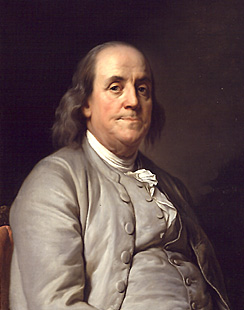
Benjamin Franklin (Joseph Siffred Duplessis, ca. 1785).  National Portrait Gallery.

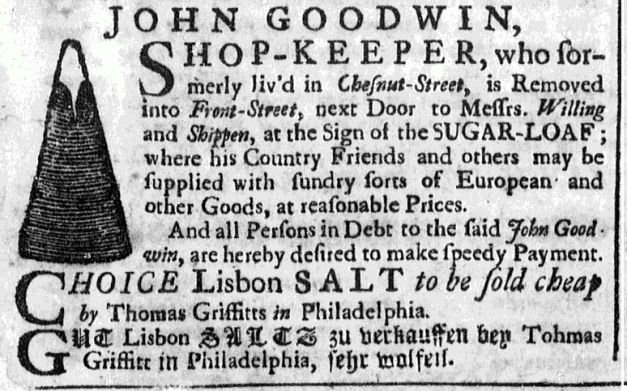
Franklin purchased the Pennsylvania Gazette in 1729. In the wake of becoming printer, he experimented with the visual layout of advertisements that appeared in the weekly newspaper, incorporating significantly more white space and varying font sizes in order to better attract readers’ and potential customers’ attention. Advertising flourished in the Pennsylvania Gazette, which expanded from two to four pages in part to accommodate the greater number of commercial notices.
jan-17-pennsylvania-gazette-19-161736
Advertisements with white space, varying sizes of font, capitals and italics, and a woodcut from Benjamin Franklin’s Pennsylvania Gazette (December 9-16, 1736).

Many historians of the press and print culture in early America have noted that Franklin became wealthy and retired as a printer in favor of a multitude of other pursuits in part because of the revenue he collected from advertising. Others, especially David Waldstreicher, have underscored that this wealth was amassed through participation in the colonial slave trade. The advertisements for goods and services featured in the Pennsylvania Gazette included announcements about buying and selling enslaved men, women, and children as well as notices offering rewards for those who escaped from bondage.

jan-17-pennsylvania-gazette-slave-19-161736
Advertisement for an enslaved woman and an enslaved child from Benjamin Franklin’s Pennsylvania Gazette (December 9-16, 1736).

In 1741 Franklin published one of colonial America’s first magazines, The General Magazine and Historical Chronicle, for all the British Plantations in America (which barely missed out on being the first American magazine, a distinction earned by Franklin’s competitor, Andrew Bradford, with The American Magazine or Monthly View of the Political State of the British Colonies). The magazine lasted only a handful of issues, but that was sufficient for Franklin to become the first American printer to include an advertisement in a magazine (though advertising did not become a standard part of magazine publication until special advertising wrappers were developed later in the century — and Mathew Carey was unarguably the master of that medium).
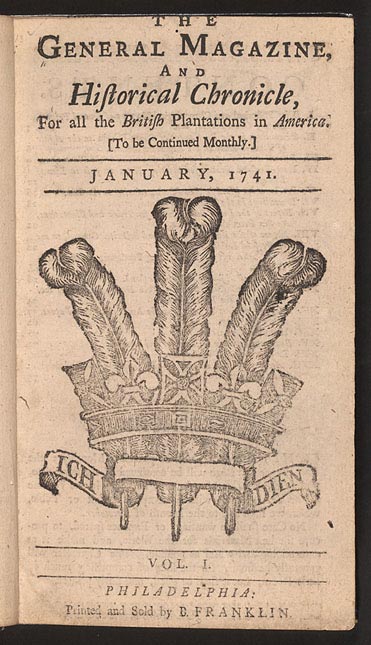
general-magazine
General Magazine and Historical Chronicle, For all the British Plantations in America (January 1741).  Library of Congress.

In 1744 Franklin published an octavo-sized Catalogue of Choice and Valuable Books, including 445 entries. This is the first known American book catalogue aimed at consumers (though the Library Company of Philadelphia previously published catalogs listing their holdings in 1733, 1735, and 1741). Later that same year, Franklin printed a Catalogue of Books to Be Sold at Auction.

Franklin pursued advertising through many media in eighteenth-century America, earning recognition as one of the founders of American advertising. Happy 319th birthday, Benjamin Franklin!

Happy Birthday, Benjamin Franklin!

Today is an important day for specialists in early American print culture, for Benjamin Franklin was born on January 17, 1706 (January 6, 1705, Old Style), in Boston. Among his many other accomplishments, Franklin is known as the “Father of American Advertising.” Although I have argued elsewhere that this title should more accurately be bestowed upon Mathew Carey (in my view more prolific and innovative in the realm of advertising as a printer, publisher, and advocate of marketing), I recognize that Franklin deserves credit as well. Franklin is often known as “The First American,” so it not surprising that others should rank him first among the founders of advertising in America.

benjamin-franklin
Benjamin Franklin (Joseph Siffred Duplessis, ca. 1785).  National Portrait Gallery.

Franklin purchased the Pennsylvania Gazette in 1729. In the wake of becoming printer, he experimented with the visual layout of advertisements that appeared in the weekly newspaper, incorporating significantly more white space and varying font sizes in order to better attract readers’ and potential customers’ attention. Advertising flourished in the Pennsylvania Gazette, which expanded from two to four pages in part to accommodate the greater number of commercial notices.

jan-17-pennsylvania-gazette-19-161736
Advertisements with white space, varying sizes of font, capitals and italics, and a woodcut from Benjamin Franklin’s Pennsylvania Gazette (December 9-16, 1736).

Many historians of the press and print culture in early America have noted that Franklin became wealthy and retired as a printer in favor of a multitude of other pursuits in part because of the revenue he collected from advertising. Others, especially David Waldstreicher, have underscored that this wealth was amassed through participation in the colonial slave trade. The advertisements for goods and services featured in the Pennsylvania Gazette included announcements about buying and selling enslaved men, women, and children as well as notices offering rewards for those who escaped from bondage.

jan-17-pennsylvania-gazette-slave-19-161736
Advertisement for an enslaved woman and an enslaved child from Benjamin Franklin’s Pennsylvania Gazette (December 9-16, 1736).

In 1741 Franklin published one of colonial America’s first magazines, The General Magazine and Historical Chronicle, for all the British Plantations in America (which barely missed out on being the first American magazine, a distinction earned by Franklin’s competitor, Andrew Bradford, with The American Magazine or Monthly View of the Political State of the British Colonies). The magazine lasted only a handful of issues, but that was sufficient for Franklin to become the first American printer to include an advertisement in a magazine (though advertising did not become a standard part of magazine publication until special advertising wrappers were developed later in the century — and Mathew Carey was unarguably the master of that medium).

general-magazine
General Magazine and Historical Chronicle, For all the British Plantations in America (January 1741).  Library of Congress.

In 1744 Franklin published an octavo-sized Catalogue of Choice and Valuable Books, including 445 entries. This is the first known American book catalogue aimed at consumers (though the Library Company of Philadelphia previously published catalogs listing their holdings in 1733, 1735, and 1741). Later that same year, Franklin printed a Catalogue of Books to Be Sold at Auction.

Franklin pursued advertising through many media in eighteenth-century America, earning recognition as one of the founders of American advertising. Happy 318th birthday, Benjamin Franklin!

Happy Birthday, Benjamin Franklin!

Today is an important day for specialists in early American print culture, for Benjamin Franklin was born on January 17, 1706 (January 6, 1705, Old Style), in Boston. Among his many other accomplishments, Franklin is known as the “Father of American Advertising.” Although I have argued elsewhere that this title should more accurately be bestowed upon Mathew Carey (in my view more prolific and innovative in the realm of advertising as a printer, publisher, and advocate of marketing), I recognize that Franklin deserves credit as well. Franklin is often known as “The First American,” so it not surprising that others should rank him first among the founders of advertising in America.

benjamin-franklin
Benjamin Franklin (Joseph Siffred Duplessis, ca. 1785).  National Portrait Gallery.

Franklin purchased the Pennsylvania Gazette in 1729. In the wake of becoming printer, he experimented with the visual layout of advertisements that appeared in the weekly newspaper, incorporating significantly more white space and varying font sizes in order to better attract readers’ and potential customers’ attention. Advertising flourished in the Pennsylvania Gazette, which expanded from two to four pages in part to accommodate the greater number of commercial notices.

jan-17-pennsylvania-gazette-19-161736
Advertisements with white space, varying sizes of font, capitals and italics, and a woodcut from Benjamin Franklin’s Pennsylvania Gazette (December 9-16, 1736).

Many historians of the press and print culture in early America have noted that Franklin became wealthy and retired as a printer in favor of a multitude of other pursuits in part because of the revenue he collected from advertising. Others, especially David Waldstreicher, have underscored that this wealth was amassed through participation in the colonial slave trade. The advertisements for goods and services featured in the Pennsylvania Gazette included announcements about buying and selling enslaved men, women, and children as well as notices offering rewards for those who escaped from bondage.

jan-17-pennsylvania-gazette-slave-19-161736
Advertisement for an enslaved woman and an enslaved child from Benjamin Franklin’s Pennsylvania Gazette (December 9-16, 1736).

In 1741 Franklin published one of colonial America’s first magazines, The General Magazine and Historical Chronicle, for all the British Plantations in America (which barely missed out on being the first American magazine, a distinction earned by Franklin’s competitor, Andrew Bradford, with The American Magazine or Monthly View of the Political State of the British Colonies). The magazine lasted only a handful of issues, but that was sufficient for Franklin to become the first American printer to include an advertisement in a magazine (though advertising did not become a standard part of magazine publication until special advertising wrappers were developed later in the century — and Mathew Carey was unarguably the master of that medium).

general-magazine
General Magazine and Historical Chronicle, For all the British Plantations in America (January 1741).  Library of Congress.

In 1744 Franklin published an octavo-sized Catalogue of Choice and Valuable Books, including 445 entries. This is the first known American book catalogue aimed at consumers (though the Library Company of Philadelphia previously published catalogs listing their holdings in 1733, 1735, and 1741). Later that same year, Franklin printed a Catalogue of Books to Be Sold at Auction.

Franklin pursued advertising through many media in eighteenth-century America, earning recognition as one of the founders of American advertising. Happy 317th birthday, Benjamin Franklin!

January 29

What was advertised in a colonial American newspaper 250 years ago this week?

New-York Gazette and Weekly Mercury (January 27, 1772).

“The Magazines from January, 1771, to October, inclusive,” Rivington stated, “are likewise come to Hand.”

James Rivington and other American booksellers sold some books printed in the colonies, but imported most of their inventory.  In January 1772, Rivington ran an advertisement in the New-York Gazette and Weekly Mercury to advise prospective that he had recently imported “Lilly’s Modern Entries, a new and correct Edition; Hawkins’s Pleas of the Crown, a new and improved Edition; Wood’s Conveyancer, a new Edition; … [and] a great Variety of other Books in Law, Physick, Divinity, Mathematicks.”  Rivington noted that “the Particulars will be given in a few Days,” signaling to readers that he intended to insert a lengthier advertisement that listed even more titles or perhaps even distribute a book catalog printed separately.

A manicule drew attention to a final note.  “The Magazines from January, 1771, to October, inclusive,” Rivington stated, “are likewise come to Hand.”  American printers published even fewer magazines than books prior to the American Revolution.  They attempted less than fifteen titles before 1775.  Most of those magazines folded in a year or less, though a couple did run for two or three years.  Some printers distributed subscription notices to incite interest, but ultimately had difficulty attracting sufficient subscribers (or advertisers) to make publishing their magazines viable ventures.

When American readers perused magazines prior to declaring independence, they read imported publications printed in London.  Given the time necessary to transport those magazines across the Atlantic, that meant that colonizers read magazines several months after they were published.  That being the case, Rivington’s advertisement for magazines published a year earlier in January 1771 did not offer outdated material.  In fact, the October editions were about as current as any magazines that American consumers purchased.  In addition, Rivington also understood what some customers did with magazines when they acquired them.  Magazines were not just for reading; they were also for display. Some readers collected a “volume” of magazines, usually editions spanning six months or a year, and had them bound together to resemble books.  Advertising magazines “from January, 1771, to October, inclusive,” let customers interested in collecting and displaying a complete run of a magazine that Rivington could supply them with all the issues they needed.  While it may seem strange to modern readers that Rivington advertised magazines published a year earlier, doing so made good sense in 1772 because it resonated with how consumers read and otherwise engaged with those monthly publications.

Happy Birthday, Benjamin Franklin!

Today is an important day for specialists in early American print culture, for Benjamin Franklin was born on January 17, 1706 (January 6, 1705, Old Style), in Boston. Among his many other accomplishments, Franklin is known as the “Father of American Advertising.” Although I have argued elsewhere that this title should more accurately be bestowed upon Mathew Carey (in my view more prolific and innovative in the realm of advertising as a printer, publisher, and advocate of marketing), I recognize that Franklin deserves credit as well. Franklin is often known as “The First American,” so it not surprising that others should rank him first among the founders of advertising in America.

benjamin-franklin
Benjamin Franklin (Joseph Siffred Duplessis, ca. 1785).  National Portrait Gallery.

Franklin purchased the Pennsylvania Gazette in 1729. In the wake of becoming printer, he experimented with the visual layout of advertisements that appeared in the weekly newspaper, incorporating significantly more white space and varying font sizes in order to better attract readers’ and potential customers’ attention. Advertising flourished in the Pennsylvania Gazette, which expanded from two to four pages in part to accommodate the greater number of commercial notices.

jan-17-pennsylvania-gazette-19-161736
Advertisements with white space, varying sizes of font, capitals and italics, and a woodcut from Benjamin Franklin’s Pennsylvania Gazette (December 9-16, 1736).

Many historians of the press and print culture in early America have noted that Franklin became wealthy and retired as a printer in favor of a multitude of other pursuits in part because of the revenue he collected from advertising. Others, especially David Waldstreicher, have underscored that this wealth was amassed through participation in the colonial slave trade. The advertisements for goods and services featured in the Pennsylvania Gazette included announcements about buying and selling enslaved men, women, and children as well as notices offering rewards for those who escaped from bondage.

jan-17-pennsylvania-gazette-slave-19-161736
Advertisement for an enslaved woman and an enslaved child from Benjamin Franklin’s Pennsylvania Gazette (December 9-16, 1736).

In 1741 Franklin published one of colonial America’s first magazines, The General Magazine and Historical Chronicle, for all the British Plantations in America (which barely missed out on being the first American magazine, a distinction earned by Franklin’s competitor, Andrew Bradford, with The American Magazine or Monthly View of the Political State of the British Colonies). The magazine lasted only a handful of issues, but that was sufficient for Franklin to become the first American printer to include an advertisement in a magazine (though advertising did not become a standard part of magazine publication until special advertising wrappers were developed later in the century — and Mathew Carey was unarguably the master of that medium).

general-magazine
General Magazine and Historical Chronicle, For all the British Plantations in America (January 1741).  Library of Congress.

In 1744 Franklin published an octavo-sized Catalogue of Choice and Valuable Books, including 445 entries. This is the first known American book catalogue aimed at consumers (though the Library Company of Philadelphia previously published catalogs listing their holdings in 1733, 1735, and 1741). Later that same year, Franklin printed a Catalogue of Books to Be Sold at Auction.

Franklin pursued advertising through many media in eighteenth-century America, earning recognition as one of the founders of American advertising. Happy 316th birthday, Benjamin Franklin!

November 25

What was advertised in a colonial American newspaper 250 years ago today?

Massachusetts Gazette and Boston Post-Boy (November 25, 1771).

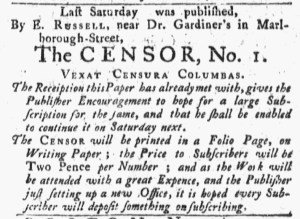
“Last Saturday was published … The CENSOR, No. 1.”

Ezekiel Russell distributed the first issue of The Censor on November 23, 1771.  Two days later, he promoted his new publication in an advertisement in the Massachusetts Gazette and Boston Post-Boy.  Russell announced that he published the inaugural issue “Last Saturday” and invited prospective subscribers to reserve their copies.  “The Receiption this Paper has already met with,” he confided, “gives the Publisher Encouragement to hope for a large Subscription for the same, and that he shall be enabled to continue it on Saturday next.”

Russell apparently had some doubts about whether The Censor would achieve a second issue.  It did, but publication lasted less than six months.  Russell distributed the last known issue on May 2, 1772.  In his monumental History and Bibliography of American Newspapers, 1690-1820, Clarence Brigham describes The Censor as “a political magazine rather than a newspaper, somewhat in the style of the ‘Tatler’ or ‘Spectator.’”  Frank Luther Mott indicates that it was one of only three American magazines founded between 1760 and 1774, but otherwise gives The Censor little attention beyond including it in a chronological list of magazines in an appendix.  “The political state of the Colonies was unfavorable to literature,” Mott intones.[1]  Brigham present a more sanguine view of The Censor, especially “its occasional ‘Postscripts’ [which] bore every appearance of being newspapers and contained certain local news and a large number of advertisements.”[2]

If such a Postscript accompanied the first issue, it has not survived.  Unlike printers who launched newspapers during the period, including Richard Draper and the Pennsylvania Packet in the fall of 1771, Russell did not seek advertisers in his notice.  Instead, he focused on attracting subscribers, expressing his desire that “every Subscriber will deposit something on subscribing” in order to defray the “great Expence” associated with the publication and “setting up a new Office.”  As Brigham notes, advertising supplements accompanied certain subsequent issues.  In the coming months, the Adverts 250 Project will examine some of those Postscripts to the Censor.

**********

[1] Frank Luther Mott, A History of American Magazines, 1741-1850 (Cambridge, Massachusetts: Harvard University Press, 1939), 26, 788.

[2] Clarence S. Brigham, History and Bibliography of American Newspapers, 1690-1820 (Worcester: Massachusetts: American Antiquarian Society, 1947), 275.

Happy Birthday, Benjamin Franklin!

Today is an important day for specialists in early American print culture, for Benjamin Franklin was born on January 17, 1706 (January 6, 1705, Old Style), in Boston. Among his many other accomplishments, Franklin is known as the “Father of American Advertising.” Although I have argued elsewhere that this title should more accurately be bestowed upon Mathew Carey (in my view more prolific and innovative in the realm of advertising as a printer, publisher, and advocate of marketing), I recognize that Franklin deserves credit as well. Franklin is often known as “The First American,” so it not surprising that others should rank him first among the founders of advertising in America.

benjamin-franklin
Benjamin Franklin (Joseph Siffred Duplessis, ca. 1785).  National Portrait Gallery.

Franklin purchased the Pennsylvania Gazette in 1729. In the wake of becoming printer, he experimented with the visual layout of advertisements that appeared in the weekly newspaper, incorporating significantly more white space and varying font sizes in order to better attract readers’ and potential customers’ attention. Advertising flourished in the Pennsylvania Gazette, which expanded from two to four pages in part to accommodate the greater number of commercial notices.

jan-17-pennsylvania-gazette-19-161736
Advertisements with white space, varying sizes of font, capitals and italics, and a woodcut from Benjamin Franklin’s Pennsylvania Gazette (December 9-16, 1736).

Many historians of the press and print culture in early America have noted that Franklin became wealthy and retired as a printer in favor of a multitude of other pursuits in part because of the revenue he collected from advertising. Others, especially David Waldstreicher, have underscored that this wealth was amassed through participation in the colonial slave trade. The advertisements for goods and services featured in the Pennsylvania Gazette included announcements about buying and selling enslaved men, women, and children as well as notices offering rewards for those who escaped from bondage.

jan-17-pennsylvania-gazette-slave-19-161736
Advertisement for an enslaved woman and an enslaved child from Benjamin Franklin’s Pennsylvania Gazette (December 9-16, 1736).

In 1741 Franklin published one of colonial America’s first magazines, The General Magazine and Historical Chronicle, for all the British Plantations in America (which barely missed out on being the first American magazine, a distinction earned by Franklin’s competitor, Andrew Bradford, with The American Magazine or Monthly View of the Political State of the British Colonies). The magazine lasted only a handful of issues, but that was sufficient for Franklin to become the first American printer to include an advertisement in a magazine (though advertising did not become a standard part of magazine publication until special advertising wrappers were developed later in the century — and Mathew Carey was unarguably the master of that medium).

general-magazine
General Magazine and Historical Chronicle, For all the British Plantations in America (January 1741).  Library of Congress.

In 1744 Franklin published an octavo-sized Catalogue of Choice and Valuable Books, including 445 entries. This is the first known American book catalogue aimed at consumers (though the Library Company of Philadelphia previously published catalogs listing their holdings in 1733, 1735, and 1741). Later that same year, Franklin printed a Catalogue of Books to Be Sold at Auction.

Franklin pursued advertising through many media in eighteenth-century America, earning recognition as one of the founders of American advertising. Happy 315th birthday, Benjamin Franklin!

July 18

What was advertised in a colonial American newspaper 250 years ago today?

Jul 18 - 7:18:1770 South-Carolina and American General Gazette
South-Carolina and American General Gazette (July 18, 1770).

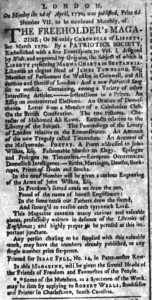
“Valuable pieces, professedly written in defence of the Liberties of Englishmen.”

An advertisement for the March edition of “THE FREEHOLDER’s MAGAZINE; Or Monthly CHONRICLE of LIBERTY,” published in London, appeared in the July 18, 1770, edition of the South-Carolina and American General Gazette.  Who placed the advertisement was not clear.  The advertisement attributed the magazine to “a PATRIOTICK SOCIETY” and declared that it was “Printed for ISAAC FELL, No. 14, in Pater-noster Row.”  Fell may have arranged with Robert Wells, the printer of the South-Carolina and American General Gazette, to insert the advertisement or Wells may have independently done so.  The advertisement concluded with a note that “Some of the Numbers, as a Specimen of the Work, may be seen by applying to ROBERT WELLS, Bookseller and Printer in Charlestown, South-Carolina.”  Wells may have acquired copies of the Freeholder’s Magazine and reprinted an advertisement from a London newspaper as part of his effort to make sales in his local market.

Either way, a publisher in London or a bookseller in Charleston believed that they could incite demand for the Freeholder’s Magazine in South Carolina given current events and public discourse.  After all, the “Magazine contains many curious and valuable pieces, professedly written in defence of the Liberties of Englishmen; and highly proper to be perused at this important juncture.”  The March issue included a frontispiece depicting “LIBERTY presenting MAGNA CHARTA to BRITANNIA.”  The advertisement stated that the April edition would feature “a curious Engraving of the Arms of John Wilkes,” a noted defender of the liberties of Englishmen who resided on both sides of the Atlantic, continuing the theme of the publication via images as well as print.  (The May edition included an engraving of “The Massacre perpetrated in King Street, Boston” pirated from Paul Revere’s print.)  Fell or Wells or both likely believed that the tone of the magazine would resonate with readers in South Carolina.  Most who lamented the abuses of Parliament and condemned the Boston Massacre had not settled on demanding independence.  Instead, they valued being part of the British Empire and expected that they would enjoy “the Liberties of Englishmen” in the colonies.  By selling the Freeholder’s Magazine, Wells contributed to the print and visual culture that shaped debates about the position of the colonies in the British Empire.  In turn, consumers who read and viewed the contents of the Freeholder’s Magazinebecame better informed and better able to participate in the discourse of liberty as it evolved during the imperial crisis that led to the American Revolution.

Happy Birthday, Benjamin Franklin!

Today is an important day for specialists in early American print culture, for Benjamin Franklin was born on January 17, 1706 (January 6, 1705, Old Style), in Boston. Among his many other accomplishments, Franklin is known as the “Father of American Advertising.” Although I have argued elsewhere that this title should more accurately be bestowed upon Mathew Carey (in my view more prolific and innovative in the realm of advertising as a printer, publisher, and advocate of marketing), I recognize that Franklin deserves credit as well. Franklin is often known as “The First American,” so it not surprising that others should rank him first among the founders of advertising in America.

benjamin-franklin
Benjamin Franklin (Joseph Siffred Duplessis, ca. 1785).  National Portrait Gallery.

Franklin purchased the Pennsylvania Gazette in 1729. In the wake of becoming printer, he experimented with the visual layout of advertisements that appeared in the weekly newspaper, incorporating significantly more white space and varying font sizes in order to better attract readers’ and potential customers’ attention. Advertising flourished in the Pennsylvania Gazette, which expanded from two to four pages in part to accommodate the greater number of commercial notices.

jan-17-pennsylvania-gazette-19-161736
Advertisements with white space, varying sizes of font, capitals and italics, and a woodcut from Benjamin Franklin’s Pennsylvania Gazette (December 9-16, 1736).

Many historians of the press and print culture in early America have noted that Franklin became wealthy and retired as a printer in favor of a multitude of other pursuits in part because of the revenue he collected from advertising. Others, especially David Waldstreicher, have underscored that this wealth was amassed through participation in the colonial slave trade. The advertisements for goods and services featured in the Pennsylvania Gazette included announcements about buying and selling enslaved men, women, and children as well as notices offering rewards for those who escaped from bondage.

jan-17-pennsylvania-gazette-slave-19-161736
Advertisement for an enslaved woman and an enslaved child from Benjamin Franklin’s Pennsylvania Gazette (December 9-16, 1736).

In 1741 Franklin published one of colonial America’s first magazines, The General Magazine and Historical Chronicle, for all the British Plantations in America (which barely missed out on being the first American magazine, a distinction earned by Franklin’s competitor, Andrew Bradford, with The American Magazine or Monthly View of the Political State of the British Colonies). The magazine lasted only a handful of issues, but that was sufficient for Franklin to become the first American printer to include an advertisement in a magazine (though advertising did not become a standard part of magazine publication until special advertising wrappers were developed later in the century — and Mathew Carey was unarguably the master of that medium).

general-magazine
General Magazine and Historical Chronicle, For all the British Plantations in America (January 1741).  Library of Congress.

In 1744 Franklin published an octavo-sized Catalogue of Choice and Valuable Books, including 445 entries. This is the first known American book catalogue aimed at consumers (though the Library Company of Philadelphia previously published catalogs listing their holdings in 1733, 1735, and 1741). Later that same year, Franklin printed a Catalogue of Books to Be Sold at Auction.

Franklin pursued advertising through many media in eighteenth-century America, earning recognition as one of the founders of American advertising. Happy 314th birthday, Benjamin Franklin!

December 10

What was advertised in a colonial American newspaper 250 years ago this weel?

Dec 10 - 12:7:1769 South-Carolina Gazette
South-Carolina Gazette (December 7, 1769).

“LONDON MAGAZINE.”

Nicholas Langford, “Bookseller, on the Bay,” inserted an advertisement for the London Magazine in the December 7, 1769, edition of the South-Carolina Gazette. At a time when many colonists participated in nonimportation agreements to protest taxes that Parliament imposed on imported paper, glass, lead, paint, and tea, most continued to seek redress of grievances rather than political separation from the most powerful empire in the world. Even as they came to think of themselves as Americans with unique concerns within that empire, most still embraced their British identity, not just politically but also culturally. Langford had a reasonable expectation that he would find subscribers for the London Magazine on the eve of the 1770s.

Commencing publication in 1731, the London Magazine had a long history and a notable reputation. According to Langford, the “present Proprietors … are resolved to spare no Cost to continue its Pre-eminence” by “collecting from their extensive Correspondence, such Pieces of Literary Knowledge and Amusement, as may best deserve the Public’s Notice.” They also composed original pieces, “each taking upon him that Department which best suits his Genius.” This sort of cultural production did not have a counterpart or competitor in the colonies. Lewis Nicola had recently tried to launch the American General Magazine, placing subscription notices in several newspapers throughout the colonies, but the magazine quickly folded. Like most other American magazine published before the Revolution, it lasted less than a year. The first issue appeared in January 1769 and the last in September. Nicola modeled the magazine after successful publications produced on the other side of the Atlantic, but did not manage to cultivate a roster of subscribers extensive enough to make the American General Magazine a viable venture. Consumers with the resources to afford magazines and the leisure time to read them had well-established alternatives, including the London Magazine with its “Copper-Plate Embellishments.” Langford also offered The Critical Review “for any Gentleman who may be desirous of having it with the Magazine.”

As colonists expressed their disdain for Parliament and its various abuses, many also continued to embrace their British identity. The politics of the period did not prevent them from marketing or consuming cultural productions that emanated from the center of the empire. For some, staying informed by reading the London Magazine did not seem incongruous with participating in acts of political resistance that included boycotting a vast array of consumer goods imported from Britain.