February 5

GUEST CURATOR:  Maia Campbell

What was advertised in a colonial newspaper 250 years ago this week?
Feb 5 - 2:3:1766 New-York Gazette
New-York Gazette (February 3, 1766).

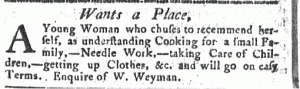
Wants a Place, a Young Woman who chuses to recemmend herself, as understanding Cooking for a small family.”

This advertisement does not sell a good, per se, but a young woman is “selling” her services. I found it interesting that this sort of advertisement would be included in a colonial newspaper. To me, it is an example of a woman having a level of freedom in the colonial area. This woman was able to put herself out there to do work for others. Now, she is still doing work associated with women and the household during the colonial period, but she now has the freedom to choose who she wants to employ her. Also, she has already chosen what work she will do for whoever hires her. She has, in a sense, laid out a contract for herself.

I do not usually associate the colonial period with women having the freedom to choose any sort of work that they will do, which is why I found this advertisement to be interesting.

**********

ADDITIONAL COMMENTARY:  Carl Robert Keyes

Several scholars have demonstrated that advertisements help us to glimpse women’s work and the role of women in the marketplace in colonial America. I first began examining advertising in early America after reading Frances Manges’ “Women Shopkeepers, Tavernkeepers, and Artisans in Colonial Philadelphia” (a Ph.D. dissertation completed at the University of Philadelphia in 1958). Manges scoured newspapers published in colonial Philadelphia to find evidence of women pursuing a variety of occupations, culling a significant amount of her evidence from advertisements for goods and services. (Other sorts of advertisements, including legal notices and announcements by executors, also fleshed out women’s visible participation in commerce in colonial Philadelphia.)

Manges focused primarily on women identified by name in their advertisements and other parts of the newspaper. This anonymous “Young Woman,” however, certainly would not have been alone among the many job seekers, female and male, throughout the colonial period who placed advertisements seeking employment, listing their skills and qualifications, and giving directions for how to contact them.

Like so many other advertisements, this one hints at a story that will likely never be fully recovered. Compiling similar advertisements can produce a general sense of what some young women experienced and the labor they performed in colonial America, but broad patterns are not the same as individual stories. What kind of circumstances led this particular “Young Woman” to seek employment in someone else’s household?

February 4

GUEST CURATOR:  Maia Campbell

What was advertised in a colonial newspaper 250 years ago this week?

Feb 4 - 2:3:1766 Newport Mercury
Newport Mercury (February 3, 1766)

“A Large Assortment of Medicines, chymical and galenical.”

This advertisement brings a variety of goods to the table, but what caught my eye was the presence of medicine at the top of the list. Prior to this period in colonial America, the Scientific Revolution was set into motion after the medieval period, which on some levels lacked innovation. In medicine, there seemed to be a regressing, especially with the presence of the Black Plague. However, scientists in the 1600s and 1700s were ever experimenting to find new solutions to problems, including diseases. Not only were there artificial remedies created, but there were natural remedies used as well, distinguished in the advertisement as “chymical and galenical.” As the Europeans composed the bulk of innovators and inventors, their ideas and products were passed on to their colonies. Although the colonial era continued to have sicknesses, including the Yellow Fever, colonists had a knowledge of medicine that would continue to grow and eventually lessen the effects of epidemics.

The American Colonies were able to benefit from improved Western medicine and they continued to see medicine develop in their time.

**********

ADDITIONAL COMMENTARY:  Carl Robert Keyes

I suspect that much of Maia’s analysis of this advertisement was inspired by the two-semester History of Western Civilization sequence taught by my colleagues, Lance Lazar in the fall and Winston Black this spring. I encourage students to look for connections among their courses, especially history courses, rather than treat different places and different eras as if they existed completely independently of each other. It’s certainly gratifying when students take content and ideas from one course and effectively apply them to the periods and places they are studying in other courses.

That being said, this advertisement offers another opportunity to challenge students to think about other perspectives, to continue to integrate new knowledge into their interpretation of the past. While Europeans were certainly influential in the development of Western medicine, this advertisement leaves out the possible contributions of indigenous peoples (just as the advertisement for Jamaican sugar earlier this week belied the labor of enslaved Africans). Consider, for instance, the work of Kathleen S. Murphy (History, California Polytechnic State University), including “Translating the Vernacular: Indigenous and African Knowledge in the Eighteenth-Century British Atlantic.”[1] Murphy demonstrates that Europeans were often assisted by non-Europeans in their quest for scientific and medical knowledge. In some cases, these so-called “others” acted as teachers to Europeans, instructing them in healing techniques and the qualities of previously unknown flora and fauna in the wake of the Columbian Exchange.

Medical knowledge did make significant advances in the eighteenth century, partly as a result of interactions and cooperation among Europeans, Africans, and indigenous Americans.  In turn, colonists could purchase “A Large Assortment of Medicines, chymical and galenical.”

**********

[1] Kathleen S. Murphy, “Translating the Vernacular: Indigenous and African Knowledge in the Eighteenth-Century British Atlantic,” Atlantic Studies 8, no. 1 (2011): 29-48.

February 3

GUEST CURATOR:  Maia Campbell

What was advertised in a colonial newspaper 250 years ago today?

Feb 3 - 2:3:1766 Boston Post-Boy
Boston Post-Boy (February 3, 1766)

“A Silver Sugar Chest and Quart Can, Gold and Silver Lace …”

A variety of the items to be sold in this new public auction room seem like the type of items that wealthier families during the eighteenth century would purchase. Goods such as horse whips and saddles would appeal more to wealthier classes because they were more likely to own many horses, as they were a symbol of wealth in the eighteenth century (and in some cases they remain a symbol of wealth to this day). Also, fancier fabrics like gold and silver lace would appeal to upper classes because they tended to dress in a more stylized manner than more common people.

Likewise, a variety of items appeal to the general public. Items such as buttons, blankets, hinges, and household furniture were things that that everybody needed to have. The advertisement demonstrates the flexibility of the vendor and his desire to reach a wide audience of customers. This colonial vendor had a vast number of clients and the knowledge of their necessities and desires.

**********

ADDITIONAL COMMENTARY:  Carl Robert Keyes

What an assortment of goods up for sale at “PUBLIC VENDUE” on Tuesday, Wednesday, and Friday evenings! I agree with Maia’s assessment that this advertisement includes merchandise intended to appeal to many different kinds of potential customers. A consumer revolution was taking place in the eighteenth-century British Atlantic world, a transformation in consumption habits experienced not only by the elite but, as the century progressed, increasingly by the middling sort and, to the alarm of some critics, the lower sorts as well, though some colonists were able to participate to greater extents than others.

Some of the goods on offer here would have permitted the better sort to demonstrate their affluence by engaging in conspicuous consumption that others would easily recognize as markers of their social and economic stature. Yet, as Maia suggests, many of the other items likely ended up in the possession of colonists from more humble backgrounds. Some may have even purchased unexpected items in hopes doing so might contribute to their social mobility.

This advertisement also hints at a much larger assortment of merchandise for consumers and retailers to purchase. Note that “&c.” (the eighteenth-century method of writing “etc.”) was included twice, suggesting too much inventory to include in the small space available.

February 2

GUEST CURATOR:  Maia Campbell

What was advertised in a colonial newspaper 250 years ago this week?

Feb 2 - 1:31:1766 New-Hampshire Gazette
New-Hampshire Gazette (January 31, 1766)

“A few Hogsheads of good MOLASSES and Jamaican SUGAR.  Also a few ANCHORS.”

What interested me about this advertisement was the trade connection with Jamaica. Jamaica was, at the time, a colony of the empire of Great Britain, and yet it does not seem that the North American colonies want to break trade with Jamaica, and understandably so. Goods from Jamaica were valued because of the inability to grow them in most of the colonies. Sugar was an especially popular import. People used sugar for cooking, baking, and for sweetening their tea. Sugar was an integral part of the colonists’ way of life.

I was also intrigued that the advertiser sold anchors along with the two sweet goods. It seemed out of place in the advertisement. Yet there was a place for anchors in colonial society. Merchants and fisherman, depending on the state of their anchors, would need to replace them. Furthermore, those new to seafaring would need to purchase anchors for their vessels.

Again, it is interesting that this colonial vendor chose to sell in two different categories, and yet they were profitable categories.

**********

ADDITIONAL COMMENTARY:  Carl Robert Keyes

Maia has selected an advertisement that testifies to the networks of exchange and commerce that crisscrossed the eighteenth-century Atlantic world. In noting that Jamaica was a British colony at the time (captured by the English from Spain more than a century earlier in 1655 and formally ceded to the British in 1670), she demonstrates an understanding of an extensive and integrated British empire that takes some students by surprise when they first enroll in early American history courses. The history of the colonial era and the founding of the nation cannot be told by exclusively focusing on the thirteen colonies on mainland North America and their interactions with England. Instead, as this advertisement indicates, colonial Americans consumed goods produced in other British colonies. But these were more than just commercial interactions; in the process of trading with each other they also shared news, ideas, and culture.

Historians continue to debate what/where/who constituted early America. Today’s advertisement argues for a Vast Early America and encourages a broad conception – and that’s before even taking into account who labored to produce “Jamaican SUGAR” for colonists’ consumption. The history of slavery and its connections to consumption lie just under the surface of this commercial notice.

February 1

GUEST CURATOR:  Maia Campbell

What was advertised in a colonial newspaper 250 years ago this week?

Feb 1 - 1:31:1766 New-London Gazette
New-London Gazette (January 31, 1766)

CASH is given for clean Linen RAGS, Old Sail-Cloth and Junk, at the Printing-Office in New-London.”

What struck me about this advertisement is the need expressed by the New-London Printing-Office for “Linen RAGS, Old Sail-Cloth and Junk.” At first glance, it might seem perplexing that the New-London Printing-Office would be interested in acquiring such objects. However, during the colonial time period these objects were directly associated with the printing universe. In opposition to paper today that is made from wood, all of these types of items would be used in the composition of the paper used for the newspaper. Junk most likely refers to scrap rope that would be used along with the rags and old sail-cloth.

Also, the New-London Printing-Office could attract a surplus of “Old Sail-Cloth.” New London, Connecticut, was a sea town, making it easy for sailors to give their unneeded materials to the New-London Gazette.

I was intrigued by this clever and efficient way to use old cloth instead of simply disposing of it.

**********

ADDITIONAL COMMENTARY:  Carl Robert Keyes

I have previously passed over similar advertisements dozens of times when I made my selections about which to feature. I didn’t think that there was much especially interesting or noteworthy about printers’ ubiquitous call for rags. Maia helped me to realize why this advertisement merits a second glance and further examination.

I work with eighteenth-century newspapers on a regular basis. I am accustomed to both their appearance and the way they feel in my hands. I also know a little bit more about the histories of printing and papermaking in early America than the average person off the street.

But for Maia and the other students in my Public History class, this is all new! This advertisement presented an opportunity to talk about the origins of the materials that printers used, including paper made from rags rather than wood (a transition that did not take place until well into the nineteenth century). Just as eighteenth-century newspapers look a bit different than their twenty-first-century counterparts, they were created from different materials.

This advertisement also prompted us to talk about eighteenth-century lexicon versus modern meanings of words. I suggested to Maia, based on context in the advertisement, that “Junk” likely referred to other textile scraps. I was close, but further research revealed that “Junk” meant “an old rope” in the eighteenth century, at least according to the Royal Standard English Dictionary published in 1788.[1]

**********

[1] William Perry, Royal Standard English Dictionary (Worcester, MA: Isaiah Thomas, 1788), 313.

January 31

GUEST CURATOR:  Maia Campbell

What was advertised in a colonial newspaper 250 years ago this week?

Jan 31 - 1:30:1766 Pennsylvania Gazette
Pennsylvania Gazette (January 30, 1766)

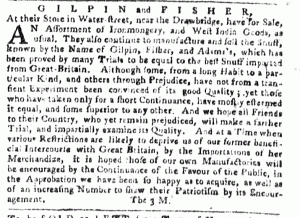
“Which has been proved by many Trials to be equal to the best snuff imported from Great-Britain.”

Advertisements for goods, such as the one depicted above, were commonplace in colonial newspapers. Advertising snuff, also known as sniffing tobacco, would not have been a shocking advertisement for the time as tobacco was a popular product. What is striking about the notice is what the tobacco was compared to:  tobacco imported from Great Britain.

I also find it interesting that Gilpin and Fisher would make a comparison to tobacco from Great Britain at a time when several of the colonies were prone to unrest. Britain had just passed the Stamp Act tax in 1765; some British products were currently being boycotted. Perhaps since the people of the colonies still considered themselves British citizens, they would have wanted to be loyal to British products. On the other hand, the advertisement would give colonists a sense of security in local products since the colonists had been so used to British goods.

**********

ADDITIONAL COMMENTARY:  Carl Robert Keyes

I was excited when Maia chose this advertisement, for a variety of reasons. She did not know that I had already selected an advertisement from the Massachusetts Gazette for yesterday that was also shaped by the Stamp Act, making this a wonderful transition into her responsibilities as guest curator for this week. I also appreciated the appeal to locally produced good, which Maia highlights in the quotation she selected from this advertisement: “Which has been proved by many Trials to be equal to the best snuff imported from Great-Britain.”

When I have featured advertisements that make similar appeals, I have emphasized their political valence and their rhetoric of resistance. Maia offers a perspective that I have not given as much attention: assuring colonists that domestic products were as good as any imported from Great Britain was not just an assurance of quality. This was also a means of offering reassurance to potential customers who faced an increasingly disorienting world of consumption disrupted by transatlantic politics.

Also, in questioning to what extent colonists might have wanted, on some level, to remain loyal to British goods Maia also reminds us that this was indeed a period of resistance – not yet revolution – and colonists continued to embrace their identity as members of the British empire even as they sought redress of grievances within the British system of law and politics.

Welcome, Guest Curator Maia Campbell

Maia Campbell is a first-year student and History major in the Honors Program at Assumption College in Worcester, Massachusetts. Outside of studying history, with the goal of ultimately becoming a public historian, she writes for the college’s paper, Le Provacateur. She will be guest curator of the Adverts 250 Project during the week of January 31 to February 6.

Welcome, Maia Campbell!