What was advertised in a colonial American newspaper 250 years ago today?
Massachusetts Spy (January 16, 1772).
“ADVERTISEMENTS taken in … Small HAND-BILLS at an Hour’s Notice.”
Advertising represented significant revenues for early American printers. For many, advertising, rather than subscriptions, determined the viability and profitability of their newspapers. Some printers included invitations to submit advertisements along with publication information in the colophons that appeared at the bottom of the final page of their newspapers. In the colophon for the Massachusetts Spy, for instance, Isaiah Thomas proclaimed, “ADVERTISEMENTS taken in.” Considering how much revenue advertisements generated, some printers devoted as much space (or more!) to paid notices in their newspapers as to other content, though others made efforts to balance news and advertising. For his part, Thomas did not allow advertising to crowd out local news for Boston, “AMERICAN INTELLIGENCE” from other cities, letters to the editor, and other content. In the January 16, 1772, edition, for instance, he filled one-third of the columns with advertising and the rest with news. He also inserted a note that “Advertisements omitted will be in our next,” alerting advertisers that their notices had not been overlooked but merely delayed.
At the same time, Thomas produced other forms of advertising, including handbills, and promoted such work as well as other job printing performed “on the most reasonable Terms.” Those services appeared in the colophon of every issue of the Massachusetts Spy in the early 1770s. The printer alerted prospective advertisers that he produced “Small HAND-BILLS at an Hour’s Notice.” Though relatively few of those handbills survive today, especially compared to newspapers (and the advertisements in them) preserved in their entire runs, they were part of a vibrant culture of advertising in the second half of the eighteenth century. As they traversed the streets of Boston and other cities and towns, colonizers glimpsed broadsides pasted to buildings and grasped handbills thrust at them as they passed. Merchants and shopkeepers gave out trade cards to promote their businesses and wrote accounts and receipts on billheads. Booksellers and auctioneers distributed catalogs. Advertisements were not the only kind of job printing undertaken by Thomas, but singling out handbills for special attention in the colophon of his newspaper suggests that he saw advertising as an especially lucrative endeavor.
What was advertised in a colonial American newspaper 250 years ago today?
Massachusetts Spy (January 2, 1772).
“WANTED immediately, a Journeyman COMPOSITER.”
This advertisement struck me because it was related to the production of the newspapers we were reading in class. This advertisement “WANTED immediately” a compositor at a newspaper. I thought it would be interesting to learn about what a compositor is and how this might increase my knowledge of early American newspapers.
The invention of movable type opened the door for a new age of printing in Europe in the 1500s. That meant new crafts and careers, including compositors. Compositors arranged the letters in advance of them being covered in ink. Historian Liz Covart describes the job expectations step by step. The compositor starts with the composition stick, placing letters in proper order. The placement of letters is done in opposite order, right to left, so they appear right side up and left to right on final edition. After a quick check to clean up errors, compositors place their work in a chase to be inked up and printed.
I found it very interesting how the printing press offered positions for compositors and others to make the newspapers we read in class and consulted for this project. Each sentence, letter, and word or punctuation mark was positioned by a compositor like the one sought in this advertisement. Seeing such a specific job and the steps involved made me think of the process today and the new jobs and careers that the internet has created, like the printing press did in early America. Lily Talavera expands on this in an article about the booming market for social media jobs. According to Talavera, “Social media has created a new category of jobs. You may have heard them as social media jobs or with other names relevant to the requested tasks. These jobs are in high demand, and many people already work full-time on social media.” Innovations in delivering news today have a similar effect on creating new kinds of jobs as an innovation like the printing press had in creating jobs for compositors in the early modern period.
**********
ADDITIONAL COMMENTARY: Carl Robert Keyes
When I taught a course about Revolutionary America, 1763-1815, in Fall 2021, I once again incorporated the Adverts 250 Project and the Slavery Adverts 250 Project. I asked each of the twenty-three students in the class to serve as guest curators for those projects. Each of them was responsible for compiling a digital archive of newspapers originally published during a particular week in 1772. Then they scoured the newspapers to identify advertisements about enslaved men, women, and children for inclusion in the Slavery Adverts 250 Project. For each of those advertisements, the guest curators composed tweets that included the project’s tagline, a quotation, and a citation. For the Adverts 250 Project, each student selected one advertisement to research in greater detail, consulting at least one secondary source by an historian of early America, and then wrote an entry about what they learned and what the advertisement reveals about some aspect of commerce, politics, or daily life during the era of the American Revolution.
Ben is the first of the students from that class to have his work as a guest curator appear on the Adverts 250 Project and the Slavery Adverts 250 Project. In many ways, it is very fitting that he starts the entries researched and written for that class with one that examines an advertisement about the printing trade. We devoted a lot of time to discussing print culture, consumer culture, slavery, and their intersections during the era of the American Revolution. Compositors set the type for the newspapers, broadsides (including the Declaration of Independence), and pamphlets (such as Thomas Paine’s Common Sense) that kept colonizers informed during the imperial crisis and, ultimately, encouraged them to sever their political allegiance to Great Britain. Compositors also set the type for the countless newspaper advertisements that offered enslaved people for sale or promised rewards for the capture and return of those who liberated themselves from their enslavers. Liberty and slavery appeared side by side on the pages of newspaper published during the era of the American Revolution. Compositors also set the type for advertisements for consumer goods as well as essays that critiqued consumption and editorials that advocated nonimportation agreements and promoted “domestic manufactures” as means of exerting economic pressure to achieve political ends.
I invited students to contemplate all of these developments, not only in the abstract but also taking into consideration actual people and their experiences during the era of the American Revolution. This advertisement for a “Journeyman COMPOSITER” provides a springboard for considering the many themes woven throughout the Revolutionary America class that I designed and that Ben completed. Throughout the colonies, compositors played a role in presenting news and opinions about current events to the public. They also played a role in shaping consumer culture and perpetuating slavery. Beyond their contributions to producing the printed page, compositors made decisions about their own political activities and what kind of society they wanted to emerge from the American Revolution. That being the case, Ben’s choice of an advertisement to start a new round of entries from guest curators is very fitting indeed.
What was advertised in a colonial American newspaper 250 years ago today?
Massachusetts Spy (December 26, 1771).
“AMES’s ALMANACK, for 1772. Sold by EDES & GILL, and T. & J. FLEET.”
Ebenezer Russell correctly anticipated that some of his competitors would produce and sell a pirated edition of “AMES’s ALMANACK, for 1772.” He warned consumers, running advertisements that proclaimed that he published “THE original Copy” of the popular almanac yet suspected that other printers planned to market their own editions. On December 26, 1771, the Massachusetts Spy carried advertisements for both. In a fairly lengthy advertisement, Russell described the contents to entice consumers. He also listed nearly twenty booksellers in Boston, Salem, Newburyport, and Portsmouth who sold his edition. A shorter advertisement simply announced, “This day published, AMES’s ALMANACK, for 1772. Sold by EDES & GILL, and T. & J. FLEET.”
Isaiah Thomas, the printer of the Massachusetts Spy, appeared on Russell’s list of booksellers. That did not prevent him from running an advertisement for the pirated edition. He also inserted his own advertisement advising readers of “AMES’s, Low’s, Bicker[st]aff’s, Massachusetts and Sheet ALMANACKS, to be sold by I. THOMAS, near the Mill Bridge.” Conveniently, that notice was the only advertisement on the second page, making it the first that readers encountered as they perused the December 26 edition. Almanacs had the potential to generate significant revenues for printers in the early American marketplace.
It was not the first time that Benjamin Edes and John Gill, printers of the Boston-Gazette, and Thomas Fleet and John Fleet, printers of the Boston Evening-Post, pirated Ame’s Almanack. In 1768, a cabal of printers issued a pirated copy of William Alpine’s legitimate edition of Nathaniel Ames’s Astronomical Diary, or, Almanack for the Year of Our Lord Christ 1769. The conspirators included Edes and Gill and the Fleets as well as Ricard Draper, the printer of the Massachusetts Gazette and Boston Weekly News-Letter. This time around, however, Draper did not join his fellow printers in that endeavor. Instead, Russell included him among the authorized sellers of “THE original Copy” in his advertisements.
As the new year approached, consumers still in the market for purchasing almanacs had a variety of choices. In addition to choosing from among a variety of popular and familiar titles, those who followed the dispute between Russell and his competitors that unfolded in newspaper advertisements faced decisions about whether they wished to acquire an “original Copy” or reward the printers and booksellers who sold a pirated edition.
What was advertised in a colonial American newspaper 250 years ago today?
Massachusetts Spy (December 19, 1771).
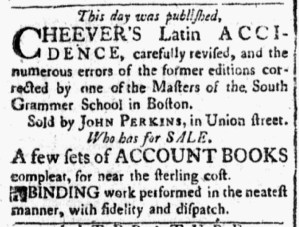
“CHEEVER’S Latin ACCIDENCE, carefully revised.”
Ezekiel Cheever, the author of A Short Introduction to the Latin Tongue, was a Puritan who migrated to New England in 1637. He originally settled in Connecticut before moving to Massachusetts to teach Latin and grammar in the public schools. In 1670 he took the position of Master of the Boston Latin Grammar School which he held until his death in 1708. During his life he was widely loved by his students despite his strict reputation. Under his leadership the school became regarded as one of the best in the colonies and his students included men such as the poet Michael Wigglesworth, Governor Johnathan Belcher, and Judge Samuel Sewall. One year after his death, one of Cheever’s students compiled his teaching notes into a book and published Cheever’s Accidence in 1709. The book was exceedingly popular and became the unofficial standard textbook for teaching Latin grammar in America. In all, twenty-three editions of the book were published, the last of which was published in 1838. While “Latin ACCIDENCE,” as the book was called in this advertisement, was written to teach students Latin, it also taught them the basics of English grammar and helped to formalize definitions that are still taught in schools today.
**********
ADDITIONAL COMMENTARY: Carl Robert Keyes
Colin selected an advertisement for the fifteenth edition of Ezekiel Cheever’s Short Introduction to the Latin Tongue. Two variants of that edition hit the market in 1771. In one, the imprint stated, “Printed and sold by Isaiah Thomas, in Union-Street.” In the other, the imprint declared, “Printed by Isaiah Thomas, for John Perkins, on Union-Street.” According to the catalogers at the American Antiquarian Society, only the imprints differed between the two volumes. Perkins most likely placed the advertisement in the Massachusetts Spy since it advised prospective customers that he sold the textbook, as well as a “few sets of ACCOUNT BOOKS,” but did not mention Thomas.
What prompted Thomas to produce variant imprints for the fifteenth edition? Did Perkins pay to publish only a certain number to carry at his shop, assuming the risk for those copies but not for any others? If so, did he and Thomas agree in advance that the printer would produce additional copies that omitted Perkins’s name from the imprint? Or did production take place in the opposite order? Perhaps Thomas initiated the project, but Perkins recognized an opportunity to profit from a new edition, one with significant improvements. The advertisement did underscore that the volume had been “carefully revised, and the numerous errors of the former editions corrected by one of the Masters of the South Grammer School in Boston.”
Whatever the order of publication of the variants, Perkins turned to Thomas when he set about marketing the book, inserting an advertisement in the newspaper that Thomas published. Did Perkins have to pay for that advertisement? Or was advertising part of a more extensive agreement? Given that Perkins also promoted “BINDING work performed in the neatest manner, with fidelity and dispatch,” the two entrepreneurs, fellow members of the book trades who possessed different skills, may have negotiated several in-kind exchanges that went beyond publishing Cheever’s “Latin ACCIDENCE.”
What was advertised in a colonial American newspaper 250 years ago this week?
Massachusetts Spy (October 24, 1771).
“Neatly engraved … The BOSTON MASSACRE.”
In the fall of 1771, Isaiah Thomas, the printer of the Massachusetts Spy, advertised an almanac for the coming year. In the October 27 edition of his newspaper, he announced that he published the “Massachusetts CALENDAR; or an ALMANACK, for the year, 1772.” He deployed several strategies to market the almanac to both retailers and readers. Like many printers, he listed the contents as a preview for prospective buyers. In addition to the usual astronomical calculations, this almanac included “Several Select Pieces … On Liberty and Government; Thoughts on Government; On the Culture of Silk,” and other essays. In addition, it contained poetry and useful tables, including one for calculating interest “on a Entire new Construction.”
Thomas also noted the price, including discounts for retailers and others who bought in volume. A single copy cost three shillings, but a dozen only twenty-two shillings and six pence. That meant that anyone who purchased eight copies received four additional copies for free, a pricing scheme that allowed booksellers, shopkeepers, and others to charge competitive prices that still allowed them to generate profits on the sale of the almanac. In addition, Thomas emphasized that he published “The SECOND Edition,” suggesting that this particular almanac was especially popular among the many choices available to consumers. Anyone interested in acquiring copies needed to act quickly.
To further entice customers, Thomas also promoted the “FOUR Plates, neatly engraved” that embellished the almanac. Those images included “The four Seasons, with the Twelve Signs of the Zodiac,” rather standard fare in eighteenth-century almanacs, as well as portraits of “The King of Denmark” and “Mr. Weatherwise,” whose “Prognosticks” appeared among the contents. Thomas considered one image especially significant, a depiction of “The BOSTON MASSACRE, on the evening of the 5th of March 1770.” He listed it first and used capital letters to draw attention to this relief cut from an engraving attributed to Paul Revere. The combination of essays examining “Liberty and Government” and an image of the Boston Massacre made clear that this almanac incorporated a particular political ideology among its contents. This was an almanac for American patriots who remained vigilant throughout the imperial crisis.
What was advertised in a colonial American newspaper 250 years ago this week?
Massachusetts Spy (August 22, 1771).
“BREWSTER’s BEST ground and made CHOCOLATE.”
Name recognition and brand loyalty have become important aspects of modern marketing campaigns, but those strategies have roots that go back centuries. Consider John Farmer’s advertisement for chocolate in the August 22, 1771, edition of the Massachusetts Spy. Although he made and sold chocolate at his shop on Fish Street in Boston, Farmer promoted his product as “BREWSTER’s BEST ground and made CHOCOLATE.”
Farmer made Brewster the centerpiece of his advertisement. Rather than have his own name serve as the headline, as John Cushing did in his advertisement for sugar and William Scott did in his advertisement for Irish linens on the same page, Farmer instead deployed Brewster’s name on its own, in capitals and centered on the first line. Readers quickly perusing the Massachusetts Spy would have much more easily spotted Brewster’s name than Farmer’s name. In addition, Farmer described himself as the “successor to the late John Brewster,” signaling to his former customers that they could acquire chocolate of the same quality from him.
He also offered assurances about quality. Just as customers came to expect the “BEST ground and made CHOCOLATE” from Brewster, they could depend on Farmer meeting the same standards. He made a promise to that effect, stating that his product was “warranted good and fre[e] from any mixture.” Farmer may have also expected that others could leverage the quality associated with Brewster’s chocolate. He sold it “Wholesale or Retail.” Shopkeepers who purchased it wholesale may have similarly informed their customers that they carried the familiar Brewster’s chocolate made by Brewster’s successor.
When it came to buying chocolate, residents of Boston had many options. To incite demand for his product, Farmer depended on name recognition and encouraged brand loyalty among consumers in his efforts to convince them to shop “at the sign of the Chocolate-Cakes” rather than anywhere else.
What was advertised in a colonial American newspaper 250 years ago today?
Massachusetts Spy (June 6, 1771).
“The Estate of JANE EUSTIS, late of Boston, Shop-keeper.”
For several weeks in the spring of 1771 the Massachusetts Spy carried a notice requesting “all those persons who are indebted to the Estate of JANE EUSTIS, late of Boston, Shop-keeper, deceased, or that have any Demands on, or accounts open with the estate … settle such accounts with JOSEPH PEIRCE, merchant, in Boston.” During her lifetime, Eustis ran advertisements in the public prints in order to promote her business, but that was not the only form of marketing that she deployed. In the late 1760s, Eustis distributed an engraved trade card, known at the time as a shopkeeper’s bill, to supplement her newspaper advertising.
Surrounded by a rococo border, the text resembled a newspaper advertisement. It opened with a familiar phrase, “Imported from LONDON,” before naming Eustis, giving her location, and listing a variety of “English and India Goods,” primarily textiles, “Millinary & Haberdashery.” A brief note assured prospective customers that Eustis sold her merchandise “All Cheap for Cash.” Although a significant number of female entrepreneurs in Boston and other towns placed newspapers advertisements, relatively few disseminated trade cards, billheads, broadsides, or other forms of advertising in eighteenth-century America. Eustis’s trade card is also notable for being the earliest known shopkeeper’s bill distributed by a woman. The copy in the collections of the American Antiquarian Society features a receipted bill for lace, gloves, and textiles dated April 17, 1769, on the reverse. Merchants and shopkeepers tended to use the same design for years, so Eustis may have commissioned her trade card well before 1769.
The design, especially the ornate border, testified to genteel tastes that resonated with many consumers. Merchants, shopkeepers, and artisans in London and other English cities distributed similar trade cards throughout the eighteenth century. Eustis, like other American entrepreneurs who commissioned trade cards, replicated a common style, positioning her marketing efforts within transatlantic networks of commerce and consumption. In so doing, she enhanced her appeal asserting connections to London and current fashions in the largest and most cosmopolitan city in the empire. Commissioning and distributing an engraved trade card that resembled those passed out in London suggested that even though Eustis operated a shop on the other side of the Atlantic neither she nor her merchandise could be dismissed as merely provincial.
Receipted Bill Dated April 17, 1769, on Reverse of Jane Eustis’s Trade Card. Courtesy American Antiquarian Society.
What was advertised in a colonial American newspaper 250 years ago today?
Massachusetts Spy (May 16, 1771).
“Mathematical Instrument-Maker.”
William Williams, a “Mathematical Instrument-Maker,” kept a shop near the Long Wharf in Boston in the early 1770s. That location likely made it relatively easy for mariners to find him and purchase a variety of navigational tools, including compasses, sextants, and manuals. According to his advertisement in the May 16, 1771, edition of the Massachusetts Spy, he also stocked a variety of other item, such as “Gauging and Surveying Instruments,” “large and small Perspective Glasses in Ivory,” “hanging and standing Compasses in Brass and Wood,” and “Sand-Glasses, from two Hours to a Quarter of a Minute.” In addition, he carried some general merchandise, such as ink powder, jackknives, and “plated Shoe and Knee Buckles,” to supplement his more specialized inventory.
The most striking aspect of Williams’s advertisement, however, was not the list of items he offered for sale but instead the image of a well-dressed man holding a sextant, an instrument that measures the angle between an astronomical object, such as the sun, and the horizon for the purposes of celestial navigation. Few visual images appeared in the Massachusetts Spy at the time Williams placed his notice. One other advertisement included an image of a ship at sea, a woodcut that could have adorned many advertisements. Eighteenth-century printers tended to have many woodcuts depicting ships among the printing ornaments that advertisers could choose for their notices. The image of a captain holding a sextant, on the other hand, corresponded specifically to Williams’s occupation as a mathematical instrument maker. That woodcut did not belong to the printer. Instead, Williams commissioned it and retained sole authority to use it. Other advertisers did not have access to that particular woodcut, unlike the generic images of ships, houses, and horses that printers made available.
The depiction of a captain holding a sextant not only attracted attention on a page devoid of other visual images; it also immediately signaled what kind of enterprise Williams operated. In that regard, it served as a rudimentary logo that enhanced his marketing efforts and branded his business. Although some advertisers previously experimented with incorporating unique visual images into their newspaper notices, the practice gained popularity in the 1770s.
What was advertised in a colonial American newspaper 250 years ago today?
Massachusetts Spy (May 9, 1771).
“An ODE set to Music, consecrated to the memory the Rev. GEORGE WHITEFIELD.”
In the months immediately after the death of George Whitefield on September 30, 1770, a variety of printers, booksellers, authors, and others produced and marketed an array of commemorative items that simultaneously commodified one of the most prominent ministers associated with the eighteenth-century religious revivals now known as the Great Awakening. This trend tapered off by the end of the year, only to be reinvigorated in the spring of 1771 when vessels arrived from England carrying copies of Whitefield’s will and sermons preached in his memory in London. Colonial printers produced and sold American editions. They also distributed them to booksellers and other retailers, enlarging the market for such items.
The May 9, 1771, edition of the Massachusetts Gazette carried an advertisement for yet another piece of Whitefield memorabilia, one not previously promoted in the public prints. John Boyles informed prospective customers that he sold “An ODE set to Music, consecrated to the memory of the Rev. GEORGE WHITEFIELD, A.M. By one of his friends in Boston, New England.” According to the catalog entry maintained by the American Antiquarian Society, this broadside featured eight stanzas and included music for four voices, making it a unique entry among the broadsides, hymnals, and other commemorative items advertised in colonial newspapers.
The catalog entry also indicates that this broadside was presumably published in Boston by an unknown printer in 1770. This advertisement, however, suggests that Boyles may have been the printer and that he published the broadside in the spring of 1771. According to his advertisement in the April 1, 1771, edition of the Massachusetts Gazette and Boston Post-Boy, Boyles ran a “PRINTING-OFFICE, next Door to the THREE DOVES in Marlborough-Street.” In advertisements for other Whitefield items published in the fall of 1770, Boyles appeared among the list of printers and booksellers who sold those items. Upon seeing a resurgence of marketing for Whitefield memorabilia in the spring, Boyles may have decided to produce a commemorative item of his own, hoping to take advantage of renewed interest and consumer demand. If so, he likely experienced steady sales of Whitefield items he carried in the fall and did not want to miss out on a potentially lucrative means of generating additional revenue. In producing his own broadside, Boyles assumed greater risk, but also stood to earn more profits.
Advertisements for Whitefield memorabilia became a familiar sight in several newspapers in New England, New York, and Pennsylvania in the spring of 1771. Printers and booksellers offered colonists several opportunities to commemorate the minister’s death by purchasing items created in his memory. The “ODE set to Music” was a novel item that likely attracted interest among both consumers who previously purchased other memorabilia and those who had not yet expressed their regard for the minister through participation in the marketplace.
What was advertised in a colonial American newspaper 250 years ago this week?
Massachusetts Spy (March 28, 1771).
“SUBSCRIPTIONS for the SPY are also taken in by Mr. J. Larkin, chairmaker.”
Most newspapers published in Boston in the early 1770s did not have extensive colophons. Consider, for example, those newspapers published at the time that Isaiah Thomas relaunched the Massachusetts Spy on March 7, 1771. The colophon for the Massachusetts Gazette and Boston Weekly News-Letter simply stated, “BOSTON: Printed by R. DRAPER.” Similarly, the colophon for the Boston Evening-Post read, in its entirety, “BOSTON: Printed by T. and J. FLEET.” The Boston-Gazette also had a short colophon, “Boston, Printed by EDES & GILL.” Limited to “Printed by GREEN & RUSSELL,” the colophon for the Massachusetts Gazette and Boston Post-Boy did not even list the city. All of those colophons appeared at the end of the final column on the last page.
In contrast, Thomas adopted a style much more often (but not universally) deployed in newspapers published in other cities and towns. Extending across all four columns on the final page, it provided much more information about the Massachusetts Spy for readers, prospective subscribers and advertisers, and others who might have business with the printing office. He included his location, “UNION-STREET, near the Market,” and listed the subscription price, “Six Shillings and Eight Pence” annually. He also noted that he sought advertising, but did not specify the rates. In addition, Thomas stated that “Articles of Intelligence … are thankfully received.” In other words, he solicited contributions to print or reprint in the Spy. Like other newspaper printers, he accepted job printing as a means of supplementing the revenues from subscriptions and advertising. Thomas proclaimed that he could produce “Small Hand-Bills at an Hour’s Notice.” He provided all of the services available in other printing offices.
Thomas included an additional enhancement in his colophon, one that not only did not appear in other newspapers published in Boston but also did not appear in other newspapers published throughout the colonies. He listed local agents who accepted subscriptions for the Spy in towns beyond Boston: “Mr. J. Larkin, chairmaker, and Mr. W. Calder, painter, in Charlestown; Mr. J. Hillier, watch-maker, in Salem; Mr. B. Emerson, Bookseller, in Newbury-Port; and Mr. M. Belcher, in Bridgewater.” That portion of the colophon reflected advertisements Thomas placed in other newspapers prior to relaunching the Spy. It testified to a network the printer established for gathering sufficient subscribers to make his newspaper a viable enterprise. The list also made it more convenient for prospective subscribers to order their copies of the Spy. Those who lived in any of the towns listed in the colophon could deal directly with the local agents rather than dispatch letters to the printing office in Boston.
When it came to publishing a newspaper in Boston, Thomas was a newcomer in the early 1770s. All of the other newspapers in circulation had been established for many years. Perhaps the printers believed that their newspapers and their printing offices were so familiar to readers that they did not need extensive colophons providing a lot of information. Thomas chose a different model, one much more common in newspapers published in other places. In the process, he added his own innovation, listing local agents, in order to gain greater advantage of the portion of each issue that he surrendered to the colophon.