January 27

What was advertised in a colonial American newspaper 250 years ago today?
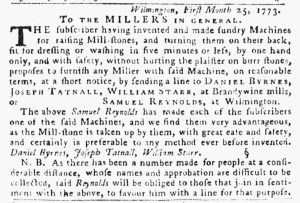
Pennsylvania Gazette (January 27, 1773).

“We find them very advantageous … and certainly is preferable to any method ever before invented.”

When Samuel Reynolds invented a machine “for raising Mill-stones, and turning them on their back, fit for dressing or washing in five minutes or less,” he took to the pages of the Pennsylvania Gazette to promote his product.  In an advertisement addressed “TO THE MILLERS IN GENERAL” in the January 27, 1773, edition, Reynolds described how millers could safely use his invention with “one hand only” to maneuver millstones for cleaning “without hurting the plaister on burr stones.”  He invited millers who wished to order the machine to contact him in Wilmington, Delaware, or any of three millers “at Brandywine mills,” Daniel Byrnes, Joseph Tatnall, and William Starr.

Rather than ask prospective customers to rely solely on the inventor’s own proclamations about his product, Reynolds included a testimonial from Byrnes, Tatnall, and Starr.  The experienced millers asserted that Reynolds “made each of [us] one of the said Machines, and we find them very advantageous, as the Mill-stone is taken up by them, with great ease and safety.”  In so doing, they reiterated the most important claims made by the inventor.  In addition, they declared that using Reynold’s new machine “certainly is preferable to any method ever before invented.”  Such an assessment bolstered the pitch made by Reynolds.

The inventor also suggested that he received advance orders or at least interest from other millers, though that may have been a marketing ploy rather than fact.  “As there has been a number made for people at a considerable distance, whose names an approbation are difficult to be collected,” he stated, “said Reynolds will be obliged to those that join in sentiment with the above, to favour him with a line for that purpose.”  In other words, he invited millers interested in the new machine to join with many others in showing their support by placing orders to acquire their own.  The savvy Reynolds sought to incite demand by demonstrating that demand already existed among experienced millers familiar with his product.

April 8

GUEST CURATOR: Bryant Halpin

What was advertised in a colonial American newspaper 250 years ago today?

Providence Gazette (April 8, 1769).

“A MEAL-MARKET.”

When I first looked at this advertisement, the phrase “MEAL-MARKET” was foreign to me. According to Oxford English Dictionary “meal” means processed grains, as in “the edible part of a grain … ground to powder” or “the finer part of ground grain.” Bucklin and Peck obtained the processed grain, such as “Wheat Flour, Rye and Indian Meal,” from millers. They also sold “Virginia Corn, and Ship Bread.”

George Washington also worked with millers. According to the historians at George Washington’s Mount Vernon, he moved away from the tobacco and began to plant more grains, mostly wheat and corn in the 1760s. Washington then expanded his gristmill and with that it became more efficient and effective and the revenue started to increase. In order to have an efficient and effective gristmill he had to set up the mill next to a reliable flowing water source. This was key because in order to power the mill water must flow past the waterwheel to generate power. When Washington did have success with his mill he then brought in extra revenue by charging neighboring farmers a fee to grind their grain.

**********

ADDITIONAL COMMENTARY: Carl Robert Keyes

Bucklin and Peck made several promises to prospective customers in their advertisement in the April 8, 1769, edition of the Providence Gazette. They pledged that they would “sell as cheap as they can possible afford, do Justice in Weight and Measure, and, for the Accommodation of the Public, will retail the smallest Quantities that shall be desired.” The second of those appeals – “do Justice in Weight and Measure” – was especially important. It addressed a complaint leveled against millers that went back centuries.

In “Mills and Millers in Old and New World Folksong,” Jessica Bank explains that both the technology of mills and milling and folk songs about millers crossed the Atlantic from Britain to the colonies. Notorious for short-weighting the grains they processed, millers were depicted in depicted in folk songs as “selfish grasping thie[ves] who take advantage of anyone [they] can.” Millers had a reputation for refusing to operate their mills in the presence of their customers, a strategy that allowed them to cheat on the weights and measures. Bank notes that the popular expression “Keep your nose to the grindstone” originally had a second imperative, “and keep your eye to the road,” derived from the practice of ceasing operations of a mill as long as customers were in view.

“The image of the shifty, untrustworthy miller who enriches himself by stealing from those who use his mill to grind their grain,” Bank explains, “appears to have been incredibly long-lived and widely-known, appearing in a number of the folksongs that made their way to Colonial America.” Given that this image of the miller was so prevalent in eighteenth-century popular culture, Bucklin and Peck made a wise decision to address it in their advertisement offering “Wheat Flour, Rye and Indian” for sale. Their other appeals – low prices and the convenience of quantities that suited the needs of their customers – were standard marketing strategies adopted by many advertisers, but proclaiming that they “do Justice in Weight and Measure” was specific to their occupation. Bucklin and Peck understood the suspicion leveled against millers and those who sold the products of their mills; they crafted their advertisement accordingly.