January 27

What was advertised in a colonial American newspaper 250 years ago today?
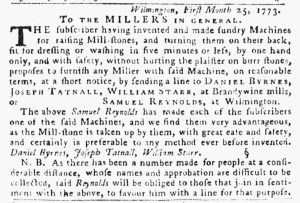
Pennsylvania Gazette (January 27, 1773).

“We find them very advantageous … and certainly is preferable to any method ever before invented.”

When Samuel Reynolds invented a machine “for raising Mill-stones, and turning them on their back, fit for dressing or washing in five minutes or less,” he took to the pages of the Pennsylvania Gazette to promote his product.  In an advertisement addressed “TO THE MILLERS IN GENERAL” in the January 27, 1773, edition, Reynolds described how millers could safely use his invention with “one hand only” to maneuver millstones for cleaning “without hurting the plaister on burr stones.”  He invited millers who wished to order the machine to contact him in Wilmington, Delaware, or any of three millers “at Brandywine mills,” Daniel Byrnes, Joseph Tatnall, and William Starr.

Rather than ask prospective customers to rely solely on the inventor’s own proclamations about his product, Reynolds included a testimonial from Byrnes, Tatnall, and Starr.  The experienced millers asserted that Reynolds “made each of [us] one of the said Machines, and we find them very advantageous, as the Mill-stone is taken up by them, with great ease and safety.”  In so doing, they reiterated the most important claims made by the inventor.  In addition, they declared that using Reynold’s new machine “certainly is preferable to any method ever before invented.”  Such an assessment bolstered the pitch made by Reynolds.

The inventor also suggested that he received advance orders or at least interest from other millers, though that may have been a marketing ploy rather than fact.  “As there has been a number made for people at a considerable distance, whose names an approbation are difficult to be collected,” he stated, “said Reynolds will be obliged to those that join in sentiment with the above, to favour him with a line for that purpose.”  In other words, he invited millers interested in the new machine to join with many others in showing their support by placing orders to acquire their own.  The savvy Reynolds sought to incite demand by demonstrating that demand already existed among experienced millers familiar with his product.

October 1

What was advertised in a colonial American newspaper 250 years ago today?

New-York Journal (October 1, 1772).

“I think it my duty to declare, that they are a curious, expeditious and elegant contrivance.”

The October 1, 1772, edition of the New-York Journal included an advertisement for a “MACHINE to dress FLOUR.”  The inventor, John Milne, or his son explained that the king “has been pleased to grant … his royal letters patent, for all his colonies in America, &c. for the sole making and vending” of this new machine.  In turn, the Milnes declared that the “said machines are to be sold by JOHN MILNE, and Co. at their house in Manchester; or by applying to James Milne (son of the said John Milne)” in New York.  They also described how this machine “not only make[s] the flour look better, but also … will dispatch three times as much business in the same time, as the common method of bolting with cloths.”  They went into detail about the greater efficiency of the machine compared to more familiar methods that relied on bolting cloths, underscoring that the efficiency resulted in savings.  Overall, Milne’s machines “are much cheaper” than the alternative.  In addition, he produced machines for cleaning wheat, barley, and other grains that removed seeds and gave “brightness and lustre to the grain.”

Rather than ask prospective customers to trust only in the inventor’s description and the “royal letters patent,” the Milnes provided two testimonials from satisfied customers near New York.  Jacob Sebring, Jr., noted that he used the machines at his mill on Long Island, “where they are now to be seen at work.”  Based on his experience with the new machines, he considered them “a curious, expeditious and elegant contrivance” … that “will answer every purpose for which they are designed, and likewise be of great service to the publick.”  Similarly, Derick Brinckerhoff of “Fish-Kills, Dutchess County” wrote that he “found Mr. Milne’s machine answer the purposes of bolting for which they are intended; infinitely better than the old method of doing it with cloths.”  He confirmed some of the claims made by the inventor, stating that the machines “really bolt three times as quick without the least exaggeration.”  He offered his endorsement “for the good of the community, and particularly to those who are manufacturers of flour.”  Both Brinckerhoff and Sebring positioned their testimonials as a public service rather than a commercial appeal.  Sebring even invoked his “duty” to share his experience with others who would benefit from acquiring Milne’s machine.

The Milnes realized that prospective customers might doubt the veracity of their claims about the efficiency of this invention, even with the “royal letters patent” granted by the king.  To answer doubts, they enlisted others who already had experience with the machine to provide testimonials that confirmed that they accurately represented their product’s capabilities.  They hoped that such endorsements would aid in making sales in the colonies once prospective customers learned that others had positive experiences with the new machines.