December 20

What was advertised in a revolutionary American newspaper 250 years ago today?

Pennsylvania Journal (December 20, 1775).

“Any person desirous of information concerning the character … of Mrs. Brodeau, may apply to … B. FRANKLIN.”

When she arrived in Philadelphia, “Mrs. BRODEAU, from England,” placed advertisements in the Pennsylvania Gazette and the Pennsylvania Journal as a means of “acquainting her friends and the public in general, that she has opened a boarding school in Walnut-street.”  She sought pupils of a certain status, pledging that “young ladies will be genteelly boarded, and taught to read and speak the French and English language; the tambour embroidery, and every kind of useful and ornamental needle work.”  In addition to the curriculum, Brodeau promoted her supervision of her charges, stating that she “hopes to prove by her assiduity and attention to the morals and behaviour of these ladies entrusted to her care, that she in some measure merits the recommendations she has been favoured with from her native country.”  Like many other schoolmasters and schoolmistresses who advertised in Philadelphia’s newspapers during the era of the American Revolution, Brodeau emphasized moral development as well as curriculum.[1]

The parents and guardians of prospective students did not have to take Brodeau’s word for it.  Instead, she inserted a testimonial from Robert Morris, the influential merchant, and Benjamin Franklin, the retired printer turned politician and diplomat.  “Any person desirous of information concerning the character and recommendations of Mrs. Brodeau,” they stated, “may apply to either of us.”  According to Claude-Anne Lopez, associated editor of the Papers of Benjamin Franklin, that was, “so far as we know, the only time that Franklin backed an enterprise of that kind with his name.”[2]  Lopez further explains that Anna Brodeau “suddenly and rather mysteriously appeared in Philadelphia with a baby daughter in her arms,”[3] yet “[n]othing is known about a Mr. Brodeau.”  If residents of Philadelphia had any concerns about Brodeau’s background, the endorsement from Franklin and Morris likely countered their concerns.  Still, the advertisement apparently did not garner as much response as Brodeau hoped when she placed it in the December 6 edition of the Pennsylvania Gazette, the newspaper that Franklin formerly printed.  Two weeks later she placed the same advertisement in the Pennsylvania Journal.  Those efforts helped launch her boarding school.  By the end of the Revolutionary War, Franklin’s daughter, Sarah Bache, wrote to her father that Brodeau “has made a handsome fortune.”  Despite the disruptions of the war, she established her boarding school and her reputation.  Lopez chronicles other accolades for Brodeau that appeared in print, including a poem by an anonymous contributor to the Columbian Magazine in 1786 and her obituary in the National Intelligencer in 1836.  With words of support from Franklin and Morris, Brodeau soon “attracted students from the best families in Philadelphia.”[4]  Her marketing incorporated the eighteenth-century version of a celebrity endorsement.

**********

[1] Carl Robert Keyes, “Selling Gentility and Pretending Morality: Education and Newspaper Advertisements in Philadelphia, 1765-1775,” Pennsylvania Magazine of History and Biography 141, no. 3 (October 2017): 245-274.

[2] Claude-Anne Lopez, “Benjamin Franklin and William Dodd: A New Look at an Old Vause Célèbre,” Proceedings of the American Philosophical Society 129, no. 3 (September 1985): 262.

[3] Lopez, “Benjamin Franklin and William Dodd,” 262, 263.

[4]Lopez, “Benjamin Franklin and William Dodd,” 263.
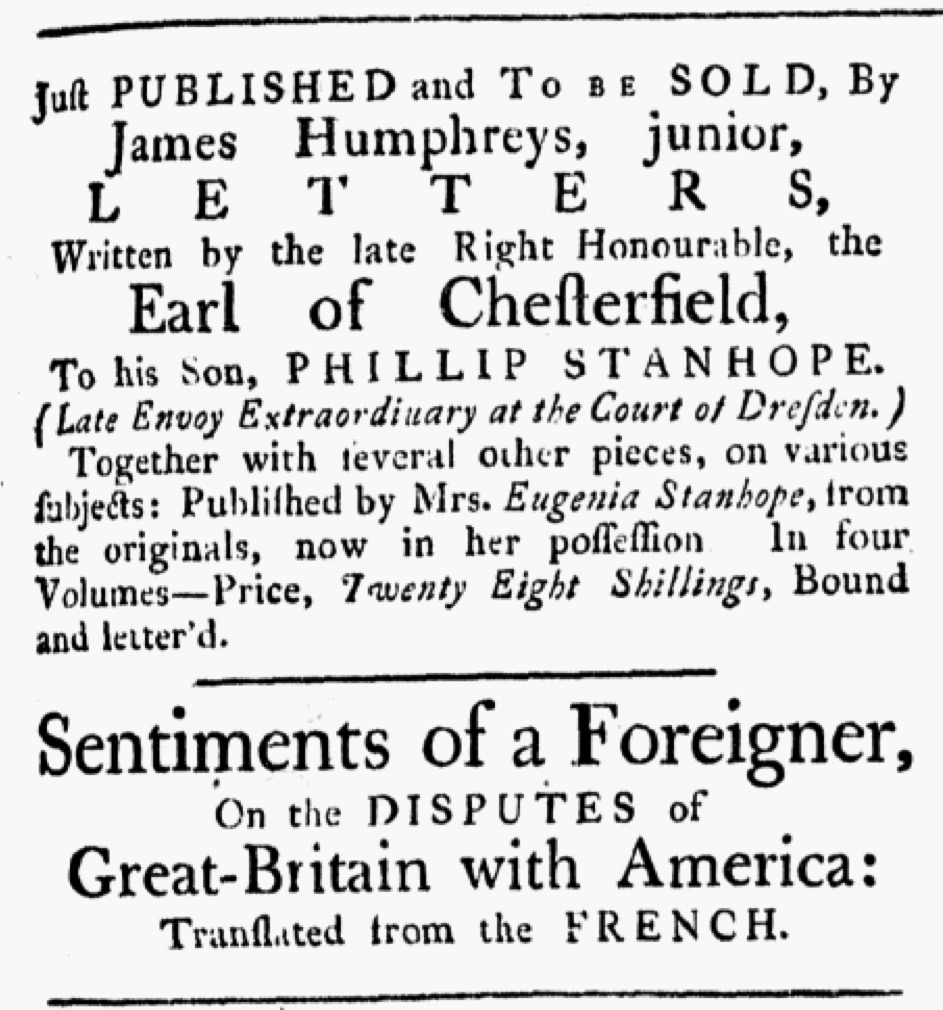
September 3

What was advertised in a revolutionary American newspaper 250 years ago this week?

Pennsylvania Ledger (September 2, 1775).

“LETTERS, Written by the late Right Honourable, the Earl of Chesterfield, To his Son.”

James Humphreys, Jr., led the September 2, 1775, edition of the Pennsylvania Ledger with an advertisement for Letters by the Late Right Honourable, the Earl of Chesterfield, to His Son, Phillip Stanhope.  Although the header proclaimed, “Just PUBLISHED and TO BE SOLD, By James Humphreys, junior,” the printer of the Pennsylvania Ledger merely sold copies of a book printed by others.  As was often the case, the phrase “Just PUBLISHED” meant that a book, pamphlet, print, or other items was now available for purchase, but advertisers expected readers to separate “Just PUBLISHED” and “TO BE SOLD.”  Only the latter applied to the advertiser.  In this case, Humphreys likely stocked copies of an American edition printed by Hugh Gaine and James Rivington in New York.

Prospective customers did not care nearly as much about who printed the book as they did about the contents.  The advertisement (drawn from the extended title of the work) indicated that it consisted of four volumes that contained the Earl of Chesterfield’s letters “Together with several other pieces, on various subjects: Published by Mrs. Eugenia Stanhope, from the original, now in her possession.”  The earl had written 448 letters to his son between 1737, when the boy was five, and his death in 1768.  At that time, the early learned that his son had been secretly wed for a decade and had two sons of his own.  The earl provided for his grandsons but did not support their mother.  In turn, she published the collection of letters.

The letters caused a stir in both Britain and America.  They presented a guide to manners for gentlemen to navigate aristocratic society, prompting colonizers concerned with demonstrating their own gentility to take note of the advice the earl offered to his son.  Yet readers did not universally celebrate the attitude and conduct the early advocated.  Some critiqued what they considered cynical and amoral values contained within the letters.  While Gaine and Rivington may have found eager audiences for the letters in New York and Humphreys in Philadelphia, readers from New England, the descendants of Puritans, were much more skeptical.  Gwen Fries notes that John Adams refused to send Abigail a copy in 1776, advising her that the letters were “stained with libertine Morals and base Principles.”  When she did read them a few years later, she agreed that they contained “the most immoral, pernicious and Libertine principals.”  In confining his advertising copy to the extended title of the work, Humphreys did not take a position.  He likely suspected that even those who had heard that the letters included some unsavory advice would be curious to assess what Chesterfield wrote for themselves.  Many others in Philadelphia, the largest and most cosmopolitan city in the colonies, may not have cared much at all about the sorts of objections raised by readers in Boston.

March 20

What was advertised in a colonial American newspaper 250 years ago today?

Providence Gazette (March 20, 1773).

“WANTED immediately, A SCHOOLMASTER.”

Dr. Jonathan Arnold needed an instructor “to take Charge of the School at Whipple Hall, Providence, North End” in March 1773.  Even though he wished to hire a schoolmaster immediately because he had “a large Number of Scholars being now ready to enter” the school, Arnold refused to settle for just anyone who could teach reading, writing, and other subjects.  Instead, any prospective schoolmaster had to be “temperate and exemplary, in Life and Manners,” in addition to possessing “Ability in his Profession.”  In the era of the American Revolution, advertisements seeking schoolmasters as well as those placed by schoolmasters and -mistresses emphasized manners and morals as much as they did classroom instruction.

Arnold underscored that he was serious about screening applicants.  In a nota bene, he declared, “It is expected, that whoever applies will produce sufficient Testimonials of his Qualifications as above, from Persons of undoubted Credit and Character.”  To make the point even more clear, he added, “None but such need apply.”  Arnold demanded references.  The “Testimonials” that they provided had to cover all of a prospective schoolmaster’s qualifications, including his skill and experience in the classroom and his morals and demeanor.  Furthermore, those giving recommendations had to be beyond reproach themselves.

Although Arnold aimed to hire a suitable instructor as quickly as possible, his advertisement had audiences other than prospective candidates for the position.  He indirectly addressed parents and guardians of current and prospective pupils as well as the entire community.  Arnold made clear that he did not entrust any of the children and youth under his charge to just any schoolmaster.  Parents and the general public could depend on him recruiting instructors who were both effective teachers and good role models.  The notice served an immediate purpose, filling an opening at the school, while also fulfilling a secondary purpose of informing the public, especially parents and guardians of the “Scholars,” about the standards maintained at the school.

July 11

What was advertised in a colonial American newspaper 250 years ago today?

Providence Gazette (July 11, 1772).

“Attention will be paid to their Learning and Morals.”

James Manning took to the pages of the Providence Gazette to promote his “Latin School” in the summer of 1772.  He pursued that venture, he claimed, upon the request of “several Gentlemen … to take and educate their Sons.”  His advertisement served as a mechanism to inform those gentlemen “and others disposed to put their Children under my Care” that he offered lessons “in the College Edifice,” the building constructed for Rhode Island College (now Brown University) two years earlier.

Presumably the “several Gentlemen” who encouraged Manning to establish a Latin school already had some familiarity with his qualifications and methods.  For others, he offered assurances that he was “a Master duly qualified” and familiar with “the most effectual Methods to obtain a competent Knowledge of Grammar.”  He supplemented the Latin curriculum with “spelling, reading, and speaking English with Propriety,” attending to the comportment of his pupils.

Such concerns extended to their morals as well.  Manning trumpeted, “I flatter myself, that such Attention will be paid to their Learning and Morals, as will entirely satisfy all who may send their Children.”  Throughout the colonies, schoolmasters and -mistresses, especially those who boarded students, posted newspaper advertisements that inextricably linked “Learning and Morals.”  In this case, reading Latin and “speaking English with Propriety” accounted for only a portion of the education that Manning’s students received.  As markers of gentility, they mattered little if the words and deeds of his charges belied upright morals.

Manning concluded his notice with a brief note that he sold “All Books for the School” in addition to providing instruction and lodging for his scholars.  He also had copies of “the classical Authors read in College” for sale “at the Lowest Rate.”  In so doing, he likely sought to leverage his location and affiliation with Rhode Island College as an additional reason for gentlemen to send their sons to his Latin school.