April 30

Who was the subject of an advertisement in a colonial American newspaper 250 years ago today?

New-London Gazette (April 30, 1773).

“LILLEY … can read … may have some forged Papers.”

Like so many other enslavers, John Foster and Roger Gibson placed newspaper advertisements that asked colonizers to participate in the surveillance of Black men, women, and children when the people they enslaved liberated themselves by running away.  In the spring of 1773, Foster and Gibson both offered rewards for identifying, capturing, and returning enslaved people to their purported masters.  In so doing, they enlisted others in perpetuating slavery.

In the April 30 edition of the New-London Gazette, Foster described Cush, “a Negro Man … born in Stonington,” who liberated himself sometime in January.  Foster did not know Cush’s exact age, but instead estimated that he was about twenty-six years old.  Readers who carefully observed the Black men they encountered could recognize Cush by his height, build, complexion, and clothing, but especially by his missing “fore Teeth” and “a Scar on one of his Ears.”  To increase his chances of liberating himself, Cush either created or acquired a “forg’d Pass.”  Accomplices may have aided his efforts to achieve his freedom, just as Foster attempted to recruit colonizers to capture Cush.

In the same issue, Gibson described Lilley, an enslaved woman who liberated herself and two of her children.  She likely did so to reunite her family in the wake of Gibson selling her and Toney, her ten-month-old son, to Joseph Miner in Colchester.  That separated mother and brother from Susan, “Four Years and Six Months old, small of her Age,” who remained enslaved to Gibson in New London.  According to Gibson, Lilley thought of herself well above her station even before she liberated herself.  She demonstrated “proud Affected Airs” and behaved in a “cunning, subtil [subtle] and insinuating” fashion.  Gibson considered it dangerous that Lilley “can read” and “publishes [or claims] that she is free” when questioned by others.  Whether or not she could write, Gibson considered it “possible [Lilley] may have some forged Papers, in order to deceive People.”  Combined with “her insinuating Manner,” she very well could “ensnare the unwary” into believing that she and her children were indeed free.  Gibson, however, bellowed that “whoever pleases, may see my indisputable Title to the above Negroes.”  He sought to leverage the power of the press to overcome the documents and demeanor of a resourceful Black woman.

Although certainly not their intention, Foster and Gibson depicted Cush and Lilley as courageous and ingenious.  As the New-London Gazette carried news from Boston, Providence, Philadelphia, and London that challenged colonizers to contemplate their own liberty in relation to Parliament and the British Empire, Foster and Gibson shared stories of Black people, committed to freedom, who staged their own revolutions.  Many eighteenth-century readers may not have recognized or appreciated such narratives at the time, but those advertisements offer powerful, though truncated, accounts of Black people seizing their liberty.

April 23

Who was the subject of advertisements in colonial American newspapers 250 years ago today?

Connecticut Journal (April 23, 1773).

“TO BE SOLD … A likely Negro Man … Enquire of the Printers.”

TO BE SOLD, A Negro Boy … Enquire of the Printers.”

Timothy Green ran a busy printing office in the early 1770s.  In addition to publishing the New-London Gazette, he sold books, some that he printed but most of them imported.  In the April 23, 1773, edition of his newspaper, Green advertised one of his own imprints, informing readers that “A Faithful HISTORY OF REMARKABLE OCCURRENCES, IN THE Captivity and Deliverances OF Mr. JOHN WILLIAMS, Minister of the Gospel in DEEERFIELD” was “Just Published, and to be Sold.”  Green also did job printing, including broadsides, handbills, and blanks (or forms).  Similarly, Thomas Green and Samuel Green oversaw a bustling printing office where they published the Connecticut Journal and New-Haven Post-Boy.  In the spring of 1773, they distributed subscription proposals for a new edition of “A Discourse on Justification by Faith alone. BY THE REVEREND JONATHAN EDWARDS.”  Those proposals also appeared in the April 23 edition of the New-London Gazette, part of a network of printers and others who cooperated in collecting the names of subscribers who reserved copies.

New-London Gazette (April 23, 1773).

Among their many other responsibilities, all three printers also served as slave brokers.  The same day that they promoted important historical and theological works, they also advised readers to “Enquire of the Printers” to learn more about enslaved people advertised for sale in their newspapers.  In the Connecticut Journal, a brief advertisement announced, “TO BE SOLD, (for no Fault, but for want of Employ,) A likely Negro Man, about 26 Years old, fit for Town or Country. Enquire of the Printers.”  An even shorter, but equally insidious, advertisement in the New-London Gazette stated, “TO BE SOLD, A Negro Boy, about 13 Years old, lately brought into the Country.  Enquire of the Printer.”  In both cases, the advertisers declined to identify themselves, instead instructing interested parties to contact the printers for more information.  In turn, the printers facilitated the sales of enslaved people twice over and generated revenue from the advertisements in the process.  First, they disseminated the notices, undertaking the labor required to print and distribute the advertisements and the rest of the newspapers.  Then, they actively participated in the sale of the “likely Negro Man” and the “Negro Boy, about 13 Years old,” responding to messages they received in the printing office and colonizers who visited to learn more.  As these advertisements demonstrate, printers in New England participated in perpetuating slavery during the era of the American Revolution, alongside their counterparts in Maryland, Virginia, South Carolina, and other colonies with greater numbers of enslaved people.  Such advertisements underwrote the production and dissemination of the news, while those that required readers to “Enquire of the Printers” further enmeshed printers in the slave trade as brokers for sales.

For an extended consideration of such advertisements, see Jordan E. Taylor, “Enquire of the Printer: Newspaper Advertising and the Moral Economy of the North American Slave Trade, 1704-1807,” Early American Studies 18, no. 3 (Summer 2020): 287-323, and the companion website.

January 29

What was advertised in a colonial American newspaper 250 years ago today?

New-London Gazette (January 29, 1773).

Difficult jobbs performed for those who pretend to the business.”

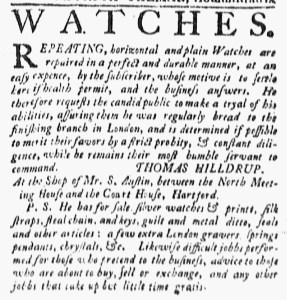
At the end of January 1773, watchmaker Thomas Hilldrup continued expanding his advertising campaign.  When he arrived in Hartford in the fall of 1772, he inserted notices in the local newspaper, the Connecticut Courant, starting on September 15.  His advertisement ran almost every week throughout the remainder of the year and continued into the new year.  Early in 1773, he decided to increase the reach of his marketing by placing the same advertisement in the Connecticut Journal and New-Haven Post-Boy.  Not much time passed before he ran that notice in the New-London Gazette as well.  With that publication, Hilldrup advertised in all of the newspapers printed in the colony at the time, making his efforts a regional campaign.

Hilldrup made a variety of appeals intended to attract attention from prospective clients who may not have otherwise considered seeking the services of a watchmaker in Hartford rather than one in their own town.  When he asked “the candid public to make a tryal of his abilities” in repairing several different kinds of watches, he emphasized his training and experience in the cosmopolitan center of the empire.  The watchmaker declared that he “was regularly bread to the finishing business in London,” implying that, as a result, he possessed greater skill than watchmakers who learned the trade in the colonies.  To underscore that point, he proclaimed that he did “difficult jobbs … for those who pretend to the business.”  In other words, he informed fellow watchmakers who did not possess the same level of skill that they could bring repairs beyond their abilities to him to complete.  Such an offer planted a seed of doubt about his competitors and prompted readers to question their capabilities.  Hilldrup also attempted to cultivate a clientele by offering free services, pledging “any other jobbs that take up but little time [done] gratis.”  That allowed him to meet new clients while also creating a sense of obligation that they would eventually purchase accessories, like chains and keys, at his shop or hire him when their watches needed more extensive repairs.

The newcomer made his presence known in the colony, first by advertising repeatedly in the Connecticut Courant and then by advertising widely in the other newspapers published in the colony.  He promoted credentials that he believed eclipsed many of his competitors and offered services intended to incite interest among prospective clients near and far.

December 11

What was advertised in a colonial American newspaper 250 years ago today?

New-London Gazette (December 11, 1772).

“All the above articles will be sold lower than can be bought either in [New] York or Boston.”

In the fall of 1772, Ebenezer Backus, Jr., ran multiple advertisements for goods available at his store in Norwich, Connecticut, in the New-London GazetteOne of those advertisements may very well have circulated separately as a broadside or handbill.  It occupied almost an entire page in the November 20 edition.  An advertisement of that size would have been expensive.  In subsequent issues, Backus published another advertisement, one more in line with the length of advertisements published by other purveyors of goods and services.

Like the longer advertisement, the shorter version included a list of goods.  To help prospective customers navigate that list, Backus divided his notice into two columns with only one or two items per line rather than including everything in a paragraph of dense text.  He stocked a variety of textiles, including checks, ginghams, damasks, “Pelong Sattins,” and “Plain Sattins” as well as accessories like buttons, “Barcelona Handkerchiefs of different colours,” and a “Compleat assortment of Ribbons.”  Beyond merchandise intended for making garments, Backus also sold “Cream coloured Ware of all Kinds.”

Although Backus included fewer goods in this advertisement than his previous one, he did add a new marketing appeal with the intention of capturing the attention of prospective customers.  In a nota bene that concluded the notice, Backus asserted that “All the above articles will be sold lower than can be bought either in [New] York or Boston.”  Consumers in and around Norwich may have expected to pay more to acquire goods in the small town of Norwich than in the region’s major urban ports, but Backus assured them that was not the case.  He hoped to entice them with bargains as good or even better than they would encounter elsewhere.  In so doing, he demonstrated that the consumer revolution reached even small towns where colonizers had access to the same goods at the same prices as their counterparts in the largest cities in the colonies.

November 20

What was advertised in a colonial American newspaper 250 years ago today?

New-London Gazette (November 20, 1772).

“A curious Assortment of new-fashion’d GOODS.”

One advertisement dominated the final page of the November 20, 1772, edition of the New-London Gazette.  Ebenezer Backus, Jr., ran a notice that filled more than three-quarters of the page, inviting customers to attend a sale of a “curious Assortment of new-fashion’d GOODS” at his store in Norwich.  Although other items appeared at the top of the page, the size of Backus’s advertisement in general combined with the size of font for the word “GOODS” in the middle of the page in particular, drew attention away from everything else.  Readers may have eventually noticed the “POETS CORNER,” a weekly feature on the final page, but the prominence of Backus’s advertisement likely meant they overlooked Thomas Hartshorn’s notice calling on those indebted to him to settle accounts, at least initially.

Backus’s notice may have circulated solely in this format, but that may not have been the case.  He could have also made arrangements with Timothy Green, the printer of the New-London Gazette, to produce additional copies to distribute as broadsides or handbills.  That seems to have been a practice among printers and entrepreneurs in the early 1770s.  Smith and Coit likely did so with a broadside book catalog that also ran in the August 4, 1772, edition of the Connecticut Courant.  Similarly, John Boyles may have adopted the same strategy with subscription proposals for Montesquieu’s Spirit of Laws in the October 19, 1772, edition of the Massachusetts Gazette and Boston Post-Boy.

The inclusion of a colophon suggests that Green printed separate broadsides or handbills for Backus to post around town or give to prospective customers.  Green did not always publish a colophon in the New-London Gazette.  When he did, it sometimes read, “NEW-LONDON: Printed by T. Green,” and other times simply stated, “Printed by T. Green.”  In contrast, the colophon centered at the bottom of the final page of the November 20 edition gave both the place of publication and the printer’s full name, “NEW-LONDON: Printed by TIMOTHY GREEN.”  Printers often placed their colophon on broadsides and handbills they printed for others, giving announcements or advertisements intended for other purposes a secondary purpose as marketing materials promoting the services offered by printers.  The presence of the colophon on the final page of the New-London Gazette does not definitively demonstrate that a broadside or handbill circulated separately, but it does support the possibility that colonizers encountered more advertising in a variety of formats than those preserved in the collections of research libraries and historical societies might suggest.

New-London Gazette (November 20, 1772).

October 9

What was advertised in a colonial American newspaper 250 years ago today?

New-London Gazette (October 9, 1772).

“Staffordshire and Liverpool Warehouse, in Kingstreet, BOSTON.”

Ebenezer Bridgham continued his efforts to create a regional market for his “Staffordshire and Liverpool Warehouse” in Boston with an advertisement in the October 9, 1772, edition of the New-London Gazette.  That advertisement featured copy identical to a notice in the October 2 edition of the New-Hampshire Gazette, though the compositors in the two printing offices made very different decisions about the format of the advertisements.  Bridgham’s advertisement ran a second time in the New-Hampshire Gazette (less the headline announcing “Crockery Ware”) the same day that it first appeared in the New-London Gazette.  He likely dispatched letters to the printing offices on the same day, but, given the distance, the New-London Gazette received its letter later and published his advertisement in the next edition after its arrival.

With advertisements in newspapers in Connecticut and New Hampshire in the fall of 1772, Bridgham continued a project that commenced more than a year earlier with advertisements in the Connecticut Courant, the Essex Gazette, and the Providence Gazette in September 1771.  He added the New-London Gazette the next month.  He placed a subsequent notice in the Connecticut Courant in June 1772, but he did not pursue the same coordinated campaign that he launched in the fall of 1771.  Although his “Crockery Ware” advertisement appeared in both the New-London Gazette and the New-Hampshire Gazette in early October 1772, it did not run in the other newspapers at that time.

That may have been the result of Bridgham learning which advertisements in which newspapers generated orders from country shopkeepers and other customers … and which did not.  His prior experience may have constituted a rudimentary form of market research that guided his decisions about where to focus his advertising efforts.  Alternately, Bridgham may have been delinquent in submitting payment for his advertisements, causing printers not to run them until he settled his debts.  His “Crockery Ware” advertisement eventually ran in Hartford’s Connecticut Courant on November 17.  In February 1772, Ebenezer Watson, printer of the Connecticut Courant, inserted a notice that “No Advertisements will for the future be published in this paper, without the money is first paid.”  The delay in publishing Bridgham’s “Crockery Ware” advertisement may have been due to waiting for payment.  Beyond these possibilities, Bridgham may have been haphazard in submitting his “Crockery Ware” advertisement to various printing offices.  If so, that deviated from the coordination he demonstrated in the fall of 1771.

September 25

What was advertised in a colonial American newspaper 250 years ago today?

New-London Gazette (September 25, 1772).

“Sold … by Samuel Loudon, in New-York.”

In his efforts to attract customers for the “Ship-Chandlery, Books, and Stationary” he stocked at his shop in New York, Samuel Loudon placed advertisements in the New-London Gazette in the fall of 1772.  For each category of merchandise, he provided a short list, concluding each with one or more “&c.” (the abbreviation for et cetera commonly used in the eighteenth century) to indicate even more choices.  He also stated that he carried “a great Variety of other Books, Divinity[, and] History” beyond the titles in his list.

Although Loudon may have welcomed retail customers for his wares, he most likely intended for his advertisement to capture the attention of masters of vessels who needed to outfit their ships and shopkeepers in New London and other towns in Connecticut interested in augmenting their inventory.  In a note near the end of the advertisement, Loudon stated that “Country Stores are supplied at the lowest Prices with Bibles, Testaments, Common Prayer Books, Spelling-Books, Entick’s Dictionary, Primmers, Bed Cords, Trace Rope, Gunpowder, Brimstone, &c.”  Loudon promised bargains to shopkeepers when they bought popular books and other items usually purchased in quantity.

Loudon could have confined his advertising to any of the three newspapers published in New York at the time.  After all, each of those publications enjoyed circulations far beyond the busy port.  Doing so, however, would have kept him in competition with others who also advertised in those newspapers.  Instead, Loudon sought to expand the market in which he operated by placing advertisements in the nearest newspaper published outside New York.  Although circulation of the New-London Gazette and New York’s newspapers overlapped, this strategy introduced him to new prospective customers.  It also gave his advertisements greater prominence.  All of the newspapers published in New York overflowed with advertising.  The New-London Gazette, a more modest publication, featured significantly less advertising.  It contained much less advertising, giving Loudon’s notice greater visibility.  Even if country shopkeepers in Connecticut perused any of the New York newspapers, they were much more likely to spot Loudon’s advertisement in the New-London Gazette.  Loudon apparently decided that advertising in large newspapers in his own city did not offer the only or even the best route to success.  Advertising in a smaller newspaper in a neighboring colony had its own advantages he considered worth the investment.

September 11

What was advertised in a colonial American newspaper 250 years ago today?

New-London Gazette (September 11, 1772).

“SCHEME Of the Second and last CLASS of a LOTTERY.”

An advertisement in the September 11, 1772, edition of the New-London Gazette promoted a “LOTTERY For raising Six Hundred Pounds, to repair and add to the Great Bridge over the Cove at Chelsea” in Norwich, Connecticut.  That was one of several public works projects in New England funded by lotteries in the era of the American Revolution.  The General Assembly passed “an especial Act” and appointed managers to oversee the lottery.  Local agents in half a dozen towns sold tickets.

Rather than hold a single set of drawings, the managers opted to sponsor more than one “class” of tickets and prizes.  Doing so gave colonizers more opportunities to participate, likely making it easier for the managers to meet their fundraising goals.  Winners in one class could reinvest in another, those less fortunate could try again, and others could purchase tickets for the first time.  The notice published in September concerned “the Second and last CLASS” limited to “2000 TICKETS at Fifteen Shillings each; of which 592 are Prizes.”  Tickets sales amounted to £1500, with £1200 paid out in prizes and the remaining £300 for the bridge.

The managers encouraged colonizers to purchase their tickets quickly because “the Tickets in the former Class were sold in less than two Months,” leaving “many people disappointed.”  They aimed to sell all the tickets in time to hold the drawing by the middle of October.  The managers pledged that “Proper Notice will be given of the Time and Place of drawing,” just as a “a List of Prizes will be published in the New London Gazette.”  By the time they encountered the advertisement for the lottery on the final page of the September 11 issue, readers likely saw the “LIST of the NUMBERS which came up PRIZES in Chelsea Bridge LOTTERY, Class the First; drawn August 31, 1772” that dominated the first page.  The printer managed to squeeze one advertisement into the right margin, but otherwise the list of winning numbers and the prizes associated with them was the only content that appeared below the masthead.  Publishing that list served many purposes, including giving a boost to the advertisement for the second class of the lottery that appeared elsewhere in the newspaper.

July 17

What was advertised in a colonial American newspaper 250 years ago today?

New-London Gazette (July 17, 1772).

“Articles of JEWELLERY.”

John B. Brimmer stocked an array of goods at his store in Norwich Landing, Connecticut, in the summer of 1772.  In an advertisement in the New-London Gazette on July 17, he promoted a “great Variety of English and Hard Ware Goods,” but claimed to have “too great a Variety to be enumerated in an Advertisement.”  That differed from his marketing efforts the previous summer, but perhaps Brimmer determined that he did not wish to incur the expense of inserting lengthy lists of his goods in the newspaper.  He did list a couple of dozen items in a dense paragraph that included “best London Pewter,” “Brass Kettles,” “Iron Tea-Kettles,” concluding with “&c. &c. &c.”  In repeating the abbreviation for et ceterathree times, he suggested to prospective customers that they would discover much more when they visited his store.

Brimmer also informed the public that he carried many “Articles of JEWELLERY.”  Those items he did choose to enumerate, listing “Cypher Drops,” “Brilliants for Rings,” “Cyphers for Buttons,” “Brilliant Drops,” and “Sparks and Garnets.”  To draw attention to this merchandise, Brimmer arranged it in two columns with only item on each line.  Decorative type separated the two columns, giving the advertisement a unique visual component compared to any other notice in that issue of the New-London Gazette.  Only the “POETS CORNER,” a weekly feature at the top of the final page, featured anything similar, lines of decorative type appearing both above and below its headline.

Like most eighteenth-century advertisers, Brimmer relied on the copy to do most of the work in marketing his goods.  He made appeals to consumer choice, invoking the word “variety” more than once, and promised low prices.  However, he also introduced a bit of graphic design to engage readers of the New-London Gazette.  The decorative type enhanced the visibility of his advertisement, distinguishing it from others.

May 15

What was advertised in a colonial American newspaper 250 years ago today?

New-London Gazette (May 15, 1772).

“A STAGE-WAGGON … from Sagharbour on Long-Island, to New-York.”

Newspaper advertisements documented some of the transportation infrastructure established in the colonies in the early 1770s.  The May 15, 1772, edition of the New-London Gazette, for instance, carried an advertisement for a “STAGE-WAGGON” that operated between New York City and Sag Harbor, a village on Long Island, and an advertisement for “Passage-Boats” that connected New London and Norwich.

Samuel Stockwell and John Springer informed readers who needed to travel or transport goods along the Thames River between New London on the coast and Norwich in the interior of the colony that their boats “Continue to ply every Day, Wind and Weather permitting.”  They pledged to keep to their schedule as faithfully as possible.  Stockwell and Springer included images of two vessels in their advertisement, simultaneously suggesting their industriousness and the destinations they served.

A more extensive advertisement for the wagon between New York and Sag Harbor explained that the route “will greatly facilitate the travelling between the New England and Southern Provinces.  That was made possible by combining travel on the wagon with sailing on “a Passage-Boat kept by James Wiggins” that crossed Long Island Sound between Sag Harbor and New London twice a week.  The wagon service departed from both New York and Sag Harbor on Monday mornings.  When they met, they exchanged passengers.  Travelers arrived at their destination by Wednesday evening.  Conveniently, the boat for New London departed “every Thursday Morning, and returns again … on Saturdays.”  Passengers sailing that direction arrived in time to catch a wagon headed to New York on Monday morning.

These two advertisements provided sufficient information for readers to plan trips between Norwich and New York, their journey involving two boats and two wagons in a little less than a week.  In an advertisement for his own stagecoach service in the Connecticut Journal, Nicholas Brown asserted that “Gentlemen from the Southern Provinces, travelling to Boston … generally go by Water from New-York to Providence.”  The advertisements in the New-London Gazetteillustrate other routes available to travelers in New England and New York.