May 18

What was advertised in a revolutionary American newspaper 250 years ago today?
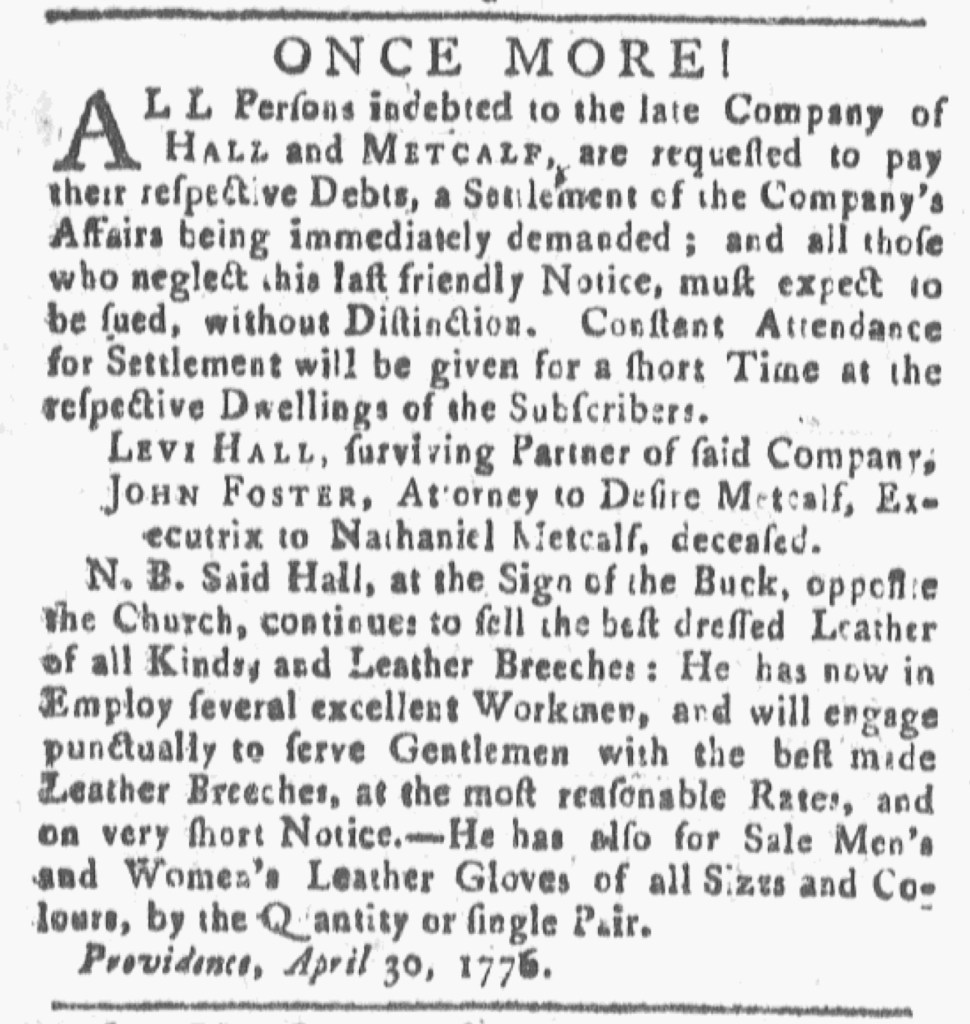
Providence Gazette (May 18, 1776).

“ONCE MORE!”

Levi Hall and John Foster wanted the headline for their advertisement in the May 18, 1776, edition of the Providence Gazette to catch the attention of readers.  Every advertiser certainly wanted their notice to reach the public, but crafting a catchy headline was not a standard practice in the eighteenth century.  Some advertisements did not have headlines at all.  Others gave a generic summary of the purpose of the notice, such as “WANTED,” “FOUND,” and “TO BE SOLD.”  Some named items offered for sale, like “WRITING PAPER,” and others gave the name of the advertiser, including “NATHANIEL GREENE,” “CLARK and NIGHTGALE,” and “ELIHU ROBINSON, Hatter.”  John Sebring, the “saddler and Cap-Maker, from London,” once again deployed his mononym, “SEBRING,” as the headline for an advertisement.  Weel after week, similar headlines for paid notices appeared in the Providence Gazette.

That made “ONCE MORE!” stand out.  Its distinctiveness may have enticed readers to look more closely at the rest of the advertisement.  When they did, they learned that Hall and Metcalf called on those “indebted to the late Company of HALL and METCALF … to pay their respective Debts.”  Hall placed the notice as the “surviving Partner of said Company,” while Foster did so as the “Attorney to Desire Metcalf, Executrix to Nathaniel Metcalf, deceased.”  Tyey reported that a “Settlement of the Company’s Affairs [was] immediately demanded,” warning that “those who neglect this last friendly Notice, must expect to be sued, without Distinction.”  In other words, neither social status nor customer loyalty nor any other factor would prevent Hall and Foster from taking to court those who refused to settle accounts.  Hall and Metcalf’s widow had placed a similar advertisement nearly a year earlier on July 29, 1775, so it was not the first time that such a notice appeared in the Providence Gazette, but it would be the last, especially considering that an attorney rather Desire Metcalf signed the notice.  “ONCE MORE!” signaled some frustration, even though Hall and Foster asked readers to think of the advertisement as a “friendly Notice.”  The headline underscored that they were running out of patience.

In both advertisements, Hall, the “surviving Partner,” added a nota bene to inform the public that he “continues to sell the best dressed Leather of all kinds” and made “Leather Breeches, at the most reasonable Rates, and on very short Notice.”  Although the partnership had been dissolved upon the death of Metcalf, Hall continued the business “at the Sign of the Buck, opposite the Church,” hoping that years of experience serving the residents of Providence would help him gain and maintain his clientele.

April 30

Who was the subject of an advertisement in a colonial American newspaper 250 years ago today?

New-London Gazette (April 30, 1773).

“LILLEY … can read … may have some forged Papers.”

Like so many other enslavers, John Foster and Roger Gibson placed newspaper advertisements that asked colonizers to participate in the surveillance of Black men, women, and children when the people they enslaved liberated themselves by running away.  In the spring of 1773, Foster and Gibson both offered rewards for identifying, capturing, and returning enslaved people to their purported masters.  In so doing, they enlisted others in perpetuating slavery.

In the April 30 edition of the New-London Gazette, Foster described Cush, “a Negro Man … born in Stonington,” who liberated himself sometime in January.  Foster did not know Cush’s exact age, but instead estimated that he was about twenty-six years old.  Readers who carefully observed the Black men they encountered could recognize Cush by his height, build, complexion, and clothing, but especially by his missing “fore Teeth” and “a Scar on one of his Ears.”  To increase his chances of liberating himself, Cush either created or acquired a “forg’d Pass.”  Accomplices may have aided his efforts to achieve his freedom, just as Foster attempted to recruit colonizers to capture Cush.

In the same issue, Gibson described Lilley, an enslaved woman who liberated herself and two of her children.  She likely did so to reunite her family in the wake of Gibson selling her and Toney, her ten-month-old son, to Joseph Miner in Colchester.  That separated mother and brother from Susan, “Four Years and Six Months old, small of her Age,” who remained enslaved to Gibson in New London.  According to Gibson, Lilley thought of herself well above her station even before she liberated herself.  She demonstrated “proud Affected Airs” and behaved in a “cunning, subtil [subtle] and insinuating” fashion.  Gibson considered it dangerous that Lilley “can read” and “publishes [or claims] that she is free” when questioned by others.  Whether or not she could write, Gibson considered it “possible [Lilley] may have some forged Papers, in order to deceive People.”  Combined with “her insinuating Manner,” she very well could “ensnare the unwary” into believing that she and her children were indeed free.  Gibson, however, bellowed that “whoever pleases, may see my indisputable Title to the above Negroes.”  He sought to leverage the power of the press to overcome the documents and demeanor of a resourceful Black woman.

Although certainly not their intention, Foster and Gibson depicted Cush and Lilley as courageous and ingenious.  As the New-London Gazette carried news from Boston, Providence, Philadelphia, and London that challenged colonizers to contemplate their own liberty in relation to Parliament and the British Empire, Foster and Gibson shared stories of Black people, committed to freedom, who staged their own revolutions.  Many eighteenth-century readers may not have recognized or appreciated such narratives at the time, but those advertisements offer powerful, though truncated, accounts of Black people seizing their liberty.