November 26

What was advertised in a revolutionary American newspaper 250 years ago this week?
Virginia Gazette [Dixon and Hunter] (November 25, 1775).

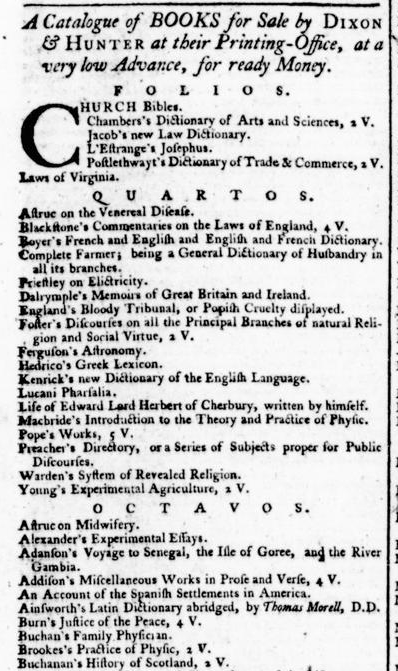
“FOLIOS … QUARTOS … OCTAVOS … DUODECIMOS.”

John Dixon and William Hunter, printers of the Virginia Gazette, published a “Catalogue of BOOKS for Saleat their Printing-Office” in the November 25, 1775, edition.  It covered most of the first page, except for the masthead and a short advertisement in which William Hewitt announced his intention to leave the colony and called on associates to settle accounts, and continued onto the second page, where it filled an entire column and overflowed into another.  Overall, Dixon and Hunter’s book catalog accounted for four of the twelve columns of news and advertising in that issue.  The printers could have printed a separate catalog (and very well may have done so), but disseminating the list of books they sold in the newspaper guaranteed that they reached consumers throughout the colony and beyond.

The printers deployed two principles in organizing the contents of their book catalog.  First, they separated the books by size – folios, quartos, octavos, and duodecimos – and then they roughly alphabetized them.  The catalog featured only half a dozen folios, including “CHURCH Bibles,” “Chambers’s Dictionary of Arts and Sciences” in two volumes, and the “Laws of Virginia,” along with nearly a score of quartos.  Dixon and Hunter stocked many more octavos and duodecimos with more than one hundred of each for prospective customers to choose.  In roughly alphabetizing the titles, they first indicated the author and then, if the book did not have an author associated with it, the title.  They clustered titles together by the first letter, but they did not observe strict alphabetical order within those clusters.  For example, the entries for “A” among the duodecimos appeared in this order:

     Addison’s Mescellaneous Works in prose and verse, 4 V.
Adventurer, 4 V.
American Gazetteer, 3 V.
Adventures of a Jesuit, with several remarkable Characters and Scenes in real Life, 2 V.
Agreeable Ugliness, or the Triumph of the Graces.
Apocrypha.
Alleine’s, Alarm to Unconverted Sinners.

A single entry for “Y” – “Yorrick’s Sermons, 7 V.” – appeared at the end of the catalog, immediately above “INTELLIGENCE from the Northern Papers.”

Even with all the “INTELLIGENCE” from London and Philadelphia and proclamation from the royal governor of Virginia, Dixon and Hunter made room in the Virginia Gazette for their book catalog.  They delivered news to their readers, but they also depended on book sales to supplement subscriptions, advertising, and job printing.  Compared to many book catalogs published earlier in the century, they presented a more organized list of titles.  Earlier book catalogs often separated titles by size.  By roughly alphabetizing the entries, Dixon and Hunter attempted to help prospective customers find the titles that interested them.
March 28

What was advertised in a colonial American newspaper 250 years ago today?

Pennsylvania Evening Post (March 28, 1775).

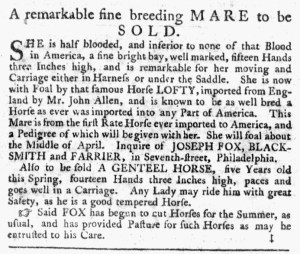
“A remarkable fine breeding MARE to be SOLD.”

It was not exactly front-page news, at least not as twenty-first-century readers think about how newspapers are organized.  The first item in the first column on the first page of the March 28, 1775, edition of the Pennsylvania Evening Post was an advertisement for a “remarkable fine breeding MARE to be SOLD.”  Immediately below, Benjamin Towne, the printer inserted an excerpt about the “right and capacity of the people to judge of government” from “CATO’s LETTERS, No. 38.”  It continued onto the second page, followed by news from Annapolis, Boston, Newport, and New York.  Local news from Philadelphia ran on the third and fourth pages, with advertisements completing the issue.

Once again, eighteenth-century methods of organizing the news differed from what modern readers have come to expect from newspapers.  The news with the dateline “PHILADELPHIA, March 28” included “the copy of a letter which was wrote by a Lady of New-York, to Capt. S—s, and Capt. McD—” and an “Extract of a letter from London, to a gentleman in Virginia, dated Dec. 24, 1774.”  Only a few very brief items relayed news from the vicinity, including a report on the “appointment [of] officers of militia for the county of Newcastle” and the date for the “MAYOR’s COURT.”

Eighteenth-century readers devised their own strategies for perusing newspapers published during the era of the American Revolution.  They did not depend on editors intentionally placing the most important news first, nor did they rely on headlines to summarize the content of letters and articles.  Instead, they had to give greater attention to that “letter which was wrote by a lady of New-York” and that “Extract of a letter … to a gentleman in Virginia” to determine what they contained and if they were interested in examining them more closely.  In contrast, the advertisement for the “breeding MARE” did feature a headline.  Advertisements were far more likely to have some sort of headline than any other items in early American newspapers.  The differences between those newspapers and today’s newspapers can be disorienting at first, yet they testify to an evolution in how publishers have disseminated the news and how readers engage with it.

December 30

What was advertised in a colonial American newspaper 250 years ago today?

New-Hampshire Gazette (December 30, 1774).

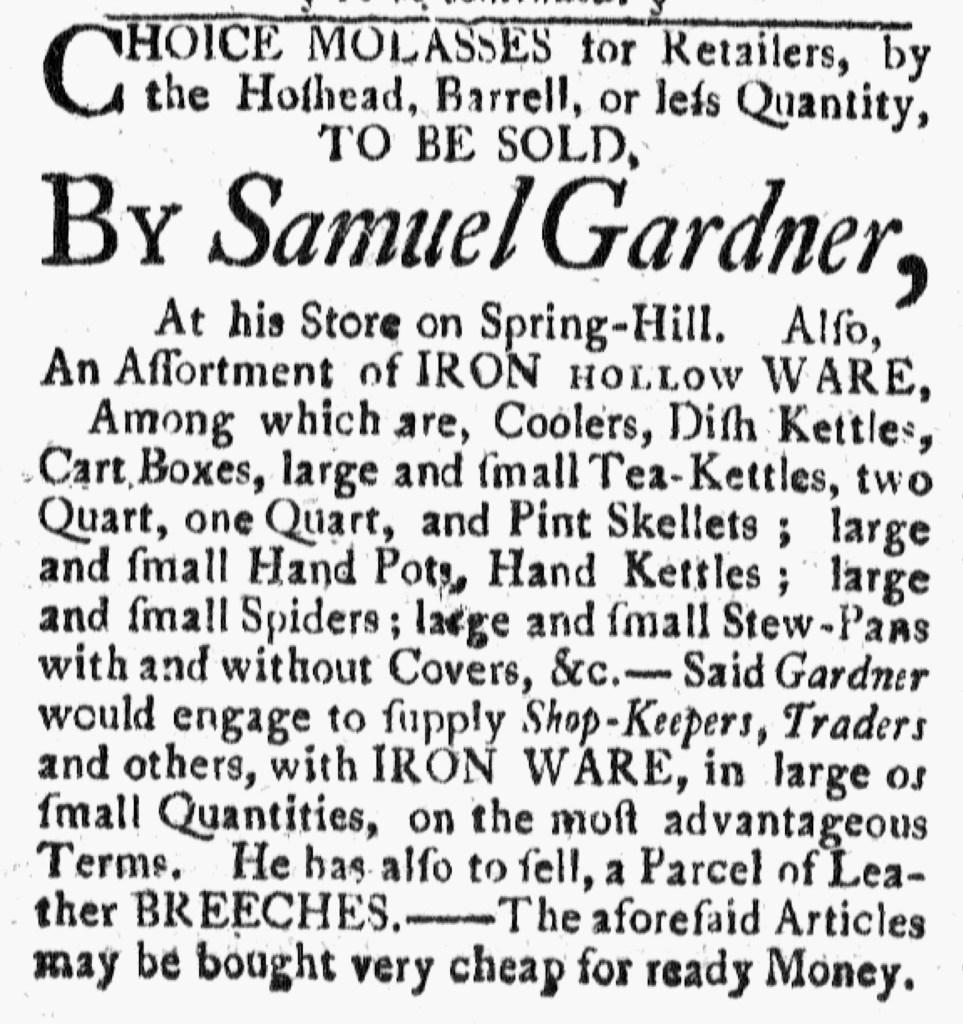
“TO BE SOLD, BY Samuel Gardner, At his Store on Spring-Hill.”

When it came to interspersing advertisements among news, editorials, and other content in colonial newspapers, the New-Hampshire Gazette was the exception to the rule.  Not all newspapers took the same approach to where advertisements appeared, but they generally avoided mixing advertisements and other content.  For instance, some newspapers reserved advertising for the final pages, printing all the news and editorials first, then the shipping news from the custom house to signal the transition to advertising, and finally the paid notices.  Others ran advertising on the first and last pages, printed first on the same side of the broadsheet, and saved the second and third pages for the latest news that arrived.  In some instances, news and advertising appeared on the same page.  The front page, for example, could include a column of paid notices and two columns of news with the advertisements in either the left column or the right column.  No matter the order, individual advertisements did not appear interspersed with news …

… except in the New-Hampshire Gazette.  Daniel Fowle, the printer, took a novel approach that may have looked haphazard to contemporary readers, though later generations came to expect news and advertising alternating in newspapers.  The layout of the New-Hampshire Gazette often required active reading to determine which portions featured advertising and which delivered news.  Consider the December 30, 1774, edition.  A short advertisement placed by George Whipple, “Attorney at LAW,” ran as the first item in the first column on the first page.  News constituted the remainder of the content on that page.  The second page began with news from the “Continental Congress continu’d” from the previous issue.”  It spilled over into a second column, followed by an advertisement for goods available at Samuel Gardner’s store, and then a lengthy essay about conditions in Boston by “MASSACHUSETTENSIS.”  That essay occupied most of the third page.  Three advertisements completed the third column.  More news and editorials appeared in the first column on the final page.  In addition, news from New York and the shipping news from the custom house ran at the top of the third column.  George Craigie’s lengthy advertisement for “A General Assortment of English Goods” interrupted the news and editorials.  Half a dozen advertisements appeared below the shipping news in the final column.  In other issues, Fowle interspersed short advertisements and short news items even more indiscriminately, giving readers of the New-Hampshire Gazette a different sort of visual experience in terms of organizing content compared to what they encountered in other colonial newspapers.

June 3

What was advertised in a colonial American newspaper 250 years ago this week?

Pennsylvania Packet (June 3, 1772).

“FOR KINGSTON, IN JAMAICA, THE SHIP POLLY AND PEGGY.”

Readers frequently encountered advertising on the front page of eighteenth-century newspapers.  Printers did not relegate that content to other sections.  Some filled all or most of the front page with advertising, as Hugh Gaine did in the June 1, 1772, edition of the New-York Gazette and Weekly Mercury.  Others divided the space between advertising and news. William Goddard devoted the first two columns of the June 1 edition of the Pennsylvania Chronicle to advertisements, reserving the third column for news.  John Dunlap, on the other hand, gave priority to news on the front page of the Pennsylvania Packet published that day, but that did not prevent him from including some advertisements.  The first two and a half columns contained news.  Four advertisements filled the remainder of the final column.

Those advertisements delivered news of a different sort.  One notice informed the public that the Polly and Peggy sought passengers and freight for a voyage to Jamaica.  Another let travelers know that Martin Delany opened a tavern “at Appiquimany Bridge (commonly called Cantwell’s Bridge) on the great road from Philadelphia to Dover.”  He encouraged them to lodge there, promising “the best usage,” “a variety of the first wines, [and] spirits,” and “completely refitted” stables.  In another advertisement, Robert Mack called on “James Pearce, of George-Town” and “David Foset of Snowhill” to “pay charges” and “take away” Jack and Charles, enslaved men in his custody at the jail in New Castle.  In addition, White and Montgomery reported that “just opened [a] store on the north side of Market-street wharf.”  A note at the bottom of the column advised, “FOR MORE NEW ADVERTISEMENTS SEE THE FOURTH PAGE.”  Dunlap suggested that readers would be just as interested in the information relayed in the paid notices that appeared on the last page as the news from Europe, the shipping news from the custom house, and the prices current in Philadelphia on the second and third pages.

Printers did not adopt uniform practices about where advertisements should appear in relation to other content, though they usually reserved some or all of the final page for paid notices.  Advertisements could appear just about anywhere in the newspaper, including on the front page, with the arrangement within any newspaper changing from week to week. Printers did not classify advertisements as content that could not appear on the front page.  As a result, advertisements often accounted for some of the first news or information that readers encountered when they perused eighteenth-century newspapers.

October 29

What was advertised in a colonial American newspaper 250 years ago today?

South-Carolina Gazette and Country Journal (October 29, 1771).

“NEW ADVERTISEMENTS.”

As was often the case, the October 29, 1771, edition of the South-Carolina Gazette and Country Journal overflowed with advertising.  The first page consisted of the masthead and more than a dozen advertisements, but no news items.  The second page did include those “freshest Advices, both Foreign and Domestic,” promised in the masthead.  The shipping news from the customs house continued on the third page, but two dozen advertisements filled the vast majority of it.  Nearly two dozen more appeared on the final page, along with a brief column identifying Charles Crouch as the printer at the bottom of the last column.  Crouch received so many advertisements at his printing office on Elliott Street that he issues a two-page supplement that contained about three dozen more advertisements, including Joseph Atkinson’s oversized notice that spread over more than half a page.  Thirteen advertisements about enslaved people ran among the other notices.

To help readers navigate the contents of the newspaper, Crouch inserted headers to identify “NEW ADVERTISEMENTS.”  The first appeared at the top of the first column on the first page.  When advertising commenced once again on the third page, the “NEW ADVERTISEMENTS” header ran once again, directing readers to notices they did not encounter in previous issues.  Midway through the page, however, Crouch transitioned to advertisements already inserted at least once without providing a different header.  Newspapers of the era tended to feature relatively few headlines and headers, so an effort to identify “NEW ADVERTISEMENTS” made Crouch’s publication distinctive even though he did not devise other markers to aid readers as they perused the advertising.  Similarly, neither Crouch nor any other printer in the colonies organized advertisements according to purpose or genre.  Instead, advertisements for consumer goods and services, legal notices, advertisements offering rewards for the capture and return of enslaved people who liberated themselves, real estate advertisements, and a variety of other kinds of notices ran alongside each other in an undifferentiated amalgamation.  A header for “NEW ADVERTISEMENTS” provided some guidance for readers, but it was a rudimentary classification system.

November 15

What was advertised in a colonial American newspaper 250 years ago today?

South-Carolina Gazette (November 15, 1770).

“ELIXIRS … PILLS … WATERS.”

The partnership of Carne and Poinsett sold a variety of medicines and medical supplies at their shop on Elliott Street in Charleston.  In a newspaper advertisement that ran for six weeks in the late fall of 1770, they advised prospective clients of a “LARGE Parcel of DRUGS and MEDICINES” and “INSTRUMENTS” they had just imported.  Like apothecaries and others who sold popular patent medicines, they provided a list for consumers to examine in advance of visiting their shop.  Carne and Poinsett, however, adopted an innovative approach to organizing their “COMPOLETE ASSORTMENT” of “FAMILY MEDICINES” within their advertisement.

Most advertisers simply listed the various patent medicines in paragraphs of dense text, expecting readers to sort through all of them.  A smaller number of advertisers enumerated one remedy per line, often dividing their notices into two columns, thus allowing readers to peruse their inventory more easily.  Still, they did not impose any particular organizing principle on the merchandise in their advertisements.

Carne and Poinsett categorized their medicines and grouped them together for the convenience of prospective clients who encountered their advertisement in the South-Carolina Gazette.  Rather than have Fraunces’s Female Elixir, Hooper’s Pills, and Stewart’s Tincture appear one after another, they instead listed all of the elixirs together, all of the pills together, and all of the tinctures together.  They did the same for waters and essences.  Rather than clutter the advertisement by repeating the words “elixir,” “pills,” “tincture,” and “water,” they instead inserted those words just once, along with printing ornaments that made clear they identified categories of medicines.  Doing so created more white space within the advertisement, which further enhanced its readability.

In their efforts to market patent medicines to prospective clients, Carne and Poinsett produced an organized catalog condensed to fit within a newspaper advertisement.  While compositors usually exercised discretion when it came to the format of notices, that does not seem to have been the case with Carne and Poinsett’s advertisement.  They placed the same notice in the South-Carolina and American General Gazette, featuring the same graphic design.  That would have been too much of a coincidence to attribute to the creativity of the compositors of the two newspapers.  Carne and Poinsett certainly submitted copy with instructions for how it should appear in print.

October 28

What was advertised in a colonial American newspaper 250 years ago this week?

South-Carolina Gazette (October 25, 1770).

“New Advertisements.”

What qualified as front page news in eighteenth-century American newspapers?  Even asking that question reveals a difference between how newspapers organized their content then compared to what became standard practice in the nineteenth century and later.  Today, most readers associate massive headlines and the most significant stories with the front page, but that was not the approach to delivering the news in the eighteenth century.

In general, news items did not include headlines that summarized their contents.  They did have datelines, such as “BOSTON, AUGUST 27,” that indicated the source of the news, yet those datelines did not necessarily mean that they covered events from a particular place, only that the printer received or reprinted news previously reported there.  For instance, a dateline might say “New York” and deliver news from London elsewhere in England that was first reported in newspapers published in New York.  Similarly, a dateline for “Boston” could lead news items that included events from other towns in New England.  Printers sometimes listed their sources, such as another newspaper or a letter, but not always.  Along with the dateline for “BOSTON, AUGUST 27” in the October 25, 1770, edition of the South-Carolina Gazette, printer Peter Timothy stated that the following news came from “An extract of a letter from a gentleman of distinction in Connecticut, dated August 14, 1770.”  The news under that dateline consisted of a single story, but printers often grouped together many different stories without distinguishing them with their own datelines.  Without headlines and other visual markers to aid them in understanding how the contents were organized, subscribers and others had to read closely as they navigated newspapers.

The placement of advertisements testifies to another stark difference between eighteenth-century newspapers and those published today.  Modern readers are accustomed to news appearing on the front page, especially above the fold.  Eighteenth-century printers and readers, however, did not associate the front page with the most significant news.  Instead, advertising often appeared on the front page.  On October 25, 1770, the front page of the Massachusetts Gazette and Boston Weekly News-Letter consisted of three columns, the first two devoted to news and the final one containing several advertisements.  The edition of the South-Carolina Gazette published the same day commenced with a column of “New Advertisements” as the first item on the first page.  The other two columns delivered news.  Most newspapers consisted of only four pages created by printing two on each side of a broadsheet and then folding it in half.  The first and fourth pages, printed simultaneously, often contained advertisements received well in advance, while the second and third pages, also printed simultaneously featured the latest news that had just arrived via newspapers from other towns, letters, and other means.  Colonists looking for what modern readers would consider front page news understood that they often would not encounter those stories until they opened their newspapers to the second page.

Then and now, newspapers delivered news and advertising, the latter providing much of the revenue necessary for the former.  The appearance and organization of newspapers, however, has changed over time.  Modern readers are accustomed to newspapers overflowing with advertising, but not advertising on the front page, a space now reserved for the lead stories.  Eighteenth-century readers, on the other hand, often saw commercial messages and other sorts of paid notices as soon as they began perusing the front page.

Massachusetts Gazette and Boston Weekly News-Letter (October 25, 1770).

May 10

What was advertised in a colonial American newspaper 250 years ago today?

May 10 - 5:10:1770 New-York Journal
New-York Journal (May 10, 1770).

Pencill’d China,” “Burnt Image China,” “Blue and white China.”

Like many other colonial shopkeepers, George Ball published an extensive list of his merchandise in an advertisement he placed in the May 10, 1770, edition of the New-York Journal.  Most advertisers who resorted to similar lists grouped all of their wares together into dense paragraphs of text.  A smaller number, like Ball, used graphic design to aid prospective customers in differentiating among their goods as they perused their advertisements.  Ball formatted his advertisement in columns with only one, two, or three items per line, just as Abeel and Byvanck, John Keating, and Jarvis Roebuck did elsewhere in the same issue.  Ball, however, instituted a further refinement that distinguished his notice from the others.  He cataloged his merchandise and inserted headers for the benefit of consumers.

Ball offered several categories of merchandise:  “Pencill’d China,” “Burnt Image China,” “Blue and white China,” “Brown China,” “White China,” “White Stone Ware,” “Delph Ware,” “Plain Glass Ware,” “Flower’d Glass,” “Iron Ware from England,” and “Queen Pattern Lamps.”  These headers appeared in italics and centered within their respective columns to set them apart from the rest of the list.  The goods that followed them elaborated on what Ball had in stock, allowing prospective customers to more easily locate items of interest or simply assess the range of goods Ball offered for sale.  His method could have benefited from further refinement.  The items that followed “Queen Pattern Lamps” were actually a miscellany that did not belong in any of the other categories.  Ball might have opted for “Other Goods” as a header instead.  Still, his attempt to catalog his merchandise at all constituted an innovation over the methods of other advertisers.

In most instances, eighteenth-century advertisers submitted copy and compositors determined the layout.  However, advertisements broken into columns suggest some level of consultation between advertisers and compositors, at the very least a request or simple instructions from one to the other.  Ball’s advertisement likely required an even greater degree of collaboration between advertiser and compositor.

March 29

GUEST CURATOR: Sean Duda

Who was the subject of an advertisement in a colonial American newspaper 250 years ago today?

Georgia Gazette (March 29, 1769).

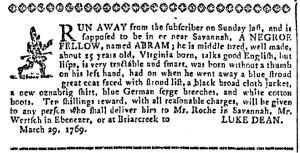
“RUN AWAY … A NEGRO FELLOW, named ABRAM.”

This advertisement contains the description of a runaway slave named Abram, including what he was wearing and distinguishing marks, and a reward for returning him. In running away, Abram participated in an his own act of resistance during a time of growing tensions between the British and the colonists. Unsurprisingly, many slaves were always looking for ways to become free. Noticing this sentiment, the governor of Virginia issued Lord Dunmore’s Proclamation on November 7, 1775. This proclamation offered freedom to slaves that belonged to people that were supporting or taking part in the war against the British, so long as they took up arms with the British against their masters. Many slaves took up this offer; according to Maya Jasanoff in Liberty’s Exiles: American Loyalists in the Revolutionary World, approximately 20,000 slaves joined up with the British. As for the Americans, many people who owned slaves had reservations against arming those that they had held in bondage. Jasanoff says only around 5,000 slaves fought for the colonists.[1] According to Ray Raphael, “Some who fought for the patriots were sent back into slavery at war’s end. … Patriot leaders in the South offered enslaved people as bounties to entice white recruits.”[2] It is not hard to see that slaves may have thought that their best shot at freedom would have been with the British instead of the colonists, who were not above using them as currency to entice more people to join their cause.

**********

ADDITIONAL COMMENTARY: Carl Robert Keyes

At a glance, the pages of the Georgia Gazette may appear rather static to modern eyes. Like most other colonial printers, James Johnston filled his newspaper with dense text and very few visual images. Yet careful attention to the issues published in early 1769 reveals variations in organization and typography that suggest Johnston and others who worked in his printing office experimented with how they presented the news and other content in the Georgia Gazette.

The March 29, 1769, edition, for instance, included another advertisement with the advertiser’s name in large gothic font, replicating an innovative visual element adopted by other advertisers in recent weeks. This time, John Johnston called on prospective customers to purchase bread.

Johnston also distributed advertisements throughout the entire issue, an organizational strategy repeated from other recent issues. Paid notices, along with the usual colophon, filled both columns of the last page. Every other page featured at least one advertisement. Two appeared at the bottom of the second column on the first page. Another, Johnston’s advertisement, ran at the top of the second column on the second page. Perhaps those on the first page served, in part, as filler to complete the column. Even so, Johnston made a choice not to continue with news coverage. The first item on the next page, news from Corsica, would have fit in the remaining space on the first page if Johnston had wished to continue with news rather than switch to advertising. Similarly, it would be difficult to argue that Johnston’s advertisement on the second page appeared there solely to neatly complete a column. Its position at the top of the column forced Johnston to continue the last item on the page, a moral tale, on the following page.

The advertisement about Abram making his escape ran in the first column on the third page, immediately following the conclusion of the moral tale. News from Savannah, including the usual lists from the customs house, appeared below it. Advertisements completed the column and the rest of the page. On the third page, Johnston switched between paid notices and other content multiple times rather than grouping all of the advertisements together. Readers holding open the newspaper to peruse the second and third pages encountered a hodgepodge of content, with advertisements in three of the four columns.

Some colonial printers chose to reserve advertising for the final pages of their newspapers, inserting paid notices only after all other content appeared. That was often Johnston’s strategy when he had only enough advertising to fill the last page. On occasions that he had more than would fit on the final page, however, he experimented with interspersing advertisements among news and other content throughout the rest of the issue. This strategy likely increased the chances readers noticed some of those advertisements since they were not consigned to space reserved solely for paid notices. Anyone seeking just the news had to make more effort to distinguish among the various types of content in the Georgia Gazette when Johnston spread out the advertisements.

**********

[1] Maya Jasanoff, Liberty’s Exiles: American Loyalists in the Revolutionary World (New York: Penguin, 2011), 361.

[2] Ray Raphael, Founding Myths: Stories that Hide Our Patriotic Past, rev. ed. (New York: New Press, 2014), 216.

July 26

What was advertised in a colonial newspaper 250 years ago today?

Jul 26 - 7:26:1766 Connecticut Gazette
Connecticut Gazette (July 26, 1766).

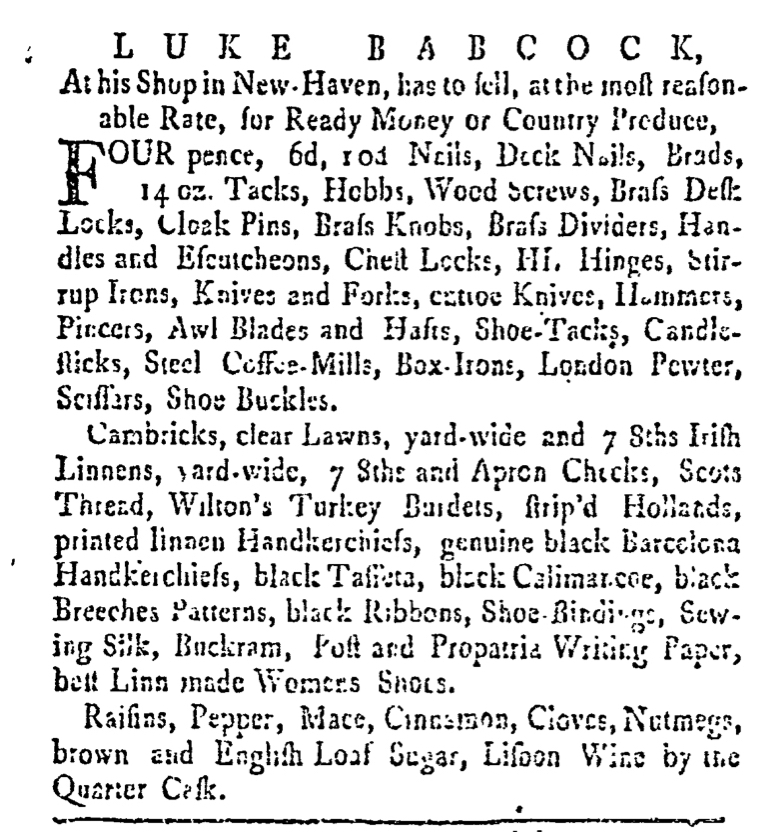
“LUKE BABCOCK, At his Shop in New Haven, has to sell … Nails, … Irish Linnens, … Raisins.”

Shopkeeper Luke Babcock’s list-style advertisement would have looked very familiar to colonial consumers. It did not elaborate much on the merchandise he stocked, except to not that Babcock sold his wares “at the most reasonable Rate.” The variety of goods – everything from “Brass Knobs” to “genuine black Barcelona Handkerchiefs” to “Lisbon Wine by the Quarter Cask” – comprised the advertisement’s primary marketing appeal, promising potential customers an assortment of choices. So many advertisers used this method of promoting their goods in eighteenth-century America that at a glance this advertisement appears indistinguishable from so many others.

On closer examination, however, it appears that Babcock introduced an innovation not readily apparent in advertisements published by many of his counterparts and competitors. His advertisement was carefully organized. Similar types of products were grouped together rather than appearing in an undifferentiated and disorienting list. Babcock first named hardware items, then textiles, and, finally, groceries. To make it even easier to navigate the advertisement, each major category had its own paragraph.

While this may seem like such common sense today that it should merit no comment, the format of this advertisement must be considered in the context of other eighteenth-century advertisements and the printing practices that shaped them. Babcock’s marketing may not have been flashy, but he attempted to make it more effective by helping readers better grasp the extent of his offerings and find merchandise that most interested them. It’s even possible that such careful organization on the printed page helped potential customers to imagine the layout of his shop, envisioning themselves examining the merchandise available in the section where hardware was stocked or in another area of the shop where textiles were displayed. Where other list-style advertisements often presented chaos, Babcock brought order to his goods, guiding consumers to the items they wanted or needed.