July 11

What was advertised in a revolutionary American newspaper 250 years ago today?

Dunlap’s Maryland Gazette (July 11, 1774).

“It is hoped that all who wish to see the Manufactures of Great-Britain established in America will encourage this work.”

Robert Moore, a “Cabinet maker in Baltimore Town,” advertised paper hangings (or wallpaper) and “MOCK INDIA PICTURES” to decorate domestic interiors in a notice in Dunlap’s Maryland Gazette in July 1775.  He did not claim that he produced the paper hangings and pictures, only that he sold them.  The cabinetmaker likely aimed to diversity the revenue streams for his workshop.

Yet earning his livelihood was not Moore’s only purpose in hawking those items or promoting them in the public prints.  He also aimed to advance the American cause, doing his part in the commercial realm as readers in Maryland continued to receive news about military encounters, especially the battles at Lexington and Concord, the siege of Boston, and the Battle of Bunker Hill, and the Second Continental Congress and provincial congresses throughout the colonies coordinated responses as the imperial crisis became a war.  Both entrepreneurs and consumers had been using commerce as a means of resistance before the fighting commenced; Moore intended to continue following that strategy.  The Continental Association that the First Continental Congress devised in response to the Coercive Acts, called for boycotting imported goods and encouraging the production and consumption of alternatives made in the colonies.

Moore echoed that ideology in his advertisement.  He proclaimed that he paper hangings and pictures were “all entire the Manufacture of this Country.”  Perhaps he stocked paper hangings produced by Ryves and Fletcher at their “NEW AMERICAN MANUFACTORY” in Philadelphia and advertised in Dunlap’s Pennsylvania Packet.  Whatever the source, Moore emphasized that their quality (“great Perfection”) and price (“lower rates”) rivaled those imported from England.  Consumers did not have to make sacrifices to when they chose to put their political principles into action in the marketplace.  Furthermore, Moore asserted that consumers had a civic responsibility to purchase goods produced in the colonies: “It is hoped that all who wish to see the Manufactures of Great-Britain established in America will encourage this work.”  Even after the fighting commenced in New England, colonizers attempted to continue exerting pressure on Parliament through the choices they made as retailers and consumers.

June 19

What was advertised in a revolutionary American newspaper 250 years ago today?

Postscript to Dunlap’s Pennsylvania Packet (June 19, 1775).

“A NEW AMERICAN MANUFACTORY.”

As summer arrived in 1775, Ryves and Fletcher took to the pages of Dunlap’s Pennsylvania Packet to inform the public that they established a “NEW AMERICAN MANUFACTORY” where they made and sold “all kinds of PAPER HANGINGS” (better known as wallpaper today).  The eighth article of the Continental Association, the nonimportation pact devised by the First Continental Congress in the fall of 1774, called for “promot[ing] Agriculture, Arts, and the Manufactures of this Country” as alternatives to imported goods.  That charge had even greater urgency following once colonizers heard about the battles at Lexington and Concord and the ensuing siege of Boston.  When Ryves and Fletcher ran their advertisement two days after the Battle of Bunker Hill, word of that engagement had not yet arrived in Philadelphia.  When it appeared again in July, readers had even more information about momentous events in Massachusetts that likely shaped how they reacted to Ryes and Fletcher marketing paper hangings made in America.

The “PAPER STAINERS,” as Ryves and Fletcher described themselves, asserted that they “are the first who have attempted that manufacture on this continent.”  Perhaps they were not aware that Plunket Fleeson made, advertised, and sold “AMERICAN PAPER HANGINGS” in Philadelphia in 1769, though they may have conveniently overlooked that enterprise in their efforts to promote their own.  Ryves and Fletcher made significant investment in procuring both workers and materials, noting in particular that their undertaking “consumes a large quantity of the paper of this country.”  In return for their dedication to the patriot cause, they “are therefore induced to hope for the countenance and protection of all well wishers to the infant manufacturers of America.”  They did their duty as producers, but that was not enough; consumers now had an obligation to purchase the paper hangings that Ryves and Fletcher made.  The paper stainers launched a “Buy American” campaign at the beginning of the Revolutionary War.  As part of their marketing efforts, they emphasized quality, extolling the “neatness of patterns and elegance of colour,” and price, pledging that “they will sell on much more reasonable terms than any paper can be disposed of which is imported into America.”  Ryves and Fletcher were among the first to produce and market paper hangings made in America, helping establish a new industry during the era of the American Revolution.

**********

I provide a brief case study of patriotic advertisements for paper hangings in Carl Robert Keyes, “A Revolution in Advertising: ‘Buy American’ Campaigns in the Late Eighteenth Century,” in Creating Advertising Culture:  Beginnings to the 1930s, vol. 1, We Are What We Sell:  How Advertising Shapes American Life … And Always Has, eds. Danielle Coombs and Bob Batchelor (New York:  Praeger, 2013), 1-25.

January 31

What was advertised in a colonial American newspaper 250 years ago today?

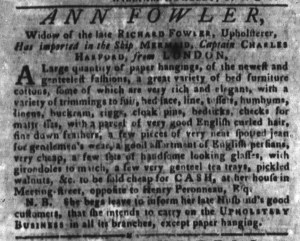
South-Carolina Gazette and Country Journal (January 31, 1775).

“She intends to carry on the UPHOLSTERY BUSINESS in all its branches, except paper hanging.”

Ann Fowler, “Widow of the late RICHARD FOWLER, Upholsterer,” took to the pages of the South-Carolina Gazette and Country Journal to advertise a variety of merchandise that she sold out of her house on Meeting Street in Charleston.  She indicated that she imported her wares “in the Ship MERMAID, Captain CHARLES HARFORD, from LONDON,” a vessel that arrived in port on December 29, 1774, according to the list of “ENTRIES INWARDS” at the custom house published in the January 3, 1775, edition of the South-Carolina Gazette and Country Journal.  Those goods should have fallen under the jurisdiction of the Continental Association.  Nevertheless, Fowler hawked a “Large quantity of paper hangings, of the newest and genteelest fashions, a great variety of bed furniture cottons, some of which are very rich and elegant, with a variety of trimmings to suit, [and] a few sets of handsome looking glasses, with girandoles to match.”  The widow was not the only advertiser who placed notices about imported goods that looked the same as those published before the Continental Association went into effect.

Fowler appended a nota bene to “inform her late Husband’s good customers, that she intends to carry on the UPHOLSTERY BUSINESS in all its branches, except paper hanging.”  Widows often took over the family business in colonial America, sometimes doing the same tasks their husbands had done and sometimes supervising employees.  Even though Ann had not been the public face of the enterprise while Richard still lived, she likely had experience assisting him in his shop and interacting with any assistants that he hired.  She hoped that she and her husband had cultivated relationships that would allow her to maintain their clientele, though they would have to look elsewhere when it came to “paper hanging” or installing wallpaper.  Fowler sold papers hangings “of the newest and genteelest fashions,” but her customers needed to contract with someone else to paste them up.  That may have been because she lacked experience with that aspect of the family business, her role having been primarily in the shop.  On the other hand, perhaps she felt comfortable doing all sorts of upholstery work in the shop, a semi-public space that now belonged to her, but she did not consider it appropriate to enter the private spaces of her customers, especially male clients who lived alone.  As a female entrepreneur, Fowler may have attempted to observe a sense of propriety that the public would find acceptable.  Whether or not Fowler had prior experience installing paper hangings, she constrained herself in discontinuing that service following the death of her husband.

October 19

What was advertised in a colonial American newspaper 250 years ago today?

Oct 19 - 10:19:1769 Pennsylvania Gazette
Pennsylvania Gazette (October 19, 1769).

“AMERICAN PAPER HANGINGS, MANUFACTURED in Philadelphia.”

Like many other advertisers, Plunket Fleeson, an upholsterer, launched a “Buy American” campaign in the late 1760s. With increasing frequency, advertisers encouraged their fellow colonists to practice politics in the marketplace as the imperial crisis intensified. The Townshend Act imposed duties on certain imported goods, including glass, lead, paint, tea, and paper. In response, merchants and shopkeepers subscribed to nonimportation agreements, seeking to exert economic pressure on British merchants and suppliers to intervene on their behalf with Parliament. At the same time that nonimportation agreements went into effect, many colonists advocated for “domestic manufactures” as alternatives to imported goods; buying items made in the colonies simultaneously helped to correct a trade imbalance, employed local workers, and made a political statement.

Fleeson joined the chorus of advertisers who encouraged consumers to consider the political ramifications of the purchases they made. In an advertisement in the October 19, 1769, edition of the Pennsylvania Gazette, he promoted “AMERICAN PAPER HANGINGS, MANUFACTURED in Philadelphia.” His paper hangings (or wallpaper) rivaled the products that came from England. He described them as “not inferior to those generally imported, and as low in price.” Although many advertisers made similar arguments about their wares and expected prospective customers to make the right connections to current events on their own, Fleeson explicitly spelled out the stakes for readers of the Pennsylvania Gazette. “[A]s there is a considerable duty imposed on paper hangings imported her,” he explained, “it cannot be doubted, but that every one among us, who wishes prosperity to America, will give a preference to our own manufacturers.” Doing so did not have to be a sacrifice. Fleeson underscored that his paper hangings were “equally good and cheap” compared to imported paper hangings. Purchasing them did not put consumers at a disadvantage. They did not pay more, nor did they acquire inferior merchandise. That being the case, there was no reason not to “give a preference to our own manufacture” and aid the American cause in doing so.

Fleeson also listed a variety of other goods available at his upholstery shop, but devoted half of his advertisement to making a political argument about the meaning associated with the “AMERICAN PAPER HANGINGS” he sold at his shop on Chestnut Street. He was one of many advertisers in the late 1760s and early 1770s who aimed to convince prospective customers that their decisions about consumer goods were imbued with political significance.

**********

For a case study on advertisements for paper hangings in the 1760s through the 1780s, see Carl Robert Keyes, “A Revolution in Advertising: ‘Buy American’ Campaigns in the Late Eighteenth Century,” in Creating Advertising Culture: Beginnings to the 1930s, vol. 1, We Are What We Sell: How Advertising Shapes American Life … And Always Has, ed. Danielle Sarver Coombs and Bob Batchelor (Praeger, 2014), 1-25.

September 28

What was advertised in a colonial American newspaper 250 years ago today?

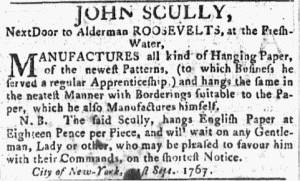
Sep 28 - 9:28:1767 New-York Gazette
New-York Gazette (September 28, 1767).

“All kind of Hanging Paper, of the newest Patterns.”

Prior to the Revolution, many Americans decorated their homes with wallpaper (known in the eighteenth century as “Hanging Paper” or paper hangings) imported from Great Britain. That trade temporarily ceased during the war, but Americans resumed acquiring wallpaper (and many other consumer goods) from England almost as soon as the Treaty of Paris brought an end to hostilities in 1783. At that time, the new nation set its own trade policies and, no longer inhibited by restrictions put in place by Parliament, increased the flow of goods from other European nation-states. Some advertisers promoted French paper hangings as alternatives to any from Britain in the 1780s and 1790s.

Yet importers did not provide Americans sole access to wallpaper, either before or after the Revolution. Domestic manufacturers incorporated “Buy American” appeals into their marketing efforts in the final decades of the eighteenth century. Some even lobbied for tariffs on imported paper hangings in order to bend competition in the marketplace to their own advantage.[1]

Advertisements from the late colonial period reveal that production of wallpaper commenced in America prior to the Revolution. John Scully, for instance, made, sold, and installed “Hanging Paper” and “Borderings suitable to the Paper” in New York in the 1760s. Realizing that many prospective clients might consider imported wallpaper superior for a variety of reasons, he advanced multiple appeals to convince readers of the New-York Gazette to give him a chance. He stressed that he “MANUFACTURES all kind” of wallpaper, implying he offered the same range of choice as his competitors who imported from England. He underscored that his wares followed “the newest Patterns,” reassuring potential customers that they did not have to purchase wallpaper produced on the other side of the Atlantic in order to keep up with fashions set in the cosmopolitan center of the empire. Lest potential clients assume that American manufacturers could not produce wallpaper of the same quality as the English imports, Scully proudly stated that he had “served a regular Apprenticeship” in that business. Customers could depend on his skill.

John Scully realized that his livelihood depended on successfully competing with shopkeepers and paperhangers who sold and installed wallpaper imported from England. To do so, he made appeals to choice, fashion, and his own training to convince consumers to purchase from him.

**********

[1] For more on the marketing of paper hangings after the Revolution, see Carl Robert Keyes, “A Revolution in Advertising: ‘Buy American’ Campaigns in the Late Eighteenth Century,” in Creating Advertising Culture: Beginnings to the 1930s, vol. 1, We Are What We Sell: How Advertising Shapes American Life … And Always Has, ed. Danielle Sarver Coombs and Bob Batchelor (Praeger, 2014), 1-25.

June 23

What was advertised in a colonial American newspaper 250 years ago today?

Jun 23 - 6:23:1767 South-Carolina Gazette and Country Journal
South-Carolina Gazette and Country Journal (June 23, 1767).

“Returns his hearty thanks to those gentlemen and ladies who have favoured him with their custom.”

Richard Fowler, an upholsterer and paperhanger, assisted residents of Charleston in adorning their homes. He sold a variety of decorative arts, including hardware to decorate chests and desk drawers as well as paper hangings (today known as wallpaper), both patterned or with landscape scenes. At the same time that shopkeepers marketed all sorts of housewares for colonists to decorate their personal spaces, Fowler provided means for transforming those spaces by updating the appearances of walls and furniture. Upholstery and paper hangings garnered immediate attention, while the “baubles of Britain” might more easily be overlooked or have less impact.

Acquiring paper hangings and upholstery thus represented both an important choice and a significant investment. Visually, both drew the eye, setting the tone for any room and creating a first impression that testified to the tastes of the residents. Prospective customers wanted to create settings where they felt comfortable, but they also wished to impress visitors and communicate their own style and awareness of current fashions.

To that end, Fowler did not merely supply and install upholstery and paper hangings. Instead, he also took on some of the duties of an eighteenth-century interior decorator, assisting clients in choosing upholstery and paper hangings that best suited them. Note that he described both patterned and landscape paper hangings as “genteel.” Exercising such responsibility required some amount of trust. To gain new patrons, Fowler needed to demonstrate that previous customers had indeed entrusted him to provide such services. He did so by extending “his hearty thanks to those gentlemen and ladies who have favoured him with their custom” and pledged to “merit it by his care and assiduity.” Through extending this invitation to former customers, Fowler implied that he had an active clientele. Regardless of whether previous customers engaged his services again, his advertisement suggested to prospective new customers that Fowler’s services were popular among local “gentlemen and ladies” because he delivered both quality and refinement.