April 24

What was advertised in a revolutionary American newspaper 250 years ago today?
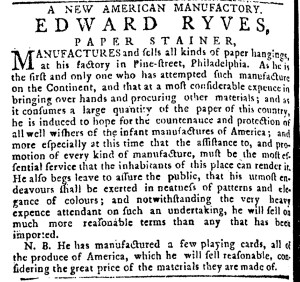
Pennsylvania Journal (April 24, 1776).

“A NEW AMERICAN MANUFACTORY.”

In the spring of 1776, Edward Ryves, a “PAPER STAINER, advertised that he “MANUFTURES and sells all kinds of paper hangings” or wallpaper “at his factory in Pine-street, Philadelphia.”  It was not the first time that Ryves placed such an advertisement.  The previous summer, the partnership of Ryves and Fletcher ran a similar advertisement, one that also proclaimed, “A NEW AMERICAN MANUFACTORY,” in its headline.  Ryves and Fletcher apparently parted ways, but the former retained their marketing strategy and updated it accordingly.  An advertisement that previously stated, “they are the first who have attempted that manufacture on this continent,” now asserted that “he is the first and only one who has attempted such manufacture on the Continent.”  Now that he was on his own, Ryves reserved that accolade exclusively for himself.

He also reiterated appeals intended to enlist consumers who supported the American cause: “he is induced to hope for the countenance and protection of all well wishers of the infant manufactures of America.”  Ryves then expanded on the appeal that he and Fletcher made, stating that “most especially at this time,” a year after a war began at Lexington and Concord, “that the assistance to, and promotion of every kinds of manufacture, must be the most essential service that the inhabitants of this place can render it.”  The paper stainer suggested that buying goods produced in the colonies gave every consumer an opportunity to support the American cause.  Military service was not an option for every colonizer, but every colonizer was a consumer who made decisions about which goods to purchase.  Throughout the imperial crisis, many colonizers advocated for encouraging “domestic manufactures” as an alternative to importing goods from Great Britain.  The Second Continental Congress codified such calls in the eighth article of the Continental Association: “we will, in our several Stations, encourage Frugality, Economy, and Industry; and promote Agriculture, Arts, and the Manufactures of this Country.”  Ryves banked on prospective customers acting on that provision.

As a bonus, Ryves promoted a new product.  In a nota bene, he announced that he “has manufactured a few playing cards, all of the produce of America, which he will sell reasonable, considering the great price of the materials they are made of.”  Readers not in the market for paper hangings could instead support his business (and, by extension, the “infant manufactures of America’) by purchasing a deck of cards for use in their leisure time.

June 19

What was advertised in a revolutionary American newspaper 250 years ago today?

Postscript to Dunlap’s Pennsylvania Packet (June 19, 1775).

“A NEW AMERICAN MANUFACTORY.”

As summer arrived in 1775, Ryves and Fletcher took to the pages of Dunlap’s Pennsylvania Packet to inform the public that they established a “NEW AMERICAN MANUFACTORY” where they made and sold “all kinds of PAPER HANGINGS” (better known as wallpaper today).  The eighth article of the Continental Association, the nonimportation pact devised by the First Continental Congress in the fall of 1774, called for “promot[ing] Agriculture, Arts, and the Manufactures of this Country” as alternatives to imported goods.  That charge had even greater urgency following once colonizers heard about the battles at Lexington and Concord and the ensuing siege of Boston.  When Ryves and Fletcher ran their advertisement two days after the Battle of Bunker Hill, word of that engagement had not yet arrived in Philadelphia.  When it appeared again in July, readers had even more information about momentous events in Massachusetts that likely shaped how they reacted to Ryes and Fletcher marketing paper hangings made in America.

The “PAPER STAINERS,” as Ryves and Fletcher described themselves, asserted that they “are the first who have attempted that manufacture on this continent.”  Perhaps they were not aware that Plunket Fleeson made, advertised, and sold “AMERICAN PAPER HANGINGS” in Philadelphia in 1769, though they may have conveniently overlooked that enterprise in their efforts to promote their own.  Ryves and Fletcher made significant investment in procuring both workers and materials, noting in particular that their undertaking “consumes a large quantity of the paper of this country.”  In return for their dedication to the patriot cause, they “are therefore induced to hope for the countenance and protection of all well wishers to the infant manufacturers of America.”  They did their duty as producers, but that was not enough; consumers now had an obligation to purchase the paper hangings that Ryves and Fletcher made.  The paper stainers launched a “Buy American” campaign at the beginning of the Revolutionary War.  As part of their marketing efforts, they emphasized quality, extolling the “neatness of patterns and elegance of colour,” and price, pledging that “they will sell on much more reasonable terms than any paper can be disposed of which is imported into America.”  Ryves and Fletcher were among the first to produce and market paper hangings made in America, helping establish a new industry during the era of the American Revolution.

**********

I provide a brief case study of patriotic advertisements for paper hangings in Carl Robert Keyes, “A Revolution in Advertising: ‘Buy American’ Campaigns in the Late Eighteenth Century,” in Creating Advertising Culture:  Beginnings to the 1930s, vol. 1, We Are What We Sell:  How Advertising Shapes American Life … And Always Has, eds. Danielle Coombs and Bob Batchelor (New York:  Praeger, 2013), 1-25.