March 2

What was advertised in a revolutionary American newspaper 250 years ago today?
Pennsylvania Ledger (March 2, 1776).

“KEYSER’s FAMOUS PILLS … are selling … By NICHOLAS BROOKS.”

His advertisements in Philadelphia’s newspapers made it clear that Nicholas Brooks diversified his participation in the marketplace in the 1770s.  He often promoted selection of general merchandise, what he called a “curious Collection of various GOODS” in one advertisement, yet on other occasions he specialized in prints and maps.  Sometimes he made special note of those items in his advertisements, such as a nota bene that called attention to a “very large quantity of elegant pictures, maps, copper plater writings, and music,” while other times devoting advertisements exclusively to a “LARGE and curious collection of the most modern PRINTS and PICTURES.”  After the battles at Lexington and Concord in April 1775, Brooks partnered with Bernard Romans, a cartographer and engraver, to publish a “MAP, FROM BOSTON TO WORCESTER, PROVIDENCE AND SALEM” that showed the “SEAT of the present unhappy CIVIL WAR in NORTH-AMERICA” and print that provided “An Exact VIEW of the late BATTLE at CHARLESTOWN,” now known as the Battle of Bunker Hill.”  On the heels of those successful ventures, Brooks also advertised a “NEAT Mezzotinto print of the of the Hon. JOHN HANCOCK, Esquire, President of the CONTINENTAL CONGRESS.”

Yet maps and prints were not Brooks’s only significant side hustle.  He also peddled patent medicines, placing an extensive advertisement for “MAREDANT’s DROPS,” complete with testimonials in March 1772.” He continued hawking patent medicines during the Revolutionary War.  For instance, he placed two advertisements in the March 2, 1774, edition of the Pennsylvania Ledger.  The one for “Dr. RYAN’s INCOMPARABLE WORM-DESTROYONG SUGAR PLUMBS” rivaled his earlier advertisement for Maredant’s Drops in length.  Brooks billed this remedy as “Necessary to be kept in all FAMILIES.”  He described the efficacy of the medicine, noted its popularity in Great Britain and Ireland, and provided directions so prospective customers could see how easily they could administer the sugar plumbs once they purchased them.  In another notice, a much shorter one, Brooks advertised “KEYSER’s FAMOUS PILLS, so well known all over Europe, and in this and the neighbouring colonies, for their superior efficacy and peculiar mildness, in perfectly eradicating every degree of a certain disease.”  He did not need to say much more because this popular cure for venereal disease was advertised widely in the public prints.  Brooks did not exaggerate when he proclaimed that Keyser’s Pills were “so well known” on both sides of the Atlantic.  He also mentioned that he stocked Maredant’s Drops as well.  He offered discounts to retailers “who sell again.”  Side ventures into patent medicines accounted for an alternative revenue stream for Brooks, supplementing his sales of general merchandise and prints.

January 3

What was advertised in a revolutionary American newspaper 250 years ago today?

Pennsylvania Journal (January 3, 1776).

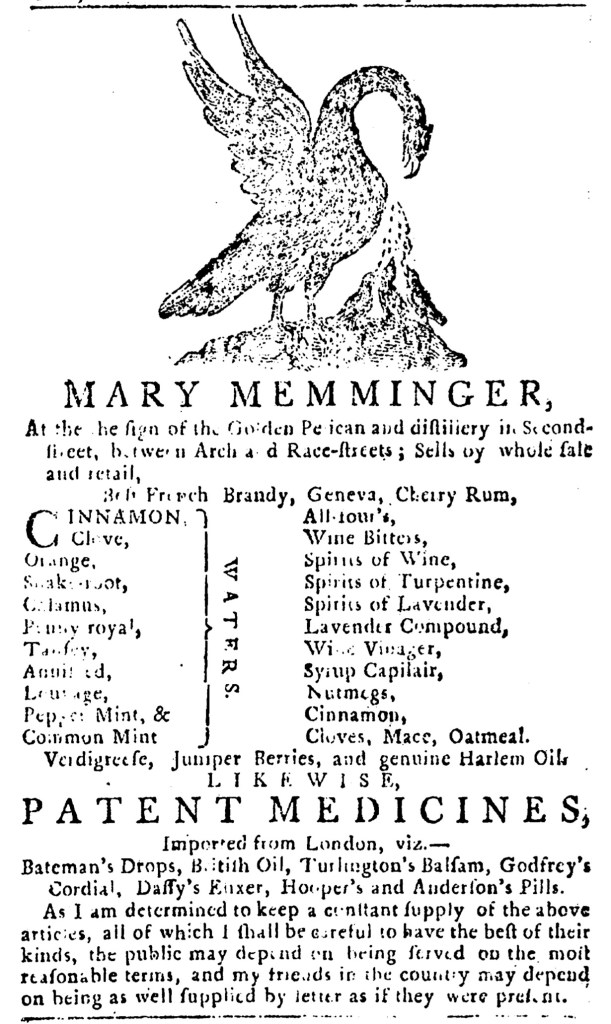
“MARY MEMMINGER, At the sign of the Golden Pelican.”

In the final issue of the Pennsylvania Journal published in 1775 and continuing in January 1776, Mary Memminger advertised the remedies available at her apothecary shop “At the sign of the Golden Pelican” on Second Street in Philadelphia.  Memminger described her shop as a “distillery,” suggesting that she may have produced some of the “WATERS” (including cinnamon, clove, orange, peppermint, and “Common Mint”) and “Spirits of Wine,” “Spirits of Turpentine,” and “Spirits of Lavender.”  She also stocked popular “PATENT MEDICINES, Imported from London,” listing “Bateman’s Drops, British Oil, Turlington’s Balsam, Godfrey’s Cordial, Daffy’s Elixer, [and] Hooper’s and Anderson’s Pills.”  Memminger apparently tended closely to her advertising.  The first time her notice appeared, it featured an error, truncating “Godrey’s Cordial, Daffy’s Elixer” to “Godfrey’s Elixer.”  The compositor fixed the mistake, a rare instance of an updated version of a newspaper advertisement for consumer goods and services after the type had been set.

Memminger did not indicate when she received the patent medicines “Imported from London,” whether they arrived in the colonies before the Continental Association went into effect on December 1, 1774.  Apothecaries and others who sold patent medicines often gave assurances that they were “fresh,” recent arrivals that had not lingered on shelves or in storerooms for months, yet Memminger left it to readers to draw their own conclusions.  She did assert that she was “determined to keep a constant supply of the above articles, all of which I shall be careful to have the best of their kinds,” perhaps indicating a willingness to make exceptions when it came to certain imported items.  Memminger made the health of her clients her priority, promising that “the public may depend on being served on the most reasonable terms, and my friends in the country may depend on being as well supplied by letter as if they were present.”  As a symbol of the care she provided, a woodcut dominated her advertisement (and the entire final page of the January 3, 1776, edition of the Pennsylvania Journal).  As William H. Helfand explains, it depicted “a pelican piercing her breast to nourish her young.”  Perhaps it replicated the “sign of the Golden Pelican” that marked Memminger’s location.  While other apothecaries, like Philip Godfrid Kast and Oliver Smith, deployed images that incorporated mortars and pestles, Memminger declined to include a tool of the trade in favor of emphasizing a symbol of motherly care and sacrifice tending to the welfare of others.

May 30

What was advertised in a revolutionary American newspaper 250 years ago today?

South-Carolina Gazette and Country Journal (May 30, 1775).

“Dr. KEYSER’s GENUINE PILLS, With FULL DIRECTIONS for their Use in all CASES.”

Like many eighteenth-century printers, Charles Crouch, the printer of the South-Carolina Gazette and Country Journal, sold patent medicines as a side hustle to supplement revenues from newspaper subscriptions, advertisements, job printing, and selling books and writing supplies.  In the May 30, 1775, edition of his newspaper, for instance, he ran an advertisement for a “FRESH PARCEL of Dr. KEYSER’s GENUINE PILLS.”  He did not need to explain that the pills treated venereal diseases because they were so familiar to consumers, but that did make it necessary to assure the public that he carried the “GENUINE” item rather than imitations or counterfeits.  Crouch also stocked “Dr. BOERHAAVE’s GRAND BALSAM of HEALTH.”  Realizing that many prospective customers would have been less familiar with this “admirable Remedy,” the printer explained that they could take it for “the dry Belly-Ach, Cholic, Griping in the Bowels, [and] Pain in the Stomach.”  In addition, the balsam “cleanses the Stomach.”  Today, many consumers have favorite over-the-counter medicines for similar symptoms.

Crouch realized that treating venereal disease was a sensitive subject and that customers purchasing Keyser’s Pills wanted to use them correctly and effectively.  He promised in his advertisement that he provided “FULL DIRECTIONS for their Use in all CASES.”  Doing so also minimized the amount of contact between the purchaser and the seller.  Customers did not need to visit an apothecary and go over how to use the medication.  Instead, they could visit the printer, ask for the pills and the directions, and avoid additional interaction.  Some may have even requested Keyser’s Pills along with other items, perhaps ink powder or a recent political pamphlet, to draw attention away from a purchase that caused embarrassment or discomfort.  Crouch also assured prospective customers that the pills were effective, inviting them to examine a “NARRATIVE of the Effects of Dr. KEYSER’s MEDICINE, with an Account of his ANALYSIS, by the Members of the Royal Academy of Sciences.”  Perusing those accounts did require more interaction between buyer and seller, but Crouch may have believed that some readers would have considered it sufficient to know that they were available.  That the printer could provide documentation upon request increased trust in the remedy.

The advertisement for Keyser’s Pills and Boerhaave’s Grand Balsam appeared immediately above a notice listing more than a dozen kinds of printed blanks commonly used for commercial and legal transactions.  Beyond publishing the South-Carolina and Country Journal, Crouch generated revenue through a variety of other means, some of them more closely related to printing than others.  He could earn money with both printed blanks and patent medicines, especially when he deployed savvy marketing.

May 23

What was advertised in a colonial American newspaper 250 years ago today?

Dunlap’s Maryland Gazette (May 23, 1775).

Proper medicines in all stages of the Venereal disease put up with the most faithful attention to the symptoms.”

Patrick Kennedy, a surgeon and apothecary, advertised an “assortment of genuine Patent Medicines” available at his “Drug-Store” in Baltimore in the May 23, 1775, edition of Dunlap’s Maryland Gazette.  He carried many familiar items, including Bateman’s Drops and Stoughton’s Bitters, as well as “a few boxes of Patent dentifrice powder, for cleaning and beautifying the teeth.”  He also “compounded [prescriptions] with care and fidelity.”

Beyond those medicines and services, Kennedy devoted a significant portion of his advertisement to addressing readers who contracted syphilis and other venereal diseases.  “Proper medicines in all stages of the Venereal disease,” the apothecary advised, “put up with the most faithful attention to the symptoms.”  In other words, Kennedy devised prescriptions baes on the specific symptoms that patients reported to him.  When doing so, he observed “the most profound secrecy” to protect the privacy of his clients.  Prospective patients could trust Kennedy’s discretion concerning such delicate matters.  In addition to residents of Baltimore who visited his shop, he offered these services to “Persons afflicted with this disorder in the country.”  He instructed them to send “a line descriptive of their case” and then he would supply “remedies of the most approved kind, with ample directions.”  Providing written directions substituted for in-person consultations, allowing patients to use the medicines responsibly and effectively.  Although some may have been anxious about submitting their requests in writing, they may have found doing so less embarrassing than discussing their symptoms with the apothecary in his shop.  Ordering medicines from a distance made the patients nearly anonymous compared to face-to-face interactions at Kennedy’s shop.  His promise of “profound secrecy” also applied to those orders.

For those who had avoided misfortune and wished to keep it that way, the apothecary promoted the “Antivenereal preventive Wash.”  He explained that “repeated experiments” demonstrated its “assured efficacy in destroying the recent venereal infection; as it never fails to search after and cleanse away the acting cause of the malady.”  Kennedy hoped that readers would consider this preventative regimen worth the investment since it “preserv[ed] the constitution from the long course of medicines” that they would otherwise take after contracting venereal diseases.  As Benjamin Franklin had advised a few decades earlier, an ounce of prevention was worth a pound of cure!  Kennedy hoped that sentiment would resonate with prospective clients who sought to avoid venereal diseases.

January 19

GUEST CURATOR: Braydon Booth-Desmarais

What was advertised in a colonial American newspaper 250 years ago today?

Norwich Packet (January 19, 1775).

“A fresh ASSORTMENT of DRUGS, and GENUINE PATENT MEDICINES.”

Benjamin Dyer Published this advertisement in the Norwich Packet on January 19, 1775.  The advertisement says that he was selling many items, including “GENUINE PATENT MEDICINES,” at his shop in Norwich-Landing.  Patent medicines were available to anyone without needing a prescription.  According to the American Antiquarian Society’s Past Is Present blog, “Usually patent medicines were made of relatively inexpensive ingredients sold at high prices. It is important to know that because many patent medicines did not explicitly list their ingredients.”  Due to this the people selling the items can make claims about what was in the medicine without being fact checked.  It is also important to realize that Dyer referred to all the medicines as “GENUINE,” meaning that whatever was supposed to be in each medicine was in that medicine. Another interesting thing about this advertisement was how it listed each type of medicine that he sold instead of just saying that medicines were available.  I believe that this is because he wanted to show that he had a large number of medicines available.  Shopkeepers like Dyer tried to convince people that their “ASSORTMENT” of medicines were truly genuine and not fakes.

**********

ADDITIONAL COMMENTARY: Carl Robert Keyes

When Braydon and I met to discuss the advertisement that he selected to examine for the Adverts 250 Project, we talked about patent medicines as the over-the-counter medications of the eighteenth century.  They were so familiar to consumers that they did not need descriptions of what each did.  Readers of the Norwich Packet recognized, for instance, Turlington’s Balsam of Life and knew which illnesses, complaints, or discomforts that nostrum treated.  Stoughton’s Elixir, Godfrey’s Cordial, and Bateman’s Drops were the name brands of the period.  When consumers had access to multiple remedies that purported to treat the same symptoms, many had favorites based on experience and reputation.  Reading the list of “GENUINE PATENT MEDICINES” in Dyer’s advertisement in 1775 would have been similar to browsing the aisles of a pharmacy in 2025.

As I worked on other aspects of producing the Adverts 250 Project and Slavery Adverts 250 Project beyond working with Braydon on developing his entry, I noticed another interesting aspect of Dyer’s advertisement.  In addition to running it in the Norwich Packet, he also inserted it in the Connecticut Gazette, published in New London, on January 20.  That increased the circulation of his advertisement, placing it before the eyes of many more prospective customers. This aspect of Dyer’s marketing campaign resonates with the analysis of yesterday’s advertisement, also selected by a student in my Revolutionary America course, that ran in the Connecticut Journal, published in New Haven.  Connecticut had four newspapers, printed in four towns, yet each circulated widely throughout the colony and beyond.  Many advertisers dispatched advertising copy to printing offices in more than one town.  In addition to Dyer’s advertisement, the January 19, 1775, edition of the Norwich Packet featured a notice from clock- and watchmaker Thomas Harland.  He simultaneously ran an advertisement in the Connecticut Courant, published in Hartford.  In his case, he ran two different advertisements rather than submitting identical copy.  Though both advertised in more than one publication, Dyer and Harland made decisions that suited their needs when it came to which messages for consumers they wished to disseminate in which newspapers.

November 12

What was advertised in a colonial American newspaper 250 years ago today?

Providence Gazette (November 12, 1774).

“He pretends not to say that no one can sell so cheap, but believes no one will.”

According to his advertisement in the November 12, 1774, edition of the Providence Gazette, Amos Throop stocked a variety of popular patent medicines, including Hooper’s Pills, Stoughton’s Elixir, Bateman’s Drops, Godfrey’s Cordial, James’s Fever Powder, Turlington’s Balsam of Life, and Hill’s Balsam of Honey “for coughs and consumptions.”  He also sold a variety of medical supplies for both physicians, apothecaries, and home use, such as “pocket cases of surgeons instruments,” “a pretty assortment of bell-metal and glass mortars,” and “beautiful smelling bottles of various figures.”

Throop’s advertisement did not list every item that he recently imported from London.  Like other retailers often did, he promised that prospective customers would discover much more merchandise upon visiting his shop.  “Many more articles might be enumerated,” he proclaimed, “but suffice to say, that a more general assortment never was imported.”  Not only did he offer an array of choices, but the selection was supposedly unrivaled in Providence or anywhere else in the colonies.

In case that was not enough to get the attention of prospective customers, Throop also promoted his prices.  He initially referred to them as “very cheap indeed,” but then elaborated on that point.  Readers would not find more choices elsewhere, “nor can any reasonable objection be made to the prices.  He pretends not to say that no one can sell so cheap, but believes no one will.”  In making that declaration, he invited readers to consider the choices made by purveyors of goods when they set prices for their wares.  Throop claimed that he was not in any sort of special position to offer such bargains.  Anyone else in his line of business could have done the same, but he did not suspect that anyone would.  Throop deliberately chose to sell his merchandise “very cheap indeed.”  Physicians, apothecaries, and other consumers, he suggested, should reward that choice by choosing to buy their patent medicines and medical supplies from him rather than any of his competitors.

October 15

What was advertised in a colonial American newspaper 250 years ago today?

Providence Gazette (October 15, 1774).

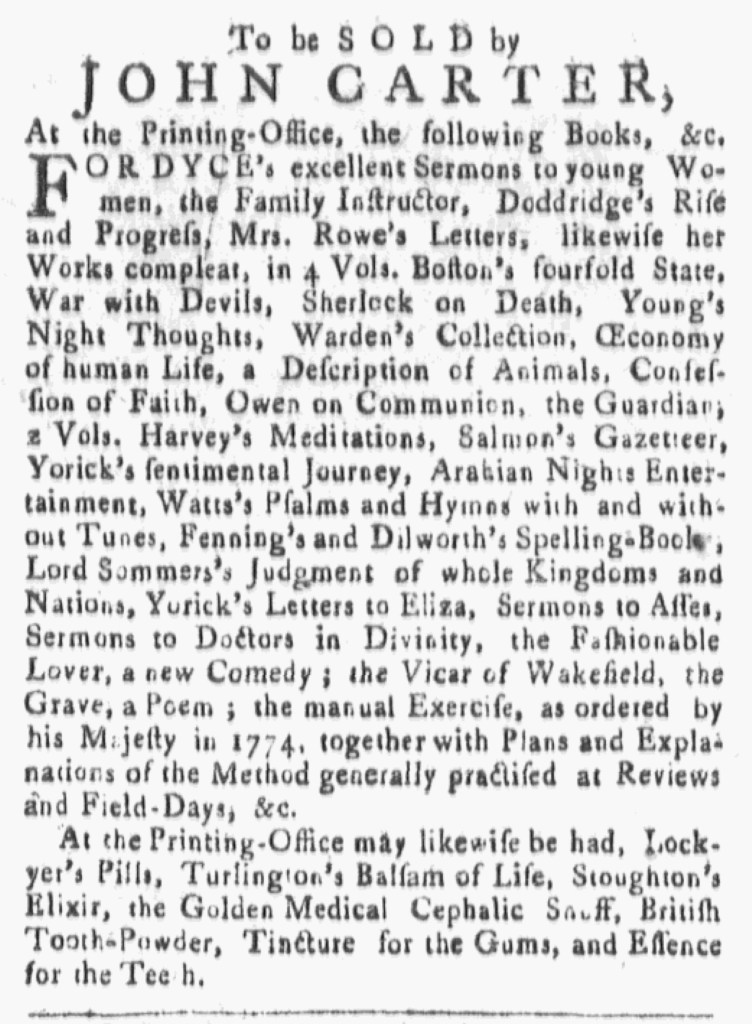
“At the Printing-Office may likewise be had, Lockyer’s Pills, Turlington’s Balsam of Life.”

Colonial printers devised multiple revenue streams to earn their livelihoods.  John Carter, the printer of the Providence Gazette, was no exception.  In addition to seeking subscribers and advertisers for his newspaper, the colophon in each issue announced that “all Manner of Printing-Work is performed with Care and Expedition” at his printing office.  Carter took orders for job printing, everything from handbills and broadsides to printed blanks and circular letters.  Like other printers, he was also a bookseller, dealing primarily in imported volumes rather than books and pamphlets produced in his own shop.  In the October 15, 1774, edition of the Providence Gazette, Carter inserted an advertisement that listed a couple of dozen titles that he had on hand, including “FORDYCE’s excellent Sermons to young Women, the Family Instructor, Doddridge’s Rise and Progress, Mrs. Rowe’s Letters, likewise he Works compleat, in 4 Vols.”  Each fall, Carter collaborated with Benjamin West, an astronomer and mathematician, in publishing an almanac.  Separate advertisements for that useful work would commence soon, though the printer did not yet promote it in the middle of October.

His advertisement did, however, conclude with a separate list of patent medicines that he stocked at the printing office: “Lockyer’s Pills, Turlington’s Balsam of Life, Stoughton’s Elixir, the Golden Medical Cephalic Snuff, British Tooth-Powder, Tincture for the Gums, and Essence for the Teeth.”  Apothecaries imported and sold these popular remedies, as did merchants and shopkeepers … and printers.  Throughout the colonies, printers frequently advertised patent medicines in addition to goods and services associated with the book trade.  They did not need to possess any specialized medical knowledge to peddle these eighteenth-century versions of over-the-counter medications.  Customers already knew which patent medicines treated which maladies.  In addition, the various pills, powders, and elixirs frequently came with printed instructions that absolved printers and other retailers from having to provide any guidance about their use.  When it came to acquiring patent medicines, consumers may have found it just as convenient to visit the local printing office as any other shop.  For his part, Carter accommodated them, supplementing the revenues he earned from printing and selling books.

October 14

What was advertised in a colonial American newspaper 250 years ago today?

Connecticut Journal (October 14, 1774).

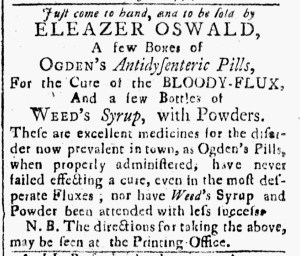
“The directions for taking the above [medicines], may be seen at the Printing Office.”

Colonial printers not only disseminated advertisements for patent medicines but also sold them to supplement the revenues from the other goods and services they offered at their printing offices.  In some instances, printers cooperated with others in advertising and selling patent medicines.  That seems to have been the case with Thomas Green and Samuel Green, printers of the Connecticut Journal and New-Haven Post-Boy, and Eleazer Oswald in the fall of 1774.  Oswald advertised a “few Boxes of OGDEN’s Antidysenteric Pills, For the Cure of the BLOODY-FLUX, And a few Bottles of WEED’S Syrup, with Powders” in the October 14 edition of the Connecticut Journal.  For those unfamiliar with these nostrums, he explained, “These are excellent medicines for the disorder now prevalent in town, as Ogden’s Pills, when properly administered, have never failed effecting a cure, even in the most desperate Fluxes; nor have Weed’s Syrup and Powder been attended with less success.”  As further evidence, Oswald suggested that prospective customers could examine the directions for the patent medicines at the printing office.

Oswald did not mention his affiliation with the Greens, nor did he give a separate address where customers could purchase the medicines.  In a town the size of New Haven, local readers did not always need advertisers to list their addresses.  In this instance, doing so might have been unnecessary if Oswald worked in the printing office and the community knew that without him stating it in the advertisement.  He apparently spent some time in New Haven in addition to seeking opportunities in other towns.  Born in England, Oswald migrated to the colonies in the early 1770s.  He served as an apprentice to John Holt, the printer of the New-York Journal.  In 1779, he entered a partnership with William Goddard in printing the Maryland Journal in Baltimore.  In 1782, he established his own newspaper, the Independent Gazetteer, in Philadelphia.  In the time between his apprenticeship with Holt and his partnership with Goddard, Oswald formed some sort of relationship with the Greens.  He may have worked in their printing office, selling patent medicines as a side hustle, or he may have been a tenant.  Either way, his advertisement for Ogden’s pills and Weed’s syrup and powders had the potential to increase traffic in the printing office, making it an even more bustling hub of activity as colonizers exchanged goods and information.

September 29

What was advertised in a colonial American newspaper 250 years ago today?

Maryland Gazette (September 29, 1774).

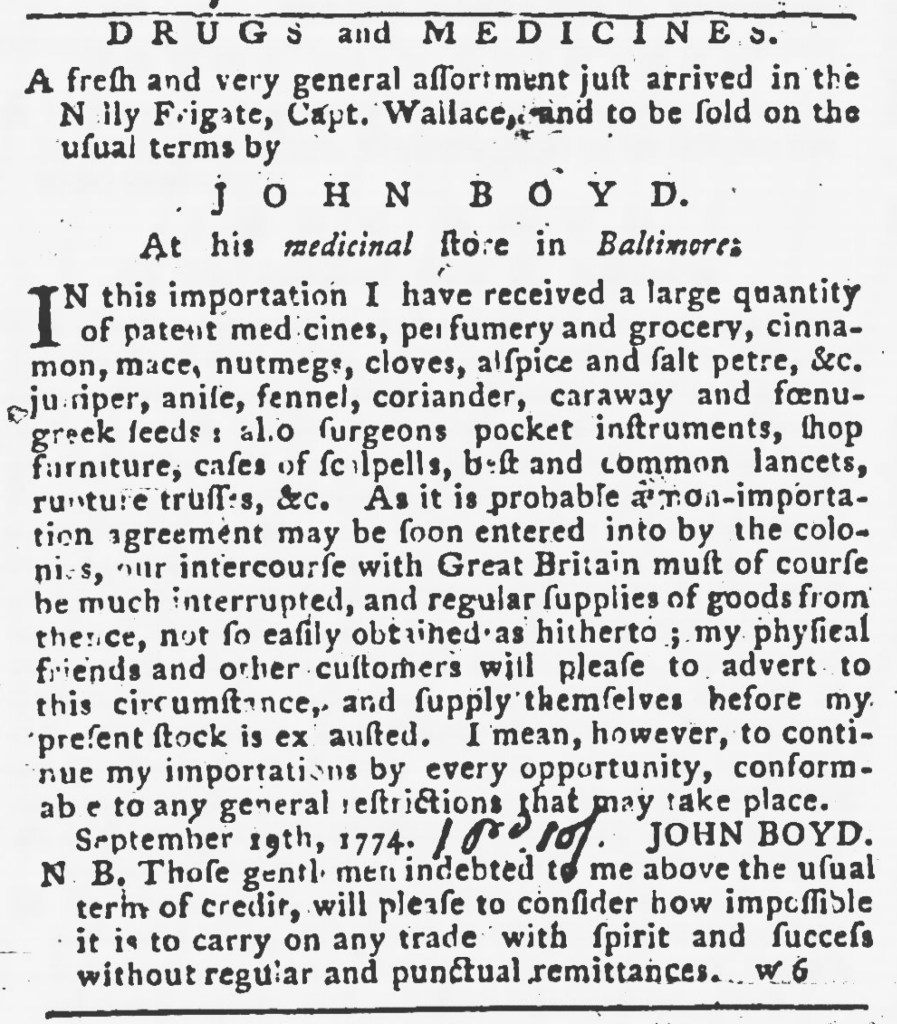
“It is probable a non-importation agreement may be soon entered into by the colonies.”

In the fall of 1774, John Boyd advertised the “DRUGS and MEDICINES” available at “his medicinal store in Baltimore” in both the Maryland Gazette, published in Annapolis, and the Maryland Journal, published in Baltimore.  The latter was still so new that the apothecary realized many of his prospective customers still relied on the former as their local newspaper.  He reported that he just imported a “fresh and very general assortment” of patent medicines, “perfumery and grocery” items, spices, and medical equipment.

Boyd also leveraged current events in hopes of moving his merchandise.  At that moment, the First Continental Congress was meeting in Philadelphia, deliberating over responses to the Coercive Acts passed after the Boston Tea Party.  He reminded readers that “it is probable a non-importation agreement may be soon entered into by the colonies” and when that happened “our intercourse with Great Britain must of course be much interrupted, and regular supplies of goods from thence, not so easily obtained as hitherto.”  That being the case, he advised doctors, his “physical friends,” and his other customers to “supply themselves before my present stock is exhausted.”  In other words, they needed to make purchases while the items they needed or wanted were still available.  A boycott would result in scarcity and, eventually, empty shelves, storerooms, and warehouses.  Boyd was not the only entrepreneur making that argument.  In Charleston, Samuel Gordon recommended to “the Ladies” that they needed to buy his textiles, accessories, and housewares while supplies lasted because “a Non-importation Agreement will undoubtedly take Place here.”  Boyd’s advertisement made clear that it was not solely “the Ladies” who needed to worry about politics causing disruptions in the marketplace.

He vowed to do what he could to limit the effects, stating that he would “continue my importations by every opportunity,” though he carefully clarified that he would do so “conformable to any general restrictions that may take place.”  He would continue accepting shipments for as long as possible, replenishing his stock to ward off scarcity, yet there would come a time that he would have to yield to whatever agreement colonizers adopted.  His advertisement preemptively suggested to prospective customers that they should check with him when they discovered that other apothecaries no longer stocked their usual wares.  Colonizers had experienced nonimportation twice in the past decade, first in response to the Stamp Act and later in response to the duties on certain imported goods in the Townshend Acts.  Savvy entrepreneurs like Boyd reminded them how to prepare for what looked to be inevitable disruptions.

August 2

What was advertised in a colonial American newspaper 250 years ago today?

Connecticut Courant (August 2, 1774).

Opportunity to express the grateful Sense he retains, of the Favors of his Customers in Time past.”

In the summer of 1774, Seth Lee of Farmington ran an advertisement for a “neat and general Assortment of Drugs and Medicines” in the Connecticut Courant.  He advised prospective customers that he sold his wares “ON THE MOST REASONABLE TERMS,” hoping that the promise of bargains would entice them to shop at his store.  His merchandise included a variety of patent medicines, each of them so familiar that Lee merely listed a dozen of them without indicating which symptoms they alleviated or maladies they supposedly cured.  He also called attention to alcohol, groceries, paint, and other items that supplemented his inventory.  Lee peddled two popular beverages, coffee and chocolate, but did not mention tea, an increasingly problematic commodity following the Boston Tea Party the previous December and the Coercive Acts passed by Parliament in response.  Elsewhere in the August 2 edition, Amos Wadsworth and Fenn Wadsworth continued hawking “BOHEA TEA, (not infected with a duty),” while Samuel Wescote advertised “good TEA” without further explanation.

Rather than wade into consumer politics, Lee appended a note to his former customers and prospective new customers.  He declared that he wished “to express the grateful Sense he retains, of the Favors of his Customers in Time past.”  In addition to demonstrating his appreciation for their business, such sentiments also testified to his experience providing satisfactory service, an implicit appeal to new customers as Lee attempted to buttress his reputation.  As he continued, Lee included prospective customers in the invitation he extended to readers to shop at his store.  He addressed “all who will be kind enough to afford him their Custom,” pledging that “it shall be his constant Endeavour to supply them … with any of the above Articles, very cheap.”  Furthermore, they would receive exemplary customer service, with “the least Favorgratefully acknowledged.”  Lee highlighted prices at the beginning and end of his advertisement, but he did not make those “REASONABLE TERMS” the focus of his notice.  Instead, he emphasized the relationships he cultivated with customers in the past and would endeavor to continue providing as “their Humble Servant.”  Lee listed goods to attract attention, then sought to hold it by wooing readers with his devotion to customer service.