May 3

What was advertised in a revolutionary American newspaper 250 years ago today?

Massachusetts Spy (May 3, 1775). Courtesy American Antiquarian Society.

“I beg the Assistance of all the Friends to our righteous Cause to circulate this Paper.”

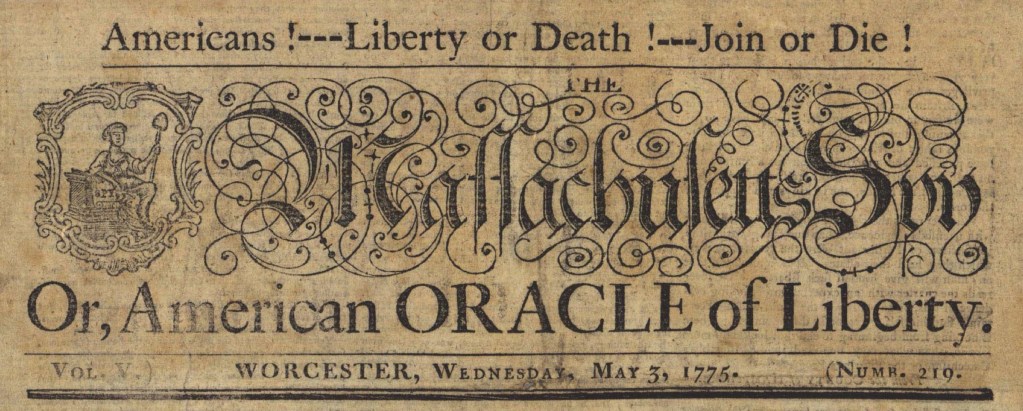
When the patriot printer Isaiah Thomas revived the Massachusetts Spy, originally published in Boston, after fleeing to Worcester to evade “friends of the British administration” who “openly threatened him with the effects of their resentment,” the first issue published in that town opened with a notice to the public.[1]  He reminded readers that he had previously entered into an agreement to aid in establishing a press in Worcester, installing a junior partner to manage a printing office there while he oversaw the enterprise from Boston.  He had issued proposals for the newspaper, intending to name it the “WORCESTER GAZETTE, or AMERICAN ORACLE of LIBERTY.”  However, when Thomas determined that it became “highly necessary that I should remove my Printing Materials from Boston to this Place,” he decided to “continue the Publication of the well-known MASSACHUSETTS SPY, or THOMAS’S BOSTON JOURNAL.”  He continued the numbering but gave it a new title, combining elements of the existing one and the proposed one: Massachusetts Spy Or, American Oracle of Liberty.  In addition, the masthead proclaimed, “Americans! — Liberty or Death! — Join or Die!”

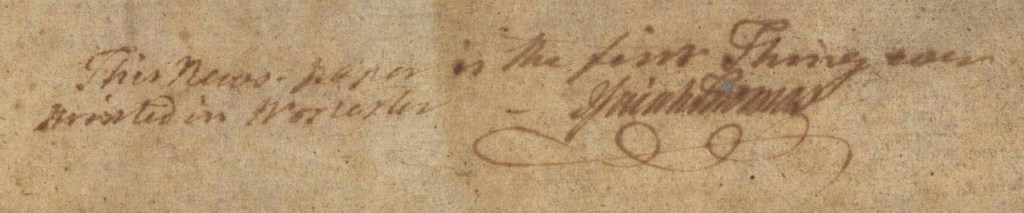
In his notice, Thomas reported that first he sent his “Printing Utensils” to Worcester and then “escaped myself from Boston on the memorable 19th of April, 1775, which will be remembered in the future as the Anniversary of the BATTLE of LEXINGTON!”  Elsewhere that first issue published in Worcester, Thomas provided a chronicle of the battle “collected from those whose veracity is unquestioned.”  That narrative likely incorporated elements drawn from the printer’s own firsthand account.  Several years later, he recorded that at daybreak on April 19 he “crossed from Boston over to Charlestown in a boat with Dr. Joseph Warren, went to Lexington, and joined the provincial militia in opposing the king’s troops.”[2]  The following day, went to Worcester to open the printing office and revive his newspaper.  He was proud of that work and the service he provided, making a note and signing his name in the margin at the bottom of the first page of the first issue published there: “This News-paper is the first Thing ever printed in Worcester – Isaiah Thomas.”
Massachusetts Spy (May 3, 1775). Courtesy American Antiquarian Society.

Having installed himself in that town, he made clear his purpose in publishing the Massachusetts Spy as such momentous events occurred.  He pledged to give “the utmost of my poor Endeavours … to maintain those Rights and Priviledges for which we and our Fathers have bled!”  To that end, he would “procure the most interesting and authentic Intelligence” to keep his readers in central Massachusetts and beyond informed of the latest news.  In addition, he called on “all the Friends to our righteous Cause” to aid in circulating the Massachusetts Spy.  Many had already enlisted in that endeavor, serving as local agents who collected the names of subscribers and forwarded them to the printing office.  In revised proposals that ran immediately below Thomas’s notice, he listed associates who accepted subscriptions in nearly three dozen towns in Worcester County and indicated that “many other Gentlemen in several parts of the province” did as well.

Of the five newspapers published in Boston at the beginning of April 1775, the Massachusetts Spy was the first to suspend publication, the decision resulting from Thomas leaving town rather than the outbreak of hostilities at Lexington and Concord.  It was also the first to resume circulating weekly issues on a regular schedule, a result of the printer’s foresight in relocating to Worcester.  Some of the other newspapers folded completely, but the Massachusetts Spy continued throughout the war and well beyond.
Massachusetts Spy (May 3, 1775). Courtesy American Antiquarian Society.

Click here to view the entire May 3, 1775, edition of the Massachusetts Spy, including Thomas’s note on the first page and the account of the Battle of Lexington on the third page.  That copy is in the collections of the American Antiquarian Society, founded by Thomas in 1812.

**********

[1] Isaiah Thomas, The History of Printing in America: With a Biography of Printers and an Account of Newspapers (1810; New York: Weathervane Books, 1970), 168

[2] Thomas, History of Printing, 168-9.
August 1

What was advertised in a colonial American newspaper 250 years ago today?

Boston-Gazette (August 1, 1774).

“This pamphlet has had a wonderful effect in removing the prejudices and convincing the people of England.”

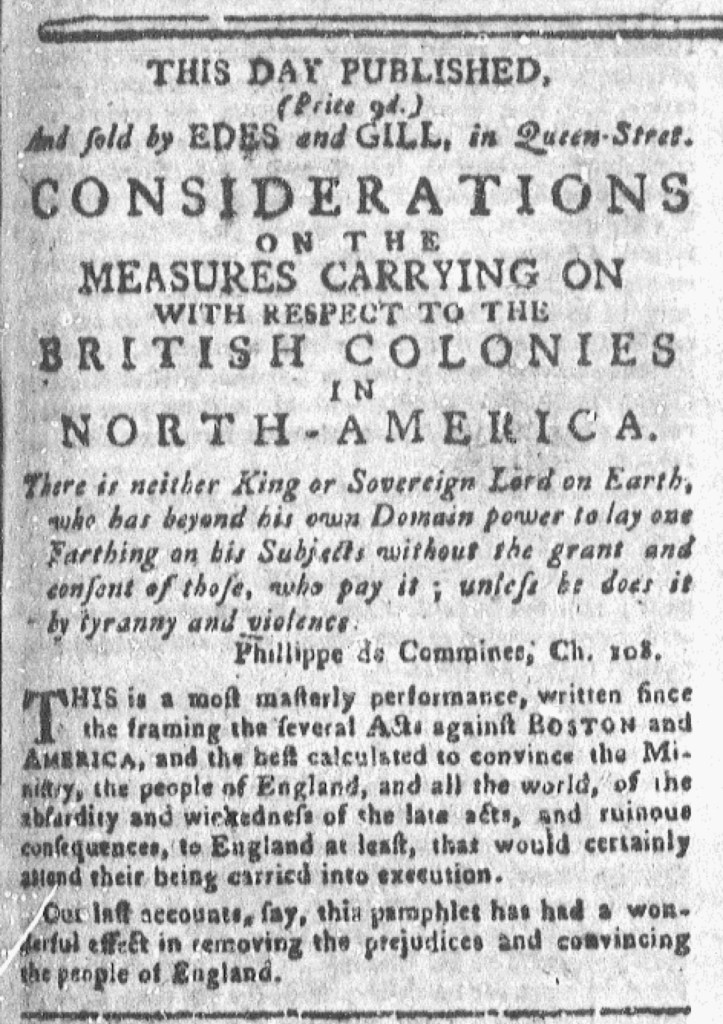
Benjamin Edes and John Gill, the printers of the Boston-Gazette, gave an advertisement for their American edition of Considerations on the Measures Carrying On with Respect to the British Colonies in North-America a prominent place in the August 1, 1774, edition of their newspaper.  It appeared as the first item in the first column on the first page, making it difficult for readers to miss.  The printers wished to call attention to the book, originally published in London, not only because they hoped to generate revenue from its sales but also as a means for colonizers to become even better informed about current events and the political challenges they faced as Parliament passed a series of laws, the Coercive Acts, following the Boston Tea Party.  As the imperial crisis intensified, patriot printers like Edes and Gill published newspapers, broadsides, pamphlets, books, and other items that documented the ongoing contest with Parliament, the king, and royal officials in the colonies.

To convince prospective customers of the necessity of purchasing and perusing this pamphlet, Edes and Gill explained that it was the “most masterly performance, written since the framing of the several Acts against BOSTON and AMERICA,” including the Boston Port Act and the Massachusetts Government Act, and “the best calculated to convince the Ministry, the people of England, and all the world, of the absurdity and wickedness of the late acts.”  Colonizers used newspapers and other publications in their efforts to shape opinion in the colonies, yet they were just as concerned with the information environment on the other side of the Atlantic.  In their publications and letters, they hoped to sway both officials and the general public in London and throughout Great Britain.  They also took note of the support they received for their plight.  In their advertisement for Considerations, Edes and Gill reported that their “last accounts” indicated “this pamphlet had had a wonderful effect in removing the prejudices and convincing the people of England” that Parliament had not been just in its treatment of the colonies.  Whether that was accurate or wishful thinking likely varied from person to person, but the printers wanted to believe that it was true.

Edes and Gill applauded how the pamphlet made a case about the “ruinous consequences, to England at least,” not just the colonies, “that would certainly attend” from the Coercive Acts “being carried into execution.”  Printers in Hartford, New York, and Philadelphia shared those sentiments, producing other American editions in each of those towns.  They hoped that the dissemination of the ideas expressed in Considerations would buttress the resolve of colonizers distressed by Parliament’s most recent legislation, especially upon learning how their allies in England made a case on their behalf.

July 27

What was advertised in a colonial American newspaper 250 years ago today?

Pennsylvania Journal (July 27, 1774).

“Many other articles, which will be sold low for cash, or a short credit.”

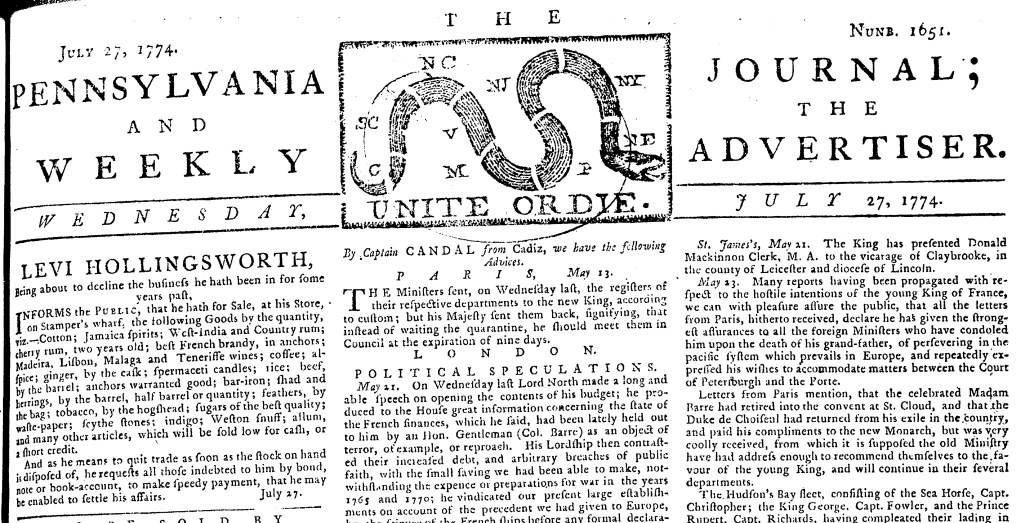
Levi Hollingsworth’s advertisement for a variety of goods available “at his Store, on Stamper’s wharf,” in Philadelphia in the July 27, 1774, edition of the Pennsylvania Journal appeared immediately below a masthead that featured a new image.  Previously, the device had four components.  In the center, a newspaper bearing the title “JOURNAL” sat on a pedestal above a cartouche that showed a ship at sea, those items testifying to information that the newspaper disseminated and the commerce that it facilitated.  An indigenous American on the left and an angel representing Fame on the right flanked the newspaper and ship.  The new device depicted a divided snake, each segment assigned to a colony, with the motto, “UNITE OR DIE.”

In recent weeks, at least two other American newspapers incorporated similar images into their mastheads.  The New-York Journal, printed by John Holt, had done so on June 23.  The images were so similar that William Bradford and Thomas Bradford, printers of the Pennsylvania Journal, likely copied directly from Holt’s newspaper after they received it via exchange networks that linked printers throughout the colonies.  On July 7, Isaiah Thomas adopted an even more elaborate image in the masthead of the Massachusetts Spy, one that showed a divided snake with a pointed tongue and a pointed tail facing off against a dragon that represented Great Britain.  Its admonition demanded that readers “JOIN OR DIE.”  Once the Bradfords updated their masthead, a newspaper published in three of the four largest American port cities circulated the divided snake political cartoon to subscribers and other readers every week.  The Pennsylvania Journalcontinued doing so for fifteen months, returning to its previous device at the end of October 1775.  By that time, the Revolutionary War had started.

In his History of Printing in America (1810), Isaiah Thomas stated that the Pennsylvania Journal “was devoted to the cause of the country.”[1]  Each time that Hollingsworth or other advertisers placed notices in that newspaper they aided in underwriting a partisan press that advocated for the rights of colonizers as British subjects and, eventually, independence from Great Britain.  Each time a reader perused those advertisements, they likely saw the political cartoon in the masthead, forced to engage with its message even if they did not read the news and editorials closely.

**********

[1] Isaiah Thomas, The History of Printing in America: With a Biography of Printers and an Account of Newspapers (1810; New York: Weathervane Books, 1970), 437.

July 17

What was advertised in a colonial American newspaper 250 years ago this week?

New-York Journal (July 14, 1774).

“The great and daily Increase in the Number of Customers to this Paper.”

John Holt’s address to readers of the New-York Journal in the July 14, 1774, edition did not include an element that many likely expected to encounter.  It did not request that subscribers and others who owed money for goods and services provided by Holt’s printing office send payment or else face legal action.  Colonial printers frequently ran such notices, what Isaiah Thomas, printer of the Massachusetts Spy, termed a “‘dunning’ advertisement” a month earlier.  Instead, Holt expressed appreciation to his customers and expounded on the satisfaction he derived from serving the public by disseminating the news.

He also took the opportunity to promote the New-York Journal to readers who were not yet subscribers, commencing his notice by noting a “great and daily Increase in the Number of Customers to this Paper.”  Drawing attention to an increase in circulation also signaled to prospective advertisers that placing notices in the New-York Journal would be a good investment, especially since Holt’s newspaper competed with the New-York Gazette and Weekly Mercury and Rivington’s New -York Gazetteer.  Yet he framed the recent increase in subscribers as approval of “the Sentiments and Measures he has from Inclination and a Sense of Duty endeavoured to inculcate and promote for the public Good.”  For instance, the front page of that edition featured two items reprinted from the South-Carolina Gazette that Holt “republished both on account of the excellent sentiments they express, which are equally applicable to all the British Colonies, and to show that our brethren in South Carolina concur with the other Colonies in resenting and opposing the tyrannical acts of the British Parliament.”  The first of those editorials encouraged colonizers to “UNITE,” echoing the sentiments expressed in the “UNITE OR DIE” image that recently replaced the British coat of arms in the masthead.

Holt allowed that more customers meant “private Advantage to himself,” alluding to more revenue in his printing office, but emphasized that his editorial decisions “have been generally acceptable to all Ranks of People.”  He considered this a “double Pleasure,” while leaving no doubt that he regarded serving the public more important than earning his livelihood.  The printer asserted that “he shall ever receive more Pleasure from those Advantages he may receive in common with the Society of which he is a Member than in those peculiar to himself.”  Positioned first among the advertisements in that issue of the New-York Journal, Holt’s notice did not explicitly make demands of readers, neither to settle accounts nor to become subscribers.  Instead, the printer cultivated support for his newspapers in a more subtle manner, explaining that “the public Good” motivated his editorial perspective and gently suggesting to readers that they become patrons of a newspaper that was already increasing in circulation because “all Ranks of People” appreciated his approach to delivering news and editorials.