September 23

What was advertised in a colonial American newspaper 250 years ago today?
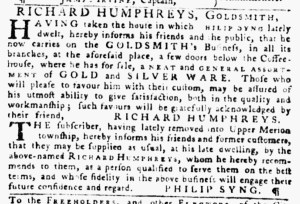
Pennsylvania Gazette (September 23, 1772).

“He hereby recommends to them, as a person qualified to serve them on the best terms.”

As fall arrived in 1772, Richard Humphreys took to the pages of the Pennsylvania Gazette to inform prospective customers that he “now carries on the GOLDSMITH’s Business, in all its branches” at “the house in which PHILIP SYNG lately dwelt” near the London Coffee House in Philadelphia.  In an advertisement in the September 23 edition, he made appeals similar to those advanced by other artisans who placed notices in the public prints.  He emphasized the choices that he offered to consumers, asserting that he stocked a “NEAT and GENERAL ASSORTMENT of GOLD and SILVER WARE.”  Humphreys also highlighted his own skills, promising that customers “may be assured of his utmost ability to give satisfaction, both in the quality and workmanship” of the items he made, sold, and mended.

In addition to those standard appeals, Humphreys published an endorsement from another goldsmith, Philip Syng!  Syng reported that he recently relocated to Upper Merion.  In the wake of his departure from Philadelphia, he “informs his friends and former customers, that they may be supplied as usual, at his late dwelling, by the above-named RICHARD HUMPHREYS.”  Syng did not merely pass along the business to Humphreys.  He also stated that he recommended him “as a person qualified to serve” his former customers “on the best terms, and whose fidelity” in the goldsmith’s business “will engage their future confidence and regard.”  With this endorsement, Humphreys did more than set up shop in Syng’s former location.  He became Syng’s successor.  In that role, he hoped to acquire the clientele that Syng previously cultivated.  Syng’s endorsement also enhanced his reputation among prospective customers.

Artisans frequently stressed their skill and experience in their advertisements.  Some detailed their training or their previous employment to assure prospective customers of their abilities and competence.  Such appeals required readers to trust the claims made by the advertisers.  Endorsements also required trust, but they did not rely solely on the word of the advertisers themselves.  In this instance, another goldsmith, one known to “friends and former customers” in Philadelphia, verified the claims that Humphreys made in his advertisement.  Syng staked his own reputation by endorsing Humphreys, a marketing strategy intended to give prospective customers greater confidence in the goldsmith who now ran the shop near the London Coffee House.

September 9

What was advertised in a colonial American newspaper 250 years ago today?

Pennsylvania Gazette (September 9, 1772).

“POOR RICHARD’s ALMANACK, for the Year 1773.”

When Isaac Collins published the Burlington Almanack, for the Year of Our Lord, 1773, he placed advertisements in the Pennsylvania Packet and the Pennsylvania Gazette.  His advertisement in the September 7, 1772, edition of the Pennsylvania Packet may have been the first extensive notice about an almanac for 1773 to appear anywhere in the colonies.  Collins, however, did not long remain the only printer occupying a considerable amount of space in the public prints to promote an almanac for the coming year.  When the same advertisement ran in the Pennsylvania Packet two days later, it appeared with a notice for another almanac, a much more familiar title with a significantly longer publication history.

David Hall and William Sellers, printers of the Pennsylvania Gazette and successors to Benjamin Franklin, announced that they “Just publishedPOOR RICHARD’s ALMANACK, for the Year 1773.” That advertisement followed a brief notice, just three lines, from the previous issue. Like Collins, they deployed a longer advertisement that listed a variety of contents “besides the usual astronomical Observations,” hoping that useful and entertaining material would attract buyers.  Poor Richard’s Almanack included, for instance, schedules for “Friends Yearly Meetings, Courts, [and] Fairs,” an essay on a “Way of preventing Wheat Crops, sowed on dunged Land, from being over-run with Weeds,” “Tables of Interest, at six and seven per Cent,” “An Antidote against mispending Time,” and “Wife Sayings.”

Hall and Sellers exercised their prerogative as printers to place their advertisement for Poor Richard’s Almanack at the top of the center column on the first page of the September 9 edition of the Pennsylvania Gazette, making it one of the first items readers encountered.  Collins’s advertisement for the Burlington Almanack appeared immediately below it.  Hall and Sellers could have instead opted to place the notice about the Burlington Almanack among other advertisements on another page rather than giving it such visibility on the first page.  Positioning the two advertisements one after the other, however, allowed for easy comparison.  It also eliminated the possibility that, if separated, prospective customers might notice only the advertisement for the Burlington Almanack and overlook the one for Poor Richard’s Almanack.

Hall and Sellers realized that the Burlington Almanack served a market in New Jersey, but they also knew that the many and varied contents of almanacs had value far beyond their places of publication.  Colonizers in and near Burlington had experience purchasing and consulting Poor Richard’s Almanack and other almanacs published in Philadelphia, especially prior to Collins launching the Burlington Almanack in 1771.  Similarly, some readers of the Pennsylvania Gazette, especially those in towns beyond Philadelphia, may have considered the Burlington Almanack just as useful as Poor Richard’s Almanack.  In placing their advertisement for Poor Richard’s Almanack immediately above Collins’s advertisement for the Burlington Almanack, Hall and Sellers increased the chances that consumers were aware of the available options.  Some may have considered the contents complementary, convincing them to purchase both.

August 26

What was advertised in a colonial American newspaper 250 years ago today?

Pennsylvania Gazette (August 26, 1772).

“Beautifully printed on a fine American Paper, and with elegant Types.”

In the summer of 1772, John Dunlap informed the public that he “JUST PUBLISHED … POEMS on SEVERAL OCCASIONS, with some other COMPOSITIONS; by NATHANIEL EVANS.”  He called on subscribers who previously reserved copies to collect them from his printing office on Market Street in Philadelphia while also encouraging others “who design to become Purchasers … as there are but few Copies thrown off above those subscribed for.”  In addition to promoting the author as a former “Missionary (appointed by the Society for propogating the Gospel) for Gloucester County, in New-Jersey; and Chaplain to the Lord Viscount Kilmorey, of the Kingdom ofIreland,” Dunlap asserted that the book was “Beautifully printed on a fine American Paper, and with elegant Types.”

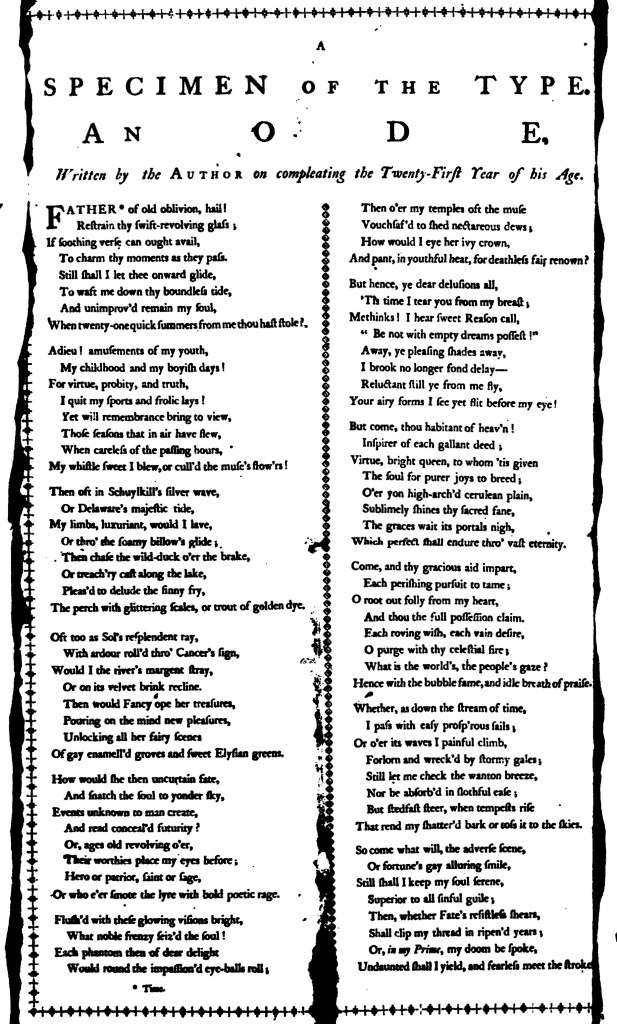
That short advertisement in the Pennsylvania Gazette reiterated several of the appeals that Dunlap previously deployed in marketing the book.  He distributed a broadsheet subscription notice that gave prospective buyers a chance to examine both the paper and the type.  At the beginning of a lengthy description of the project on one side, Dunlap declared that the book would be “printed on the same Pennsylvania manufactured Paper as this Advertisement, and the same Type as the Poem annexed.”  During the imperial crisis, many colonizers express their appreciation for domestic manufactures, items produced in the colonies, making “Pennsylvania manufactured Paper” an attractive alternative to imported paper.  The printer devoted the other side of the broadsheet to “AN ODE, Written by the AUTHOR on compleating the Twenty-First Year of his Age” that doubled as a “A SPECIMEN OF THE TYPE.”  That preview of the content simultaneously allowed buyers to see what they could expect in terms of the material qualities of the book.

An excerpt from the “PREFACE,” including a history of collecting and preparing the poems for publication following the death of the author, appeared on the other side of the broadsheet.  Dunlap appended a note that “the List of Subscribers will be committed to the press,” instructing “all who are desirous of encouraging this Publication, and who may not yet have subscribed [to] send their names.”  He also advised “those who have taken subscriptions of others” to send their lists as quickly as possible so he could include all subscribers in the list and print enough copies to match the advance orders.  In the newspaper advertisement, Dunlap promised that non-subscribers who bought any of the surplus copies would have their name “printed in the List of Subscribers to the 2d Edition.”  They would eventually be recognized among the ranks of those who supported the project.

Dunlap did not rely solely on newspaper advertisements in marketing his edition of Evans’s Poems.  Instead, he printed and distributed a broadsheet subscription notice that incorporated excerpts to entice prospective subscribers.  He also promised public recognition in the form of a printed subscription list.  Unlike newspaper advertisements, the broadsheet utilized the paper and the type for the project, allowing prospective customers to assess the material conditions of the proposed book when they decided if they wished to subscribe.  Although newspaper notices accounted for most advertising in eighteenth century America, entrepreneurs circulated many other kinds of marketing media, including trade cards, catalogs, and subscription notices with excerpts and type specimens.

John Dunlap, Type Specimen from Subscription Notice (Philadelphia, 1772). Courtesy Historical Society of Pennsylvania.

August 19

What was advertised in a colonial American newspaper 250 years ago today?

Pennsylvania Gazette (August 19, 1772).

“The FULLING BUSINESS, in all its branches.”

Joseph Blackwood operated a fulling mill “on the north branch of Raccoon creek, in the county of Gloucester,” New Jersey, in the early 1770s.  In an effort to cultivate customers for this enterprise, he ran an advertisement in the August 19, 1772, edition of the Pennsylvania Gazette.  Blackwood confidently informed readers that he pursued “the FULLING BUSINESS, in all its branches, in as extensive a manner and at as cheap rates, as at any Mill in New-Jersey or Pennsylvania.”

To convince prospective customers that was the case, the fuller declared that he possessed “all necessary tools and conveniences” for processing any cloth delivered to him.  In addition, he was able to operate the mill throughout the year because it had been “so commodiously constructed, with all the works inclosed in a large stone house, in order to avoid being retarded in the winter season.”  Blackwood believed that the equipment combined with his skill and experience would result in customers “having their cloth dressed in the neatest and best manner, and with the greatest expedition.”  He promised quality as well as a quick turnaround on his services.  Blackwood also made it convenient for prospective customers to hire him by establishing a network of local agents in several towns in New Jersey.  Those associates collected “CLOTH for the Mill” and instructions.  The fuller visited each local agent once a week to collect cloth for new orders and deliver processed cloth.

Blackwood made a variety of appeals, yet he did not rely on advertising copy alone.  A woodcut depicting equipment at the fulling mill occupied nearly half the space he purchased in the Pennsylvania Gazette, making his advertisement the only one adorned with an image not supplied by the printers.  Throughout the remainder of the issue, only two other images appeared, the ornate shield with three balls, the crest of the Penn family, in the masthead and a vessel at sea, a stock image, in an advertisement for a ship departing for South Carolina.  The image of the equipment at the fulling mill likely caught the attention of readers, further enhancing an advertisement that incorporated a variety of marketing strategies.  The woodcut encouraged readers to learn about Blackwood’s low prices, speedy service, notable equipment, and network of local associates.  The image likely prompted some readers to examine the dense text in the fuller’s advertisement more closely than they would have without an image to engage their curiosity.

August 12

What was advertised in a colonial American newspaper 250 years ago today?

Pennsylvania Gazette (August 12, 1772).

“He proposes to affix his Name on the Heads of all his Bolts, rolling Screens, and Fans.”

In the summer of 1772, John Sellers of Darby placed advertisements promoting “VARIOUS Kinds of Wire Work” in the Pennsylvania Gazette.  He made and sold “rolling Screens for cleaning Wheat,” “rolling Screens for cleaning Flaxseed from the yellow or wild Seed,” “small Bolts for separating the Cockle from the Flaxseed,” and “common Dutch Fans” for separating wheat from chaff.

Sellers presented a variety of reasons that readers in need of any of those devices should purchase them from him.  He promised that customers who “favour him with their Orders, may depend on their Work being done with Care,” reiterating a description of his products as “made in the neatest and best Manner.”  He also offered a guarantee, stating that “the Work [is] Warranted.  Furthermore, Sellers drew on long experience as an artisan who met the expectations of his clients.  He was “not pretending to perform that which he has not, in a great Number of Instance, given the utmost Satisfaction.”  Over time, he made “upwards of 50 rolling Screens for Wheat, and upwards of 70 for Flaxseed,” establishing his reputation.

Sellers did not expect prospective customers to visit his workshop in Darby, six miles away from Philadelphia, to examine his products or purchase them.  Instead, “for the Conveniency of his Customers,” he arranged to have them on display “in Plumsted’s Stores, in Philadelphia.”  Sellers instructed to customers to ask for John Brown to handle sales.  For those who wished to confer with the artisan directly, he advised that he “attends generally twice a Week, in Philadelphia.”  Anyone interested in contacting him directly could do so by “leaving a Line at the Conestogoe Waggon, in Market-street, or sending by the Post.”

To attract notice to the various appeals he deployed in the copy of his advertisement, Sellers adorned it with a woodcut depicting one of the rolling screens he constructed.  He commissioned that image at least five years earlier, having included it in an advertisement that ran in the Pennsylvania Gazette in September 1767.  Just as sellers aimed to make his newspaper notice distinctive, he also marked the items he made in his workshop.  He informed his customers that he “affix[ed] his Name on the Heads of all his Bolts, rolling Screens, and Fans.”  That demonstrated pride in his craft while also marketing his products every time someone encountered his name on this equipment after it left his workshop. Sellers did not limit his marketing strategy to describing his products.  Instead, he used distinctive marks to draw attention, both an image in his newspaper advertisement and his name branding his bolts, screens, and fans.

August 5

Who was the subject of an advertisement in a colonial American newspaper 250 years ago today?

Pennsylvania Gazette (August 5, 1772).

“Probably will endeavour to pass for a freeman.”

Jem, a “Mulattoe SLAVE,” made his escape during the night of July 15, 1772, liberating himself from Thomas May in Elk Forge, Maryland.  In his efforts to capture Jem and return him to enslavement, May ran an advertisement in which he described Jem as a “cunning ingenious fellow” who “probably will endeavour to pass for a freeman.”  Jem possessed several skills that may have helped him elude May, but those skills also made him even more valuable to the enslaver.  In addition to being able to read “pretty well” and speak Dutch, Jem was a “good workman in a forge, either in finery or chafery, can do any kind of smith’s or carpenter’s work, necessary about a forge, [and] can also do any kind of farming business.”  May also described the clothes that Jem wore when he liberated himself.  No doubt Jem would have offered other details had he been given an opportunity to publish his own narrative.  Even in Jem’s absence, May exerted control over his depiction in the public prints.

Wochentliche Pennsylvanische Staatsbote (August 4, 1772).

May also made decisions about how widely to disseminate advertisements describing Jem and offering “FIVE POUNDS REWARD” for capturing him.  His advertisement appeared in both the Pennsylvania Gazette and the Pennsylvania Journal on August 5.  Of the newspapers published in Philadelphia at the time, those had the longest publication history.  That likely gave May confidence that those newspapers circulated to many readers in Pennsylvania, Maryland, Delaware, and New Jersey.  Apparently, however, he did not consider that sufficient.  May was so invested in capturing and returning Jem to enslavement at the forge that he also placed advertisements in the Pennsylvania Chronicle on August 8 and the Pennsylvania Packet on August 10.  Considering the skills that Jem possessed, May probably thought it well worth the fees to place notices in all four English-language newspapers published in Philadelphia at the time.  He even took advantage of the translation services that Henry Miller, printer of the Wochentliche Pennsylvanische Staatsbote, offered to advertisers in a nota bene that appeared at the bottom of the masthead.  May’s advertisement describing Jem ran in that newspaper on August 4, further increasing the number of colonizers who might read it, carefully observe Black men they encountered, and participate in capturing the fugitive seeking freedom.  Thomas May expended significant money and effort in attempting to re-enslave Jem, using the power of the press to overcome the various advantages Jem sought to use to his own benefit.

July 29

What was advertised in a colonial American newspaper 250 years ago today?

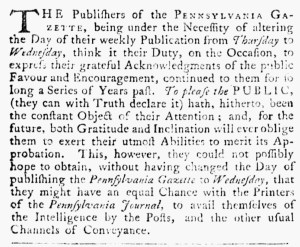
Pennsylvania Gazette (July 29, 1772).

“The Necessity of altering the Day of their weekly Publication.”

It last only two weeks.  On July 15, 1772, William Bradford and Thomas Bradford shifted the publication day of their weekly newspaper, the Pennsylvania Journal, from Thursdays to Wednesdays.  That meant they circulated the Pennsylvania Journal a day earlier than David Hall and William Sellers distributed the Pennsylvania Gazette.  In a notice on the first page, they explained that “A Great number of our friends, thinking that the publication of two Papers on the same day was rather inconvenient to the public, have solicited us to alter ours from Thursday to Wednesday.”  Whether or not any friends played a role in the decision, the Bradfords aimed to scoop their competitor among both subscribers and advertisers.

They managed to do so for two weeks.  On July 29, Hall and Sellers altered their publication day, inserting a notice in their own newspaper to announce that the “Publishers of the PENNSYLVANIA GAZETTE, being under the Necessity of altering the Day of their weekly Publication from Thursday to Wednesday, think it their Duty, on the Occasion, to express their grateful Acknowledgments of the public Favour and Encouragement, continued to them for so long a Series of Years past.”  The printers indicated that the Bradfords forced their hand, making it necessary to change “the Day of publishing the Pennsylvania Gazette to Wednesday, that they might have an equal Chance with the Printers of the Pennsylvania Journal, to avail themselves of the Intelligence by the Posts, and the other usual Channels of Conveyance.”  That was the only way for Hall and Sellers to “exert their utmost Abilities to merit [the public’s] Approbation” and serve their readers.

Did this change come to the attention of the Bradfords before Hall and Sellers distributed a new issue on a Wednesday instead of a Thursday?  Perhaps.  On July 22, they moved their notice about shifting the publication day to the third page, interspersing it among other advertisements, but on July 29, the day Hall and Sellers altered the schedule for the Pennsylvania Gazette, the Bradfords moved their notice back to the top of the first column on the first page of the Pennsylvania Journal.  If they had an inkling that the two newspapers once again appeared on the same day, they may have wished to underscore that their new publication day at least meant that they had not lost any ground to their competitor.  A week later, the Bradfords dropped their notice after the public witnessed the other newspaper follow their lead by adjusting the publication schedule.  Hall and Sellers continued publishing their announcement that the Pennsylvania Gazette matched the recent change by the Pennsylvania Journal.

June 4

What was advertised in a colonial American newspaper 250 years ago today?

Pennsylvania Gazette (June 4, 1772).

“At the Sign of the Scythe and Sickle.”

William Dawson advertised “A LARGE Quantity of SCYTHES and SICKLES, prepared for the ensuing Harvest” in a brief notice in the June 4, 1772, edition of the Pennsylvania Gazette.  His advertisement likely attracted less notice than those placed by other cutlers who marketed their goods and services in the same issue.  Dawson’s competitors in Philadelphia used images to enhance their advertisements.

James Hendricks adorned his advertisement with a woodcut depicting a sickle.  Her announced that he had “ONE HUNDRED and Twenty DOZEN” sickles crafted “with the utmost care, and sold at the lowest Rates, and ensured to be good.”  It was not the first time that he incorporated that image into one of his advertisements.  Two years earlier, it ran in an advertisement that stated that the cutler had a workshop “at the Sign of the Sickle” on Market Street.

Benjamin Humphreys advertised both “SAW-MILL SAWS, And a large QUANTITY of SICKLES.”  An image of a saw occupied the upper third of his notice.  The cutler clearly commissioned the woodcut for his exclusive use.  No other advertiser could use it because the name “B. HUMPHREYS” appeared on the saw.  Like Hendricks, Humphreys incorporated his woodcut into a previous advertisement.  The repetition helped to create a visual identity for his business.  In another advertisement, placed in collaboration with Stephen Paschall in 1768, Humphreys used another woodcut.  That one depicted a scythe and sickle, both of them bearing his last name.

By 1772, Humphreys and Paschall advertised separately, perhaps as a result of the Paschall forming a partnership with his son.  The Paschalls determined that they also needed an image to make their advertisements memorable.  Their woodcut depicted several tools, including a scythe, a sickle, and mechanisms for gristmills, that they made and sold “at the sign of the Scythe and Sickle” on Market Street.  They also had the image personalized for their exclusive use, the initials “SP” on one of the tools. Paschall previously noted that he marked his work with “S. PASCHALL.”

Dawson offered the same merchandise as Hendricks, Humphreys, and Paschall and Paschall, but he might have experienced more difficulty attracting customers to his shop.  His competitors made their advertisements easier to spot in the newspaper as well as more memorable.  Did the images matter?  Were they effective?  Several cutlers in Philadelphia considered it worth the expense to commission their own woodcuts and pay for additional space to include them in their newspaper advertisements.

April 30

What was advertised in a colonial American newspaper 250 years ago today?

Pennsylvania Gazette (April 30, 1772).

“A servant lad of slender fame, / And WILLIAM COCHRAN is his name.”

To increase the chances that readers of the Pennsylvania Gazette would take note of his advertisement about a runaway indentured servant, James Wilson resorted to more than a dozen rhyming couplets.  In the spring of 1772, he advised that “THIS instant April the twelfth day, / From the subscriber run away, / A servant lad of slender fame, / And WILLIAM COCHRAN is his name.”  Wilson then described Cochran’s clothing, age, and physical characteristics, incorporating as much information as appeared in other advertisements placed for the same purpose but in verse to entertain and to hold the attention of readers who might recognize the fugitive.  In addition, Wilson commenced his advertisement with a headline that proclaimed, “SIX DOLLARS Reward,” and concluded, as was common practice in such notices, with more details about the reward.  “Whoever will this lad secure, / That I again may him procure,” Wilson declared, “As I my honour do regard, / He shall get the above reward, / And all costs reasonable thereon, / By the subscriber, JAMES WILSON.”

Many of the rhymes were quite strained, though Wilson generally did better with the meter.  Still, composing a great work of literature was not his goal.  Instead, he sought to produce an advertisement that readers would notice and remember, especially considering how frequently advertisements for runaway apprentices and indentured servants as well as notices offering rewards for enslaved people who liberated themselves appeared in the Pennsylvania Gazette and other newspapers published in the colony.  The combination of rhyming couplets and the white space within the advertisement that resulted from that format distinguished Wilson’s notice from others.  Three notices about runaway indentured servants appeared immediately above Wilson’s advertisement in the April 30, 1772, edition of the Pennsylvania Gazette, each of them a dense paragraph of text.  Such advertisements were so familiar to eighteenth-century readers that Wilson apparently believed that bad poetry was better than no poetry in drawing attention to his advertisement.

March 12

What was advertised in a colonial American newspaper 250 years ago today?

Pennsylvania Gazette (March 12, 1772).

The case and cure of Thomas Hewitt, sent to the Proprietor.”

An advertisement for Maredant’s Drops, a patent medicine, in the March 12, 1772, edition of the Pennsylvania Gazetteconsisted almost entirely of testimonials from patients who claimed that it cured impurities of the blood, scurvy, ulcers, “long continued inflammations of the eyes,” and a variety of other maladies.  Nicholas Brooks sold Maredant’s Drops at his shop on Market Street in Philadelphia.  In his advertisement, he directed prospective customers to visit in order to examine “the cases of the following persons, and many others, cured by Maredant’s drops.”  He listed several individuals, including “Joseph Feyrac, Esq; lately Lieutenant-Colonel in the 18th regiment of foot,” “Mr. Stoddard, brewer, Mr. Thomas Forrest, Attorney,” and “John Good, late surgeon to his Majesty’s sloop Ferrit.”  Brooks anticipated that the volume of testimonials would convince colonizers to take a chance on the patent medicines to see if they would benefit from similar results.

The shopkeeper noted that the patent medicine “may be taken in any season, without the least inconvenience or hindrance from business.”  In addition, this nostrum would “perfect digestion, and amazingly create an appetite.”  He did not say much else about Maredant’s Drops, but instead relied on two testimonials inserted in the advertisement.  In the first, dated “Kilkenny, June 25, 1771,” Thomas Hewitt explained that twenty years earlier he “was afflicted with a most violent scurvy” in his arms that eventually led to “large ulcers and blotches” on his face.  He consulted “several eminent physicians, and tried various medicines, prescribed by them, to little or no effect.”  Other residents of Kilkenny, where Hewitt lived for more than thirty years, could confirm that was the case.  Eventually, Hewitt saw Maredant’s Drops advertised by a printer in Kilkenny.  He purchased four bottles.  The medicine “quite restored” his appetite and the scurvy “gradually left [his] face, and all parts of [his] body.”  Hewitt declared himself “perfectly cured.”  The mayor of Kilkenny co-signed Hewitt’s testimonial to “certify the above case to be a fact.”

In another testimonial, Charles Ashley, an innkeeper, described the misfortunes of his son, afflicted with “the King’s evil” (scrofula, a form of tuberculosis) after surviving smallpox.  His son “was in so much misery, and without hopes of recovery” that Ashley “despaired of his life.”  When Ashley’s son recovered upon taking the “most excellent drops,” the innkeeper felt such “gratitude for so extraordinary a cure” that he “desired this to be made public.”  Furthermore, he invited readers to call at his house, “the Talbot inn, in the Strand,” to learn more and “see the child” for themselves.  Brooks apparently believed that he did not need to say more about Maredant’s Drops.  He depended on the testimonials to do all the necessary marketing.