Happy Birthday, Benjamin Franklin!

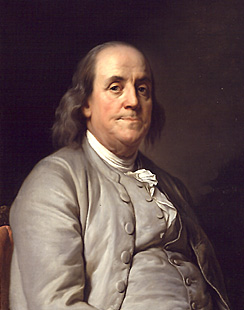
Today is an important day for specialists in early American print culture, for Benjamin Franklin was born on January 17, 1706 (January 6, 1705, Old Style), in Boston. Among his many other accomplishments, Franklin is known as the “Father of American Advertising.” Although I have argued elsewhere that this title should more accurately be bestowed upon Mathew Carey (in my view more prolific and innovative in the realm of advertising as a printer, publisher, and advocate of marketing), I recognize that Franklin deserves credit as well. Franklin is often known as “The First American,” so it not surprising that others should rank him first among the founders of advertising in America.
benjamin-franklin
Benjamin Franklin (Joseph Siffred Duplessis, ca. 1785).  National Portrait Gallery.

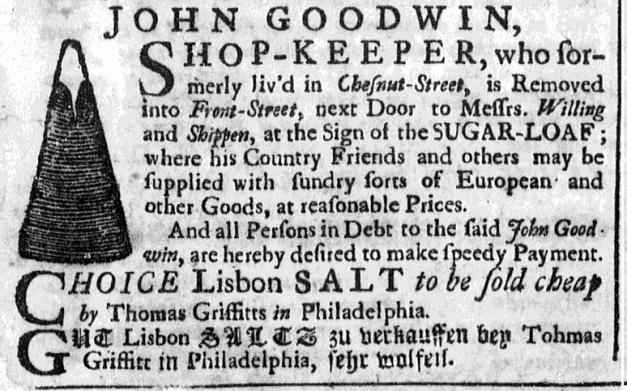
Franklin purchased the Pennsylvania Gazette in 1729. In the wake of becoming printer, he experimented with the visual layout of advertisements that appeared in the weekly newspaper, incorporating significantly more white space and varying font sizes in order to better attract readers’ and potential customers’ attention. Advertising flourished in the Pennsylvania Gazette, which expanded from two to four pages in part to accommodate the greater number of commercial notices.
jan-17-pennsylvania-gazette-19-161736
Advertisements with white space, varying sizes of font, capitals and italics, and a woodcut from Benjamin Franklin’s Pennsylvania Gazette (December 9-16, 1736).

Many historians of the press and print culture in early America have noted that Franklin became wealthy and retired as a printer in favor of a multitude of other pursuits in part because of the revenue he collected from advertising. Others, especially David Waldstreicher, have underscored that this wealth was amassed through participation in the colonial slave trade. The advertisements for goods and services featured in the Pennsylvania Gazette included announcements about buying and selling enslaved men, women, and children as well as notices offering rewards for those who escaped from bondage.

jan-17-pennsylvania-gazette-slave-19-161736
Advertisement for an enslaved woman and an enslaved child from Benjamin Franklin’s Pennsylvania Gazette (December 9-16, 1736).

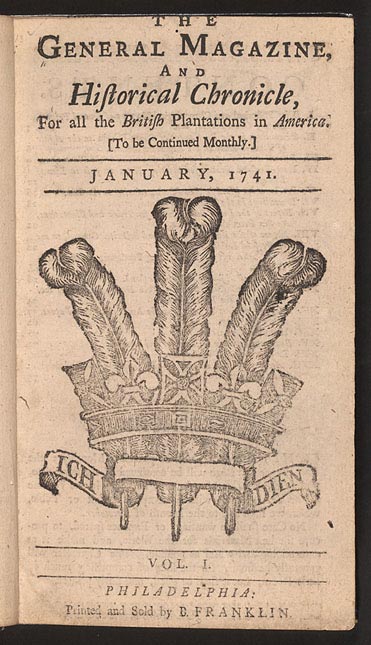
In 1741 Franklin published one of colonial America’s first magazines, The General Magazine and Historical Chronicle, for all the British Plantations in America (which barely missed out on being the first American magazine, a distinction earned by Franklin’s competitor, Andrew Bradford, with The American Magazine or Monthly View of the Political State of the British Colonies). The magazine lasted only a handful of issues, but that was sufficient for Franklin to become the first American printer to include an advertisement in a magazine (though advertising did not become a standard part of magazine publication until special advertising wrappers were developed later in the century — and Mathew Carey was unarguably the master of that medium).
general-magazine
General Magazine and Historical Chronicle, For all the British Plantations in America (January 1741).  Library of Congress.

In 1744 Franklin published an octavo-sized Catalogue of Choice and Valuable Books, including 445 entries. This is the first known American book catalogue aimed at consumers (though the Library Company of Philadelphia previously published catalogs listing their holdings in 1733, 1735, and 1741). Later that same year, Franklin printed a Catalogue of Books to Be Sold at Auction.

Franklin pursued advertising through many media in eighteenth-century America, earning recognition as one of the founders of American advertising. Happy 317th birthday, Benjamin Franklin!

January 13

What was advertised in a colonial American newspaper 250 years ago today?

Pennsylvania Gazette (January 13, 1773).

“MASON AND PATTON … have purchased all the remaining stock of MASON and HARTLEY.”

Mason and Hartley sold dry goods in Philadelphia in the early 1770s.  When the partners went their separate ways, a new firm, Mason and Patton, positioned itself as the successor to Mason and Hartley in a newspaper advertisement that asked former customers to give them their business.  Though the new partners certainly wished to retain the patronage of the clientele that Mason and Hartley cultivated, they also had other purposes when they published their advertisement in the January 13, 1773, edition of the Pennsylvania Gazette.

Indeed, Mason and Patton commenced their notice by announcing that the “partnership of MASON and HARTLEY is now dissolved” and called on “all those indebted to the company, to make immediate payment, as their respective debts become due.”  The new partners asserted that they “are invested with the sole power to collect and settle their company books.”  In addition to customers with outstanding bills, Mason and Patton also requested that those “that have any demands against the said company … send in their accounts … for payment.”  Before promoting their new endeavor, Mason and Patton first attended to the responsible conclusion of the previous partnership.

In so doing, they used the same advertisement “to acquaint the public, that they have purchased all the remaining stock of MASON and HARTLEY, … which they will sell on the most reasonable terms.”  That inventory included a “compleat assortment of EUROPEAN and EAST-INDIA GOODS.”  The new partners retained the location formerly occupied by Mason and Hartley.  They hoped that the continuity in the merchandise and the location would prompt “the continuance of the customers of Mason and Hartley.”  To entice both former and prospective new customers, Mason and Patton proclaimed that they “intend to pursue the Dry Goods Business in a very extensive manner,” touting their “constant fresh supplies from Europe.”  Although they acquired the remaining stock of the former company, that did not mean that customers would select only among goods that lingered on the shelves.  Mason and Patton promised choices to consumers, both returning customers and “the public in general.”

December 30

What was advertised in a colonial American newspaper 250 years ago today?

Pennsylvania Gazette (December 30, 1772).

“The threatening destruction of orchards by catterpillars.”

Rudolph Hains and Jacob Hains operated a tree nursery “near the Red Lion, in Uwchland township, Chester county,” about twenty-five northwest of Philadelphia, in the early 1770s.  In an advertisement in the December 30, 1772, edition of the Pennsylvania Gazette, they related their story of having “for many years past, followed the business of raising young apple-trees, of grafted fruit, of divers sorts, for sale.”  Throughout that time, they “planted many orchards, both for themselves and others.”

Yet the Hains did not place this notice merely to make a sale pitch.  Instead, they framed it as a public service announcement, stating that through their long experience they “found that Catterpillars are some of the worst enemies to Orchards.”  Indeed, the headline for the advertisement proclaimed, “To DESTROY CATTERPILLARS,” inviting readers to peruse it for advice and guidance.  Along the way, prospective customers learned a little more about the Hainses and their business, including Rudolph’s nearly thirty years of experience.  In telling their story, the Hainses warned that “they find a far greater number of [caterpillar] eggs this fall, than either of them ever seen before.”  The problem was so severe that just days earlier Rudolph “gathered upwards of 300 of such Lumps of Eggs” in his orchard in the course of just a few hours.  As a result of a widespread infestation, the Hainses anticipated that “much more damage will be done by them next summer, if not by some means prevented.”  As a remedy, they recommended that readers “pull or cut off their eggs with some instrument for that use … and burn them.”  This required inspecting trees, but the eggs “are easy to be seen sticking on the small limbs of the tree.”

The Hainses offered this advice “for the good of the public” in general as well as for “their customers in particular, who have bought trees of them, or may yet buy.”  There the sales pitch became more blatant.  The Hainses announced that they “purpose to continue said business.”  This public service announcement enhanced their visibility to prospective customers.  It also suggested that customers could depend on an additional service, consultation and advice from the Hainses beyond the initial transaction.  The Hainses concluded their advertisement by asserting that “they thought it their duty to publish this” in order to avoid “the threatening destruction of orchards by catterpillars.”  They invited readers to contact them directly for more information, while also noting that a “sample of the EGGS maybe seen at the New Printing-Office, in Market-street,” where the newspaper that carried the advertisement was published.  This notice served the interests of the entire community.  The Hainses, savvy marketers, hoped that their public service announcement would generate customers for their tree nursery.

December 23

What was advertised in a colonial American newspaper 250 years ago today?

Pennsylvania Journal (December 23, 1772).

“Repeated INSULTS the City has lately received, by damaging, and taking away, the Public Lamps.”

On one of the shortest days of the year, the “WARDENS of the CITY” of Philadelphia offered a significant reward “for discovery of the person or persons, who … TOOK AWAY, one of the PUBLIC LAMPS” on Fourth Street.  To draw attention to this act of vandalism and theft, the wardens placed advertisements in both the Pennsylvania Gazette and the Pennsylvania Journal on December 23, 1772.  The wardens had determined that someone removed and stole the lamp sometime between ten and eleven on Saturday night.  That they could pinpoint the time that precisely suggested that members of the public took enough notice of the light provided by the lamps to notice when that particular lamp was lit for their safety and convenience and when it disappeared.

The wardens considered the removal of the lamp more than an act of vandalism.  They framed it as an assault on the city and its residents.  “The repeated INSULTS the City has lately received, by damaging, and taking away, the Public Lamps,” the wardens proclaimed, “WILL, doubtless, be PROPERLY RESENTED by the INHABITANTS.”  That being the case, the wardens “Request the ASSISTANCE of their FELLOW-CITIZENS, in order to a discovery of the Perpetrators of those infamous practices, that a check may be put, to a growing evil, of the most dangerous tendency.”  Public works, like street lamps, only benefited the public when they remained in place and optional.  The entire community, the wardens argued, shared the responsibility of identifying the vandals, just as the entire community benefitted from the installation of “Public Lamps” to light the streets during the winter months.

The compositors for the Pennsylvania Gazette and the Pennsylvania Journal did their part in alerting the public to this call to action from the wardens of the city.  In the former, the notice ran immediately below the shipping news from the customs house.  As readers finished perusing news items, they encountered the advertisement offering “TWENTY-FIVE POUNDS REWARD” upon the conviction of the vandals.  Even if they did not closely examine other advertisements in the remainder of the issue, readers interested in the news likely saw this notice.  In the Pennsylvania Journal, the compositor placed the notice at the top of the first full column of advertising in the issue.  In the upper right corner of the third page, it appeared next to local news from Philadelphia.  For added measure, the compositor added a manicule to direct readers to the advertisement, the only manicule anywhere in that issue.

December 16

What was advertised in a colonial American newspaper 250 years ago today?

Pennsylvania Journal (December 16, 1772).

“Physicians prescriptions, or family receipts put up in the most careful manner.”

Moses Bartram ran a shop that he called “the OLD MEDICINAL STORE.”  In December, 1772, he ran a newspaper advertisement advising residents of Philadelphia that he “CONTINUES to carry on the business in its various branches” and offered a variety of goods and services.  He stocked “a fresh and general assortment of DRUGS and MEDICINES, Chymical and Galenical preparations of the best quality.”  He also carried patent medicines and, like many apothecaries, both “shop furniture for Practitioners” and “painters colours for either oil or water.”  Bartram filled “orders from town and country.”  He also prepared “Physicians prescriptions” and “family receipts” or remedies “in the most careful manner.”

In marketing the goods and services available at the Old Medicinal Store, Bartram placed his advertisement in three of the five newspapers published in Philadelphia at the time.  Doing so helped him achieve greater market saturation with his notices.  His notice first appeared in the Wöchentliche Pennsylvanische Staatsbote, a German-language newspaper, on December 15.  A note that ran across the bottom of the masthead advised “All ADVERTISEMENTS to be inserted in this Paper, or printed single by HENRY MILLER, Publisher hereof, are by him translated gratis.”  The following day, Bartram’s advertisement ran in both the Pennsylvania Gazette and the Pennsylvania Journal.

Wöchentliche Pennsylvanische Staatsbote (December 15, 1772).

The apothecary chose not to place his advertisement in the two newest newspapers published in the city, the Pennsylvania Chronicle and the Pennsylvania Packet.  Both of them had a healthy number of advertisements each week, suggesting that other advertisers had confidence in the circulation numbers for those newspapers.  The Pennsylvania Packet frequently distributed a two-page supplement to accommodate all of the advertisements submitted to the printing office.  In making his choices about where to advertise, Bartram clustered the dissemination of his notices on Tuesdays (Wöchentliche Pennsylvanische Staatsbote) and Wednesdays (Pennsylvania Gazette and Pennsylvania Journal).  He could have spread out the days by placing his advertisements in the Pennsylvania Packet, published on Mondays, or the Pennsylvania Chronicle, published on Saturdays.

Given that all of these newspapers were published only once a week rather than daily, allowing readers more time to peruse the contents before discarding an earlier issue in favor of the newest one, Bartram may not have considered it necessary to spread out the days that his advertisements initially appeared in print.  Other factors, including price, his existing relationships with the various printers, and his perceptions of the circulation of each newspaper, may have been more important to Bartram in choosing where (and when) to advertise.

November 18

Who was the subject of an advertisement in a colonial American newspaper 250 years ago today?

Pennsylvania Gazette (November 18, 1772).

“I AM very sorry for advertising my Wife.”

Marital discord in the Elwell household spilled over into the public prints in the fall of 1772.  In a notice dated October 20, John Elwell of “Salem County, West New-Jersey” revealed some of those difficulties to the readers of the Pennsylvania Gazette.  His advertisement ran a week later in the October 28 edition, stating that “MARCEY ELWELL, my Wife, hath eloped from me, and I am apprehensive that she will run me in Debt.”  Accordingly, he placed the notice “to forewarn all Persons not to trust her on my Account, as I am determined not to pay any Debts of her contracting, after the Date hereof.”  Elwell used formulaic language that appeared in many similar advertisements published throughout the colonies.  As in almost every other instance, the notice told only a portion of the story without any commentary from the wife who reportedly “eloped” from her husband.  Only in rare instances did women publish rebuttals.

Marcey Elwell was not one of those wives who found the resources to run her own advertisement, but a short time later her husband apparently had a change of heart.  In a notice dated November 2, he rescinded his previous statement.  “I AM very sorry for advertising my Wife,” he wrote, “it being done through the Heat of Passion and Inconsideration; which I now retract.”  It took longer for that advertisement to reach the printing office in Philadelphia than the initial one.  The updated notice ran in the November 18 edition, more than two weeks after John wrote it.  By that time, news that the Elwells reconciled may have spread via word of mouth in their local community.  The second newspaper notice served as an update and conclusion for the broader public, alerting shopkeepers, artisans, and others that they could once again do business with Marcey.  Although John did not discuss the particulars in either advertisement, the second notice may have also been part of his penance in convincing his wife to return to him.  The husbands who placed such advertisements sought to shape the narratives about what occurred in their households, though readers knew that the wives had their own perspectives about what happened.  Marcey’s side of the story did not appear in print, but her husband did make a rare public acknowledgment that it was he who had given in to “the Heat of Passion and Inconsideration.”  Few wives received such apologies in the public prints.

November 4

What was advertised in a colonial American newspaper 250 years ago today?

Pennsylvania Journal (November 4, 1772).

“MARGARET DUNCAN … has for sale, A LARGE assortment of MERCHANDIZE.”

Newspapers published in urban ports carried advertisements placed by female shopkeepers hawking their wares, though women were generally less likely to resort to the public prints to promote their businesses than their male counterparts.  Those female shopkeepers and “she merchants” who did advertise demonstrate that women participated in the marketplace in a variety of ways, not solely as shopkeepers.

Margaret Duncan was one of those women who ran newspaper advertisements.  On November 4, 1772, her notice appeared in both the Pennsylvania Gazette and the Pennsylvania Journal.  She advised current and prospective customers that she moved to a new location on Second Street, “three doors below the corner of Arch-street” and “four doors above where she formerly dwelt.”  Duncan stocked a “LARGE assortment of MERCHANDIZE, suitable to the season, imported in the last vessels from Europe.”  She declared that she sold her wares “on the lowest terms for cash or the usual credit.” In terms of substance and style, Duncan’s advertisement did not differ from those placed by other retailers.  She did not address women in particular as prospective customers, nor did she make any feminized appeals to consumers.  Duncan apparently understood that men were consumers as well as producers and retailers, just as women inhabited multiple roles in consumer society.

The shopkeeper did benefit from enhanced visibility the first time her advertisement appeared in the Pennsylvania Journal.  It ran in the middle of the second column on the front page, immediately below news items that began in the first column and overflowed into the next.  She was almost as fortunate with the placement of her notice in the Pennsylvania Gazette.  In that publication, it also appeared in the middle of the second column on the first page, though in that instance it was the second advertisement.

Duncan was the only female shopkeeper to run an advertisement in either of those newspapers that week, but she was not the only woman in Philadelphia who was selling goods to consumers.  Despite their relative absence in the public prints, women running businesses were much more visible to colonizers as they traversed the streets of the busy port and went about their daily activities.  The prominence of Duncan’s advertisement on the front page of two newspapers only hinted at the visibility of women in the marketplace.

October 28

What was advertised in a colonial American newspaper 250 year ago today?

Pennsylvania Gazette (October 28, 1772).

“A catalogue of new and old books … is given away gratis.”

William Woodhouse, a bookseller, stationer, and bookbinder in Philadelphia, regularly advertised in the public prints in the early 1770s.  For instance, he ran an advertisement in the October 28, 1772, edition of the Pennsylvania Gazette, advising consumers that he had recently received a shipment of new inventory from London.  Woodhouse provided some examples to entice prospective customer, starting with stationery items.  He stocked everything from “a large assortment of the best writing paper in all sizes” to “round pewter ink stands” to “sealing-wax, wafers, quills, [and] black and red pencils.”  Woodhouse also listed some of the “variety of new books” at his shop, including “Baskerville’s grand family folio bible, with cuts,” “Pope’s Young’s Swift’s Tillotson’s, Shakespear’s, Bunyan’s. and Flavel’s works,” and “Blackstone’s commentaries, 4 vols. 4to.”  The abbreviation “4to” referred to quarto, the size of the pages, allowing readers to imagine how they might consult or display the books.  Woodhouse even had “Newberry’s small books for children, with pictures” for his youngest customers.

The bookseller concluded his newspaper advertisement with a nota bene that invited consumers to engage with other marketing materials.  “A catalogue of new and old books, with the prices printed to each book,” the nota bene declared, “is given away gratis, by said Woodhouse.”  That very well may have been the “CATALOGUE OF A COLLECTION OF NEW AND OLD BOOKS, In all the Arts and Sciences, and in various Languages” that Woodhouse first promoted six weeks earlier in another newspaper, the Pennsylvania Packet.  That catalog also included “a large quantity of entertaining Novels, with the lowest price printed to each book.”  Most book catalogs, like newspaper advertisements, did not indicate prices.  Woodhouse apparently believed that stating his prices would help in convincing customers to purchase their books from him rather than from any of his many competitors in Philadelphia.  To draw attention to both the prices and his selection, he gave away the catalog for free.

This catalog may have been part of a larger advertising campaign that Woodhouse launched in the fall of 1772.  He might have also distributed handbills or posted broadsides.  In 1771, he circulated a one-page subscription proposal for “A Pennsylvania Sailor’s Letters; alias the Farmer’s Fall.”  A quarter of a century later, Woodhouse distributed a card promoting copies of “Constitutions of the United States, According to the Latest Amendments: To Which Are Annexed, the Declaration of Independence, and the Federal Constitution, with Amendments Thereto.”  It stands to reasons that Woodhouse used advertising media other than newspapers on other occasions, though such ephemeral items have not survived in the same numbers as newspaper advertisements.  I suspect that far more advertising circulated in early America than has been preserved and identified in historical societies, research libraries, and private collections.

October 7

What was advertised in a colonial American newspaper 250 years ago today?

Pennsylvania Gazette (October 7, 1772).

“A quantity of large and small silver work.”

In the fall of 1772, John David, a goldsmith, placed an advertisement in the Pennsylvania Gazette to inform prospective customers that he recently imported a “Neat Assortment of JEWELLERY” as well as a “quantity of large and small silver work.”  To entice consumers, he provided some examples of the merchandise they would find at his shop near the drawbridge in Philadelphia.  The jewelry included “paste shoe, knee, and stock buckles,” “stone sleeve buttons, of different sorts,” “coral necklaces,” and “very neat paste and garnet ear-rings.”  He also stocked “silver soup and punch ladles” and “silver and steel top thimbles.”  He pledged that he would “dispose of” these goods “on the most reasonable terms,” leveraging price in his effort to attract customers.

David used an image of a silver teapot to draw attention to his advertisement.  The woodcut occupied the left third of his advertisement, accounting for a significant amount of the space he purchased in the Pennsylvania Gazette.  In addition, he paid to have the image created for his exclusive use.  Of the fifty advertisements that appeared in the October 7, 1772, edition of the Pennsylvania Gazette, only four included an image. The other three all used stock images of ships at sea in notices that alerted readers of ships seeking passengers and freight.  The printer provided those familiar woodcuts.  In contrast, David made special arrangements for his image of a silver teapot, an image not previously seen by readers of any of the newspapers published in Philadelphia at the time.

The use of images commissioned by advertisers seemed to accelerate in the early 1770s compared to their frequency in newspapers in earlier decades, especially newspapers published in major urban ports.  As merchants, shopkeepers, artisans, and other entrepreneurs experimented with marketing strategies, a growing number decided that visual images augmented advertising copy.  Images commissioned for the exclusive use of particular advertisers remained relatively rare compared to the overall volume of advertising, due to both cost and technology, yet more advertisers decided to enhance their newspaper notices with images that replicated their shop signs or depicted their merchandise.

September 23

What was advertised in a colonial American newspaper 250 years ago today?

Pennsylvania Gazette (September 23, 1772).

“He hereby recommends to them, as a person qualified to serve them on the best terms.”

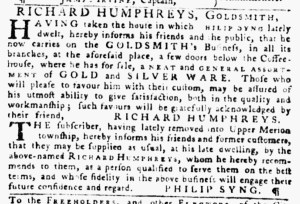
As fall arrived in 1772, Richard Humphreys took to the pages of the Pennsylvania Gazette to inform prospective customers that he “now carries on the GOLDSMITH’s Business, in all its branches” at “the house in which PHILIP SYNG lately dwelt” near the London Coffee House in Philadelphia.  In an advertisement in the September 23 edition, he made appeals similar to those advanced by other artisans who placed notices in the public prints.  He emphasized the choices that he offered to consumers, asserting that he stocked a “NEAT and GENERAL ASSORTMENT of GOLD and SILVER WARE.”  Humphreys also highlighted his own skills, promising that customers “may be assured of his utmost ability to give satisfaction, both in the quality and workmanship” of the items he made, sold, and mended.

In addition to those standard appeals, Humphreys published an endorsement from another goldsmith, Philip Syng!  Syng reported that he recently relocated to Upper Merion.  In the wake of his departure from Philadelphia, he “informs his friends and former customers, that they may be supplied as usual, at his late dwelling, by the above-named RICHARD HUMPHREYS.”  Syng did not merely pass along the business to Humphreys.  He also stated that he recommended him “as a person qualified to serve” his former customers “on the best terms, and whose fidelity” in the goldsmith’s business “will engage their future confidence and regard.”  With this endorsement, Humphreys did more than set up shop in Syng’s former location.  He became Syng’s successor.  In that role, he hoped to acquire the clientele that Syng previously cultivated.  Syng’s endorsement also enhanced his reputation among prospective customers.

Artisans frequently stressed their skill and experience in their advertisements.  Some detailed their training or their previous employment to assure prospective customers of their abilities and competence.  Such appeals required readers to trust the claims made by the advertisers.  Endorsements also required trust, but they did not rely solely on the word of the advertisers themselves.  In this instance, another goldsmith, one known to “friends and former customers” in Philadelphia, verified the claims that Humphreys made in his advertisement.  Syng staked his own reputation by endorsing Humphreys, a marketing strategy intended to give prospective customers greater confidence in the goldsmith who now ran the shop near the London Coffee House.