February 5

What was advertised in a colonial American newspaper 250 years ago today?
Feb 5 - 2:5:1768 New-Hampshire Gazette
New-Hampshire Gazette (February 6, 1768).

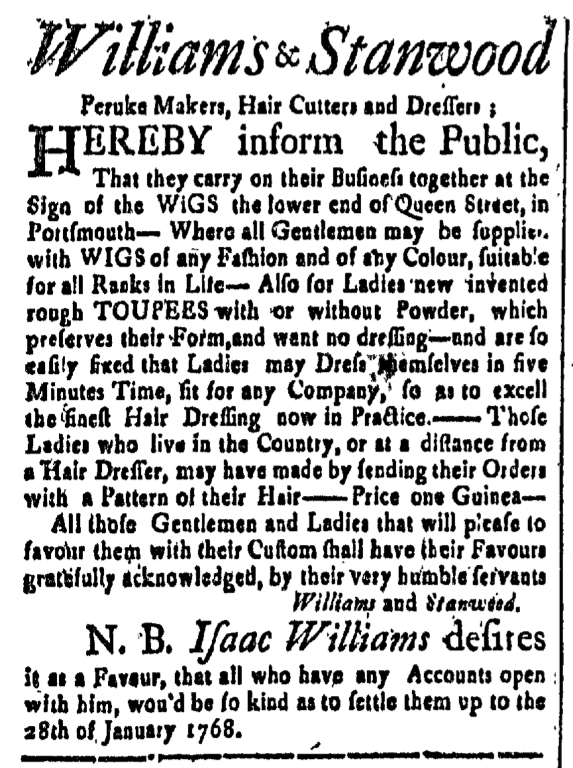
Williams & Stanwood Peruke Makers, Hair Cutters and Dressers.”

In eighteenth-century America wigmakers and hairdressers like Williams and Stanwood did not restrict their attempts to incite demand for their services to the better sorts who resided in the largest port cities. Their advertisement in the February 5, 1768, edition of the New-Hampshire Gazette informed prospective clients in Portsmouth and its hinterland that “they carry on their Business together at the lower end of Queen Street.” Rather than cultivating a clientele of the local elite, they sold gentlemen’s wigs “suitable for all Ranks in Life.” In addition, they served “Ladies who live in the Country, or at a distance from a Hair Dresser,” accepting orders for wigs submitted by post or messenger. Whether potential customers lived in a busy port city or a quiet village did not matter: wigmakers and hairdressers insisted that they must keep up with current fashions by enlisting their services.

Williams and Stanwood also used their advertisement to instruct the ladies about products that might not have been familiar to them previously, including “new invented rough TOUPEES.” Such merchandise needed some explanation to help prospective clients understand their value and convenience. Sold “with or without Powder,” such wigs “preserves their Form, and want no dressing.” They made it that much easier for women to prepare themselves to receive guests in their homes or to appear in public since these wigs were “so easily fixed that Ladies may Dress themselves in five Minutes Time, fit for any Company.” Customers did not, however, benefit from this ease and simplicity by sacrificing the quality or style derived from sitting with the hairdressers at their shop. Williams and Stanwood proclaimed that their toupees “excel the finest Hair Dressing now in Practice.” Ladies did not necessarily need the advantage of leisure time to appear smartly coiffed, especially if they acquired “new invented rough TOUPEES” from Williams and Stanwood.

Urban ports like Charleston, New York, and Philadelphia may have been the cosmopolitan centers of colonial life, but wigmakers and hairdressers did not allow the gentry to dictate that they be the only beneficiaries of their services. Instead, wigmakers and hairdressers encouraged much broad swaths of the colonial population to engage their products and services, portraying them as simultaneously stylish and convenient. Williams and Stanwood sold their wigs to customers of “all Ranks in Life” from city and countryside alike. To that end, they explained new products to prospective clients, training them to desire the most recent creations available in the marketplace.

December 30

What was advertised in a colonial American newspaper 250 years ago today?

Dec 30 - 12:30:1767 Georgia Gazette
Georgia Gazette (December 30, 1767).

“GEORGE NORMAN, PERUKE-MAKER and HAIR-DRESSER … has opened a shop.”

When he opened a new shop in Savannah in 1767, George Norman placed an advertisement in the Georgia Gazette to offer his services as a “PERUKE-MAKER and HAIR-DRESSER” to readers in town and throughout the countryside. Although the term “peruke” has fallen into disuse today, colonists knew that it referred to wigs.

In their examination of “Wigmaking in Colonial America,” Thomas K. Bullock and Maurice B. Tonkin, Jr., summarize the activities of Norman and his counterparts in cities and towns throughout the colonies: “The work of the wigmaking craft in Colonial America consisted primarily of three types of activities; making and selling wigs and false hair pieces for men and women, cutting and dressing ladies’ and gentlemen’s hair, and shaving men.”[1] Individual wigmakers engaged in each of these activities to varying extents. Although Norman did not mention shaving in his advertisement, it may have been an ancillary service he provided for male clients who visited his shop.

The presence of Norman’s advertisement in the Georgia Gazette testifies to the growth of Savannah in the second half of the eighteenth century. According to Bullock and Tonkin, the “wig custom … was primarily an urban practice” in colonial America. Although small in comparison to busy urban ports like Boston, Charleston, New York, and Philadelphia, the largest town in Georgia achieved a sufficient “concentration of people and wealth [to create] a society in which the wig was considered a social or economic asset.” Whether they resided in town or country, planters, merchants, and clergy commonly wore wigs, but the practice was not always limited to elites. Bullock and Tonkin indicate that “certain craftsmen, small shopkeepers, and other skilled workers and artisans, whose jobs brought them in contact with the public, found it advantageous to wear wigs.”[2] More than a mere fashion accessory, wearing a wig served as a symbol of respectability in colonial society.

Bullock and Tonkin also comment on the significance of newspaper advertisements in examining the production and sale of wigs in colonial America: “There is a general scarcity of material relating to the practice of the wigmaking craft in America. Newspaper advertisements constitute the bulk of available information, and it is on this we must rely for an insight into the conduct of the craft.”[3] For more on the tools, methods, and processes involved, consult Colonial Williamsburg’s “Wigmaking in Colonial America.”

**********

[1] Thomas K. Bullock and Maurice B. Tonkin, Jr., “Wigmaking in Colonial America,” (Williamsburg, VA: Colonial Williamsburg Foundation Library, 1957), 11.

[2] Bullock and Tonkin, “Wigmaking,” 9.

[3] Bullock and Tonkin, “Wigmaking,” 10.

May 4

What was advertised in a colonial newspaper 250 years ago this week?

May 4 - 5:2:1766 Virginia Gazette
Virginia Gazette (May 2, 1766).

“William Godfrey, PERUKE MAKER, ACQUAINTS the publick that he has opened shop/”

What was a peruke maker? Once again we discover that eighteenth-century consumers often spoke a language that would become unfamiliar to modern readers. “Peruke” is another name for “periwig” or “wig.” William Godfrey made wigs! When he stated that “he proposes carrying on his business in all its branches,” he most likely meant “making wigs, shaving, cutting and dressing men’s hair and, presumably, dressing wigs,” according to historians from Colonial Williamsburg.

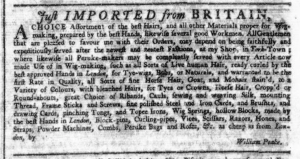
Although his advertisement was relatively short, Godfrey’s occupation opens up an entire world of colonial fashion, a culture of consumption, and the commerce and labor that fueled both. For instance, although Godfrey made his wigs in Virginia, he most likely imported hair and other materials from England. In 1751, William Peale advertised that he had “Just IMPORTED from BRITAIN, A CHOICE Assortment of the best Hairs, and all other Materials proper for Wigmaking.”

May 4 - 7:25:1751 Virginia Gazette
Virginia Gazette (July 25, 1751).

Other scholars have created a variety of resources about peruke makers for various audiences, including:

I find the use of advertisements from eighteenth-century Virginia in “Wigmaking in Colonial America” especially interesting. With only one extant account book from a  wigmaker in colonial Virginia, much of what we know about their wares and services in that colony derives from newspaper advertisements. The original intention of those advertisements may have been to incite demand and attract customers, but, just as language has shifted over time, our purpose in examining those advertisements and what we expect to learn from them has changed as well.