
What was advertised in a revolutionary American newspaper 250 years ago today?
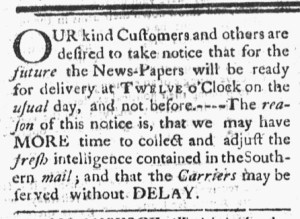
“The News-Papers will be ready for delivery at TWELVE o’Clock on the usual, day, and not before.”
Residents of Worcester really wanted to read the latest news! They were so eager to get their hands on the latest issue of the Massachusetts Spy, a weekly newspaper published on Wednesdays, that they caused problems in the printing office. The disruptions were significant enough that on August 28, 1776, William Stearns and Daniel Bigelow, the printers, found it necessary to insert an advertisement with instructions about when subscribers and others who were curious for “freshintelligence” about the Revolutionary War and other current events should expect to pick up their newspapers. The printers made their notice the first item in the first column on the first page to increase the chances that the offenders saw it and took note.
“OUR kind Customers and others,” Stearns and Bigelow implored, “are desired to take notice that for the future the News-Papers will be ready for delivery at TWELVE o’Clock on the usual, day, and not before.” In other words, the printers did not want subscribers and others dropping by the printing office to ask for copies of the latest edition before noon on Wednesdays. They needed time to produce each new issue, but such inquiries merely distracted them. Stearns and Bigelow explained that the “reason of this notice is, that we may have MORE time to collect and adjust [or select and edit] the fresh intelligence contained in the Southern mail,” which included both correspondence and newspapers from other towns. Like other printers, Stearns and Bigelow reprinted extensively from newspapers they received via their exchange networks. Furthermore, Stearns and Bigelow explained, if local readers waited until noon to pick up their newspapers, then that meant “that the Carriers may be served without DELAY.” After all, the Massachusetts Spy had many subscribers outside of Worcester. They also wanted to know the latest news as soon as post riders could deliver their newspapers.
Two weeks earlier, an advertisement for the newspaper’s “Post Rider to Fitchburg,” a town north of Worcester, emphasized that the Massachusetts Spy carried the “freshest and most important intelligence from the Grand Continental Army at New-York,” news that Stearns and Bigelow “published the next morning after the arrival of the Southern Mail, which contains ALL the LATEST advices from the grand seat of military operation.” Demand for the news apparently matched the interest that the printers sought to incite. Readers knew that “fresh intelligence” arrived at the printing office on Tuesdays for inclusion in a new issue of the newspaper on Wednesdays and they impatiently tried to get more information about current events before the printers had sufficient time to publish it.
[…] and resumed the publication” of the Massachusetts Spy.[1] People clamored for the news, as a notice from Stearns and Bigelow in the Massachusetts Spy demonstrated, yet that was not necessarily enough to make printing a newspaper a viable […]