December 14

What was advertised in a colonial American newspaper 250 years ago today?
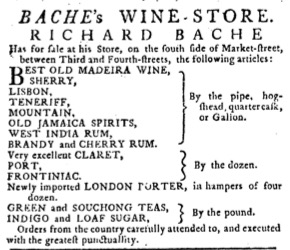
Pennsylvania Journal (December 14, 1774).

“GREEN and SOUCHONG TEAS.”

A year after the Boston Tea Party, advertisements for tea continued to appear in newspapers throughout the colonies.  They even continued to run after the Continental Association, a nonimportation agreement adopted by the First Continental Congress, went into effect on December 1, 1774.  The December 14, 1774, edition of the Pennsylvania Journal, for instance, carried two advertisements, side by side at the top of the final page, that included tea among the commodities offered for sale.  “BACHE’s WINE-STORE” stocked more than just wine and spirits.  Richard Bache also promoted “GREEN and SOUCHONG TEAS … By the pound.”  Similarly, “JOHN MITCHELL’s Wine, Spirit, Rum and Sugar STORES” provided consumers with “Bohea Tea, warranted good, by the chest, half chest or dozen” and “Best Green and Hyson Tea, by the dozen or pound.”  These advertisements apparently did not meet with the sort of ire that resulted in Bache or Mitchell quickly discontinuing them.  Instead, James R. Fichter documents in Tea: Consumption, Politics, and Revolution, 1773-1776, that “between May 1774 and March 1775 their ads appeared most weeks.”[1]

That seems incongruous considering the editorial position of the Pennsylvania Journal and the actions of William Bradford, one of its printers.  Fichter explains that Bradford “hosted in his home the meeting which decided how to oppose the East India Company’s shipment to Philadelphia in 1773.  Furthermore, he published “John Dickinson’s denunciation of the 1773 tea scheme, the broadsides from ‘Committee on Tarring and Feathering,’ which threatened pilots” who brought ships carrying tea up the Delaware River, and the “JOURNAL OF THE PROCEEDINGS” of the First Continental Congress.  On July 27, 1774, the Pennsylvania Journal altered its masthead to include a woodcut depicting a severed snake, each segment labeled to represent one of the colonies, and the motto, “UNITE OR DIE.”  How did advertisements that offered tea for sale find their way into such a newspaper so regularly?  Fichter explains that Bradford “was also a business” as well as a Patriot.  Like other newspaper printers who shared his political principles, he “did not censor tea ads” but instead “ran these ads as long as they were politically permissible.”  Even so late in 1774, “discourse and consumption were only partially politicized,” Fichter asserts, “and advertisements remained separate from but parallel to political debate.”[2]  While that was the case for advertisements about tea, other advertisements did take positions, either implicitly or explicitly, about the politics of consumption, yet Fichter demonstrates the complexity and nuance in how printers, advertisers, and the public approached such issues.  Neither the Boston Tea Party nor the Continental Association resulted in colonizers immediately giving up tea or other imported goods.

**********

[1] James R. Fichter, Tea: Consumption Politics, and Revolution, 1773-1776 (Ithaca: Cornell University Press, 2023), 143.

[2] Fichter, Tea, 143.
October 13

What was advertised in a colonial American newspaper 250 years ago today?

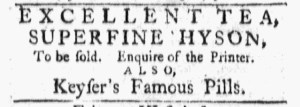
Rivington’s New-York Gazetteer (October 13, 1774).

“EXCELLENT TEA, SUPERFINE HYSON.”

Advertisements for tea did not disappear from American newspapers immediately following the Boston Tea Party, nor did they disappear in anticipation of nonimportation agreements enacted in protest of the Coercive Acts that Parliament passed in response.  In Tea: Consumption, Politics, and Revolution, 1773-1776, James R. Fichter notes, “Printers Isaiah Thomas (Patriot) and James Rivington (Loyalist) used their newspapers to advertise their own tea.”[1]  Rivington did so in the October 13, 1774, edition of Rivington’s New-York Gazetteer, offering both “EXCELLENT TEA, SUPERFINE HYSON,” and “Keyser’s Famous Pills,” one of the most famous patent medicines of the era.

Yet that was not only advertisement for tea in that issue.  In the next column, Abraham Duryee provided an extensive list of imported merchandise that concluded with a familiar list: “sugar, tea, coffee, corks, &c. &c. &c.”  On the next page, tavernkeeper Edward Bardin once again inserted his advertisement that promoted “TEA and COFFEE every afternoon” among the amenities available at his establishment.  In the two-page supplement, filled entirely with advertisements, William Parsons included “Green Tea” among the wares in stock at his store.  Peter Elting sold “best Hyson and Bohea tea” along with other groceries.  Fichter reports that Rivington’s New-York Gazetteer “carried tea ads until early 1775, reaching colonies where local tea advertising had already ended.”[2]  Colonial newspapers tended to circulate across regions, including Rivington’s New-York Gazetteer; or, the Connecticut, Hudson’s Rivers, New-Jersey, and Quebec Weekly Advertiser.

Rivington’s editorial stance as well as the advertisements for tea in his newspaper caught the attention of Patriots in New York and beyond.  They often burned Rivington’s New-York Gazetteer, both along with tea and separately.  Furthermore, Fichter identifies “[c]ommittees in at least twenty communities from Rhode Island to South Carolina called for boycotts of his Gazetteer” and “also pressed Rivington’s advertisers” by “urg[ing] ‘Friends of America’ to avoid Rivington and his advertisers.”[3]  Even as tea became the subject of news coverage and editorials and advertisements for tea no longer appeared in some colonial newspapers, other continued to publish advertisements for tea for more than a year after the Boston Tea Party.  The commodity was hotly contested, even as Patriots attempted to impose a boycott of the problematic beverage.

**********

[1] James R. Fichter, Tea: Consumption, Politics, and Revolution, 1773-1776 (Ithaca: Cornell University Press, 2023), 144.

[2] Fichter, Tea, 154.

[3] Fichter, Tea, 208.

August 14

What was advertised in a colonial American newspaper 250 years ago this week?

Rivington’s New-York Gazetteer (August 11, 1774).

“TEA and COFFEE every afternoon.”

Amid the turmoil over tea that included the Boston Tea Party in December 1773 and closure and blockade of the harbor via the Boston Port Act in June 1774, not all advertisers and consumers abstained from the problematic beverage, despite general calls for boycotting and destroying tea and newspaper editorials that condemned both the threat to liberty and negative effects on the body associated with drinking tea.  Along with coffee, tea had become so much a part of dining, entertaining, and socializing that some entrepreneurs continued to include it among the amenities they offered to their customers in August 1774.

For instance, Edward Bardin, an experienced tavernkeeper, promoted tea when he “open’d the noted tavern at the corner house in the Fields … where ladies and gentlemen may depend upon the best entertainment and attendance.”  In an advertisement in the August 11 edition of Rivington’s New-York Gazetteer, he advised that “The PANTRY opened every evening” with an array of items on the menu, including veal, mutton, duck, chicken, lobster, pickled oysters, custards, and tarts “of different KINDS.”  Patrons could also rent a “large commodious ROOM, fit for balls or assemblies.”  For those interested in a leisurely outing, Bardin served “TEA and COFFEE every afternoon.”  Even though the political crisis intensified, he neither removed the troublesome beverage from his menu nor, apparently, believed that advertising it would lead to more trouble than it was worth.  Not everyone lined up to take a principled stand against tea.

New-York Journal (August 11, 1774).

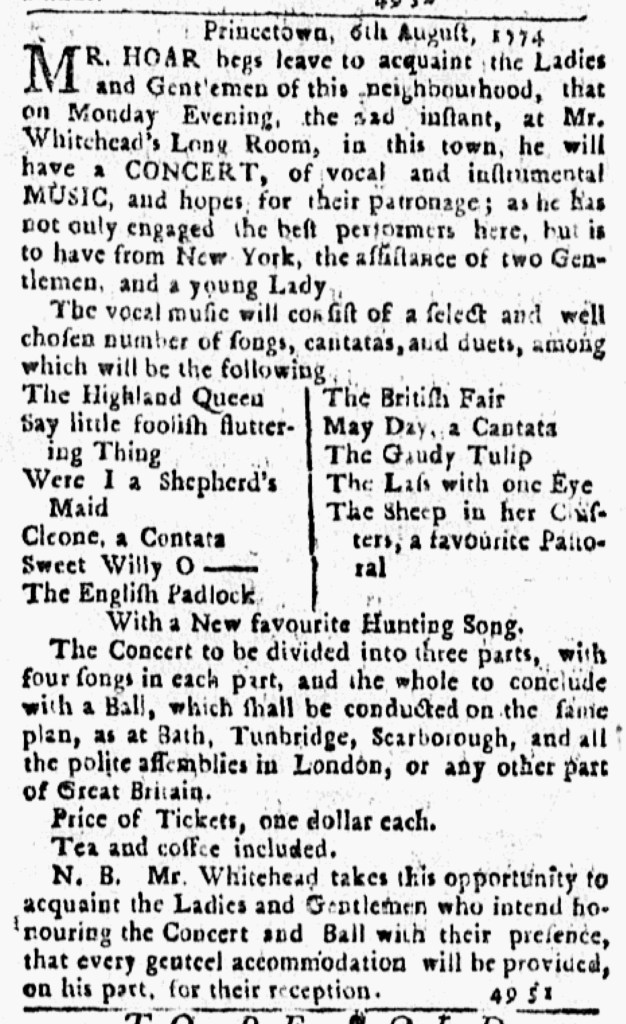
The same day that Bardin published his advertisement for the first time, Mr. Hoar of Princeton, New Jersey, inserted his own notice in the New-York Journal to invite readers in his town to attend a “CONCERT, of vocal and instrumental MUSIC” at “Mr. Whitehead’s Long Room.”  He listed several “songs, cantatas, and duets” on the program.  In addition, the concert would “conclude with a Ball, which shall be conducted on the same plan, as at Bath, Tunbridge, Scarborough, and all the polite assemblies in London.”  The proprietor of the establishment, in a nota bene, promised that “every genteel accommodation will be provided.”  Among those genteel accommodations, “Tea and coffee included” with each ticket.  Neither Hoar nor Whitehead anticipated that serving tea would alienate so many people that it would be better not to mention the beverage.  Instead, they made it a selling point in their advertisement.  Did they face any ramifications for doing so?  Perhaps growing public sentiment eventually encouraged more caution, but the tide had not turned against tea so much that some advertisers refused to include the drink as one amenity among many when they promoted entertainments to colonizers in the summer of 1774.

August 5

What was advertised in a colonial American newspaper 250 years ago today?

South-Carolina and American General Gazette (August 5, 1774).

“*Extract from Dr. RUSH’s Oration.”

Robert Wells had sufficient content to fill a four-page supplement (though printed on a smaller sheet) as well as the standard four-page issue when he took the August 5, 1774, edition of the South-Carolina and American General Gazetteto press.  With so much space to fill, he devoted the entire final page of the standard issue to a book catalog, listing dozens and dozens of titles in four columns.  His inventory represented an array of subjects, though he did not classify or categorize his offerings under headings like other booksellers sometimes did.  Instead, he left it to readers to discover the variety as they perused the catalog.  Among the many titles, he hawked “THE VISIONS of THOMAS SAY of the City of Philadelphia, which he saw in a Trance.”  Wells was either unaware that Say had disavowed that publication in an advertisement in the Pennsylvania Gazette several months earlier or he disregarded it in favor of generating revenue from selling the curious work.

The printer and bookseller also stocked “AN ORATION delivered … before the American Philosophical Society at Philadelphia, containing an Enquiry into the NATURAL HISTORY of MEDICINE among the INDIANS in NORTH-AMERICA … By BENJAMIN RUSH, M.D. Professor of Chemistry in the College of Philadelphia*.”  The asterisk directed readers to an “*Extract from Dr. RUSH’s Oration” that filled the bottom third of the column.  Despite the title, the excerpt (starting on page 67) warned against “luxury and effeminacy” among colonizers, stating that the damage was not so extensive that it could not be remedied.  He offered a series of recommendations, including improved education for children and temperance for adults, while some of them reflected the imperial crisis.  Politics and medicine intertwined when Rush commented on “the ravages which Tea is making upon the health and populousness of our country.  Had I a double portion of all that eloquence which has been employed in describing the political evils which lately accompanied this East-India herb, it would be too little to set forth the numerous and complicated diseases which it has introduced among us.”  The doctor described tea as a hydra, asserting that colonizers needed the strength of Hercules “to vanquish monsters.”  Parliament, the East India Company, and colonizers’ own desire for tea were presumably among the many heads of that monstrous hydra.  The excerpt concluded with an argument that “America is a theatre where human nature will probably receive her last and principal literary, civil and military honours.”

Wells almost certainly selected passages intended to pique the curiosity of readers and leave them wanting more.  They could examine Rush’s entire argument and learn what his comments about education, temperance, and tea had to do with “MEDICINE among the INDIANS” by purchasing the book.  Just as modern publishers provide excerpts to entice prospective customers, Wells published an “Extract” to help boost sales.

South-Carolina and American General Gazette (August 5, 1774).

July 28

What was advertised in a colonial American newspaper 250 years ago today?

Rivington’s New-York Gazetteer (July 28, 1774).

“Excellent Tea.”

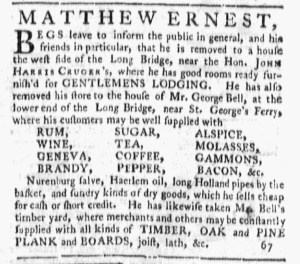
Despite the complicated politics of tea in the wake of the Boston Tea Party and the Boston Port Act that closed and blockaded the harbor as punishment, some merchants and shopkeepers continued to sell tea and printers continued to publish their advertisements in the summer of 1774.  At the same time that many advertisers quietly dropped tea from the lists of merchandise in their newspaper notices, others refused to do so.  In New York, for instance, Matthew Ernest enumerated a dozen commodities that customers could acquire at his store.  In capital letters in three columns, making each item easy for readers to spot, Ernest listed “RUM, WINE, GENEVA, BRANDY, SUGAR, TEA, COFFEE, PEPPER, ALSPICE, MOLASSES, GAMMONS, [and] BACON.”  The merchant supplied tea to consumers willing to purchase it.

Rivington’s New-York Gazetteer (July 28, 1774).

One printer, James Rivington, even sold tea himself or acted as a broker for a customer who did wish for their name to appear in print.  For many weeks, Rivington’s New-York Gazetteer ran an advertisement that announced “Excellent Tea” in a font much larger than almost anything else that appeared among news or advertisements.  It further clarified, “SUPERFINE HYSON, To be sold.  Enquire of the Printer.”  Colonial printers often stocked books, stationery, patent medicines, and other goods, so perhaps Rivington sought to supplement revenues with tea.  On the other hand, an advertisement on the same page as the “Excellent Tea” notice in the July 28 edition promoted “Middleton’s incomparible Pencils, Red and black Lead, Sold by James Rivington.”  Whether or not he was the purveyor of the tea or merely a broker, the printer disseminated the advertisement and sought to earn money through trucking in tea.

In Tea: Consumption, Politics, and Revolution, 1773-1776, James R. Fichter argues that most colonizers who continued to advertise tea did not face significant repercussions, quite a different interpretation than the traditional narrative.  “If we only look at people who got in trouble over tea,” Fichter states, “we will think tea was troublesome.  But if we note the hundreds of people who did not get in trouble over tea, we see a very different story.”[1]  Even as the imperial crisis intensified, there was still space in the public marketplace for advertising and selling tea in the summer of 1774.

**********

[1] James R. Fichter, Tea: Consumption, Politics, and Revolution, 1773-1776 (Ithaca: Cornell University Press, 2023), 145.

July 19

What was advertised in a colonial American newspaper 250 years ago today?

Connecticut Courant (July 19, 1774).

“BOHEA TEA, (not infected with a duty).”

Advertisements for tea did not disappear from American newspapers following the Boston Tea Party in December 1773, nor after the Boston Port Act closed that city’s harbor as punishment in June 1774.  Some merchants and shopkeepers made a point of announcing that they no longer stocked such a controversial commodity.  Others did not include tea alongside coffee and chocolate, an omission that likely did not escape notice since shopkeepers so often marketed those three beverages together.  A few continued with business as usual.  William Beadle, for instance, advertised “GOOD TEA” in the Connecticut Courant in the summer of 1774.

Amos Wadsworth and Fenn Wadsworth also advertised tea in the Connecticut Courant, but they took a more careful approach in marketing it to the public.  They included “BOHEA TEA” among a list of groceries that included coffee and chocolate, though they clarified that their tea was “not infected with a duty.”  The Wadsworths did not explain how they had managed to acquire tea without paying a duty; perhaps they acknowledged with a wink and a nod that they sold smuggled tea, thus enhancing its value to consumers who would derive pleasure from the part they would play in putting one over on Parliament when they purchased the tea.

Realizing how much consumers enjoyed tea despite the political problems associated with it, the Wadsworths highlighted that item in their advertisement.  They stocked “a genuine assortment of DRUGS, MEDICINS” and “an assortment of European and India GOODS” as well as the groceries that they listed in their advertisement.  Among the groceries, only “BOHEA TEA” appeared in capital letters, drawing attention to that item over others.  With capital letters used sparingly in throughout the advertisement, the Wadsworths seemingly made a deliberate decision to accentuate tea while simultaneously affirming that it was acceptable for supporters of the American cause to purchase and drink this tea “not infected with a duty.”  That made their marketing strategy consistent with the principles expressed in editorials that lamented the “oppressive and unconstitutional Acts of the British Parliament.”  The July 19, 1774, edition of the Connecticut Courant also included the text of the Massachusetts Government Act and a poem, “HAIL LIBERTY!”  In that context, the Wadsworths provided a means for consumers to enjoy their favorite beverage in good conscience.

July 8

What was advertised in a colonial American newspaper 250 years ago today?

New-Hampshire Gazette (July 8, 1774).

“Molasses, Coffee, Chocolate; & all Sorts of Spices.”

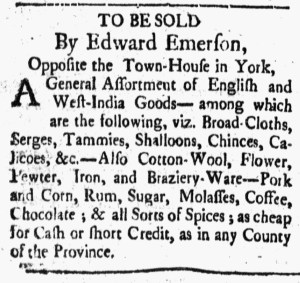
In the summer of 1774, Edward Emerson advertised that he sold a “General Assortment of English and West-India Goods” at his shop “Opposite the Town-House” in York.  At the time, his town, about ten miles northeast of Portsmouth, New Hampshire, was in that portion of Massachusetts that eventually became Maine in 1820.  When Emerson declared that he set prices “as cheap … as in any County of the Province” in the New-Hampshire Gazette, the local newspaper for York, he left it to readers to decide if he made the comparison to Massachusetts or New Hampshire or both.

Emerson likely considered current events in both colonies important in determining how to present his business in the public prints, making it notable that among the groceries he stocked he listed “Pork and Corn, Rum, Sugar, Molasses, Coffee, Chocolate: & all Sorts of Spices,” but not tea.  Merchants and shopkeepers who advertised coffee and chocolate very often promoted tea at the same time, though many had stopped doing so following the Boston Tea Party in December 1773.  Emerson had been no stranger to selling tea in the past, including “TEA by the dozen or smaller quantity” along with “Coffee, Chocolate, and all sorts of Spices” in February 1771 and “Bohea TEA, and all sorts of GROCERIES” in July 1772.  Yet tea had become a much more problematic commodity in recent months …

… so problematic that that Daniel Fowle, the printer of the New-Hampshire Gazette, devoted the entire front page of the July 8, 1774, edition to reporting on “TWENTY-SEVEN Chests of India TEA … consigned to Mr. Parry” and landed in Portsmouth “before it was in fact generally known that any Tea had arrived in the ship.”  The coverage documented the “peaceable and prudent conduct of the inhabitants of Portsmouth” in the face of this crisis, their actions almost certainly influenced by the repercussions that Boston faced following the destruction of the tea there.  At a town meeting, “a committee of eleven respectable inhabitants, were elected to treat with the consignee, and to deliberate what would be most expedient to be done in a cause of so much difficulty and intricacy.”  They also voted to establish “a watch of twenty-five men … to take care and secure the tea” and prevent disorder and disturbances until the committee could devise a method to remove the tea from Portsmouth.  Just as they sought to avoid destroying the tea, they realized that they could not allow any of it to be sold due to “the dependence state of this town and province upon our sister colonies, even for necessary supplies, which would undoubtedly and justly be denied” should they “suffer the sale and consumption of said Tea.”  Once the tea had been safely sent away, the town meeting voted to create “a committee of Inspection to examine and find out if any Tea is imported here” and another committee to draft a measure “against the importation, use, consumption or sale of all Teas, in this town while the same are subject to a duty.”

Given the circumstances, Emerson made a savvy decision not to market tea in his advertisement in the New-Hampshire Gazette.  Not all merchants and shopkeepers refrained from advertising and selling tea at the time, but many decided to discontinue trading that commodity even before boycotts officially went into effect.

June 28

What was advertised in a colonial American newspaper 250 years ago today?

Connecticut Courant (June 28, 1774).

“GOOD TEA, To be Sold.”

William Beadle was at it again.  He advertised “GOOD TEA, To be Sold by WILLIAM BEADLE, At Wethersfield” in the June 28, 1774, edition of the Connecticut Courant and Hartford Weekly Intelligencer.  Unlike many other merchants and shopkeepers, Beadle had not refrained from advertising tea after colonizers disguised as Indians dumped tea into Boston Harbor on December 16, 1773.  In March 1774, he advertisedBest Bohea TEA, Such as Fishes never drink!!”  In April, he opened a new advertisement with a headline promoting “A New Supply of TEA, Extraordinary good.”  Perhaps Beadle sold smuggled tea that evaded the duties imposed by Parliament but could not state that was the case in the public prints … or his politics did not align with the patriots who objected to Parliament regulating trade in the colonies … or he realized that many consumers still wished to drink tea even with the controversy swirling around that commodity.

Still, his latest advertisement hawking tea and only tea seemed especially bold.  It was the first one he published after the Boston Port Act closed and blockaded the harbor until residents of that town paid for the tea that some of them destroyed.  Word of that punishment arrived in the colonies in May, before the legislation went into effect on June 1.  Newspapers throughout the colonies carried coverage of the Boston Port Act and reactions in Boston and other towns.  Many people called for a new round of boycotts on goods imported from England, including tea.  Further coverage focused on other measures meant to bring Boston in line, the series of Coercive Acts that included an Act for the Impartial Administration of Justice and a Quartering Act.  The issue of the Connecticut Courant that ran Beadle’s advertisement featured “AnAUTHENTIC ACCOUNT” from London “of Friday’s DEBATE on the second Reading of the Bill regulating the civil government of the Massachusetts-Bay.”  Known as the Massachusetts Government Act, that legislation abrogated the colony’s charter from 1691 and gave new powers to the royal governor.  That same issue included updates from Boston and, on the same page as Beadle’s advertisement for tea, a “Copy of a Letter from the Committee of Correspondence in New-York, to the Committee in Boston.”  Yet not everyone held what seemed to be the prevailing political sentiments captured in the public prints.  Even as John Holt swapped out the British coat of arms for the severed snake representing American unity in the masthead of the New-York Journal, some merchants and shopkeepers, such as William Beadle, continued advertising tea rather than making pronouncements about abstaining from the beverage due to political principles.

May 27

What was advertised in a colonial American newspaper 250 years ago today?

South-Carolina and American General Gazette (May 27, 1774).

“Souchong Tea at 60s. the Pound.”

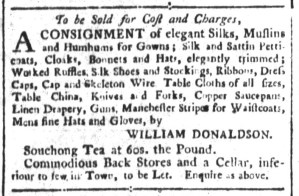
As summer approached in 1774, William Donaldson advertised a variety of goods in the South-Carolina and American General Gazette.  On May 27, he promoted “elegant Silks, Muslins and Humhums for Gowns; Silk and Sattin Petticoats, Cloaks, Bonnets and Hats, elegantly trimmed; [and] Table China,” among other merchandise.  He had a separate entry for “Souchong Tea at 60s. the Pound.”  As in other towns, decisions about buying, selling, and consuming tea were part of an unfolding showdown between the colonies and Parliament.

Residents of Charleston were well aware of the Boston Tea Party that occurred the previous December.  They also anticipated some sort of response from Parliament, but at the time that Donaldson ran his advertisement, word of the Boston Part Act had not yet arrived in South Carolina.  Indeed, four days after Donaldson’s advertisement appeared in the South-Carolina and American General Gazette, another newspaper, the South-Carolina Gazette and Country Journalcarried updates from London, dated March 15, that included an overview of the proposed act to close Boston Harbor until the town paid for the tea that had been destroyed and “made proper concession for their tumultuous behaviour.”  In addition, the report stated that a “light vessel is said to have been kept ready by some friends to the Bostonians in England, in order to carry accounts of the first determination of a Great Assembly.”  By the end of May, colonizers in New England and New York knew that the Boston Port Act had passed and would go into effect on June 1.  The news was still making its way to South Carolina.

When it arrived, Peter Timothy, the printer of the South-Carolina Gazette, considered it momentous enough to merit an extraordinary, a supplemental issue.  Timothy usually published his newspaper on Mondays, but felt that this news could not wait three more days.  He rushed the South-Carolina Gazette Extraordinary to press on Friday, June 3.  The masthead included thick black borders, traditionally a sign of mourning the death of an influential member of the community but increasingly deployed by American printers to lament the death of liberty.  Confirmation of the Boston Port Act inspired new debates about consuming tea and purchasing other imported goods, eventually leading to a boycott known as the Continental Association, but colonizers did not immediately forego buying, selling, drinking, or advertising tea following the Boston Tea Party.  That happened over time (and loyalists like Peter Oliver claimed that even those who claimed to support the boycott devised ways to cheat).  In the interim, Donaldson continued marketing tea along with other merchandise.

May 15

What was advertised in a colonial American newspaper 250 years ago this week?

Massachusetts Spy (May 12, 1774).

“All sorts of Groceries as usual – except TEA.”

By the time that Thomas Walley’s advertisement ran in the May 12, 1774, edition of the Massachusetts Spy, it would have been a familiar sight to regular readers of that newspaper.  It previously appeared on six occasions in March, April, and May, advising the public that Walley stocked a variety of items that he sold wholesale or retail at his “Store on Dock-Square” in Boston.  He had “Dutch looking-glasses of various sizes,” “quart and pint Mugs and Chamber Pots,” and “choice junk” (or old rope) “to make into cordage of any size.”

Walley also sold “Oatmeal per bushel,” “all sorts of Spices,” “choice Rice,” “new Raisins,” and “all sorts of Groceries as usual – except TEA.”  That last entry, listing what he did not sell rather than what he wanted to put into the hands of consumers, may have the primary reason that Walley inserted his advertisement in the Massachusetts Spy so many times.  As one of the owners of the Fortune, the vessel that transported the tea involved in the second Boston Tea Party, Walley had been under suspicion, though he and his partners asserted that they did not have “any share, interest or property, directly or indirectly in any part of the Tea that came from London in said vessel.”  They made that declaration, affirmed by a justice of the peace, in an advertisement that ran in the March 10 edition of the Massachusetts Spy, just days after colonizers disguised as Indians once again dumped tea into Boston Harbor.

A week later, Walley’s advertisement listing a variety of goods “except TEA” appeared in the Massachusetts Spy for the first time.  Given the political orientation of that publication, printed by ardent patriot Isaiah Thomas, it made sense for Walley to take to the pages of that newspaper in his effort to convince the public that he was not trucking in tea.  His advertisement ran again the following week and then on April 7, 15, and 22 and May 5 and 12, missing from only the March 31 and April 28 editions.  Merchants and shopkeepers often ran notices for several months, but in this instance a desire to sell his inventory probably was not Walley’s sole consideration.  He continuously reminded the public that he wanted nothing to do with peddling tea, probably even more so on May 12 when Thomas published a two-page Postscript to the Massachusetts Spy that featured the text of the Boston Port Act that closed the harbor until the colonizers made restitution of the tea they destroyed.  As the crisis intensified, Walley sought to distance himself from tea.