April 12

What was advertised in a colonial American newspaper 250 years ago today?

Connecticut Courant (April 12, 1774).

“A New Supply of TEA, Extraordinary Good.”

William Beadle was at it again.  A few months after the Boston Tea Party, he once again took to the pages of the Connecticut Courant, published in Hartford, to inform readers that he stocked “A New Supply of TEA, Extraordinary Good” at his shop in Wethersfield.  That advertisement first ran on April 12, 1774, a month after the first time he promoted “Best Bohea TEA, Such as Fishes never drink!!”  Readers could not miss the reference to the destruction of the tea in Boston Harbor, though they could have read Beadle’s comment in different ways.  In Tea: Consumption, Politics, and Revolution, 1773-1776, James R. Fichter proposes that Beadle might have sold smuggled tea that had not been subject to import duties or he might have underscored that Connecticut did not have a tea boycott in place so consumers could make their own decisions about purchasing it.  He suggests that Beadle did not experience any backlash, at least not enough to make him reconsider his marketing efforts, because “he placed generic advertisements for tea,” such as today’s featured advertisement, “throughout the spring and summer of 1774 and early 1775.”[1]

Tea was certainly a topic of discussion in Wethersfield and other towns in Connecticut.  In the same issue that first carried Beadle’s “New Supply of TEA” advertisement, updates about tea appeared in several places among the “American Intelligence.”  One “Extract of a letter from Baltimore” stated, “The intentions of the British Administration relative to the American duty on tea, are not yet fixed; the Minister has many weighty subjects to lay before the lower house, before the article will be brought into debate, and the session will be far expended ere any alteration in the revenue laws will be attended to.”  An “Extract of a Letter from London” warned that “Three Men of War are ordered to be immediately in Readiness to sail to Boston, and exact Payment for the Tea.”  News from Newport, Rhode Island, focused on the “New-Yorkers [who] are determined in their resolutions of sending back the tea ship without suffering an ounce to be landed.” That report referred to the Nancy and the trouble that was brewing in New York as the Sons of Liberty there advertised that they would hold weekly meetings “till the Arrival and Departure of the TEA SHIP.”  Tea had become such a sensitive topic that many merchants and shopkeepers ceased listing it among their inventory in their advertisements, but, especially without a nonimportation pact in place, Beadle charted his own course in promoting the popular beverage to consumers in Connecticut.

**********

[1] James R. Fichter, Tea: Consumption, Politics, and Revolution, 1773-1776 (Cornell University Press, 2023), 147.
March 20

What was advertised in a colonial American newspaper 250 years ago this week?

New-York Journal (March 17, 1774).

“The SONS OF LIBERTY will meet on THURSDAY Night … till the Arrival and Departure of the TEA SHIP.”

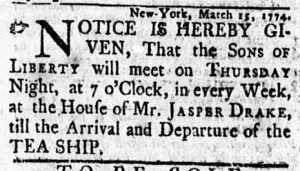
It was a call to action.  An advertisement in the March 17, 1774, edition of the New-York Journal proclaimed, “NOTICE IS HEREBY GIVEN, That the SONS OF LIBERTY will meet on THURSDAY Night, at 7 o’Clock, in every Week, at the House of Mr. JASPER DRAKE, till the Arrival and Departure of the TEA SHIP.”  That advertisement ran in the column next to an anonymous address “TO THE PUBLICK” that anticipated “the TEA-SHIP, which has been long expected, is near at hand.”  The address asserted, “Our sister colonies have gloriously defended the common cause of this country,” referring to the destruction of several shipments of tea in Boston the previous December and colonizers in Philadelphia had managed to prevent the Polly from landing its tea there.  In turn, the address called on colonizers in New York “to stand our ground, and as the day of tryal is now come, that we shall convince the whole American world that we are not slack and indolent, nor in the least degree unworthy, of being registered as a genuine sister province.”  It was a call to match the resolve and resistance already demonstrated in Boston and Philadelphia.

The “TEA SHIP” in these advertisements referred to the Nancy.  As James R. Fichter explains in Tea: Consumption, Politics, and Revolution, 1773-1776, the consignees of the tea aboard the Nancy “hoped to land and store this tea (but not sell it), which was initially acceptable to local Patriots.”[1]  But that was in November.  On December 1, 1773, even before the Boston Tea Party, the consignees “gave up their role in the tea and asked Governor Tryon to take over.”  The governor initially intended to land and store the tea, emboldened by support from British troops, but reconsidered that plan when Patriots in New York decided they could no longer endorse that plan and, especially, after the colony received word about the destruction of the tea in Boston.  That news encouraged Patriots in their position while convincing Tryon that “‘the Peace of Society’ and ‘good Order,’ trumped landing the tea, and the best he could hope for was an outcome like at Philadelphia (where the ship was turned around).”  The governor engineered a plan for the Nancy to land at Sandy Hook, outside New York City’s customs area, where it could be resupplied to return to Boston while evading any legal obligation to unload its cargo.  Yes, as Fichter notes, the governor “could not formally condone smuggling around His Majesty’s customs, even if it would maintain order.  So Tryon made no official announcement.”  Instead, he made sure that Patriots overheard conversations about this plan when they gathered at one of the coffeehouses in the city.

In the meantime, the Nancy continued making its way across the Atlantic, sheltering in Antiqua in February 1774 following a storm.  The ship made then its way to British mainland North America, arriving at Sandy Hook on April 18, a month after the Sons of Liberty advertised their weekly meetings at Drake’s house.  Conveniently, the governor was away from the city at the time.  Local Patriots observed the Nancy receiving supplies for its return to London, intervening only to prevent sailors who did not wish to continue on a ship further damaged in another storm from coming ashore.  The Nancy needed a crew to return to London without lingering in the waters near New York or inciting any sort of disorder that the carefully orchestrated plan had avoided so far.  As the Son of Liberty’s advertisement in the New-York Journal demonstrates, tea remained a flashpoint for resistance after the Boston Tea Party.  They achieved their goal of the “Arrival and Departure of the TEA SHIP.”

**********

[1] For quotations and a more extensive overview of the Nancy, see James R. Fichter, Tea: Consumption, Politics, and Revolution, 1773-1776 (Ithaca: Cornell University Press, 2023), 88-93.

February 20

What was advertised in a colonial American newspaper 250 years ago this week?

Massachusetts Spy (February 17, 1774).

“Pointing out the names of several persons concerned in destroying the Tea.”

Two months after what has become known as the Boston Tea Party, tea continued to occupy the minds of colonizers in that port city and beyond.  In the February 17, 1774, edition of the Massachusetts Spy, Joseph P. Palmer once again ran his advertisement for “GRANADA RUM” with a nota bene that emphatically proclaimed, “NO TEA.”  Immediately above it, Jeremiah Cronin placed a notice in which he attempted to disassociate himself from any sort of political position concerning the recent dumping of tea into the harbor, hoping to reduce unwanted and, he claimed, unwarranted attention.

Cronin reported that on a morning early in February he discovered that “an Advertisement appeared posted up at the North-End of this town, signifying that I the subscriber, have been active in taking minutes, and pointing out the names of several persons concerned in destroying the Tea, and tarring and feathering.”  He likely feared the ire of patriots who believed that he undermined their cause and planned to inform on them to the authorities.  Yet, Cronin declared, he had no such intentions!  “I hereby beg leave to inform the Public,” he pleaded, “that so far from being active and busy on any such occasions, I have neither directly or indirectly concerned myself with public affairs.”  Instead, he promised, “I have always kept myself within doors when any disturbance happened in the town.”  Just as he did not want patriots looking too closely at him, Cronin aimed to avoid trouble with the authorities and the loyalists who supported them.  He ran his advertisement to declare his neutrality.  To buttress his effort to convince the public that was the case, he appended a declaration by a justice of the peace, Joseph Gardner, who affirmed that Cronin “made solemn oath to the whole of the above declaration.”

Massachusetts Spy (February 17, 1774).

The politics of tea also received attention in the upper left corner of the page that carried Cronin’s notice and Palmer’s advertisement.  The “POETS CORNER” for that issue featured “A Lady’s Adieu to her TEA-TABLE.”  Perhaps written by a woman, perhaps not, the poem said “FArewel [to] the tea board and its equipage” and the “many a joyous moment” of “Hearing the girls tattle” and “the old maids talk scandal” while drinking “hyson, congo, and best double fine” tea.  “No more shall I dish out the once lov’d liquor,” the lady asserted, considering tea “now detestable.”  Consuming tea was no longer a diversion or a treat, but instead a vice: “Its use will fasten slavish chains upon my country, / And Liberty’s the goddess I would choose / To reign triumphant in AMERICA.”  The lady’s “Adieu to her TEA-TABLE” suggested, even more forcefully than Palmer’s proclamation of “NO TEA,” that Cronin might not much longer have the luxury of taking a neutral position in “public affairs.”  When it came down to tea or liberty, when decisions about consumption had political meaning, when neighbors and acquaintances observed decisions that fellow colonizers made in the marketplace, Cronin would find it increasingly difficult to avoid taking a side in the trouble that was brewing.

December 28

What was advertised in a colonial American newspaper 250 years ago today?

Essex Gazette (December 28, 1773).

“At private Sale, Choice Bohea Tea.”

Tea, tea, tea.  Everyone was talking about tea after Parliament passed the Tea Act in 1773.  That legislation allowed the East India Company to sell tea directly in colonies without paying export taxes in London.  This reduced the cost of tea for American consumers, but many colonizers resisted because this arrangement included paying duties when the tea was unloaded from the vessels once they arrived in American ports.  If they paid those duties, colonizers would implicitly recognize Parliament’s right to tax them.  They had rejected such assertions when they protested the Townshend Acts and, as a matter of principle, rejected them once again, even when presented with the prospect of buying tea at lower prices.  Many also worried about greater enforcement to prevent smuggling, realizing that they illicit trade also yielded bargain prices.

The talk about tea continued as colonizers anticipated the arrival of ships carrying tea belonging to the East India Company.  The talk about tea continued when three of ships arrived in Boston and residents prevented them from unloading their cargo.  The talk about tea continued after the destruction of that tea during a protest now known as the Boston Tea Party.  The December 28, 1773, edition of the Essex Gazette, for instance, featured plenty of talk about tea.  Two of the three columns on the first page covered the “Proceedings of the PEOPLE, previous to the Destruction of the Tea at Boston.”  The final column followed up with “the following Particulars respecting that HAPPY EVENT, the Destruction of the East-India Company’s ministerial Tea,” reprinted from the December 23 edition of the Massachusetts Gazette and Boston Weekly News-Letter.  At the bottom of that column, a short item with a dateline from “NEWPORT, December 13,” reported that “[b]y a letter from Boston, it seems as though our brethren there had some fears that we should receive the India Company’s detestable Tea; but we think it may be safely affirmed, that it will not be suffered to be sold here.”  Furthermore, there would be consequences “if landed, which is scare possible.”  The article proclaimed that such tea “will be reshipped on board the LIBERTY, and sent to GASPEE, the first favourable wind or weather,” invoking memories of another significant protest, the burning of the Gaspee in June 1772.  Elsewhere in that issue, news articles of varying lengths summarized talk about tea in New York, Philadelphia, and Portsmouth.

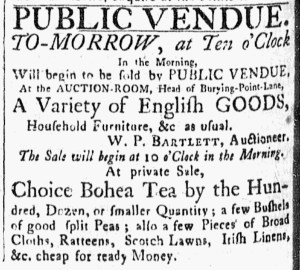
Among all that talk about tea, W.P. Bartlett, an auctioneer, advertised “Choice Bohea Tea” available “At private Sale.”  In Salem as in Boston, advertising, selling, buying, and drinking tea did not cease immediately as a rection to the Boston Tea Party.  Tea remained on the market as colonizers continue to debate what to do about tea and how to continue protesting against the Tea Act.

December 27

What was advertised in a colonial American newspaper 250years ago today?

Boston Evening-Post (December 27, 1773).

“The above Teas were imported before any of the East-India Company’s Tea arrive, or it was known they would send any on their own Account.”

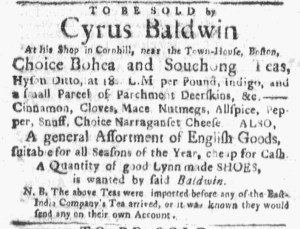
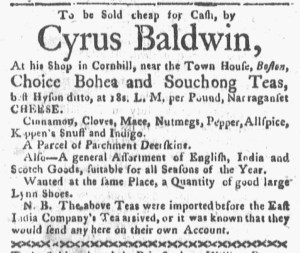
Cyrus Baldwin advertised “Choice Bohea and Souchong Tea” in the December 20, 1773, edition of the Boston Evening-Post, the first issue published following the protest now known as the Boston Tea Party.  In an effort to convince both prospective customers and the general public that he traded in good faith, he appended a nota bene to assert that his teas “were imported before any of the East-India Company’s Tea arrive, or it was known they would send any on their own Account.”  Three days later, he ran a similar advertisement in the Massachusetts Spy.  That notice included new merchandise, but it still listed “CHOICE Bohea and Souchong Teas” and concluded with the same nota bene.  As the politics of tea became a main topic of discussion, in town meetings, in the press, in everyday conversation, did not decide to discontinue his advertisements presenting tea for sale at his shop in Boston.

Boston-Gazette (December 27, 1773).

On December 27, Baldwin once again advertised in the Boston Evening-Post, replacing his advertisement from the previous issue with the one from the Massachusetts Spy.  In addition, that advertisement, complete with the nota bene, also ran in the Boston-Gazette on December 27.  Over the course of several days, Baldwin inserted it in three of the five newspapers published in Boston at the time.  Notably, neither Isaiah Thomas, the printer of the Massachusetts Spy, nor Benjamin Edes and John Gill, the printers of the Boston-Gazette, rejected the advertisement, though they had earned reputations as the printers who most vociferously advocated for the patriot cause and critiqued Parliament and colonial officials.  Did their willingness to publish the advertisement serve as tacit endorsement of the rationale Baldwin offered to justify selling his tea?  Maybe not.  The printers may have been too busy participating in events as they unfolded after the Boston Tea Party and gathering news from near and far that they did not scrutinize the contents of all the advertisements submitted to their printing offices.  After all, other merchants and shopkeepers continued to advertise tea in the Boston-Gazette and the Massachusetts Spy.  The printers may not have examined each advertisement closely to spot tea among the lists of merchandise.  They might have also been satisfied, at least for the moment, because they knew any tea sold by Baldwin and others had not been acquired via the problematic shipments that ended up in the harbor rather than in shops and stores.

As colonizers, including “Venders of Tea,” debated what to do next following the Boston Tea Party, they did not immediately cease advertising, buying, selling, and drinking tea.  Following strategies that they adopted in response to the Stamp Act and the Townshend Acts, they eventually devised nonimportation and consumption agreements.  Loyalists like Peter Oliver accused patriots, especially women, of cheating on those agreements.  Such indiscretions would have been a continuation of the flexibility toward tea exhibited in newspaper advertisements published in the days immediately after the Boston Tea Party.