November 21

What was advertised in a colonial American newspaper 250 years ago today?
Nov 21 - 11:21:1767 Providence Gazette
Providence Gazette (November 21, 1767).

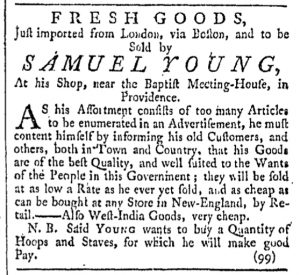
“At as low a Rate as he ever yet sold, and as cheap as can be bought at any Store in New-England, by Retail.”

Throughout the eighteenth century shopkeepers and merchants consistently made appeals to price as they attempted to incite demand for their wares. Almost every advertisement for consumer goods and services in the November 21, 1767, edition of the Providence Gazette, for instance, made some sort of reference to low prices. While some advertisers resorted to formulaic language, others devised increasingly innovative and elaborate ways of promoting bargain prices to potential customers. These appeals ranged from simple to bold.

Joseph and William Russell characterized their prices as “very cheap.” Similarly, Jonathan Russell offered an array of imported merchandise “at the very cheapest rate,” allowing the typography to provide additional emphasis. In terms of standardized language, advertisers frequently used both “cheap” and “reasonable” to describe their prices. Archibald Stewart and Robert Taylor promised to sell their goods “at the most reasonable rates.” Edward Thurber pledged to “sell on the most reasonable Terms” at his shop at the Sign of the Brazen Lion. Jabez Bowen, Jr., used the same phrase, one encountered in newspaper advertisements throughout the colonies.

Rather than merely claim that they set low prices, some advertisers favorably compared their prices to what consumers could expect to pay elsewhere. Samuel Nightingale, Jr., asserted that he “will sell as cheap as any Person in Town.” Nathaniel Greene made a similar claim, stating the he was “determined to sell [his goods] as low as any are sold in this Town.” Not to be outdone, Samuel Black and James Brown proclaimed that they “will sell as cheap as are sold in New-England by Retail.” Samuel Young also raised the stakes, trumpeting that he sold his merchandise “at as low a Rate as he ever yet sold, and as cheap as can be bought at any Store in New-England, by Retail.” While not quite as verbose, Benjamin Thurber and Daniel Cahoon professed “to sell … as cheap as any Person in this Town, or elsewhere.” Potential customers did not need to look to Boston or New York for better deals!

Gideon Young inserted perhaps the most novel appeal to price, assuring readers “of having the full Worth of their Money,” but he followed that with formulaic language about “the very lowest rates.” Regardless of how they described their prices, retailers regularly noted them as a means of enticing prospective customers to visit their shops. Their advertisements were not mere announcements about goods for sale that relied on incipient consumer demand; instead, eighteenth-century shopkeepers promised bargains as a means of marketing their merchandise to customers who sometimes needed to be convinced to make purchases.
October 20

What was advertised in a colonial American newspaper 250 years ago today?

Oct 20 - 10:20:1767 South-Carolina Gazette and Country Journal
South-Carolina Gazette and Country Journal (October 20, 1767).

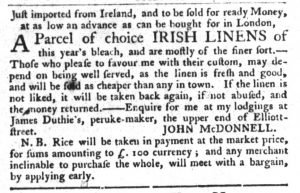
“If the linen is not liked, it will be taken back again, if not abused, and the money returned.”

In the fall of 1767 John McDonnell advertised “A Parcel of choice IRISH LINENS” in the South-Carolina Gazette and Country Journal. To entice potential buyers he resorted to several marketing appeals. Like many other merchants and shopkeepers, he underscored price. Indeed, he mentioned low prices even before naming the merchandise, first stating that customers could acquire his wares “at as low an advance as can be bought for in London” and only then revealing that he sold linens. Even though they had been transported across the Atlantic that did not raise the cost he charged for Irish linens in Charleston; local buyers enjoyed the same prices as their counterparts in faraway London. In addition, McDonnell pledged that he would not be undercut by any of his competitors, vowing to sell his linens “as cheaper than any in town.”

McDonnell also offered another opportunity for a potential customer to enjoy a discount, provided they had a willingness to purchase in bulk. “[A]ny merchant inclinable to purchase the whole,” he proclaimed, “will meet with a bargain.” McDonnell understood that he stood to generate greater revenues by selling his entire inventory at a reduced price than gradually selling smaller lots and perhaps ending up with surplus linens that never sold. (He was also willing to barter with customers who bought in bulk, accepting rice rather than cash.)

Yet emphasizing the low price was not the only marketing strategy McDonnell advanced in his advertisement. He also offered a money-back guarantee: “If the linen is not liked, it will be taken back again, if not abused, and the money returned.” He did stipulate one condition, that he would only accept returns and pay refunds if unsatisfied customers returned the merchandise in the same condition they purchased it. He needed to protect his own interests even as he proposed an arrangement that worked in potential customers’ favor.

Relying exclusively on text without images, McDonnell constructed a vibrant advertisement to convince readers to purchase his imported Irish linens. He made nods toward quality and customer service, but repeatedly emphasized low prices and bargains for consumers. If that was not enough to attract buyers, he also provided additional assurances about quality via an innovative money-back guarantee. Readers had nothing to lose if they gave McDonnell and his linens a chance.

September 2

What was advertised in a colonial American newspaper 250 years ago today?

Sep 2 - 9:2:1767 Georgia Gazette
Georgia Gazette (September 2, 1767).

“EXCEEDING GOOD OLD BARBADOS RUM, by the hogshead, quarter-cask, or small quantity.”

Horton and Moore placed a fairly simple advertisement in the September 2, 1767, issue of the Georgia Gazette. In it, they announced that they sold a small number of items: rum, sugar, vinegar, and Delftware (a popular blue and white pottery made in the Netherlands and exported to locales throughout the Atlantic world). Compared to the list-style advertisements that crowded the pages of many eighteenth-century newspapers, their notice was relatively short. Yet the simplicity and the length did not mean that Horton and Moore neglected to advance marketing messages in their advertisement. For each item, they offered some sort of commentary intended to entice potential customers to visit Horton and Moore’s wharf to make their purchases.

The partners resorted to some of the most common appeals made to consumers throughout the eighteenth century. They emphasized quality, explicitly and implicitly, to promote both rum and sugar. They described the former as “EXCEEDING GOOD” and the latter as “of an extraordinary good quality.” In noting the places of origin – “BARBADOS RUM” and “JAMAICA SUGAR” – they further testified to quality since those locations were widely recognized for producing the finest examples of their respective commodities.

When it mattered, Horton and Moore made an appeal to consumer choice: they carried a ‘COMPLETE ASSORTMENT” of Delftware. This implied a variety of (fashionable) patterns as well as an array of items, from plates and bowls to canisters and sugar dishes to tiles and tureens for household use and decoration. Horton and Moore invited customers to examine all the possibilities, promising that they would not be forced to choose from a tiny selection. A “COMPLETE ASSORTMENT” meant the freedom to express themselves by identifying their favorites and choosing items that distinguished them from their friends and relations.

Horton and Moore also marketed convenience when they offered to sell their commodities in various quantities. Customers could purchase rum “by the hogshead, quarter-cask, or small quantity,” sugar “by the hogshead, barrel, or small quantity,” and vinegar “in any quantity.” Presumably shoppers were also welcome to select as many or as few pieces of Delftware as they desired.

Finally, the partners made an appeal to price, stating they sold all of their merchandise “on the most reasonable terms.” Combined with the other appeals, this made their wares even more attractive to prospective customers.

Horton and Moore’s advertisement demonstrates that commercial notices aimed at consumers did not need to be elaborate or lengthy to incorporate marketing appeals. In the space of half a dozen lines, the merchants deployed messages about quality, choice, convenience, and price as they attempted to incite demand among customers in Savannah and its hinterland.

August 2

What was advertised in a colonial American newspaper 250 years ago this week?

Aug 2 - 7:30:1767 Pennsylvania Gazette
Pennsylvania Gazette (July 30, 1767).

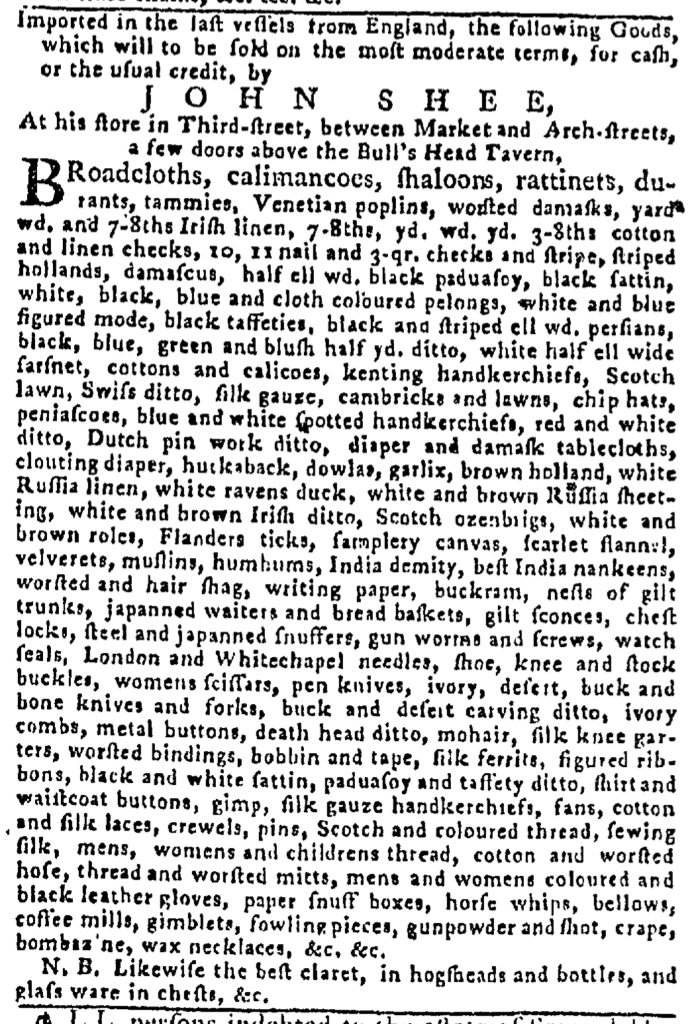
“The following Goods, which will to be sold … by JOHN SHEE.”

Consisting of a block of densely formatted text with little white space and almost no variation in font size, John Shee’s advertisement certainly would not have been considered flashy, but that did not necessarily mean that it was ineffective by eighteenth-century standards.

Shee observed many of the conventions of the day. He made an appeal to price (“sold on the most moderate terms”) and offered more than one option for payment (“cash, or the usual credit”). In noting that his merchandise had been “Imported in the last vessels from England,” he reminded potential customers that they were participating in transatlantic consumer culture that linked them to their counterparts in London and the English provinces. That these goods arrived via the “last vessels” also suggested that they were the most current fashions available.

Shee expended the most effort in detailing the assortment of items he stocked, everything from textiles and adornments (comprising more than half the advertisement) to coffee mills to pen knives to gunpowder and shot. Even then, he had not exhausted his inventory. Eighteenth-century readers knew that the “&c. &c.” that concluded his list meant “etc. etc.,” a promise that potential customers could examine an even greater array of goods upon visiting Shee’s shop. By listing dozens and dozens of items, Shee made an appeal to consumer choice. He invited potential customers to imagine acquiring, wearing, admiring, using, displaying, and possessing the goods he sold. He also offered them independence, the ability to make their own decisions about which items to purchase to fit their own tastes or to distinguish themselves from friends and neighbors. Such a lengthy list meant that customers did not have to content themselves with whatever happened to be on the shelves. A nota bene appended to the conclusion even suggested that the shopkeeper was constantly adding new merchandise to the selection he offered for sale.

In terms of the graphic design elements, Shee’s advertisement replicated others in the Pennsylvania Gazette. Short of paying extra for a woodcut to accompany his advertisement, he likely had little control over the layout. Instead, he accepted the standard format adopted by a compositor who squeezed as much content as possible onto the pages of the Pennsylvania Gazette. It was not the visual appeal of their advertisements that Shee and many of his counterparts were convinced would sell their goods. Instead, they relied on careful attention to a set of appeals they believed resonated with consumers. In the absence of varied graphic elements, Shee and other shopkeepers expected potential customers to approach their advertisements as active readers.

July 18

What was advertised in a colonial American newspaper 250 years ago today?

Jul 18 - 7:18:1767 Providence Gazette
Providence Gazette (July 18, 1767).

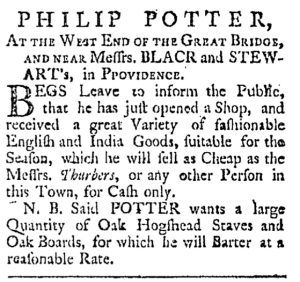
“He will sell as Cheap as the Messrs. Thurbers.”

Philip Potter placed an advertisement in the Providence Gazette to announce that “he has just opened a Shop, and received a great Variety of fashionable English and India Goods.” In the process of promoting his own wares, Potter made reference to other shopkeepers in the city.

To help potential customers find his shop, Potter indicated that it was located “AT THE WEST END OF THE GREAT BRIDGE, AND NEAR Messrs. BLACK and STEWART.” While this may have called attention to a competitor (who happened to advertise on the following page of the same issue), the public’s familiarity with Black and Stewart and where they kept shop may have outweighed any risk of giving them free publicity. After all, Potter’s new shop would fail if customers could not find it, making it necessary to refer to prominent landmarks in an era before standardized street numbers.

Potter also mentioned two shopkeepers in North Providence, proclaiming that “he will sell as Cheap as the Messrs. Thurbers, or any other Person in this Town.” Merchants and shopkeepers commonly promised potential customers that they offered the best prices, but rarely did they single out specific competitors for special notice. For their part, Benjamin and Edward Thurber had previously advertised that their prices were “as low as any Person in this or the neighboring Towns, or in North-America.” They made a bold claim to the lowest prices on the continent, but they did not name any of their competitors. Did Potter refer to them because they had indeed established a reputation among consumers for particularly low prices? In promoting his own shop, did he also acknowledge the Thurbers as the shopkeepers most likely to offer great deals for shoppers? Did Potter give voice to a general sentiment among Providence residents? If the Thurbers were indeed known to offer the lowest prices, then Potter used their reputation to his own advantage, provided that he actually matched their prices when customers visited his shop.

Most local readers of the Providence Gazette would have been familiar with the commercial landscape of their city. Rather than pretend that his competitors did not exist, Potter mobilized general knowledge about their businesses to attract customers to his own shop.

June 8

What was advertised in a colonial American newspaper 250 years ago today?

Jun 8 - 6:8:1767 Newport Mercury
Newport Mercury (June 8, 1767).

“At as low a Rate for Cash as can be bought at any Shop in Newport.”

In the June 8, 1767, edition of the Newport Mercury, Josias Lyndon advertised that he sold an assortment of imported goods “Very cheap for Cash, or short Credit.” Invoking low prices was one of the most common marketing appeals of the eighteenth century. Lyndon chose a standard method: promoting his own prices without making reference to those of his competitors. In that regard, he advertisement differed from most placed by shopkeepers in that issue. Others went into greater detail about the nature of their prices.

Samuel Lyndon, Jr., for instance, offered his wares “at as low a Rate as can be bought in any Shop in the Town of NEWPORT.” Similarly, David Moore sold dry goods and groceries “AS CHEAP FOR CASH as at any Shop in Newport.” Issachar Polock boldly proclaimed that he parted with his merchandise “at a LOWER PRICE than any advertised before him.” Each of these shopkeepers adapted the standard appeal to price in ways that more directly positioned their shops as preferable to local competitors.

Other advertisers expanded on this trend. Napthaly Hart, Jr., stated that was “determined to sell at as low Rate as any of the Shops in NEWPORT or PROVIDENCE.” In an advertisement that also appeared in the Providence Gazette, William Rogers promised that customers purchased his inventory “as cheap as can be bough at any Shop in Providence.” Both of these shopkeepers seemed as concerned (or, in Rogers’ case, more concerned) with losing business to counterparts in Providence than others in Newport.

Christopher Champlin’s advertisement suggested why Newport’s shopkeepers provided more elaborate appeals to price than usual in the late spring of 1767. “FINDING many of his Brother Shopkeepers,” Champlin declared, “to prevent most of the circulating Cash from being sent to Providence, have greatly lowered the Price of their Goods; therefore … said CHAMPLIN … has to sell … a neat Assortment of GOODS … at as low a Rate for Cash as can be bought at any Shop in Newport.”

Cash was scarce in colonial America. By charging low prices, Newport’s shopkeepers not only competed with each other but also pursued the public interest on behalf of their entire community by not allowing scarce resources to seep away to another port city. Champlin annunciated this as “so laudable a Motive,” one that was “worthy of Imitation.” He was late to the game in lowering his own prices, but managed to position himself, along with his “Brother Shopkeepers” in Newport, as doing something noble when setting his prices.

May 30

What was advertised in a colonial American newspaper 250 years ago today?

May 30 - 5:30:1767 Providence Gazette
Providence Gazette (May 30, 1767).

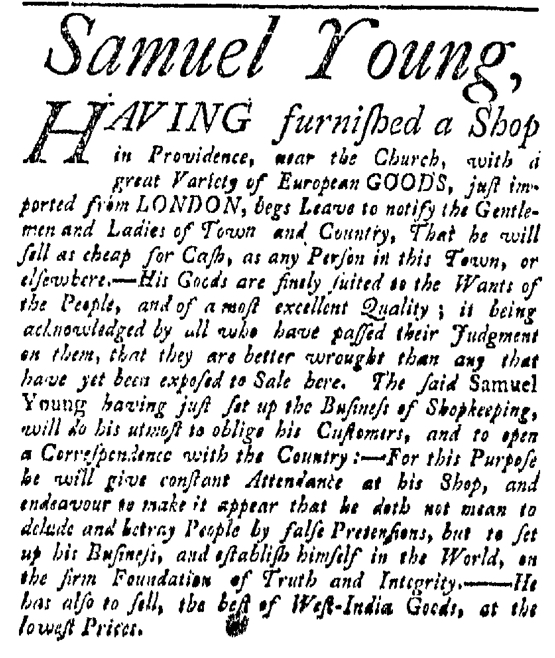
“Samuel Young … begs Leave to notify the Gentlemen and Ladies of Town and Country.”

Samuel Young of Providence was new to shopkeeping, but he demonstrated in his first advertisement that he understood the conventions of eighteenth-century advertising. He incorporated several of the most common marketing appeals of the era, including price, quality, and consumer choice. He opened his notice with a pledge to “sell as cheap for Cash, as any Person in this Town, or elsewhere” and concluded by reiterating that he offered “the lowest Prices.” He went into greater detail about the “most excellent Quality” of his “European GOODS,” claiming that “all who have passed their Judgment on them” acknowledged “that they are better wrought than any that have yet been exposed to Sale here.” Similarly, he sold “the best of West-India Goods.” Savvy consumers probably greeted these boasts with some skepticism. After all, Young sold the same imported goods as his competitors. Although he did not enumerate his wares, Young stated that they comprised “a great Variety” and were “finely suited to the Wants of the People.” Hyperbolic at times, Young did not merely place a notice that announced he opened a new shop. Instead, drew on techniques already popular in consumer advertising to market his merchandise.

As a newcomer to his occupation, Young also attempted to reassure potential customers about his own character, arguing that he possessed the personal qualities to make sure they would receive satisfactory treatment during transactions. He was not afraid of hard work, intending to “give constant Attendance at his Shop.” He also seemed sensible that some of his claims came off a bit overstated. To that end, he persuaded readers “that he doth not mean to delude and betray People by false Pretensions.” Instead, he simply wished to “establish himself in the World, on the firm Foundation of Truth and Integrity.” Young’s advertisement appeared alongside commercial notices by shopkeepers with established reputations. He realized that he needed to make bold claims to attract attention to his business while simultaneously cultivating his own standing as an honest and fair dealer.

May 29

What was advertised in a colonial American newspaper 250 years ago today?

May 29 - 5:29:1767 New-London Gazette
New-London Gazette (May 29, 1767).

Cheaper for Cash than can be had at Capt. Nathl. Backus’s, or any Store in Norwich.”

Ebenezer Coburn sold “All Sorts of Iron-Mongery, and Cutlery Ware … at his Shop … at the Sign of the Black Horse, at Norwich-Landing” in Connecticut. In marketing his wares, he resorted to one of the most common appeals in eighteenth-century newspaper advertisements, low prices, promising that customers could purchase his merchandise “cheaper for Cash” from him than from “any store in Norwich.” Merchants and shopkeepers throughout the colonies frequently made similar claims. Many simply stated that they had low prices, but others specified that they offered the best prices in town and would not be undersold by any of their competitors. A few even boasted that they offered the lowest prices in the entire colony or the region, especially in New England.

In that regard, Coburn’s notice replicated standard advertising practices. Yet he deviated from most other advertisements in one significant way: he named one of his competitors and explicitly stated that his prices were lower. Before even mentioning other shops in Norwich, Coburn singled out Captain Nathaniel Backus. In their advertisements, most shopkeepers either graciously pretended that their competitors did not exist or politely acknowledged them by indicating that their own shop had the best prices. Coburn, on the other hand, fired a shot in a price war with Backus, challenging consumers to take special note of what the captain charged for his wares.

Why did Coburn take aim at Backus in particular? Was the captain the most prominent trader in Norwich and thus Coburn’s most significant competitor? Had Backus established a reputation for especially low prices that Coburn hoped to turn to his advantage? Did some sort of personal, rather than professional, animosity exist between Coburn and Backus? The captain was a man of some prominence in Norwich, a descendent of the founders of the town and one of only six men who owned his own carriage prior to the Revolution. He exercised some clout in the local marketplace.

Something happened relatively recently that caused Coburn to compare their prices. Two weeks earlier he had published a nearly identical advertisement in the New-London Gazette; it did not mention Backus or that Coburn sold “by Wholesale or Retail.” Given the number of vessels that had “Entered In” according to the recent shipping news, Backus very well may have recently received a large shipment of imported goods, enough to seemingly flood the local market in Norwich. By naming Backus in particular, Coburn may have been trying to gain ground on his most prominent and most significant competitor, one who commanded the attention of local consumers even without advertising in the New-London Gazette.

May 2

What was advertised in a colonial American newspaper 250 years ago today?

May 2 - 5:2:1767 Providence Gazette
Providence Gazette (May 2, 1767).

“They hope to accommodate their Customers with whatever they may want.”

Thompson and Arnold frequently advertised in the Providence Gazette. At a glance, their notices resembled those placed by shopkeepers in newspapers throughout the colonies, but Thompson and Arnold often added at least one additional element to distinguish their marketing from the efforts of their competitors.

Consider today’s advertisement. It made several of the standard appeals in eighteenth-century advertisements for consumer goods and services: price (“at the cheapest Rate”), choice (an “Assortment of English and India Goods”), current fashions (the “Assortment” was “new and fresh”), and connections to the cosmopolitan center of the empire (“imported in the last Ships from LONDON”). To underscore the extent of consumer choice, Thompson and Arnold listed dozens of items in a dense paragraph. Like other retailers, they packed a variety of appeals into a relatively short advertisement.

Most of their counterparts incorporated one or more of these strategies but did little to elaborate on them. Thompson and Arnold, on the other hand, supplemented the formulaic format and language of these appeals with an animated nota bene, an entire paragraph that expanded on their low prices and the extensive choices they presented to customers. The shopkeepers boasted that they could “accommodate their Customers with whatever they may want” not only because they stocked so much merchandise but also because their inventory was superior to what could be found anywhere else in Providence. Their customers benefited from the convenience of what has become known as one-stop shopping; Thompson and Arnold had “a greater variety, and a larger quantity of goods than can be found in any one store in this town.” Potential customers did not need to worry about popular or inexpensive items selling out!

Unlike other shopkeepers that mentioned prices once at the beginning of an advertisement or perhaps again at the end, Thompson and Arnold doubled down on their low prices in their nota bene. They beat the prices they charged in the past (“they will now sell their goods much cheaper than they have yet sold”), but they also undersold their competitors (“cheaper than can be bought elsewhere in this town”).

Given that some advertisements lingered in colonial newspapers for weeks or months, Thompson and Arnold also affixed a date (“May 2, 1767,” the date of that issue of the Providence Gazette) so readers and potential customers would be aware of the timeliness of the appeals they made.

On their own, the introduction and list of goods in Thompson and Arnold’s advertisement replicated many other advertisement for consumer goods published in the 1760s, advancing multiple appeals to potential customers but each of them briefly. To garner additional attention and generate more business, Thompson and Arnold inserted an additional paragraph elaborating on two of those appeals, price and choice.

March 11

What was advertised in a colonial American newspaper 250 years ago today?

Mar 11 - 3:11:1767 Georgia Gazette
Georgia Gazette (March 11, 1767).

“THOMAS LEE jun. House-Carpenter and Joiner.”

Thomas Lee, Jr. most likely placed this advertisement to introduce himself to residents of Savannah. As far as introductions went, it was brief but covered a lot of ground. In a single sentence, Lee assured “gentlemen who will be pleased to employ him, that they may depend upon having their work done in the best manner and at the most reasonable rates, with the utmost dispatch.” In so doing, Lee incorporated two of the most common appeals made in advertisements for consumer goods in the eighteenth century. Artisans and others who offered services often adapted those appeals to their own purposes. An appeal to price (“at the most reasonable rates”) required little shift in the meaning, but an appeal to quality (“”having their work done in the best manner”) moved the focus away from merchandise to the skills possessed by the advertiser offering the service. Lee added another appeal sometimes advanced by shopkeepers but more often deployed by artisans. When he pledged to complete work “with the utmost dispatch,” he promised attentiveness and efficiency. Then and now, customers hiring artisans (or contractors) to work on their homes value jobs completed in a timely manner. Similarly, Lee provided “estimations and plans” so customers could hold him accountable for the work he was hired to do.

In describing himself as a “House-Carpenter and Joiner,” Lee informed potential clients that he was a versatile craftsman. Like carpenters, joiners worked with wood, but they specialized in lighter and more ornamental work. Lee was qualified to work on the structure of a building or make and repair any of the fittings that adorned it. Those fittings might include simple doors and windows or they could include intricate pediments and mantels. That being the case, he addressed his introduction “to all gentlemen” in Savannah because affluent merchants and other members of the local gentry would have been most likely to hire (and afford) his services for more ornate work. As the consumer revolution placed an increasing number of goods in the hands of all sorts of colonists, the elite used architectural adornment to express their tastes and attempt to assert distinctions between themselves and others who sometimes mimicked their fashions.

At first glance, Lee’s advertisement looks like a simple notice, but the savvy “House-Carpenter and Joiner” actually incorporated several types of appeals to make a good first impression when introducing himself and his services to residents of Savannah.