
What was advertised in a revolutionary American newspaper 250 years ago this week?
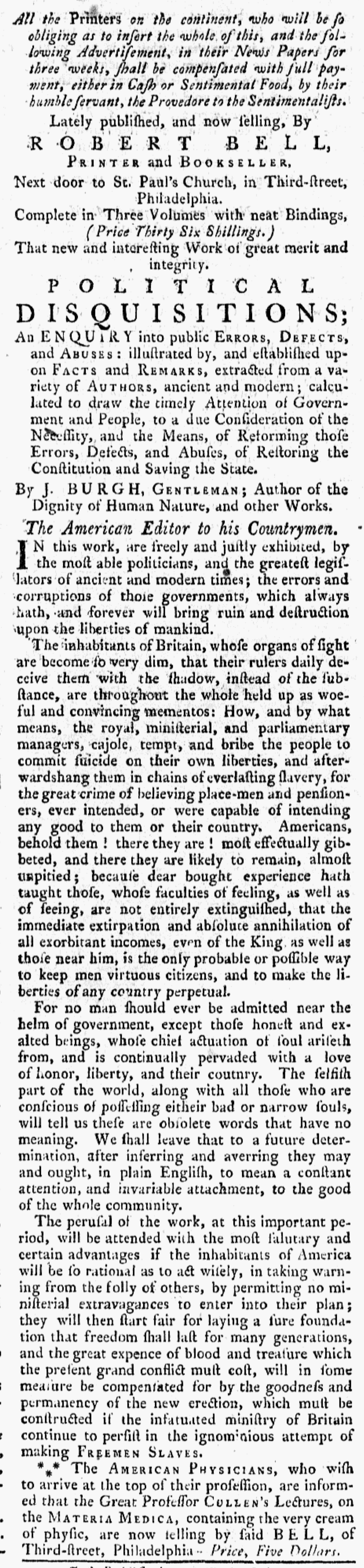
“All the Printers … shall be compensated with full payment, either in Cash or Sentimental Food.”
Robert Bell, one of the most prominent American printers and booksellers during the second half of the eighteenth century, frequently distributed subscription proposals for works he wished to publish far and wide. Such was the case when he marketed an American edition of James Burgh’s Political Disquisitions in 1775. The extensive secondary title provided an overview of the multi-volume work: “An ENQUIRY into public ERRORS, DEFECTS, and ABUSES: illustrated by, and established upon FACTS and REMARKS, extracted from a variety of AUTHORS, ancient and modern; calculated to draw the timely ATTENTION of Government and People, to a due Consideration of the Necessity, and the Means, of Reforming those Errors, Defects, and Abuses, of Restoring the Constitution and Saving the State.”
Upon publishing the work, Bell set about a new round of marketing. Once again, he wished to advertise widely. This time, he appended a note to his advertisement that appeared in the December 2 edition of the Pennsylvania Ledger. Addressing “All the Printers on the continent,” Bell offered that those “who will be so obliging as to insert the whole of this, and the following Advertisement, in their News Papers for three weeks, shall be compensated with full payment, either in Cash or Sentimental Food, by their humble servant, the Provedore to the Sentimentalists.” The “following Advertisement” consisted of three portions: a standard notice typical of others for books that appeared in the Pennsylvania Ledger and other newspapers, a lengthy address from “The American Editor to his Countrymen,” and a brief announcement that Bell also sold “the Great Professor CULLEN’s Lectures, on the MATERIA MEDICA” to “AMERICAN PHYSICIANS, who wish to arrive at the top of their profession.” The standard advertisement included the name of the book and its author, the price (“Thirty Six Shillings”), a description of some of its material aspects (“Three Volumes with neat Bindings”), and where to purchase it. In the address, Bell asserted, “The perusal of the work, at this important period, will be attended with the most salutary and certain advantages if the inhabitants of America will be so rational as to act wisely, in taking warning from the folly of others, by permitting no ministerial extravagances to enter into their plan.” They could lay “a sure foundation that freedom shall last for many generations” instead of allowing the current British administration to make “FREEMEN [into] SLAVES.”
The entire advertisement was much longer than most subscription proposals or notices about books already published. That may have been the reason that Bell appended the note to “All the Printers on the continent.” In other instances, fellow printers may have published shorter advertisements gratis, but this one required significant space in weekly newspapers that consisted of only four pages. To increase the chances that printers would reprint it when they saw the advertisement in newspapers that they received through their exchange networks, Bell made sure that they knew that he would compensate them “with full payment, either in Cash or Sentimental Food.” In other words, he would supply copies of Political Disquisitions or other books he published to those who preferred them rather than cash. The flamboyant Bell was already known as “the Provedore to the Sentimentalists” from his newspaper advertisements, broadsides, and book catalogs. He sought to maintain the image he cultivated by including that language in his note to printers, yet he realized that his reputation alone would not convince them to publish such an extensive advertisement. Accordingly, he promised payment in advance rather than expecting newspaper printers to publish his advertisement as a courtesy, no matter how well their politics might align with those in Bell’s address “to his Countrymen.”
