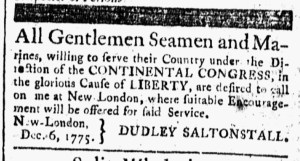
What was advertised in a revolutionary American newspaper 250 years ago today?

“Making application to BENJAMIN CROFTS, recruiting Serjeant in Capt. LLOYD’s company.”
A recruiting notice ran in the April 9, 1776, edition of the Pennsylvania Evening Post. It called on “ALL able-bodied freemen, willing to enter into the Provincial service, in the battalion of MUSQUETRY now raising for the immediate defence of this province.” It was not the only news of that sort that appeared in that issue. In the column to the left of that advertisement, a news update informed readers that “[a]t a meeting of the battalion of riflemen held yesterday at Carpenters-hall in this city, the following officers were chosen by ballot, viz. Timothy Matlack, Esq; Colonel – Daniel Clymer, Esq; Lieutenant-Colonel – Lawrence Herbert, First Major – George Miller, Second Major.” Both news articles and advertisements relayed information about the companies forming as the war that started at Lexington and Concord nearly a year earlier continued and moved into a new phase following the British evacuation of Boston in the middle of March.
Those who enlisted in the “battalion of MUSQUETRY” would receive one month’s pay in advance, amounting to “Five Dollars per man.” They would also “enter into present good quarters, with an allowance of Ten Shillings per week to each for subsistence.” The notice instructed “able-bodied freemen” interested in enlisting to “mak[e] application to BENJAMIN CROFTS, recruiting Serjeant in Capt. LLOYD’s company, at said Croft’s quarters, the sign of the Britannia, in Front-street.” That “the sign of the Britannia,” the personification of the British Empire, marked the location for recruits to enlist to defend the colony against British troops was an interesting juxtaposition. When the war started, the colonies desired a redress of their grievance by Parliament. In April 1776, they had not yet declared independence, though public opinion seemed to be moving in that direction rather than continuing to seek reforms within the imperial system. In an extract of “a letter from a gentleman in Virginia to his friend” in Philadelphia immediately to the left of the recruiting notice, the correspondent stated, “I have read COMMON SENSE with much pleasure. … He has made many converts here. Indeed every man of sense and candor, with whom I have had an opportunity of conversing, with whom I have had an opportunity of conversing, acknowledges the necessity of setting up for ourselves, having already tried in vain every reasonable mode of accommodation.” Symbols of British identity, such as “the sign of the Britannia,” were part of everyday life in the colonies, but they did not hold the same power as they did throughout most of the eighteenth century. For many colonizers, they lost their meaning. For “able-bodied freemen, willing to enter into the Provincial service,” Britannia merely marked the location of the recruiting office. The sign was no longer an expression of pride in being part of the British Empire.