December 8

What was advertised in a revolutionary American newspaper 250 years ago today?
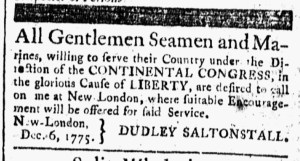
Connecticut Gazette (December 8, 1775).

“All Gentlemen Seamen and Marines, willing to serve their Country … are desired to call on me.”

A variety of advertisements ran in the December 8, 1775, edition of the Connecticut Gazette.  Some marketed consumer goods and services, one described an indentured servant who ran away, one offered a “convenient Dwelling-House for Sale,” and a couple concerned strayed livestock.  The advertisement that appeared first after the news, however, was a recruiting notice.  A thick black line helped to draw attention to it, though that visual element that signified mourning was part of the memorial to “Mrs. FAITH HUNTINGTON, the late amiable Consort of Col. JEDEDIAH HUNTINGTON of Norwich … and greatly beloved Daughter of the Honorable Governor [Jonathan] TRUMBULL,” the only governor who supported the American cause at the beginning of the Revolutionary War.  The memorial attributed Huntington’s death to the distress she experienced during her husband’s absence from their home while he dedicated himself to military service, declaring that the “Authors of American Oppression and the public Calamity, are accountable for her death.”  That assertion may have helped rally readers to respond to the recruiting notice that appeared immediately after the memorial.  “All Gentlemen Seamen and Marines, willing to serve their Country under the Direction of the CONTINENTAL CONGRESS, in the glorious Cause of LIBERTY,” it proclaimed, “are desired to call on me at New-London, where suitable Encouragement will be offered for said Service.”  Dudley Saltonstall signed the notice.

Who was Dudley Saltonstall?  The finding aid for the Dudley Saltonstall Papers at the Penobscot Marine Museum notes that Saltonstall “sailed as a privateer during the Seven Years’ War.  At the beginning of the Revolutionary War, he was one of the first men commissioned by Connecticut as a Navy captain.”  His brother-in-law, Silas Deane, a delegate to the First Continental Congress and the Second Continental Congress, recommended Saltonstall.  He also had a career as a slave trader.  In 1779, he had command of an expedition “sent to dislodge the British from Castine, Maine.”  The Penobscot Expedition resulted in failure, the entire American fleet lost, and Saltonstall court martialed and dismissed from the Continental Navy.  Although Saltonstall is now best known for the Penobscot Expedition, at the time he placed this recruiting notice in the Connecticut Gazette he was putting together a crew for other ventures.  A few months later, he sailed for the Bahamas to acquire gunpowder.  The fleet captured Nassau, but only after the governor moved most of the gunpowder.
July 2

What was advertised in a revolutionary American newspaper 250 years ago this week?

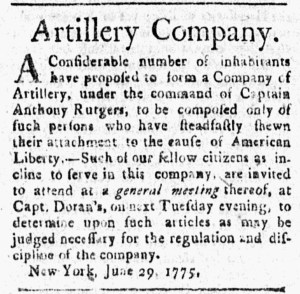
New-York Journal (June 29, 1775).

“Artillery Company.”

One advertisement in the June 29, 1775, edition of the New-York Journal seems to stand out from the others, at least to this reader perusing that issue 250 years later.  The colonizers who placed the advertisement no doubt hoped that readers would take note and heed its call, intending that the headline, “Artillery Company,” would resonate differently with readers than the headlines for other notices that promoted goods and services, such as “FURRS,” “CLOCKS,” “WATCHES,” and “PUBLIC AUCTION.”  This advertisement certainly served a different purpose once the imperial crisis boiled over into the battles at Lexington and Concord and the siege of Boston that followed.  It may have seemed even more urgent and imperative appearing in the same issue as an “account of the engagement between the Provincials and Regulars on Saturday the 17th,” now known as the Battle of Bunker Hill.

That issue also featured an “Address of the Provincial Congress of the Colony of New-York. To his Excellency GEORGE WASHINGTON, Generalissimo of all the Forces raised, and to be raised, in the Confederated Colonies of America.”  The advertisers sought to do their part in raising forces to defend against British troops.  “[A]n atmosphere of patriotic fervor,” Alan C. Aimone and Eric I. Manders argue, “brought forth a spate of volunteer companies” in the spring and early summer of 1775, companies that “were to be the city’s independent militia.”  Some volunteers had previous experience serving in the colonial militia.  “A Considerable number of inhabitants have proposed to form a Company of Artillery, under the command of Captain Anthony Rutgers,” the advertisement reported.  Aimone and Manders note, “Membership in the independent companies was restricted.  All new volunteers were prosperous city men.”[1]  The advertisement stated other qualifications.  The ranks of this company would be limited to “only … such persons who have steadfastly shewn their attachment to the cause of American Liberty.”  Accordingly, “Such of our fellow citizens as incline to serve in this company, are invited to attend at a general meeting … to determine upon such articles as may be judged necessary for the regulation and discipline of the company.”  Several other independent companies had formed in the city by the time this advertisement appeared in the New-York Journal, yet updates about events unfolding in New England underscored the need to continue recruiting “fellow citizens” devoted “to the cause of American Liberty.”

**********

[1] Alan C. Aimone and Eric I. Manders, “A Note on New York City’s Independent Companies, 1775-1776,” New York History 63, no. 1 (January 1982): 59, 61.