August 27

What was advertised in a revolutionary American newspaper 250 years ago today?
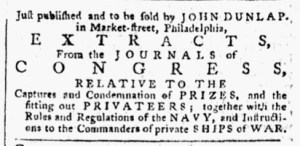
Dunlap’s Pennsylvania Packet (August 27, 1776).

“EXTRACTS … relative to the … fitting out PRIVATEERS; together with the Rules and Regulations of the NAVY.”

During the imperial crisis and the Revolutionary War, printers regularly published news from the Continental Congress and local assemblies in their newspapers.  Sometimes they compiled the proceedings into books that they marketed and sold to consumers who wanted convenient access to that sort of overview of current events.  Printers in many towns, for instance, published local editions of “EXTRACTS FROM THE VOTES AND PROCEEEDINGS OF THE AMERICAN CONTINENTAL CONGRESS” in the fall of 1774.

Nearly two years later, John Dunlap, the printer of Dunlap’s Pennsylvania Packet, saw an opportunity to publish a collation of rules and regulations about naval regulations for both privateers and the Continental Navy.  In an advertisement that appeared at the top of the final column on the first page of the August 27, 1776, edition of his newspaper, Dunlap informed the public that he “Just published … EXTRACTS, From the JOURNALS of CONGRESS, RELATIVE TO THE Captures and Condemnation of PRIZES, and the fitting out PRIVATEERS; together with the Rules and Regulations of the NAVY and Instructions to the Commanders of private SHIPS of WAR.”  As was common in many advertisements for books and pamphlets, the lengthy title doubled as advertising copy.  Dunlap did not generate original appeals to market the volume because the title already contained so much information.

The printer apparently believed that a market for this item existed in the largest city in the new nation.  Philadelphia was, after all, a busy port and many owners of vessels who pursued maritime commerce during times of peace contemplated how they could aid the war effort while simultaneously getting their share of prize money when they outfitted their ships for privateering.  Dunlap made this handy manual available alongside an array of military manuals published in Philadelphia and other cities.  Rather than hundreds of pages, like some of volumes containing the proceedings of the Continental Congress, this octavo pamphlet consisted of only forty-eight pages.  That made it a convenient size for officers on both privateers and naval vessels to stow among their possessions when they went to sea and then consult as necessary.  Dunlap printed this practical guide as a service, yet he also generated revenue from its sale.
December 8

What was advertised in a revolutionary American newspaper 250 years ago today?

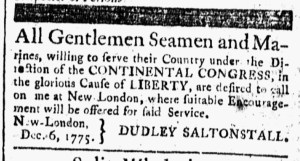
Connecticut Gazette (December 8, 1775).

“All Gentlemen Seamen and Marines, willing to serve their Country … are desired to call on me.”

A variety of advertisements ran in the December 8, 1775, edition of the Connecticut Gazette.  Some marketed consumer goods and services, one described an indentured servant who ran away, one offered a “convenient Dwelling-House for Sale,” and a couple concerned strayed livestock.  The advertisement that appeared first after the news, however, was a recruiting notice.  A thick black line helped to draw attention to it, though that visual element that signified mourning was part of the memorial to “Mrs. FAITH HUNTINGTON, the late amiable Consort of Col. JEDEDIAH HUNTINGTON of Norwich … and greatly beloved Daughter of the Honorable Governor [Jonathan] TRUMBULL,” the only governor who supported the American cause at the beginning of the Revolutionary War.  The memorial attributed Huntington’s death to the distress she experienced during her husband’s absence from their home while he dedicated himself to military service, declaring that the “Authors of American Oppression and the public Calamity, are accountable for her death.”  That assertion may have helped rally readers to respond to the recruiting notice that appeared immediately after the memorial.  “All Gentlemen Seamen and Marines, willing to serve their Country under the Direction of the CONTINENTAL CONGRESS, in the glorious Cause of LIBERTY,” it proclaimed, “are desired to call on me at New-London, where suitable Encouragement will be offered for said Service.”  Dudley Saltonstall signed the notice.

Who was Dudley Saltonstall?  The finding aid for the Dudley Saltonstall Papers at the Penobscot Marine Museum notes that Saltonstall “sailed as a privateer during the Seven Years’ War.  At the beginning of the Revolutionary War, he was one of the first men commissioned by Connecticut as a Navy captain.”  His brother-in-law, Silas Deane, a delegate to the First Continental Congress and the Second Continental Congress, recommended Saltonstall.  He also had a career as a slave trader.  In 1779, he had command of an expedition “sent to dislodge the British from Castine, Maine.”  The Penobscot Expedition resulted in failure, the entire American fleet lost, and Saltonstall court martialed and dismissed from the Continental Navy.  Although Saltonstall is now best known for the Penobscot Expedition, at the time he placed this recruiting notice in the Connecticut Gazette he was putting together a crew for other ventures.  A few months later, he sailed for the Bahamas to acquire gunpowder.  The fleet captured Nassau, but only after the governor moved most of the gunpowder.