December 31

What was advertised in a colonial American newspaper 250 years ago today?

Connecticut Gazette (December 31, 1773).

“Clocks and Watches repaired … as well and cheap as in New-York or Boston.”

John Champlin, a goldsmith and jeweler, ran a shop in New London in the early 1770s.  He occasionally placed advertisements in the Connecticut Gazette to promote the goods and services that he provided.  For instance, as 1773 came to a close, he advised the public that he stocked a “good Assortment of cypher’d and brilliant Ear-ring & Button Stones, Locket Stones, Ring Stones of all Kinds,” “Wires of all Kinds, a neat Assortment of Files,” “Materials for repairing Clocks and Watches,” “best plated Shoe and Knee Buckles,” and “many other Articles.”  Like others advertisers, he intended that a list demonstrating the many choices he offered would entice consumers to visit his shop.

Champlin deployed other marketing strategies as well.  He made an appeal to price, asserting that he sold “All Sorts of Gold-smith, Silver-smith, and Jeweller’s Work as cheap” as anywhere else in the colony.  In so doing, he acknowledged that he operated within a regional rather than a local marketplace.  Prospective customers in New London and nearby towns had the option to send away to smiths and jewelers in New Haven, Hartford, and other towns if they thought they might get better deals, but Champlin assured them that was not necessary.  The market also extended beyond the colony.  Champlin declared that his customers “may have Clocks and Watches repaired at his Shop … as well and cheap as in New-York or Boston.”  In recent months, Thomas Hilldrup, a watchmaker in Hartford, advertised widely in newspapers in Hartford, New Haven, and New London, encouraging colonizers to send their watches to him via post riders.  Champlin may have deliberately avoided alluding to Hartford, not wishing to amplify Hillrup’s marketing efforts, and instead focused on low prices often associated with major ports.  All the same, the message was clear that customers should bring or send their clocks and watches to him rather than sending them for repairs in any other city or town.

The goldsmith and jeweler advanced and adapted some of the most common marketing appeals that appeared in eighteenth-century newspaper advertisements.  He emphasized consumer choice, low prices, and quality.  In so doing, he sought to make himself competitive not only in the town where he kept his shop but anywhere in the colony and throughout New England where readers perused the Connecticut Gazette.

October 23

What was advertised in a colonial American newspaper 250 years ago today?

Maryland Journal (October 23, 1773).

“APOTHECARY in MARKET-STREET.”

Robert Bass ran an apothecary shop in Philadelphia in the early 1770s.  Along with several other apothecaries, he regularly advertised in the various newspapers published in the Quaker City.  In the fall of 1773, he expanded his marketing efforts to include the Maryland Journal and Baltimore Advertiser.  That newspaper, the first in Baltimore, commenced publication near the end of August.  Previously, residents of that growing port and nearby towns relied on the Maryland Gazette, printed in Annapolis, and newspapers from Philadelphia as their local newspapers.  Merchants, shopkeepers, and artisans in Baltimore sometimes placed advertisements in those publications.  Similarly, advertisers based in Philadelphia, including apothecaries, often mentioned that they served customers in the countryside and promptly filled orders that they received from a distance.  When Bass placed advertisements in the Pennsylvania Chronicle or the Pennsylvania Gazette, for instance, he expected that prospective customers in Baltimore (and many other towns) would see them.

The founding of the Maryland Journal altered the print culture landscape in the region.  The newspapers that previously served Baltimore and its environs continued to circulate there, but residents had more immediate access to a local newspaper.  Hoping to retain his share of the market or perhaps even make gains via advertising in the new publication, Bass quickly decided to place notices in the Maryland Journal.  His advertisement received a privileged place in the October 23 edition.  It appeared as the first item in the first column on the first page, below a masthead for “NEW ADVERTISEMENTS.”  The apothecary advised that he had just acquired “a very large supply of capital DRUGS and PATENT MEDICINES, to serve the fall and winter seasons.”  In addition, he “properly compounded” prescriptions at his shop.  Unfortunately for Bass, he was not the only advertiser who offered such services.  Two columns over, Patrick Kennedy, “Surgeon and Apothecary,” hawked “a large assortment of patent medicines” and declared that he “carefully prepared” prescriptions at his shop in Baltimore.  Readers who lived relatively close to Kennedy’s shop may have preferred to obtain their medicines from him as a matter of convenience, but for prospective customers in the countryside it may not have mattered whether they sent orders to Baltimore or Philadelphia.  Bass even expected that some readers would visit his shop, advising that he gave “constant attendance every day except Sundays.”  Although Baltimore now had its own newspaper, Bass did not consider it a separate local market.  Instead, he attempted to use the new publication to maintain or even expand his share of a regional market.  Whatever the outcome may have been, he considered it worth the investment of placing an advertisement in some of the first issues of the Maryland Journal.

October 9

What was advertised in a colonial American newspaper 250 years ago today?

New-London Gazette (October 9, 1772).

“Staffordshire and Liverpool Warehouse, in Kingstreet, BOSTON.”

Ebenezer Bridgham continued his efforts to create a regional market for his “Staffordshire and Liverpool Warehouse” in Boston with an advertisement in the October 9, 1772, edition of the New-London Gazette.  That advertisement featured copy identical to a notice in the October 2 edition of the New-Hampshire Gazette, though the compositors in the two printing offices made very different decisions about the format of the advertisements.  Bridgham’s advertisement ran a second time in the New-Hampshire Gazette (less the headline announcing “Crockery Ware”) the same day that it first appeared in the New-London Gazette.  He likely dispatched letters to the printing offices on the same day, but, given the distance, the New-London Gazette received its letter later and published his advertisement in the next edition after its arrival.

With advertisements in newspapers in Connecticut and New Hampshire in the fall of 1772, Bridgham continued a project that commenced more than a year earlier with advertisements in the Connecticut Courant, the Essex Gazette, and the Providence Gazette in September 1771.  He added the New-London Gazette the next month.  He placed a subsequent notice in the Connecticut Courant in June 1772, but he did not pursue the same coordinated campaign that he launched in the fall of 1771.  Although his “Crockery Ware” advertisement appeared in both the New-London Gazette and the New-Hampshire Gazette in early October 1772, it did not run in the other newspapers at that time.

That may have been the result of Bridgham learning which advertisements in which newspapers generated orders from country shopkeepers and other customers … and which did not.  His prior experience may have constituted a rudimentary form of market research that guided his decisions about where to focus his advertising efforts.  Alternately, Bridgham may have been delinquent in submitting payment for his advertisements, causing printers not to run them until he settled his debts.  His “Crockery Ware” advertisement eventually ran in Hartford’s Connecticut Courant on November 17.  In February 1772, Ebenezer Watson, printer of the Connecticut Courant, inserted a notice that “No Advertisements will for the future be published in this paper, without the money is first paid.”  The delay in publishing Bridgham’s “Crockery Ware” advertisement may have been due to waiting for payment.  Beyond these possibilities, Bridgham may have been haphazard in submitting his “Crockery Ware” advertisement to various printing offices.  If so, that deviated from the coordination he demonstrated in the fall of 1771.

October 2

What was advertised in a colonial American newspaper 250 years ago today?

New-Hampshire Gazette (October 2, 1772).

“His customers may depend on having their ware packed in the best manner.”

Ebenezer Bridgham sold “Crockery Ware” and other goods at his “Staffordshire and Liverpool Ware House” on King Street in Boston in the early 1770s.  In an advertisement in the October 2, 1772, edition of the New-Hampshire Gazette, he declared that he imported his merchandise “directly from the Pot-Houses in Staffordshire and Liverpool” rather than purchasing from English merchants.  Fewer links in the supply chain meant fewer markups for his inventory.  Bridgham passed along the savings to his customers, making bold claims about his prices.  He trumpeted that he sold his wares “as low as they can be bought in London,” adding that he was “determined not to be UNDERSOLD by any person in America.”

Bridgham made that assertion in the midst of his attempts to create a regional market for the “Staffordshire and Liverpool Ware House.”  In a sense, every newspaper advertiser engaged a regional market since newspapers circulated far beyond the cities where they were published, usually serving entire colonies before the American Revolution.  Bridgham, however, intentionally placed advertisements in newspapers throughout New England.  In addition to Portsmouth’s New-Hampshire Gazette, he also advertised in Salem’s Essex Gazette, the Providence Gazette, Hartford’s Connecticut Courant, and the New-London Gazette.  Bridgham aimed to provide shopkeepers throughout the region with an assortment of merchandise for their own shops.  He expected that his “resolution” not to be “UNDERSOLD by any person in America” resonated with “his former good customers” who he hoped would “continue to favour him with their custom.”  In turn, invoking former customers signaled to new customers that Bridgham merited their orders since he already established and successfully served a clientele.

As evidence of his attention to the needs of his customers, he emphasized more than low prices for an incredible array of choiuces among the “full & complete assortment of Delph, Flint and Glass Ware” at the “Staffordshire and Liverpool Ware House.”  In a nota bene, Bridgham announced that he “lately procur’d packers from England” so “his customers may depend on having their ware packed in the best manner.”  They did not need to worry about receiving broken goods shipped to their towns throughout New England.  Bridgham believed that this ancillary service aided his efforts to serve a regional market, one that extended beyond Boston and beyond Massachusetts.

October 18

What was advertised in a colonial American newspaper 250 years ago today?

Connecticut Journal (October 18, 1771).

“Much cheaper to the buyer than can be purchased at Retail in Boston or New-York.”

Several purveyors of goods inserted advertisements in the October 18, 1771, edition of the Connecticut Journal and New-Haven Post-Boy.  Each of them made some sort of appeal to price in their attempts to entice consumers into acquiring goods from their shops.  Levi Ives of Derby, for instance, advised readers that he stocked a “good Assortment of GOODS, which he will sell on very moderate Terms.”  Most advertisers made even bolder claims about their price.

That was the case for John Sherman.  He “acquaint[ed] the PUBLIC” that he had just received a “fresh supply of GOODS … which he intends to sell at the very lowest advance.”  Unlike the “moderate Terms” offered by Ives, this pledge implicitly suggested to prospective customers that they would not find better bargains in the vicinity.  The partnership of Morgan and Shipman made a similar statement, declaring that they were “determined to sell as cheap as any Person in Town.”  They matched the prices set by Sherman and other competitors in New Haven.

The estate of Stephen Whitehead Hubbard did not limit their comparison to the prices set by local merchants and shopkeepers.  That advertisement commenced with a pronouncement that the “English and India GOODS” would be sold “at PRIME COST.”  In a nota bene, the executors proclaimed that because the goods “were bought on the best Terms by Wholesale, consequently [they] will be afforded much cheaper to the buyer than can be purchased at Retail in Boston or New-York.”  The estate acknowledged that it operated within a regional marketplace in which consumers and retailers both looked to major ports for the best deals.

Price was one of the most common marketing appeals made in eighteenth-century newspaper advertisements, but advertisers devised a variety of means of deploying the strategy.  Sometimes they simply promoted reasonable prices, but other times they implicitly or explicitly made comparisons to local and regional competitors as they sought to convince consumers to visit their shops instead of others.

September 10

What was advertised in a colonial American newspaper 250 years ago today?

Connecticut Courant (September 10, 1771).

“The Staffordshire and Liverpool Ware House, In King Stret BOSTON.”

As summer turned to fall in 1771, Ebenezer Bridgham, the proprietor of the “Staffordshire and Liverpool Ware House” on King Street in Boston, attempted to cultivate a regional reputation for his store.  Not content seeking customers in Boston and the surrounding towns, he also placed advertisements in newspapers published in other places in New England. On September 7, for instance, he inserted an advertisement in the Providence Gazette, informing prospective customers that he stocked “a very large and elegant Assortment of China, Glass, Delph and Stone Ware” that he imported “directly from the several Manufacturers in Staffordshire and Liverpool.”  Three days later, the same advertisement also ran in the Connecticut Courant, published in Hartford, and the Essex Gazette, published in Salem.  Bridgham disseminated information about the Staffordshire and Liverpool Warehouse far more widely than if he had placed his notice solely in the several newspapers published in Boston.  To entice customers in towns throughout New England to place orders from his store, he pledged to part with his wares “as low as they were ever sold in America.”

Essex Gazette (September 10, 1771).

The appearance of Bridgham’s advertisement in several newspapers demonstrated a division of responsibilities in the creation of marketing materials in the eighteenth century.  As the advertiser, Bridgham supplied the copy.  The composition, however, made decisions about the format.  In each newspaper, the graphic design of Bridgham’s advertisement looked consistent with other paid notices in that publication.  In the Essex Gazette, for example, the advertisement promoted “a very large and elegant Assortment of CHINA, GLASS, DELPH and STONE WARE,” the various categories of goods in capital letters.  Other advertisements in the Essex Gazette also featured key words in all capitals.  On the other hand, notices in the Connecticut Courant did not tend utilize that means of drawing attention to particular goods, reserving capitals for names of advertisers and towns.  Similarly, “Staffordshire” and “Liverpool” appeared in italics in the headline in the Essex Gazette, but “King Street” appeared in italics in the Connecticut Courant.  The compositors made decisions independently when they set type.  As a result, Bridgham’s advertisement had variations in design, but not copy, when it ran in multiple newspapers.

June 7

What was advertised in a colonial American newspaper 250 years ago today?

New-Hampshire Gazette (June 7, 1771).

“As neat, as good, as handsome, as cheap, as ever was, or can be fabricated in New England.”

In the late 1760s and early 1770s, James Haslett and Matthew Haslett occasionally placed advertisements in the New-Hampshire Gazette.  Originally from Boston, the Hasletts relocated to Portsmouth.  They set up shop as leather dressers, making breeches, jackets, gloves, and other garments.  They also sometimes stocked tea, coffee, and other grocery items, their efforts as shopkeepers supplementing the revenues they generated as artisans.  Some of their advertisements were quite notable for featuring woodcuts depicting the “Sign of the BUCK and GLOVE.”  Other advertisements were more modest in appearance, though not in content.

Such was the case for an advertisement that ran in the June 7, 1771, edition of the New-Hampshire Gazette.  It extended only five lines, taking up much less space than some of the Hasletts’ more elaborate advertisements, but its brevity did not mean that it lacked appeals intended to entice consumers to hire the Hasletts to make breeches and other leather items.  The Hasletts proclaimed that they made and sold their wares “As neat, as good, as handsome, as cheap, as ever was, or can be fabricated in New England.”  The unique cadence of their message to prospective customers may have caught the attention of readers.  In just a few words, they made several claims about the price, quality, and appearance of their breeches and other leather goods.  They also envisioned a regional marketplace rather than a local one, declaring that consumers would not acquire superior goods or better bargains in Boston or any other town in New England.

Visually, the Hasletts’ advertisement, like so many others in eighteenth-century newspapers, may seem unremarkable, especially compared to modern graphic design standards.  The copy, however, advanced multiple appeals intended to engage consumers.  The Hasletts did not merely announce that they made and sold leather breeches and other items.  Instead, they made a series of assertions about why prospective customers should select them to provide their services, incorporating many of the most popular appeals made in advertisements of the period.

June 23

What was advertised in a colonial American newspaper 250 years ago today?

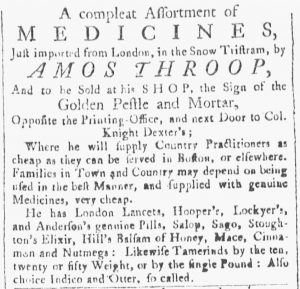
Jun 23 - 6:23:1770 Providence Gazette
Providence Gazette (June 23, 1770).

“Supplied with genuine Medicines, very cheap.”

In the summer of 1770, Amos Throop sold a “compleat Assortment of MEDICINES” at his shop in Providence, appropriately identified by “the Sign of the Golden Pestle and Mortar.”  His inventory included a variety of popular patent medicines imported from London, including “Hooper’s, Lockyer’s, and Anderson’s genuine Pills,” “Stoughton’s Elixir,” and “Hill’s Balsam of Honey.”

In an advertisement in the Providence Gazette, the apothecary addressed different sorts of prospective customers.  He informed “Country Practitioners” that he could fill their orders “as cheap as they can be served in Boston, or elsewhere.”  Throop competed in a regional market; druggists in other port towns also imported medicines from London.  Prospective customers could send away to Boston, Newport, or even New York if they anticipated bargain prices, but Throop sought to assure them that they did not need to do so.  Throop may have anticipated particular benefits from cultivating this clientele.  “Country Practitioners” were more likely than others to purchase by volume.  Their patronage indirectly testified to the efficacy of Throop’s medicines and his standing as a trusted apothecary.

Those factors may have helped him attract other customers who did not practice medicine.  Throop also invited “Families in Town and Country” to shop at the Golden Pestle and Mortar.  He promised them low prices, but he also emphasized customer service, stating that they “may depend on being used in the best Manner.”  In addition, he also attempted to allay concerns about purchasing counterfeit remedies.  Throop pledged to supply his customers “with genuine Medicines,” putting his own reputation on the line as a bulwark against bogus elixirs and nostrums.  When it came to patent medicines, the fear of forgeries merited reiterating that his inventory was “genuine” when he listed the choices available at his shop.

The neighborhood pharmacy is ubiquitous in the twenty-first century, but that was not the kind of business that Throop operated in Providence in the eighteenth century.  Instead, he served both local residents and “Country Practitioners” and “Families in Town and Country,” competing with apothecaries in Boston and other towns.  To do so effectively, he had to depict the many advantages of choosing the Golden Pestle and Mortar, from low prices to authentic medicines to good customer service.

February 8

What was advertised in a colonial American newspaper 250 years ago today?

Feb 8 - 2:81770 Massachusetts Gazzette and Boston Weekly News-Letter
Massachusetts Gazette and Boston Weekly News-Letter (February 8, 1770).

“AUCTION HALL … JOHN GERRISH, (And COMPANY).”

This week the Adverts 250 Project has examined John Gerrish’s attempts to expand his media market beyond newspapers in Boston. In the late 1760s, he regularly inserted notices in several newspapers published in the city where he operated an auction hall, but in 1770 Gerrish experimented with running advertisements in newspapers in other towns as well. On February 3, for instance, he placed an advertisement in the Providence Gazette. On February 6, he ran a different advertisement in the Essex Gazette. The copy in those advertisements differed from what previously appeared in Boston’s newspapers; each included material likely of special interest to prospective buyers, bidders, and clients who resided away from the city. Gerrish promoted “Wholesale and Retail” sales of a “GREAT Variety of ARTICLES” in the Providence Gazette rather than promoting the goods up for bid at any particular auction scheduled for a particular time. In the Essex Gazette, Gerrish made note of “Very Good Lodgings and Boarding, for COUNTRY GENTLEMEN, Travelers, and Traders” who might journey to Boston for the auctions he held “chiefly on TUESDAYS, and THURSDAYS.”

Even as he attempted to create a larger regional market for his goods and services by advertising in newspapers published in Salem and Providence, Gerrish understood that newspapers printed in Boston already served a region much larger than the bustling port and nearby neighboring towns and villages. Until recently, no other town in Massachusetts produced a newspaper; even after the Essex Gazette commenced publication, Boston’s newspapers continued to enjoy wide circulation throughout the colony and beyond. For that reason, some of the special appeals that Gerrish made in the Providence Gazette (wholesale and retail sales from a stable inventory rather than auctions) and the Essex Gazette (lodging and boarding for clients who traveled to the city) would also find ready audiences among readers of the Boston newspapers who resided in places other than Boston.

To that end, Gerrish placed three advertisements in the February 8, 1770, edition of the Massachusetts Gazette and Boston Weekly Post-Boy. The first was a standard announcement of an imminent auction to take place “THIS EVENING.” By the time many readers outside of Boston received the newspaper with this notice, the sale already took place. For those prospective customers, Gerrish placed his advertisement from the Providence Gazette in its entirety, though he made two additions after signing his name. This slightly revised version added “Sets of China Cups, Saucers, &c.” to the list of inventory. It also assured colonists concerned about potential violations of the nonimportation agreement currently in effect that “The above Goods have been imported above a Twelve Month past.” In other words, the merchandise arrived in the colony prior to the agreement. Another advertisement appeared immediately below, that one advising “Country Gentlemen, Strangers, Traders, [and] Travelers” of “Lodgings and Boarding” available near Gerrish’s auction hall. It deployed copy nearly identical to what appeared near the end of Gerrish’s advertisement in the Essex Gazette. It also instructed interested parties to “Enquire of the Printer, or at Auction-Hall, King-Street.” Gerrish undoubtedly placed that advertisement as well.

John Gerrish and Company faced constant competition from other vendue masters and auctioneers in Boston. In an effort to maintain and expand his share of the market, Gerrish devised an advertising campaign that extended to newspapers published in places other than Boston and reiterated the strategies he developed in those advertisements in notices that he placed in local newspapers.

February 6

What was advertised in a colonial American newspaper 250 years ago today?

Feb 6 - 2:6:1770 Essex Gazette
Essex Gazette (February 6, 1770).

“WHOEVER sends Goods … may be assured of the Fidelity of the Master of said Hall.”

In February 1770, John Gerrish “(And COMPANY.)” expanded his efforts to address prospective customers in a regional market when he published an advertisement for his “Auction-Hall” in the Essex Gazette just days after placing an advertisement in the Providence Gazette. He continued to insert advertisements in several of the newspapers printed in Boston.

Although Gerrish tended to submit the same copy to local printing offices, the advertisement he drafted for the Essex Gazette was quite different from the one in the Providence Gazette. He did not provide details about auctions for readers in Rhode Island, instead focusing on “Wholesale and Retail” sales for a “GREAT Variety of ARTICLES.” For readers of the Essex Gazette, however, he extended an invitation to “Public-Vendues” or auctions “held Weekly in said Auction-Hall; but chiefly on TUESDAYS, and THURSDAYS.” He also encouraged prospective bidders to become clients, asserting that “WHOEVER sends Goods … to be Sold by private or public Sale, may be assured of the Fidelity of the Master of said Hall.” In other words, Gerrish recognized that clients took risks when they entrusted goods to him to sell; he sought to alleviate anxiety that he might give deals to close associates who did business with him regularly and, in the process, deprive clients of the best possible prices they could have achieved for their goods. When he pledged “Fidelity” to his clients, Gerrish vowed to operate in their best interests rather than underselling for his own benefit. He was not the only auctioneer in Boston to address such issues of trust in newspapers advertisements in the late 1760s and early 1770s.

To further entice “Country GENTLEMEN, Travelers, and Traders” from beyond Boston to examine the wares or attend a vendue at his auction house, Gerrish added a nota bene that advised they could find “Very Good Lodgings and Boarding … in Court-Square, opposite to AUCTION HALL.” In addition to seeing to the comfort of prospective bidders, buyers, and clients, that establishment also provided “very good Keeping for Horses.”

Gerrish had been advertising in multiple newspapers in Boston for years, but early in 1770 he experimented with placing notices in newspapers published in nearby towns. He likely hoped to expand his client base by enlarging the market for his services as a “Public Vendue-Master” and interest in the “New & Second-Hand” goods available at his auction house. He certainly increased his investment in advertising, hoping that it would result in more business and higher revenues at an auction house that competed with several others in Boston.