December 3

What was advertised in a revolutionary American newspaper 250 years ago this week?
Pennsylvania Ledger (December 2, 1775).

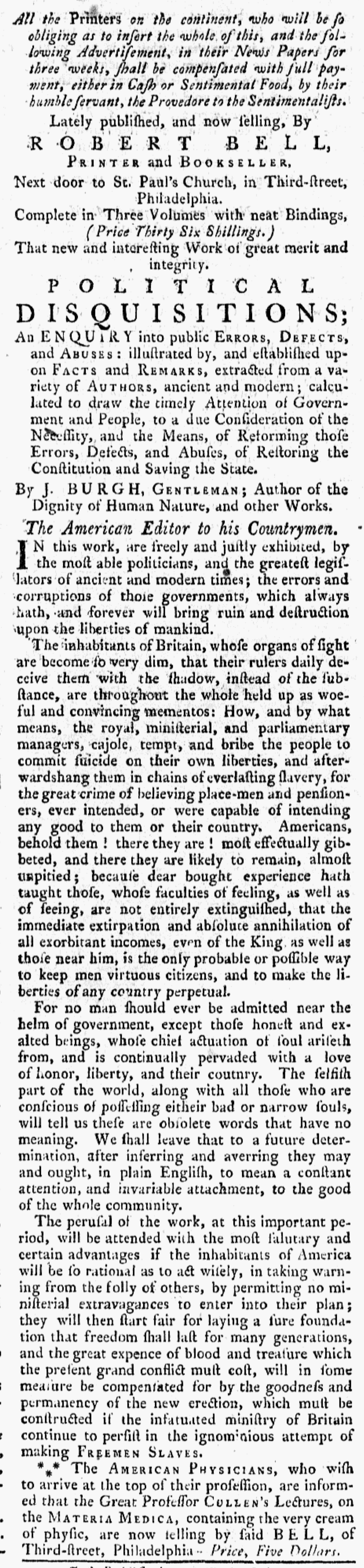
All the Printers … shall be compensated with full payment, either in Cash or Sentimental Food.”

Robert Bell, one of the most prominent American printers and booksellers during the second half of the eighteenth century, frequently distributed subscription proposals for works he wished to publish far and wide.  Such was the case when he marketed an American edition of James Burgh’s Political Disquisitions in 1775.  The extensive secondary title provided an overview of the multi-volume work: “An ENQUIRY into public ERRORS, DEFECTS, and ABUSES: illustrated by, and established upon FACTS and REMARKS, extracted from a variety of AUTHORS, ancient and modern; calculated to draw the timely ATTENTION of Government and People, to a due Consideration of the Necessity, and the Means, of Reforming those Errors, Defects, and Abuses, of Restoring the Constitution and Saving the State.”

Upon publishing the work, Bell set about a new round of marketing.  Once again, he wished to advertise widely.  This time, he appended a note to his advertisement that appeared in the December 2 edition of the Pennsylvania Ledger.  Addressing “All the Printers on the continent,” Bell offered that those “who will be so obliging as to insert the whole of this, and the following Advertisement, in their News Papers for three weeks, shall be compensated with full payment, either in Cash or Sentimental Food, by their humble servant, the Provedore to the Sentimentalists.”  The “following Advertisement” consisted of three portions: a standard notice typical of others for books that appeared in the Pennsylvania Ledger and other newspapers, a lengthy address from “The American Editor to his Countrymen,” and a brief announcement that Bell also sold “the Great Professor CULLEN’s Lectures, on the MATERIA MEDICA” to “AMERICAN PHYSICIANS, who wish to arrive at the top of their profession.”  The standard advertisement included the name of the book and its author, the price (“Thirty Six Shillings”), a description of some of its material aspects (“Three Volumes with neat Bindings”), and where to purchase it.  In the address, Bell asserted, “The perusal of the work, at this important period, will be attended with the most salutary and certain advantages if the inhabitants of America will be so rational as to act wisely, in taking warning from the folly of others, by permitting no ministerial extravagances to enter into their plan.”  They could lay “a sure foundation that freedom shall last for many generations” instead of allowing the current British administration to make “FREEMEN [into] SLAVES.”

The entire advertisement was much longer than most subscription proposals or notices about books already published.  That may have been the reason that Bell appended the note to “All the Printers on the continent.”  In other instances, fellow printers may have published shorter advertisements gratis, but this one required significant space in weekly newspapers that consisted of only four pages.  To increase the chances that printers would reprint it when they saw the advertisement in newspapers that they received through their exchange networks, Bell made sure that they knew that he would compensate them “with full payment, either in Cash or Sentimental Food.”  In other words, he would supply copies of Political Disquisitions or other books he published to those who preferred them rather than cash.  The flamboyant Bell was already known as “the Provedore to the Sentimentalists” from his newspaper advertisements, broadsides, and book catalogs.  He sought to maintain the image he cultivated by including that language in his note to printers, yet he realized that his reputation alone would not convince them to publish such an extensive advertisement.  Accordingly, he promised payment in advance rather than expecting newspaper printers to publish his advertisement as a courtesy, no matter how well their politics might align with those in Bell’s address “to his Countrymen.”
November 20

What was advertised in a revolutionary American newspaper 250 years ago today?

Boston-Gazette (November 20, 1775).

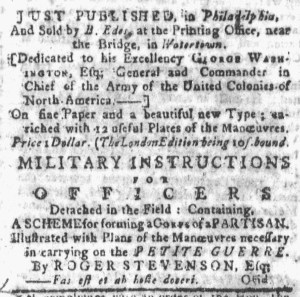
“MILITARY INSTRUCTIONS for officers Detached in the Field.”

On November 20, 1775, Benjamin Edes, the printer of the Boston-Gazette, ran an advertisement for a military manual “JUST PUBLISHED, in Philadelphia,” and available at his printing office in Watertown.  The printer had relocated there shortly after the battles at Lexington and Concord, though he did not update the name of his newspaper.  He advertised an edition of Roger Stevenson’s Military Instructions for Officers Detached in the Field published by Robert Aitken.  Although the advertisement proclaimed that the book had been “JUST PUBLISHED,” another edition had been available in Philadelphia since June.  At the time that Aitken advertised it, he noted that “A new Edition of this Book, with some Additions, is now in the Press and will soon be published.”  That likely referred to the edition that Edes stocked, especially considering that the appeals in his advertisement paralleled the advertisement that Aitken published in the Pennsylvania Ledger in August.

Both advertisements opened with an announcement that the book had been published and where to acquire copies, followed by a note that this edition was “Dedicated to his Excellency GEORGE WASHINGTON, Esq; General and Commander in Chief of the Army of the United Colonies of North-America.”  Next, both advertisements commented on the material aspects of the book, noting the “fine Paper and a beautiful new Type” as well as the “12 useful Plates [or illustrations] of the Manœuvres.”  The price in the local currency followed, along with a comparison to the price of a bound London edition.”  As was so often the case in advertisements for books, all that preamble appeared before the title of the book.  Aitken’s much longer advertisement then presented an address “TO THE PUBLIC” drawn from the preface.  Edes did not devote that much space to his advertisement in the Boston-Gazette.  Instead, he inserted a quotation from Ovid: “Fas est et ab roste doceri” (It is right to be taught from the pulpit).  That phrase invoked Stevenson’s experience as a British officer.  Edes did not devise it on his own.  Instead, he borrowed it from the title page.  Overall, Edes did not generate original copy for his advertisement for a military manual printed in Philadelphia.  Instead, he borrowed heavily from Aitken’s advertisement, revising the location where customers could purchase the book and the price in local currency.  He also substituted the quotation on the title page for an excerpt from the preface but did not compose anything new for his advertisement.  The marketing for the book in the Boston-Gazette thus replicated the strategies that Aitken introduced in the public prints in Philadelphia months earlier.  He may even have dispatched a clipping of the advertisement with the copies he sent to Edes.

May 4

What was advertised in a revolutionary American newspaper 250 years ago today?

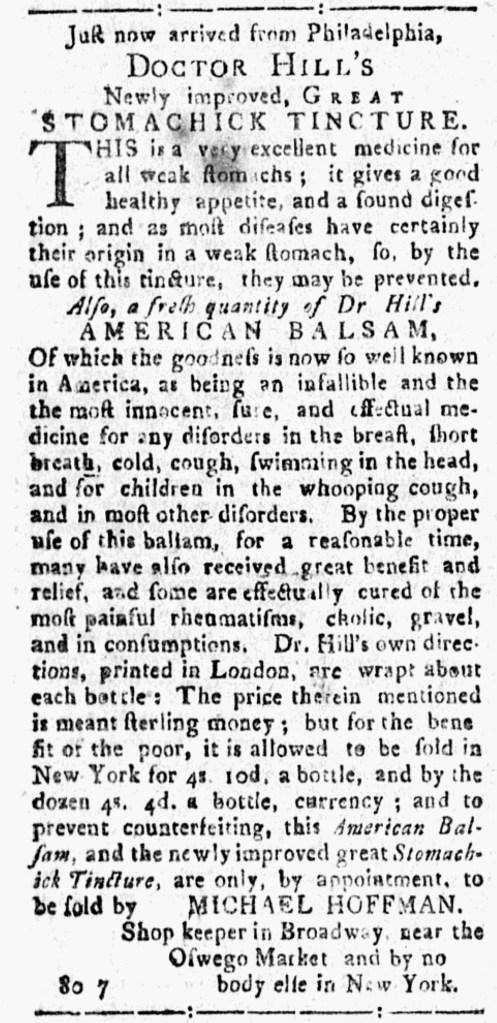
New-York Journal (May 4, 1775).

“To be sold by MICHAEL HOFFMAN … and by no body else in New-York.”

In the spring of 1775, Michael Hoffman took to the pages of the New-York Journal to advertise two patent medicines, “DOCTOR HILL’S Newly improved, GREAT STOMACHICK TINCTURE” and “Cr. Hill’s AMERICAN BALSAM.”  Even though he asserted that the goodness of that second remedy “is now so well known in America, as being an infallible … end effectual medicine” for a variety of “disorders,” Hoffman listed symptoms that it alleviated.  He also advised that the tincture prevented “most diseases” since they tended to have “their origin in a weak stomach.”

Hoffman declared that his supply had “Just now arrived from Philadelphia.”  He likely received it from William Young, an associate who advertised both the tincture and the balsam in the Pennsylvania Journal in November 1774 and in the first issue of Story and Humphreys’s Pennsylvania Mercury in April 1775.  Those advertisements included a short list of five local agents who sold Dr. Hill’s medicines in Philadelphia, Germantown, Kingsessing, Lancaster, and New York.  The shopkeeper did not incorporate that list into his notice, but he did underscore that “to prevent counterfeiting” the remedies were sold “only, by appointment … by MICHAEL HOFFMAN … and by no body else in New-York.”  Judging by an advertisement in the Pennsylvania Packet in May 1772, he held that exclusive “appointment” for at least three years.  As another means of guaranteeing authenticity, “Dr. Hill’s own directions, printed in London, are wrapt about each bottle.”

In addition to the patent medicines, Hoffman apparently received copy for his advertisement from Young.  Much of it repeated the notices that ran in Philadelphia’s newspapers word for word.  In the initial advertisement in November, Young stated that the medicines had been “Lately imported from London.”  Hoffman updated that to “Just now arrived from Philadelphia,” not mentioning when his associate there imported them even though he could have affirmed that Young had received the shipment before the Continental Association went into effect on December 1, 1774.  Perhaps he depended on his own reputation as sufficient testimony that he did not sell goods in violation of the nonimportation agreement.

July 26

What was advertised in a colonial American newspaper 250 years ago today?

Essex Gazette (July 26, 1774).

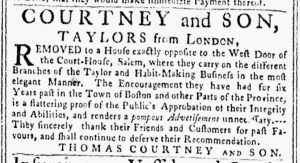
“Public approbation … renders a pompous advertisement unnecessary.”

When Thomas Courtney and Son relocated from Boston to Salem, they ran in advertisement in the Essex Gazette to inform readers that they “carry on the different Branches of the Taylor and Habit-Making Business” at a shop near the courthouse.  They described themselves as “from LONDON,” hoping that their origins gave them some cachet among prospective clients, yet also reported that they had followed their trade “for six Years past in the Town of Boston.”

Their experience there served as even more of a recommendation and evidence that prospective customers should give them a chance.  The “Encouragement” they received for so many years, the tailors argued, “is a flattering proof of the Public’s Approbation of their Integrity and Abilities.”  No tailoring shop could have lasted for so long without the “Encouragement” of satisfied customers who gave them return business or offered positive reviews to friends.  Courtney and Son earned such a reputation that “renders a pompous Advertisement unnecessary.”  With that critique of the elaborate appeals made by some of their competitors and other purveyors of goods and services, the tailors expressed gratitude to former customers and declared that they “shall continue to deserve their Recommendation.”

It was not the first time that Courtney and Son deployed that marketing strategy.  Nine months earlier, they moved to a new location in Boston.  On that occasion, they ran an advertisement in the Massachusetts Spy.  Its copy was so similar, nearly identical, to their notice in the Essex Gazette that the tailors may have clipped it from the Massachusetts Spy and later from it.  The two advertisements featured variations in capitalization, not uncommon when advertisers ran notices in more than one newspaper.  In both, the phrase “pompous advertisement” appeared in italics.  While this does not reveal the effectiveness of the advertisement, it does suggest that Courtney and Son believed that it met with a positive reception that merited republishing it rather than devising other sorts of appeals to prospective customers in their new town.

February 14

GUEST CURATOR:  Caroline Branch

What was advertised in a colonial American newspaper 250 years ago today?

Boston-Gazette (February 14, 1774).

“KEYSER’s FAMOUS PILLS … eradicating every Degree of a certain Disease.”

The date of this advertisement for “KEYSER’s FAMOUS PILLS” to treat venereal disease is an ironic one, appearing on Valentine’s Day, but advertisements for these pills ran often. This advertisement displays the fear of venereal diseases throughout Europe and the colonies in the eighteenth century. Doctors agreed that mercury was the way to treat the disease, including Jean Keyser, a French military surgeon. According to Micheline Louis-Courvoisier, many doctors prescribed a mercurial ointment that patients rubbed all over their bodies for about forty days. In contrast, Keyser’s Pills “contain[ed] a combination of mercuric acid and acetic acid.”  The pills were an invention to treat venereal diseases better. In 1761 doctors in Geneva tested the two methods. Louis-Courvoisier states that “following that trial, Keyser pills were considered a good treatment.” They were deemed a success due to the improvement of side effects from previous medications. The pills became a common medication to treat syphilis and other diseases in Europe and the American colonies.

**********

ADDITIONAL COMMENTARY:  Carl Robert Keyes

Keyser’s Pills may very well have been the most popular, or at least the most widely advertised and generally recognized, patent medicine marketed in British mainland North America in the 1760s and 1770s.  Apothecaries stocked the pills, as did shopkeepers and even printers.  The Adverts 250 Project traced the competition among apothecaries and printers in New York and Philadelphia in the fall of 1773.  That competition (or was it a coordinated effort?) continued into the winter of 1774, extending to Boston as well.

Hugh Gaine, the printer of the New-York Gazette and Weekly Mercury, continued advertising Keyser’s Pills in his newspaper in the new year.  To corner as much of the market as he could, he had previously advertised in the Newport Mercury, encouraging prospective customers in Rhode Island to submit orders to “his book store and printing-office, at the bible & crown in Hanover-square” in New York.  When Benjamin Edes and John Gill, printers of the Boston-Gazette, advertised “KEYSER’s FAMOUS PILLS” on February 14, 1774, they lifted the copy for their notice directly from Gaine’s advertisement.  Edes and Gill used the same headline, followed by two paragraphs of identical text (with some variations in capitalization and italics).”  Like Gaine, they declared that declared that the remedy was “So well known all over Europe, and in this and the neighbouring Colonies, for their superior Efficacy and peculiar Mildness,” making note of the less severe side effects that Caroline discusses above.  The format continued to replicate Gaine’s advertisement, with a secondary headline distributed over three lines.  It announced, “THESE PILLS ARE NOW SOLD BY / EDES and GILL, / (In Boxes of 7s6 L.M. each, fresh imported).”  They simply traded out Gaine’s name for their own and converted the price into local currency.  In another paragraph, Edes and Gill claimed that they “have in their Hands a Letter from the Widow KEYSER, and a Certificate from under her own Hand of the Genuineness of the above Pills.”  Apothecaries, shopkeepers, printers, and other purveyors of Keyser’s Pills frequently squabbled over who sold the real remedy and who peddled counterfeits.  Edes and Gill invited “any Person” to have a “Perusal” of the letter and certificate at their printing office, once again replicating and only slightly editing as necessary Gaine’s advertisement.

Printers and others competed to sell Keyser’s Pills, sometimes even appropriating advertising copy devised by their rivals.  Edes and Gill may not have needed to resort to consulting an advertisement from the Newport Mercury published a couple of months earlier when they first ran their own notice on January 31 and again on February 7 and 14.  More recently, Gaine ran the same advertisement in his New-York Gazette and Weekly Mercury, commencing on January 17.  (He resurrected copy that previously appeared in both his own newspaper and the Newport Mercury.)  That allowed enough time for Edes and Gill to receive that issue in Boston.  Perhaps Gaine even franchised out Keyser’s Pills to Edes and Gill to sell in New England, providing them with both pills and copy for their marketing efforts.  Whatever the explanation, readers in New York and New England experienced consistent messaging about a product imported from Europe and sold in several American ports.  That likely contributed to the acclaim the pills earned in the colonies.

February 23

What was advertised in a colonial American newspaper 250 years ago today?

Essex Gazette (February 23, 1773).

“Also at NATHANIEL DABNEY’s Apothecary-Shop, at the Head of Hippocrates, Salem, New-England.”

Advertisements for Essence of Pearl and Pearl Dentifrice regularly appeared in newspapers printed in Boston in the early 1770s.  According to the notice, Jacob Hemet, “DENTIST to her Majesty, and the Princess Amelia,” manufactured these products to “preserve the Teeth in a perfect sound State, even to old Age” as well as “render them white and beautiful,” “fasten such as are loose,” and prevent the Tooth-Ach.”  Hemet’s products also helped with the gums.  Supposedly they could “perfectly cure the Scurvy of the Gums,” “make them grow firm and close to the Teeth,” and “remedy almost all those Disorders that are the Consequence of scorbutic Gums.”  Like many patent medicines, Essence of Pearl and Pearl Dentifrice had many uses for a variety of maladies.

Advertisements bearing Hemet’s name in capital letters as the primary headline and his occupation and service to royalty as the secondary headline appeared in several newspapers in Boston, including the February 18, 1773, edition of the Massachusetts Spy.  Advertisements with identical copy also ran in the New-Hampshire Gazette, published in Portsmouth.  Those notices indicated that Hemet appointed a select few agents to sell his products, “W. Bayley, Perfumer, in Cockspur-street, near the Bottom of the Hay-Market, London,” and William Scott at the “Irish Linen-Store, near the Draw-Bridge, Boston, New-England.”  Those may not have been all of the associates that Hemet authorized to sell his products.  Other advertisers included his Essence of Pearl and Pearl Dentifrice among lists of patent medicines and other merchandise, though they did not go into detail about the products.  They may have expected that consumers were already familiar with them.

One advertiser, however, did attempt to establish a connection to Hemet and encourage readers to purchase the dentist’s products from him.  For many months, Nathaniel Dabney took to the pages of the Essex Gazette, published in Salem, Massachusetts, with an advertisement that featured copy nearly identical to those in the New-Hampshire Gazette and the Boston newspapers … except he added himself to the list of authorized dealers: “also at NATHANIEL DABNEY’s Apothecary-Shop, at the Head of Hippocrates, Salem, New-England.”  Residents of the town and readers of the only newspaper published there in the early 1770s likely would have been familiar with Dabney’s shop and the device that marked its location.  The apothecary sometimes included images of “the Head of HIPPOCRATES” in his advertisements that listed a variety of patent medicines and other goods available at his shop.  He did not publish advertisements for specific products, making the advertisement for Hemet’s Essence of Pearl and Pearl Dentifrice an exception.  Had he entered into some sort of agreement with Hemet?  Or had he acquired the products wholesale, perhaps from William Scott, and decided to take advantage of advertising copy already in circulation?  Printers generated much of the news content by reprinting generously from one newspaper to another.  Perhaps Dabney adopted a similar method in his efforts to market Hemet’s products.  He likely would not have been the only advertiser to borrow copy from notices placed by others during the era of the American Revolution.

June 27

What was advertised in a colonial American newspaper 250 years ago today?

Jun 27 - 6:27:1767 Providence Gazette
Providence Gazette (June 27, 1767).

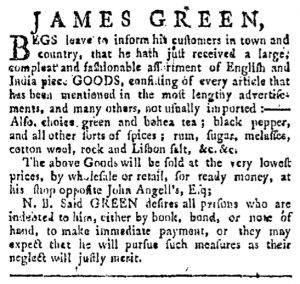
“GOODS, consisting of every article that has been mentioned in the most lengthy advertisements, and many others, not usually imported.”

James Green sold a variety of imported goods at his shop in Providence. For several weeks in the late spring and early summer of 1767 he placed a notice that “he hath just received a large, compleat and fashionable assortment of English and India piece GOODS, consisting of every article that has been mentioned in the most lengthy advertisements, and many others, not usually imported.” This claim caught my attention because it so closely replicated an advertisement placed by Gilbert Deblois in the Boston Evening-Post, the Boston Post-Boy, and the Massachusetts Gazette at about the same time. Deblois carried “A complete fashionable Assortment of English & India Piece GOODS, consisting of every Article that has been mentioned in the most lengthy Advertisements, and many others not usually imported.” Green eliminated the italics that consistently appeared in Deblois’s advertisements in all three Boston newspapers, but he otherwise adopted the same language to make a fairly unique appeal.

Many eighteenth-century advertisements included formulaic phrases, such as “compleat and fashionable assortment,” but appropriation of entire sentences that expressed distinctive marketing efforts was not common. Shopkeepers occasionally stated that they carried too much merchandise to list all of it in an advertisement, but rarely did they claim to carry goods “not usually imported.” Green, whose advertisement first appeared in the Providence Gazette on May 23, apparently lifted copy from Deblois’s notice, probably hoping that it would have the same effect of intriguing potential customers and inciting curiosity about what might be on the shelves in his shop. He may have believed that he could get away with treating this marketing strategy as his own if he was the first and only shopkeeper in Providence to adopt it.

Other scholars have demonstrated that news flowed through networks of printers who liberally borrowed news items from other newspapers, reprinting them word for word, sometimes with attribution and other times without. This advertisement suggests that sometimes advertisers engaged in the same practices, keeping their eyes open for innovative marketing appeals formulated by their counterparts in other cities and adopting them as their own.