May 14

What was advertised in a colonial American newspaper 250 years ago today?

May 14 - 5:14:1770 New-York Gazette and Weekly Mercury
New-York Gazette and Weekly Mercury (May 14, 1770).

“She has had the honour of being employed by several ladies in this city.”

Mary Morcomb did not indicate how recently she had arrived in New York in her advertisement, but it was recently enough that she described herself as a “Mantua-Maker, from London.”  After migrating to the colonies, she hoped to establish a new clientele.  To that end, she informed readers of the New-York Gazette and Weekly Mercury that she made “all sorts of negligees, Brunswick dresses, gowns, and every other sort of lady’s apparel.”  In addition, she extended her skills working with textiles to “cover[ing] UMBRELLOES in the neatest and most fashionable manner.”  Invoking her London origins testified to her access to the latest styles and taste, reassuring prospective customers that she did indeed produce both garments and umbrellas, a new and exotic accessory in the early 1770s, in the “most fashionable manner.”

As a newcomer who could not depend on a reputation established through interacting with clients and acquaintances over time, Morcomb instead attempted to accelerate the process.  She claimed that she already “had the honour of being employed by several ladies in this city.”  Those ladies, Morcomb reported, were satisfied with the garments she made for them and had “declared their approbation of her work.”  This was a secondhand testimonial, delivered by the provider of the goods and services, yet Morcomb hoped it would be sufficient to garner “encouragement from the ladies, in her business.”  She concluded by pledging that if prospective clients put their trust in her that they “May depend upon having their work done with all possible care and dispatch.”

In her effort to attract new customers, Morcomb deployed strategies often used by artisans, especially those in the garment trades, who only recently arrived in the colonies.  Many emphasized their connections to cosmopolitan cities where they had access to the latest fashions and then suggested that this already translated to serving select clients in their new location.  Although unfamiliar to many residents in their communities, Morcomb and other artisans attempted to incite demand by asserting that their services were already in demand.  Prospective customers should be eager to hire them, they proposed, because they had already successfully demonstrated their proficiency at their trades.

May 6

What was advertised in a colonial American newspaper 250 years ago this week?

May 6 - 5:3:1770 Pennsylvania Journal Supplement
Supplement to the Pennsylvania Journal (May 3, 1770).

“Carry on the business with the same head workman as manufactured for Jackson and Gibbons.”

At the beginning of 1770, William Norton and Company placed an advertisement for “MUSTARD and CHOCOLATE” in the Pennsylvania Journal and then continued to insert it on occasion over the next several months.  They advised prospective customers that they “fitted up a shop” on Front Street.  Buyers could visit them there or, if they lived “at a distance,” send orders to the company.  Norton and Company made both wholesale and retail sales of their mustard and chocolate.  To encourage others to purchase in bulk for resale, they offered a discount.  They also pledged good customer service.

Yet these were not the only appeals deployed by Norton and Company.  Their business may have been new, but the enterprise was not.  They built on a foundation that had already been established by Jackson and Gibbons, familiar names in Pennsylvania when it came to the production of mustard and chocolate.  Jackson and Gibbons previously ran their own advertisements, complete with a woodcut depicting their seal flanked by a bottle of mustard and a brick of chocolate, in the Pennsylvania Gazette.  Norton and Company opened their own notice by proclaiming that they had “purchased the mills, late Benjamin Jackson’s, and carry on the business with the same head workman as manufactured for Jackson and Gibbons.”  They assumed that for many consumers it mattered less whose names appeared at the top of the advertisement and oversaw the business and more who actually produced the mustard and chocolate for Norton and Company.

They sought to benefit from the reputation Jackson and Gibbons already earned.  In prior advertisements, their predecessors proclaimed, “The said JACKSON is the Original, and indeed only, proper Manufacturer on this Continent … and has brought his Machines to greater Perfection than any other even in England.”  Having acquired Jackson and Gibbons’s mill and head workman, Norton and Company were prepared to provide the same quality products to consumers without interruption.

March 22, 1770

What was advertised in a colonial American newspaper 250 years ago today?

Mar 22 - 3:22:1770 Pennsylvania Journal
Pennsylvania Journal (March 22, 1770).

My customers are therefore requested to be upon their guard against such deceptions.”

Counterfeit hams!  In an advertisement that ran in the March 22, 1770, edition of the Pennsylvania Journal, Joseph Borden warned consumers against purchasing hams that unscrupulous retailers passed off as his product.  That warning comprised half of his advertisement.

Borden opened his notice by advising prospective customers that he supplied the “best Salt-peter’d HAMS, flitch BACON, or JOWELS.”  He did not give his location, only that he raised hogs outside of Philadelphia.  Francis Hopkinson in Front Street accepted orders on his behalf and then communicated them to Borden.  In turn, Borden delivered the hams, bacon, and jowls to customers “as soon as the distance will permit.”

Below his signature, Borden inserted a nota bene to advise consumers to beware of counterfeit hams.  “I have not this year, not any preceeding year,” he asserted, “sent Hams to Philadelphia to be stor’d and retail’d.  Whoever, therefore, offers any for sale as mine, would impose upon the public – my customers are therefore requested to be upon their guard against such deceptions.

Borden’s notice suggests two possibilities.  Others may have been trafficking in counterfeit hams, hoping to benefit from Borden’s reputation.  If that was the case, Borden sought to protect both his reputation and his share of the market by insisting that consumers accept no substitutes.  Alternately, neither Borden nor consumers had been victims of such trickery.  Instead, Borden may have invented the tale of hams being sold as his, intending to enhance his reputation and incite demand by suggesting that his hams were so widely recognized for their quality that his business became a casualty of counterfeiters.  Borden did not actually accuse any merchants and shopkeepers in Philadelphia of attaching his name to their hams, but he did present the scenario for consumers to contemplate.

Whether or not counterfeit hams were circulating in Philadelphia in the late 1760s and early 1770s, Borden apparently believed that consumers would consider such a scheme plausible.  After all, manufacturers of patent medicines sometimes warned against imitations in their advertisements.  Artisans occasionally did so as well.  Borden followed their lead in declaring that pork was also a product subject to counterfeiting.

October 12

What was advertised in a colonial American newspaper 250 years ago today?

Oct 12 - 10:12:1769 Massachusetts Gazette and Boston Weekly News-Letter
Massachusetts Gazette and Boston Weekly News-Letter (October 12 1769).

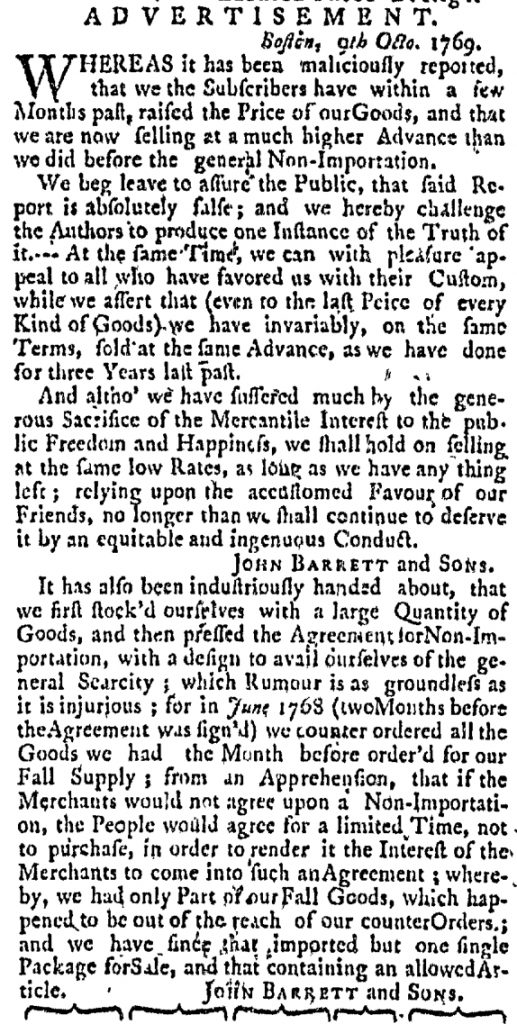
“We have suffered much by the generous Sacrifice of the Mercantile Interest to the public Freedom and Happiness.”

This “ADVERTISEMENT” by John Barrett and Sons most likely was not a paid notice but rather a letter to the editor of the Massachusetts Gazette and Boston Weekly News-Letter. Either the Barretts or the printer used the word “advertisement” to mean a notification or a written statement calling attention to something, common usage in the eighteenth-century but chiefly historical today. Unlike most paid notices that ran for multiple weeks, this “ADVERTISEMENT” appeared only once, suggesting that the printer did indeed insert it as an article of interest for readers. Still, this “ADVERTISEMENT” appeared immediately above a paid notice for consumer goods. It testifies to some of the discourse that animated the appeals made in paid notices that promoted consumer goods and services.

Barrett and Sons sought to address rumors that dogged their business in the midst of the nonimportation agreement. Others had “maliciously reported” that they engaged in price gouging, charging much more than they did “before the general Non-Importation” to take advantage of the perceived scarcity of goods. The Barretts assured readers, both their customers and the general public, that they had “invariably, on the same Terms” sold their wares at the same prices “as we have done for three Years last past.” Just as significantly, they had accepted the ramifications to their business for doing so, indicating that they had “suffered much by the generous Sacrifice of the Mercantile Interest to the public Freedom and Happiness.” They pledged to continue “selling at the same low Rates” as to support the cause. The prospects for their business and their personal interests mattered less than virtuously participating in the nonimportation agreement for the benefit of all colonists.

That being the case, Barrett and Sons addressed a second rumor that accused them of ordering surplus stock ahead of the nonimportation agreement going into effect in order to have plenty of merchandise to continue selling to colonial consumers. The Barretts argued that was exactly the opposite of what happened: the “Rumour is as groundless as it is injurious.” Instead, in June 1768, two months before the merchants of Boston signed the nonimportation agreement, Barrett and Sons cancelled their orders for fall goods. They feared that the merchants would not reach agreement on nonimportation and, if that happened, the general public would then assume adopt nonconsumption as an alternative strategy, refusing to purchase imported goods. The Barretts expected that a broad nonconsumption movement by colonists would sway merchants, convincing them to overcome their hesitation about nonimportation. That had not become necessary, but Barrett and Sons informed the public (and prospective customers) that they envisioned the possibility of such a plan going into effect.

The politics of commerce and consumption tinged every word in this “ADVERTISEMENT” by Barrett and Sons. They defended their reputation to the general public, presenting a narrative of their own actions in relation to nonimportation and nonconsumption intended to enhance, rather than merely rehabilitate, their standing in the community. They sought to convince their fellow colonists that they were savvy but not unscrupulous traders who simultaneously tended their own business interests and promoted the public good … and when the two came into conflict, they opted for the public good over their own enterprises. Civic virtue imbued the decisions they made about their business.

September 15

What was advertised in a colonial American newspaper 250 years ago today?

Sep 15 - 9:15:1769 New-London Gazette
New-London Gazette (September 15, 1769).

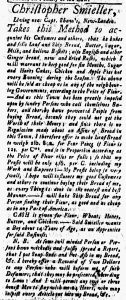
Some evil minded Person or Persons have wickedly and falsely spread a Report, that I put Soap Suds and Pot-Ash in my Bread.”

As summer turned to fall in 1769, Christopher Smieller took to the pages of New-London Gazette to defend his reputation and mitigate damage already done to his business. The baker had become aware of a vicious rumor about his bread. In a lengthy nota bene at the conclusion of even lengthier advertisement, he expressed his outrage that “some evil minded Person or Persons have wickedly and falsely spread a Report, that I put Soap Suds and Pot-Ash in my Bread.” Smellier could not let this slander pass unremarked. Instead, he offered “a Reward of Two Dollars to any Person who will inform me of such Defamers that they may be prosecuted according to law.” In order to rehabilitate his standing in the community, he also made provision for witnesses to observe him as he went about his business: “I will permit any two or three honest Men to stay with me 24 Hours, who may inspect every Article put into my Bread.”

Combatting gossip circulating about unsavory additions to his bread may have prompted Smieller to insert other aspects of his lengthy advertisement. It opened like many other advertisements for consumer goods, listing his wares. Smieller also advanced an appeal to price, stating that he sold loaf and ship bread, gingerbread, cakes, and pies “as cheap as in any of the neighbouring Governments.” In other words, his prices in New London were as good as prospective customers could find in Massachusetts, New York, or Rhode Island. He doubled down on this assertion later in the advertisement, proclaiming the he baked ship bread “as good and as cheap as in any Part of America.”

Smieller tied the prices he charged for bread to the prevailing prices for flour. He made allusion to “sundry Persons who call themselves Bakers” who had been overcharging the residents of New London and making it unaffordable for them to buy bread. To demonstrate that he charged fair prices, Smieller specified how much a loaf of bread weighed and the corresponding price at the current price for flour. He explained that he would adjust the price per loaf as his own costs for flour fluctuated, but that he would hold his profit consistent. He hoped current and prospective customers would patronize his business out of appreciation for his commitment to keeping prices low by earning “so very small” profits on his bread. Smieller might not otherwise have outlined the expenditures and profits for his business, but defending himself against the rumor that he put soap and potash in his bread may have motivated him to devise other methods of convincing the people of New London to purchase from him.

September 4

What was advertised in a colonial American newspaper 250 years ago today?

Sep 4 - 9:4:1769 New-York Gazette or Weekly Post-Boy
New-York Gazette or Weekly Post-Boy (September 4, 1769).

“She has had the Honour of being employed by several Ladies in this City.”

In an advertisement that ran in the September 4, 1769, edition of the New-York Gazette or Weekly Post-Boy, Mary Morcomb, a dressmaker, announced that she made “all Sorts of Negligees, Brunswick Dresses, Gowns, and every other Sort of Lady’s Apparel.” She also applied her skills to covering umbrellas, a fashionable accessory for many women and some men in the 1760s and 1770s.

Morcomb deployed the standard market strategies. She made appeals to price, quality, and fashion, promising prospective customers that she made garments and covered umbrellas “in the neatest, and most fashionable Manner, at the lowest Prices.” Morcomb also realized that reputation was important in attracting clients and building her business. She informed readers that she “has had the Honour of being employed by several Ladies in this City, who have declared their Approbation of her Work.” Given that Morcomb described herself as a “MANTUA-MAKER from LONDON,” she may have arrived in New York relatively recently. The newcomer may not have had time to establish a clientele in the city but had managed to find some work from “several Ladies,” leveraging their approval into a secondhand testimonial. Satisfied customers generated more customers, but word-of-mouth referrals and cultivating a reputation took time. To speed along the process, Morcomb asked the women of New York to trust her that she already served “several Ladies in this City.” In exchange for that trust, Morcomb pledged that new customers “may depend upon having their Work done with all possible Care and Dispatch.” This may not have been enough to convince every prospective client of her skills and the quality of her garments, but it may have been sufficient for some to take a chance with Morcomb. Even if the dressmaker entice only a few more clients with her advertisement, that new business could further enhance her reputation among female consumers in New York.

July 14

What was advertised in a colonial American newspaper 250 years ago today?

Jul 14 - New-Hampshire Gazette Jul 14
New-Hampshire Gazette (July 14, 1769).

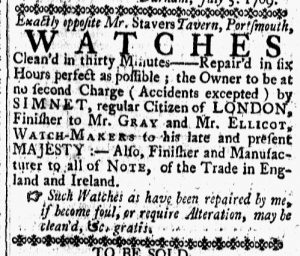
“Finisher to Mr. GRAY and Mr. ELLICOT, WATCH-MAKERS to his late and present MAJESTY.”

John Simnet was an industrious advertiser, perhaps in part due to competition with a rival watchmaker in Portsmouth, New Hampshire. Their competition descended into a feud that took place via their advertisements in the public prints in 1769. Simnet regularly published new advertisements rather than instructing the printers of the New-Hampshire Gazette to once again insert notices that previously appeared in the pages of their newspaper. As a result, the copy in Simnet’s advertisements featured greater variation than readers encountered in notices placed by others who regularly advertised consumer goods and services. His new advertisements often contained variations on appeals he previously presented to prospective clients and new information intended to entice those not yet convinced by what they already knew about the watchmaker and his business.

Such was the case for an advertisement in the July 14, 1769, edition of the New-Hampshire Gazette. Simnet reiterated a promise that he had previously presented: “Such Watches as have been repaired by me, if become foul, or require Alteration, may be clean’d, &c. gratis.” In other words, Simnet offered a guarantee for his work and pledged free service and maintenance if he did not manage to completely fix the problem the first time. As for new appeals to prospective clients, the watchmaker emphasized convenience by providing a timetable for his services: “WATCHES Clean’d in thirty Minutes—Repair’d in six Hours.” Customers did not even need to part with their watches overnight. That same week he announced this timetable in an advertisement in the Essex Gazette, but he had not previously discussed the amount of time necessary to make repairs except to state that he did his work “expeditiously.” Finally, Simnet expanded on an appeal that he deployed in earlier advertisements. He had noted his twenty-five years of experience in London, but in his newest advertisement he associated himself with prominent watchmakers, declaring that he had worked as “Finisher and Manufacturer to all of NOTE” in the watchmaking trade in England and Ireland. Most significantly, Simnet proclaimed that he had previously been employed as “Finisher to Mr. GRAY and Mr. ELLICOT, WATCH-MAKERS to his late and present MAJESTY.” He had worked on watches for George II and George III. Simnet did not name his local rival in this advertisement, but the competition almost certainly could not claim to have served such eminent clients! Supplying this additional information enhanced the reputation Simnet cultivated throughout his advertising campaign.

July 2

What was advertised in a colonial American newspaper 250 years ago this week?

Jul 2 - 6:29:1769 New-York Journal
New-York Journal (June 29, 1769).

“Doing so was contrary to the Non-Important Agreement.”

The success of the nonimportation agreements adopted during the imperial crisis depended not only on the cooperation of merchants and consumers but also on surveillance and enforcement, both formal and informal. Committees of merchants and traders devised the nonimportation agreements and then set about policing themselves, but colonists also observed their friends and neighbors to assess whether they complied and, when necessary, shame them in public and deprive them of business as punishment for not adhering to the agreement.

The June 26, 1769, edition of the New-York Journal carried an advertisement that testified to the stakes of following the nonimportation agreement. It told a story about Peter Clopper, “Merchant of this City, whose Zeal for promoting he good of his Country, has never been called in Question.” To that end, he was one of the first merchants in New York to sign the nonimportation agreement. About two weeks before the advertisement ran in the New-York Journal, Clopper traveled to Philadelphia to attend to “Business of Importance” and, while there, purchased “one Piece of Callico, two Pieces of coloured, and one Piece of black Persian.” He did not intend to sell these fabrics in New York, instead acquiring them “principally for the Use of his Family.” Still, this violated the nonimportation agreement, as Clopper soon realized. He then packaged up the textiles and sent them back to Philadelphia, yet that was not the end of atoning for his transgression. He voluntarily approached the Committee of Inspection into the Importation of Goods to relay the entire story and received credit for his honesty since the infraction “otherwise in all Probability never [would have] come to Light.”

In response to this incident, the committee determined that Clopper’s purchase was an “involuntary Transaction” that “ought not to be imputed to him as a Crime.” Having returned the merchandise and then presented himself to the committee of his own accord, he was “intitled to the Favour of the Committee for his candid Behaviour.” Yet Clopper did not seek the “Favour of the Committee” alone. He also wished to defend and maintain his reputation among the residents of New York, colonists who were also current and prospective customers. The introduction to the account of Clopper’s indiscretion and remedy depicted the alternatives. On the one hand, “it must afford great Satisfaction to every Friend of the American Colonies” to know the “Indignation and Abhorrence” that would be incurred by anyone who “willfully and personally” behaved in a manner “to counteract the Agreement entered into” for the “common Preservation” of the entire colony. On the other hand, “it must also give them Pleasure to know how cautious and fearful Individuals are of incurring the Censure of the Public.”

The merchants and traders who signed and enforced the nonimportation agreement were not Clopper’s only concern when he took action to fix his supposedly inadvertent mistake. He also worried about maintaining his reputation among the general public and avoiding the “Censure of the Public” that could spell ruin for his business. Yet it was not only commerce at stake. Clopper realized that his error could also affect his social relationships with friends and neighbors who supported the nonimportation agreement. When it came to adhering to that pact, political acts had personal ramifications. The purpose of the advertisement in the New-York Journal was to diffuse those ramifications for Clopper, given his eager cooperation once he realized his transgression, as well as remind others of the consequences if they willfully tried to evade the nonimportation agreement.

May 5

What was advertised in a colonial American newspaper 250 years ago today?

May 5 - 5:5:1769 New-Hampshire Gazette
New-Hampshire Gazette (May 5, 1769).

“Mends and cleans Watches, in as neat a Manner as any Watch-Finisher in Town or Country.”

John Simnet, “Watch-Finisher, and Manufacturer of London and Dublin,” continued his advertising campaign in the May 5, 1769, edition of the New-Hampshire Gazette. In this installment, he took a more aggressive approach than in previous notices, especially concerning his own expertise and the quality of the service he provided compared to other watchmakers in the area.  Having previously reduced the length of his advertisements, he found himself in a position of needing to elaborate in greater detail. He boldly proclaimed, “The entire Satisfaction I have given the Public, employed on numbers of imperfect Watches, after ev’ry other Workman hath either practised on them in vain, or given them up, gives me occasion to intimate to Gentlemen, that ‘tis much easier to me to repair a Watch before, than after another has with mistaken Judgment, operated on it.” Although he did not give any names, the watchmaker clearly denigrated his competition. He informed prospective customers that they might as well save themselves the time and expense and bring their watches to him first because the lack of skill of other watchmakers would ultimately cause them to seek out Simnet’s services anyway. He promoted his services in other ways as well, offering to do “Small repairs gratis” and pledging not to charge anything if he did not “do [his] Work perfect.”

Nathaniel Sheaff Griffith was not impressed with this newcomer and the competition he presented. In his own advertisement, conveniently placed next to Simnet’s notice, Griffith stated that he “mends and cleans Watches, in as neat a Manner as any Watch-Finisher in Town and Country, & much cheaper.” He invoked the term Simnet applied to himself, “Watch-Finish,” leaving little doubt that he referred to that rival in particular, even as he made a general appeal about his own skills, the quality of his work, and his low price. Griffith also played on his reputation as someone who had lived and worked in New Hampshire for quite some time. “As the said Griffith is well known in this Province,” he declared, “Gentlemen may with Safety leave their Watches in his Custody and depend upon their being seasonably returned.” Prospective customers could hardly have missed the implication that because Simnet was unfamiliar in the community that he could not be trusted. Griffith further demeaned Simnet, who had previously advertised that he planned to remain in New Hampshire for only a year, as an outsider by proposing that “Every Itenerant, or Walking-Watch-Manufacturer, especially those who carries their whole Stock upon ther Backs, should bring Credentials of their Honesty, before they can be trusted with Brass, much more Silver and Gold Watches.” According to Griffith, it was clear that Simnet was not to be trusted. He went so far as to imply that his competitor trafficked in stolen goods. “Some Men may have Watches to sell,” Griffith cautioned, “which for want of being known, may admit of a Doubt, whether they came honestly by them.” For his part, Simnet attempted to alleviate fears that he would steal watched from customers; the final line of his advertisement advised, “Security deposited in Hand, if requir’d.” In other words, he provided some sort of collateral when customers entrusted him with their watches. Just in case it was not abundantly clear that he targeted Simnet, Griffith invoked another aspect of the newcomer’s advertisements. He warned that by arranging for “mending for the low Price of a Pistereen, he may endanger the Loss of his whole Watch.”  Simnet explicitly stated that his price for mending and cleaning was “as low as a Pistereen.”

Simnet had been promoting his services in a series of advertisements in the New-Hampshire Gazette for several months. Griffith apparently did not appreciate the competition infringing on what he considered his market. While many eighteenth-century advertisers made general comparisons between themselves and others who pursued the same occupation, very rarely did they launch attacks at specific individuals. Griffith, however, launched a savage attack against Simnet, even though he never mentioned his rival by name. In so doing, he attempted to use the skepticism and anxiety of local consumers as a wedge to keep them away from Simnet.

April 28

GUEST CURATOR: Patrick Waters

What was advertised in a colonial American newspaper 250 years ago today?

New-Hampshire Gazette (April 28, 1769).

“A SCHOOL for teaching young MASTERS and MISSES, DANCING and GOOD MANNERS.”

Peter Curtis took out an advertisement in the April 28, 1769, edition of the New Hampshire Gazette to advertise his dance school. This advertisement is particularly interesting because it demonstrates one of the ways that people found entertainment in the eighteenth century. The lives of colonists during the revolutionary era were not focused only on work and survival. The services that Peter Curtis offered might have been a great way for people to take a break and learn how to dance. The profession of dance master could be quite rewarding because, according to an online exhibition from the American Antiquarian Society, these dances were difficult to master and would require many classes. However, having the time and money to attend a dance class would have been a luxury that mostly the middling sort and elites would have been able to take advantage of. In another part of this advertisement that is interesting Curtis states that he will also teach good manners. This would be a must for elites who wanted their children to learn the proper way to behave themselves when in the company of other affluent members of society. A common way that people asserted their affluence was through consumer culture, but being able to dance and have well-mannered children also accomplished the same goal.

**********

ADDITIONAL COMMENTARY: Carl Robert Keyes

In this advertisement Peter Curtis announced that he “has again opened a SCHOOL for teaching young MASTERS and MISSES, DANCING and GOOD MANNERS.” In declaring that he had “again opened a SCHOOL,” he assumed that readers and prospective clients were already aware of his previous endeavors as a dancing master. The brevity of his advertisement, especially compared to another he previously inserted in the New-Hampshire Gazette, suggests that was indeed the case. For instance, Curtis did not even state his location; he instead expected that others knew where to find his dancing school. In an advertisement that ran almost two years earlier, however, when Curtis launched that enterprise, he informed residents of Portsmouth that “he proposes to open a DANCING SCHOOL, at the House where the late Mr. David Horney kept a Tavern, and opposite Mr. John Stavers.” Over the course of a couple of years, his school became so familiar that Curtis no longer considered it necessary to give directions.

The dancing master himself had also become familiar in the community, so much so that he no longer underscored one of his most important credentials. When he first opened his school he introduced himself in the public prints as “Peter Curtis, From PARIS.” After outlining his services, he noted that he “has resided fifteen Years in France; he will teach them in the most polite and genteel Manner.” In so doing, he linked the experience he gained living and working in France with gentility and proper comportment. He encouraged prospective clients to desire the additional cachet of employing a dancing master with connections to Paris, at least when he first marketed his services in a community as yet unfamiliar with him. Over time, however, he apparently decided that he had established such a reputation in Portsmouth that he no longer needed to explicitly attach himself to the cosmopolitan French center of fashion and manners.

That Curtis once again advertised in the New-Hampshire Gazette suggests that he experiences some success in Portsmouth and its environs. Dancing masters were notorious for being itinerant in eighteenth-century America. Curtis apparently attracted enough clients and cultivated sufficient demand that he planned to remain in the relatively small port for another season rather than seek his fortune in New York or Philadelphia or any of the larger cities in the colonies. Even beyond urban centers, genteel colonists (and those who aspired to gentility) considered dancing and the manners associated with the pastime an important signifier of their status.