June 25

What was advertised in a revolutionary American newspaper 250 years ago today?
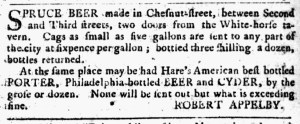
Pennsylvania Evening Post (June 25, 1776).

“SPRUCE BEER made in Chesnut-street … Hare’s American best bottled PORTER.”

Was advertising in early American newspapers effective?  Robert Appleby apparently thought so.  At the end of June 1776, he invested in placing an advertisement in the Pennsylvania Evening Post that he previously published in March.  “SPRUCE BEER made in Chestnut-street,” he announced.  For the convenience of his customers, “Cags [or kegs] as small as five gallons are sent to any part of the city at sixpence per gallon” or three shillings for a dozen bottles of spruce beer.  That was not the only product that Appleby stocked.  “At the same place may be had,” de declared, “Hare’s American best bottled PORTER, [and] Philadelphia bottled BEER and CYDER, by the grose or dozen.”  He was one of several tavernkeepers and other purveyors of beer in Philadelphia who promoted Hare’s Best American Draught Porter.  Other than patent medicines, Robert Hare’s porter was one of the first products recognized by a brand name.  Appleby also promised quality: “None will be sent out but what is exceeding fine.”

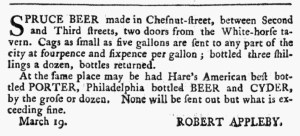
Appleby deployed the same copy in both advertisements, but this was not a case of the type remaining set and inserting it once again.  The new iteration of his advertisement had a different format.  The use of capital letters for “SPRUCE BEER,” “PORTER,” “BEER,” and “CYDER” remained the same and the first two lines broke at the same point, but the remainder of lines did not.  The compositor may have referred to a clipping of the previous advertisement when setting the type for the new one.  In addition, this version removed the date, “March 19,” and featured a variant spelling of the advertiser’s name, “APPELBY” rather than “APPLEBY.”  Sometimes type for advertisements remained set and undisturbed in printing offices for weeks, but that was not the case for Appleby’s advertisement.  The differences make clear that the compositor set the type for the same advertising copy a second time.  Appleby seemingly had confidence that his notice worked the first time and merited inserting in the Pennsylvania Evening Post once again.

March 19

What was advertised in a revolutionary American newspaper 250 years ago today?

Pennsylvania Evening Post (March 19, 1776).

“Hare’s American best bottled PORTER.”

Robert Appleby apparently specialized in beers brewed locally.  Those were the only products that he promoted in an advertisement that ran in the March 19, 1776, edition of the Pennsylvania Evening Post.  He opened with “SPRUCE BEER” that he brewed himself “in Chesnut-street, between Second and Third streets, two doors from the White-horse tavern” in Philadelphia.  Even if prospective customers were not already familiar with his beer, they could certainly find him once they were in the vicinity of the tavern.  Flavored with spruce needles or buds, this popular beverage helped in preventing scurvy.  Appleby sold his spruce beer in bottles, charging three shillings a dozen, or kegs as small as five gallons.  For the convenience of his customers, he offered delivery “to any part of the city.”

He also distributed beer that he did not brew, “Hare’s American best bottled PORTER.”  That beverage already had quite a reputation in Philadelphia.  Over the past several months, several tavernkeepers placed advertisements to alert prospective patrons when they planned to “open a TAP of Mr. HARE’s best AMERICAN DRAUGHT PORTER,” often associating drinking a brew brewed in the colony (and gathering together to do so) with support for the American cause.  Patrick Meade, for instance, declared that he “expects the Associators of Freedom will encouragement to the American Porter it deserves,” and Joseph Price called on “all the SONS of AMERICAN LIBERTY” to drink it at his tavern at “the sign of the Bull and Dog.”

In addition to his spruce beer and the most famous beer brewed in the city at the time, Appleby also sold “Philadelphia bottled BEER and CYDER, by the grose or dozen,” pledging that “None will be sent out but what is exceeding fine.”  Elsewhere in the same issue, Robert Bell placed competing advertisements for his third edition of Thomas Paine’s Common Sense and James Chalmers’s Plain Truth, a response that depicted the “scheme of INDEPENDANCE” as “ruinous, delusive, and impracticable.”  Whether or not they purchased those pamphlets, the readers who consumed Appleby’s spruce beer and Hare’s porter likely had animated conversations as they discussed current events.