
What was advertised in a revolutionary American newspaper 250 years ago today?
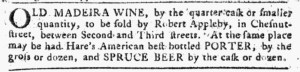
“Hare’s American best bottled PORTER.”
Most goods advertised and sold in eighteenth-century America did not have brand names associated with them. Patent medicines were the exception. Consumers were familiar with a variety of patent medicines, so much so that advertisers could mention them by name without giving any further explanation of their use and purpose. In an advertisement in the August 10, 1776, edition of the Pennsylvania Evening Post, for instance, George Weed informed the public that he stocked “Dr. Bateman’s pectoral drops[,] Turlington’s balsam of life[,] Dr. Anderson’s pills[,] Dr. Hooper’s female pills[, and] Dr. Benjamin Godfrey’s cordial” at his apothecary shop in Philadelphia.
On the same page, Robert Appleby once again advertised “Hare’s American best bottled PORTER.” Unlike the generic descriptions of the other items in his notice, “OLD MEDEIRA WINE” and “SPRUCE BEER,” Robert Hare’s porter described a particular beer produced by a particular brewer. When Hare, the son of an English brewer, migrated to Pennsylvania, he became the first brewer to produce porter in the colonies. He did so at a time that patriotic Americans boycotted imported goods and made a point of supporting “domestic manufactures” and their producers. Consumers knew Hare’s Best American Draught Porter by name and for many months by the time Appleby ran his advertisement consumers already associated drinking it with support for the American cause. In a notice in the Pennsylvania Evening Post published the previous November, William Dibley expressed his confidence “that the sturdy friends of American freedom will afford due honor to this new and glorious manufacture.” A few weeks later, Dibley’s advertisement appeared alongside one from Patrick Meade who promoted Hare’s porter to “the TRUE FRIENDS to LIBERTY” and another from Joseph Price that offered “HARE’s and Co. best DRAUGHT and BOTTLED AMERICAN PORTER” to “all the SONS of AMERICAN LIBERTY.” Beyond those accolades, Hare’s porter achieved the distinction of becoming one of the dew products other than patent medicines known to consumers by a brand name during the era of the American Revolution.
