November 2

Who was the subject of an advertisement in a revolutionary American newspaper 250 years ago today?

New-Hampshire Gazette (November 2, 1775).

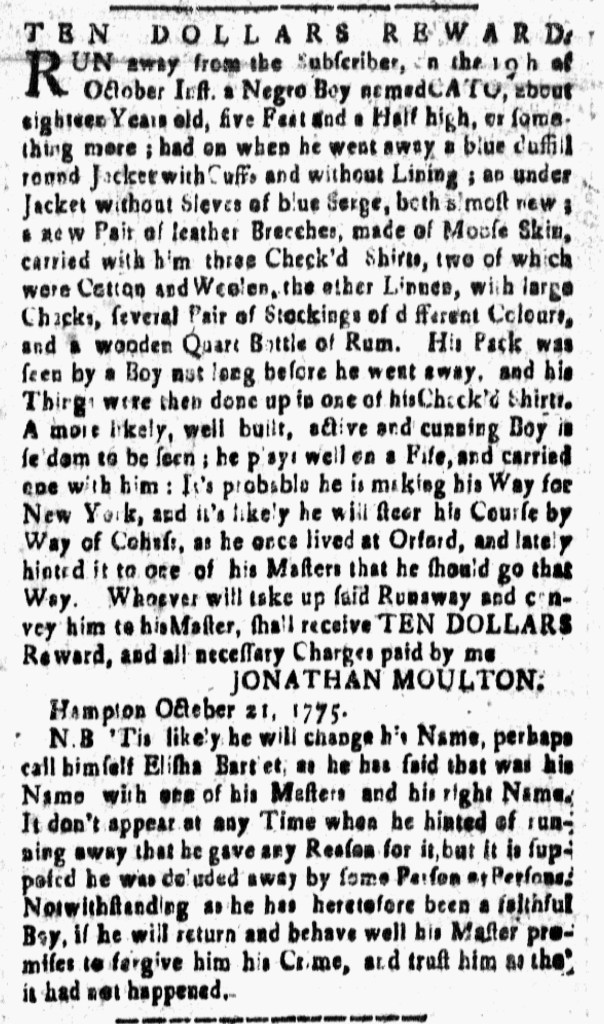
“’Tis likely he will change his Name, perhaps call himself Elisha Bartlet, as he has said that was … his right Name.”

Even though the disruption in the paper supply once again meant that the New-Hampshire Gazette consisted of only two pages instead of the usual four, Daniel Fowle, the printer, found space to publish three advertisements about enslaved men who liberated themselves by running away from their enslavers in the November 2, 1775, edition.  They appeared one after the other in the final column on the first page.  All three men – Cato (also known as Elisha Bartlet), Peter Long, and Oliver – made their escape in October, perhaps taking advantage of the turmoil caused by the outbreak of hostilities at Lexington and Concord the previous spring and the ongoing siege of Boston.

Jonathan Moulton’s advertisement describing Bartlet was about three times the length of Marifield Berry’s advertisement about Peter Long and Gould French’s advertisement about Oliver.  Moulton reported on the clothes that Bartlet wore when he departed, noting that he “carried with him three Check’d Shirts [and] several Pair of Stockings of different Colours.”  Apparently, Bartlet had been spotted by a boy who observed that “his Things were then done up in one of Check’d Shirts” as a pack that he carried.  Moulton suspected that the man he called Cato would “change his Name, perhaps call himself Elisha Bartlet, as he has said that was his Name with one of his Masters and his right Name.” Although not his intention in placing the advertisement, Moulton revealed Bartlet’s commitment to self-determination in naming himself.  It did not matter to Bartlet what Moulton or any other enslaver called him at their own whim.  He considered Elisha Bartlet his true name, though Moulton did not share enough of the enslaved man’s story to explain why that was the case.

The enslaver did indicate that Bartlet had suggested on more than one occasion that he planned to escape.  He thought it “probable [Bartlet] is making his Way for New York,” having “lately hinted it to one of his Masters.”  In addition, Moulton stated, “It don’t appear at any Time when he hinted of running away that he gave any Reason for it.”  Given the circumstances, Moulton conjectured that Bartlet had been “deluded away by some Person or Persons.”  The enslaver seemingly did not entertain the notion that the man he insisted on calling Cato had the same aspirations for freedom that animated so much of the news and editorials about current events that ran alongside his advertisement in the New-Hampshire Gazette.  Instead, Moulton asserted that since Bartlet “has heretofore been a faithful Boy, if he will return and behave well his Master promises to forgive him his Crime, and trust him as tho’ it had not happened.”  Considering that Bartlet planned his escape from slavery for some time and chose an opportune moment to flee, he likely had little interest in any promises that his enslaver published in the public prints.

October 25

Who was the subject of advertisements in a revolutionary American newspaper 250 years ago today?

Constitutional Gazette (October 25, 1775).

“RUN-AWAY … a Negro man, named MINGO.”

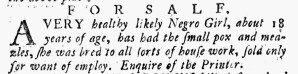
“FOR SALE, A VERY healthy Negro Girl.”

In the fall of 1775, John Anderson joined the ranks of newspaper printers who helped perpetuate slavery by disseminating advertisements about enslaved people in their publications.  In this case, one advertisement concerned “a Negro man, named MINGO,” who liberated himself from Benjamin Hutchinson by escaping from Hutchinson of Southold in Suffolk County on Long Island in early October.  The enslaver described the young man, both his physical features and his clothing, and offered a reward for his capture and return.  Another advertisement offered a “healthy Negro Girl, about 18 years of age,” for sale.  She was capable of “all sorts of house work” and sold “only for want of employ” rather than any deficiency.

Those advertisements first appeared in the October 25 edition of the Constitutional Gazette, a newspaper that commenced publication near the beginning of August.  The new publication initially did not carry advertisements, though Anderson began soliciting them by the end of the month.  Local entrepreneurs who had experience advertising in other newspapers, including goldsmith and jeweller Charles Oliver Bruff and Abraham Delanoy, who pickled lobsters and oysters, soon placed notices in the Constitutional Gazette.  Beyond marketing consumer goods and services, others ran advertisements for a variety of purposes, replicating the kinds of notices found in other newspapers of the period.

Constitutional Gazette (October 25, 1775).

That included advertisements about enslaved people.  Two months after first soliciting advertisements (and less than three months after publishing the inaugural issue), Anderson disseminated Hutchinson’s advertisement about Mingo’s escape from slavery and another notice offering an enslaved young woman for sale.  Like printers from New England to Georgia, he compartmentalized the contents of his newspaper, not devoting much thought to the juxtaposition of news and editorials advocating on behalf of the American cause and advertisements placed for the purpose of perpetuating slavery and the slave trade.

Even as Anderson used his newspaper to advocate for liberty for colonizers who endured the abuses perpetrated by Parliament, he used it to constrain the freedom of Black men, women, and children.  The advertisement about Mingo encouraged readers to engage in surveillance of Black men to determine if any they encountered matched his description.  In addition to publishing advertisements about enslaved people, Anderson also served as a broker.  The advertisement for the young enslaved woman whose name was once known instructed interested parties to “Enquire of the Printer.”  Anderson did more than merely disseminate information.  He actively participated in the sale of the young enslaved woman as one of the services he provided as printer.

October 17

Who was the subject of an advertisement in a revolutionary American newspaper 250 years ago today?

New-Hampshire Gazette (October 17, 1775).

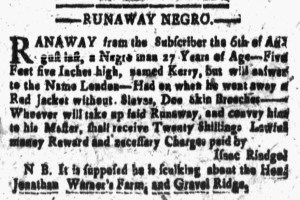
“RUNAWAY NEGRO … named Kerry, but will answer to the Name London.”

During the first year of the Revolutionary War, Daniel Fowle, the printer of the New-Hampshire Gazette, sometimes experienced disruptions to his paper supply that forced him to resort to broadsheets of alternate sizes.  His newspaper carried less content, both news and advertising, on such occasions.  That was the case on October 3, 1775, when he inserted an “Apology” that stated that “he could not procure any other” paper.  Compared to the usual three columns on each of four pages, that issue had only two columns on each of two pages.  Fowle did not include any advertisements.

The following week, Fowle managed to acquire broadsheets of the usual size, but apparently not enough of them for a four-page issue.  Instead, he published a half sheet edition that had three columns on each of two pages.  He found room for advertisements and even a poem, “On LIBERTY.”  On October 17, however, the New-Hampshire Gazette returned to the smaller sheet from two weeks earlier, but he had enough to publish four pages instead of two.  With twice as much space compared to the October 3 edition, he had room for five advertisements, including one by Mrs. Hooper, a milliner, and another for John Williams’s “House of Entertainment … at the Sign of the SALUTATION.”

Another advertisement featured a headline that proclaimed, “RUNAWAY NEGRO.”  Isaac Rindgel described a “Negro man 27 Years of Age … named Kerry, [who] will answer to the Name London.”  Kerry liberated himself by escaping from his enslaver on August 6.  For two and a half months he managed to elude capture, though Rindgel suspected that Kerry “is sculking about Hon. Jonathan Warner’s Farm, and Gravel Ridge.”  He did not indicate why he thought Kerry might be in that area.  Perhaps Kerry had a wife, a parent, a sibling, or a friend at Warner’s farm.  The advertisement, composed by an enslaver seeking to recover his human property, did not include the details about Kerry’s life and experiences that mattered most to the fugitive seeking freedom.  In addition to not explaining why Kerry may have been in the proximity of Warner’s farm, Rindgel did not speculate on why the enslaved man departed when he did.  Kerry was likely aware of the disruptions caused by the battles at Lexington and Concord in April, the ensuing siege of Boston, and the Battle of Bunker Hill in June.  The same events that affected Fowle’s access to paper created an opportunity for Kerry to liberate himself by running away.  It is impossible to know for certain that was the case since the newspaper advertisement reflected his enslaver’s perspective and included only the details Rindgel chose.  Kerry certainly would have told a different and more complete story had he been given the opportunity.

October 6

Who was the subject of an advertisement in a revolutionary American newspaper 250 years ago today?

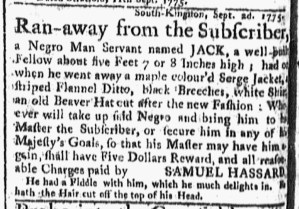
“Ran-away … a Negro Man Servant named JACK.”

Connecticut Gazette (October 6, 1775).

Even as it carried essays about the imperial crisis and news about one of the first battles of the Revolutionary War, the October 6, 1775, edition of the Connecticut Gazette also ran advertisements described enslaved men and women who liberated themselves by running away from their enslavers.  Each notice encouraged readers to engage in surveillance of Black people they encountered to determine if they matched the description in the newspaper.  Each also offered a reward to those who assisted in capturing fugitives from slavery and returning them to their enslavers.

One of those advertisements, for instance, described a “Negro Man Servant named JACK” who fled from Samuel Hassard of South Kingstown, Rhode Island, at the beginning of September.  He had managed to elude capture for a month.  Hassard described Jack as a “well-built Fellow about five Feet 7 or 8 Inches high,” but did not indicate his approximate age.  At the time he departed, he wore a “maple colour’d Serge Jacket, a striped Flannel [Jacket], black Breeches, white Shirt, [and] an old Beaver Hat cut after the new Fashion.”  Hassard also mentioned that Jack “had a Fiddle with him, which he much delights in” and that he “Hath the Hair cut off the top of his Head.”  Both details made Jack more easily recognizable to readers of the Connecticut Gazette.

In another advertisement, Mortemore Stodder of Groton described a “Negro Girl about 17 or 18 Years old” whose name was once known but did not appear in the notice.  Instead, Stodder informed readers that the “thick set” young woman “speaks good English” and “has a Scar across her Nose and another Scar on the top of one Foot occasioned by a burn.”  In addition to those distinguishing features, she “[h]ad on a tow Shift, a striped woollen Petticoat, and a brown Gown.”  Stodder was so concerned that others might help the young woman remain free that he added a nota bene advising, “All Persons are hereby forbid to harbour, conceal, or carry off the above Servant, on Penalty of the Law.”  There would be consequences beyond Stodder’s frustration and displeasure if he learned that anyone aided this young woman in liberating herself.

As the siege of Boston continued, Timothy Green, the printer of the Connecticut Gazette, published the latest entry in “The Crisis,” a series of essays supporting the American cause, new details about the Battle of Bunker Hill, and an address from George Washington, “Commander in Chief of the Army of the United Colonies of North-America,” to the inhabitants of Canada.  Even as those pieces each promoted liberty in various ways, Green continued a practice adopted by all newspaper printers.  He generated revenue by disseminating advertisements about enslaved people who fled from their enslavers to seize their own freedom.

**********

For all advertisements about enslaved people that ran in American newspapers published 250 years ago today, visit the Slavery Adverts 250 Project‘s daily digest.

July 7

What was advertised in a revolutionary American newspaper 250 years ago today?

North-Carolina Gazette (July 7, 1775).

“EXTRACTS from the Votes and Proceedings of the AMERICAN CONTINENTAL CONGRESS.”

When they perused the July 7, 1775, edition of the North-Carolina Gazette, readers encountered an advertisement that proclaimed, “JUST PUBLISHED, And to be sold at the Printing Office … EXTRACTS from the Votes and Proceedings of the AMERICAN CONTINENTAL CONGRESS, held at Philadelphia, on the Fifth Day of September, 1774.”  The Extracts, however, were not “JUST PUBLISHED,” though James Davis certainly had them for sale at the printing office in New Bern.  The Adverts 250 Project previously featured this advertisement’s appearance in the April 7, 1775, edition of the North-Carolina Gazette.  Few issues of that newspaper survive, preventing a complete reconstruction of when the advertisement ran.  Only seven issues, all from 1775, are available via America’s Historical Newspapers, the most comprehensive database of digitized eighteenth-century newspaper.  Davis’s advertisement for the Extracts did not run on March 24, but appeared on April 7, May 5, and May 12.  It was not in the June 30 issue, yet it returned for the July 7 and July 14 issues.

It is not clear how often the advertisement ran between May 12 and June 30, but Davis did not insert it in the issue immediately before the one that delivered several important updates that might have influenced him to believe that readers who had not yet purchased the Extracts would have increased interest in the “Bill of Rights, a List of Grievance, Occasional Resolves,” and “General Gage’s Answer to the Letter sent him by the General Congress.”  The Extractsdocumented the meeting of the First Continental Congress in the fall of 1774.  When the advertisement ran on July 7, 1775, the Second Continental Congress had been meeting for nearly two months.  That issue included an update that “By Letters from the Congress of the 19th of June, we are informed, that Col. Washington, of Virginia, is appointed General and Commander in Chief of all the American Forces.”  It also delivered news of the Battle of Bunker Hill, acknowledging that the account received in the printing office was “very imperfect, and must leave us in Suspence till a further Account of this most momentous Affair arrives.”  Indeed, that “imperfect” account inaccurately claimed that “General Burgoyne fell … and was interred in Boston with great Funeral Pomp.”  As he sorted through newspapers and letters arriving from the north, Davis apparently believed that the news he selected for publication would spark new interest in his remaining copies of the Extracts from the First Continental Congress.

As had been the case in the April 7 edition, that advertisement ran alongside another that described an enslaved man who liberated himself by running away from his enslaver.  In this instance, “a Negro Slave … named JEM,” was a fugitive from slavery who might have been “harboured or kept out by his Wife, named Rachel.”  James Biggleston, Jem’s enslaver, suspected that Jem was “lurking in the Neighborhood” of the plantation where Rachel was enslaved. Biggleston offered a reward for the capture and return of Jem in a nota bene at the end of the advertisement, though the main body of the notice consisted of a warrant signed by “Two of his Majesty’s Justices of the Peace” that authorized that “if the said Jem doth not surrender himself, and return home immediately … that any Person or Persons may kill and destroy the said Slave … without Impeachment or Accusation of any Crime or Offence … or without incurring any Penalty.”  Most readers of the North-Carolina Gazette and other newspapers compartmentalized the contents of those publications.  They did so to such an extent that the juxtaposition of colonizers demanding freedom from oppression and enslaved people seeking liberty did not register as a contradiction.

July 4

Who was the subject of an advertisement in a revolutionary American newspaper 250 years ago today?

Dunlap’s Maryland Gazette (July 4, 1775). NB: The compositor mistakenly updated the masthead to “TUESDAY, JULY 3, 1775,” instead of “TUESDAY, JULY 4, 1775.”

“SOLOMON, a negro, … will make for Boston to the soldiers.”

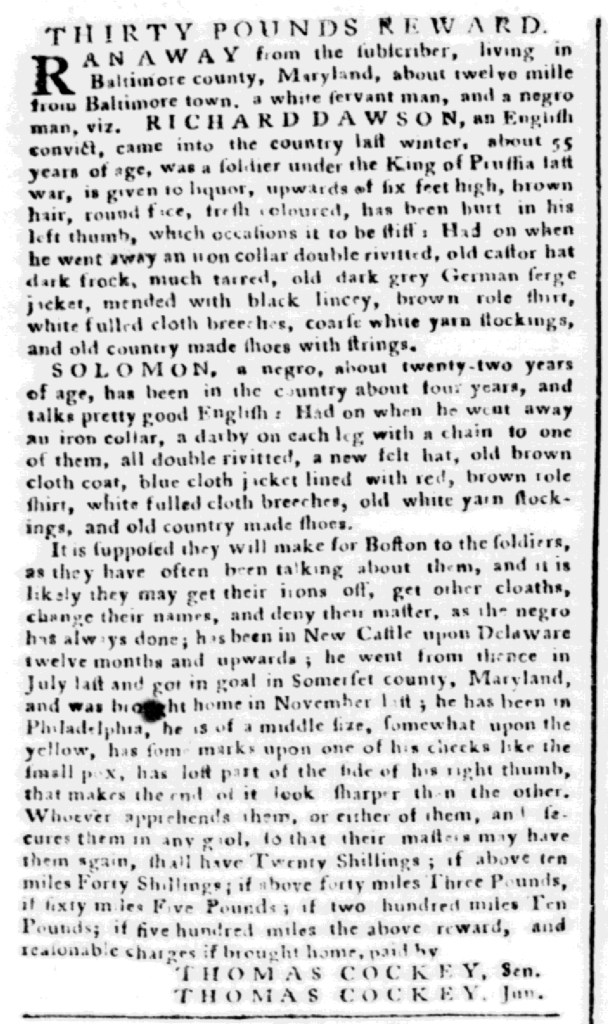
They made their escape together.  Solomon, an enslaved man, and Richard Dawson, a “white servant man” and “an English convict,” ran away from Thomas Cockey, Sr., and Thomas Cockey, Jr., in Baltimore County in the spring of 1775.  Their advertisement describing Solomon and Dawson first appeared in the May 16, 1775, edition of Dunlap’s Maryland Gazette.  The two men apparently eluded capture because the notice ran regularly for the next several months, including in the July 4 edition.

When they departed, both Solomon and Dawson had an “iron collar double rivetted.”  Solomon had also been outfitted with “a darby” or fetters “on each leg with a chain to one of them,” probably because the Cockeys correctly considered him likely to attempt to liberate himself.  He did, after all, have a history of making a break for freedom.  According to the Cockeys, Solomon previously made it to New Castle in Delaware, remaining there for “twelve months and upwards,” but then in July 1774 went to Somerset County, Maryland.  There he was captured, jailed, and “brought home in November.”  Within months, he became a fugitive seeking freedom once again.  The Cockeys believed that Solomon “has been in Philadelphia.”

Solomon was a young man, “about twenty-two years of age,” who had been in the colonies “about four years.”  Dawson, in contrast, was older, “about 55 years of age.”  He had served as a soldier “under the King of Prussia [during the] last war.”  The Cockeys did not indicate which crimes Dawson committed to merit punishment as a convict servant transported to America.  They did speculate that Solomon and Dawson “will make for Boston to the soldiers, as they have often been talking about them,” though they did not reveal the particulars of what the enslaved man and the former soldier had to say about the British troops or when their conversations first occurred.  Had they taken place after learning of the battles at Lexington and Concord?  Did Dawson think that British soldiers might feel some sympathy for a former comrade?  Did Solomon believe that regulars would shelter him from the colonizers who put him in bondage?  Even if they did not hope for aid, Solomon and Dawson might have considered the upheaval in New England the best opportunity to avoid detection and capture.  The Cockeys anticipated that both men would “get their irons off, get other cloaths [to disguise themselves], change their names, and deny their master.”  Since Solomon “talks pretty good English” and evaded capture for so long during his previous attempt to liberate himself, he had likely learned to tell plausible stories.

Some advertisements about enslaved men and women who liberated themselves by running away from their enslavers during the era of the American Revolution suggested that they received assistance from enslaved relatives and friends.  On occasion, other advertisements recorded enslaved people and unfree colonizers (indentured servants, convict servants, apprentices) working together.  The role that the battles at Lexington and Concord and the siege of Boston played in Solomon’s decision to make common cause with Dawson cannot be determined from the narrative the Cockeys presented in their advertisement.  What is clear, however, is that Solomon repeatedly made his own declarations of independence.

For other stories of enslaved people liberating themselves originally published on July 4 during the era of the American Revolution, see:

June 14

Who was the subject of an advertisement in a revolutionary American newspaper 250 years ago today?

Massachusetts Spy (June 14, 1775).

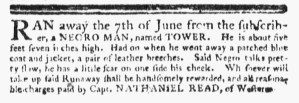
“RAN away … a NEGRO MAN, named TOWER.”

Isaiah Thomas, the printer of the Massachusetts Spy, left Boston just before the battles at Lexington and Concord in April 1775.  He had previously advertised that he intended to establish a printing office in Worcester and install a junior partner there to print the town’s first newspaper.  When he decided to leave Boston to escape the ire of British officials he had angered with his advocacy for the Patriot cause, however, he revised his plans.  Instead of a junior partner printing a new newspaper, Thomas moved the Massachusetts Spy to Worcester and continued publishing it there, safely beyond the reach of Tories in Boston.  Although the numbering of the newspaper continued uninterrupted, it gained a new subtitle, American Oracle of Liberty, and a warning that ran across the top of the masthead, “Americans! — Liberty or Death! — Join or Die.”

When published in Boston, the Massachusetts Spy carried advertisements that offered enslaved people for sale and notices that described enslaved people who liberated themselves by running away from their enslavers and offered rewards for their capture and return.  Despite the new subtitle and the admonitions in the masthead, Thomas continued to earn revenue for his newspaper by printing those advertisements in the Massachusetts Spy after moving it to Worcester.  Away from the colony’s largest urban port, colonizers did not resort to such notices as often, but they did submit them to the printing office and Thomas did publish them. The June 14, 1775, edition of the Massachusetts Spy, the seventh issue printed in Worcester, carried an advertisement about a “NEGRO MAN, named TOWER” who “RAN away” from Nathaniel Read of the nearby town of Western.  Read stated that “Whoever will take up said Runaway shall be handsomely rewarded.”  That advertisement appeared immediately below a news update that confirmed that residents of Charleston, South Carolina, had received word of “a skirmish, or in fact rather an engagement, which happened between his Majesty’s troops and the Provincials” on April 19.  The extract of the letter, written by a British officer in Boston and sent to a correspondent in Charleston, acknowledged that “On the whole the Provincials behaved with unexpected bravery.”  Tower also acted with courage, though not necessarily “unexpected bravery,” as he enacted his own plan for “Liberty or Death!”  Neither Read nor most readers allowed for that possibility, though an item that appeared in the next issue of the Massachusetts Spyindicated that some colonizers in Massachusetts did grapple with the meaning of freedom for enslaved people and the applied the rhetoric of the Revolution to them as well.  The Adverts 250 Project will feature that item next week.

April 29

Who was the subject of an advertisement in a revolutionary American newspaper 250 years ago today?

Supplement to the Virginia Gazette [Dixon and Hunter] (April 29, 1775).

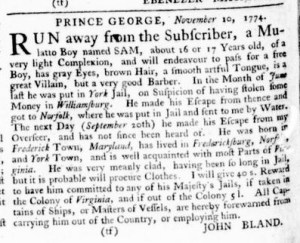
“RUN away … a Mulatto Boy named SAM … will endeavour to pass for a free Boy.”

As the imperial crisis intensified in 1774 and erupted into a war in 1775, Sam, an enslaved youth, had his own concerns and fought his own battle for independence.  Like so many other enslaved people, Sam did not author his own story; instead, it was recorded by an enslaver in a newspaper advertisement that offered a reward for the capture and return of the young man after he had liberated himself by running away.

John Bland’s efforts to recover Sam and return him to bondage stretched over many months.  His advertisement indicated that he composed it on November 10, 1774, three weeks before the Continental Association, a nonimportation agreement enacted in response to the Coercive Acts, went into effect.  It ran regularly, including in the supplement that accompanied the April 29, 1775, edition of John Dixon and William Hunter’s Virginia Gazette.  That supplement included the first reports of the battles at Lexington and Concord that appeared in newspapers published in Virginia.  What did Sam think of those events?  Perhaps he welcomed the distraction they provided, shifting attention away from efforts to discover his whereabouts as he “endeavour[ed] to pass for a free Boy.”

Bland offered a brief biography of Sam, likely not emphasizing the details that the youth would have chosen had he written his own narrative.  The enslaver stated that Sam was a mulatto “born in Frederick Town, Maryland,” but did not say anything about his parents or other relations.  Bland considered Sam a “great Villain” with a “smooth artful Tongue,” but acknowledged that he was “a very good Barber,” a rare note of praise in an advertisement of that type.  Bland reported that in June 1774 Sam had been imprisoned in Yorktown “on Suspicion of having stolen some Money in Williamsburg,” but escaped and made his way to Norfolk.  He had been captured and jailed there before being sent back to Bland.  On September 20, Sam once again made a bid for freedom, escaping from Bland’s overseer and “has not since been heard of.”  Having lived in Fredericksburg, Norfolk, and Yorktown, Sam was “well acquainted with most Parts of Virginia,” a factor that likely aided in eluding Bland.  In addition, the enslaver considered it “probable” that Sam “will procure Clothes” to disguise himself.  Bland warned “Captains of Ships” and “Masters of Vessel” against employing Sam or transporting him out of the colony.

Where was Sam?  Did he manage to get aboard a ship?  What other strategies did he deploy to make good on his escape?  Did he have assistance from other enslaved people, free Black men and women, or even sympathetic white colonizers?  What kind of freedom had he experienced in the months since he fled from Bland?  Was he aware that Bland published an advertisement and offered a reward for him?  What was Sam thinking and feeling over those many months?  Bland’s advertisement does not answer those questions, but it does chronicle Sam’s courage and resilience as well as his commitment to seizing his own liberty during an era when colonizers claimed that Parliament and the king perpetrated acts of tyranny against them.  Like so many other fugitives seeking freedom advertised in newspapers from New England to Georgia, Sam made a declaration of independence.

January 13

Who was the subject of an advertisement in a colonial American newspaper 250 years ago today?

New-Hampshire Gazette (January 13, 1775).

“A NEGRO FELLOW named POMP … procur’d a counterfeit Pass.”

On January 13, 1775, nearly two dozen advertisements about enslaved people appeared in newspapers printed in the American colonies.  Twenty-two of them ran in the South-Carolina and American General Gazette, published in Charleston, and one in the New-Hampshire Gazette, published in Portsmouth.  Those numbers tell a familiar story about the size of the enslaved population in the southern colonies, yet the example from New-Hampshire Gazette demonstrates that slavery was practiced throughout the colonies on the eve of the American Revolution.

Ebenezer Sayer of Wells, Massachusetts (now Maine), placed a notice in the newspaper printed closest to his town, the New-Hampshire Gazette, to advise that “a NEGRO FELLOW named POMP” liberated himself by running away sometime during the evening of December 18, 1774.  Sayer described Pomp’s clothing, including the “black silk Handkerchief round his Neck, and a green Cap,” to help readers recognize him.  He also offered a reward to anyone who apprehended Pomp and brought him to Sayer in Wells or secured him in the jail in York, Massachusetts (Maine).

In a nota bene, Sayer revealed that Pomp was quite ingenious and carefully planned his escape from enslavement.  Before he departed, Pomp “procur’d a counterfeit Pass, changing his own Name and his Master’s.”  Sayer did not reveal how he learned about the pass or anything about its origins, though he does suggest that Pomp could read and write well enough to alter the pass on his own.  “All Persons are cautioned against being deceived by such Artifice,” Sayer admonished.  He also issued a standard warning to “all Masters of Vessels and others … not to harbour, conceal or carry off said Negro.”  Those who aided him would face “Penalties of the Law.”  In other words, colonies in New England had their own slave codes to maintain social order, further demonstrating that slavery was not restricted to plantations in southern colonies.  Yet Pomp’s story (and the stories of many of the enslaved people in advertisements in the South-Carolina and American General Gazette) also testifies to the spirit of resistance and resilience among enslaved people on the eve of the American Revolution, an exceptionally important story itself.

October 10

Who was the subject of an advertisement in a colonial American newspaper 250 years ago today?

Connecticut Courant (October 10, 1774).

A Negro answering the above Discription has let himself to Mr. Jesse Leavensworth of New-Haven.”

In the fall of 1774, Samuel Boardman of Wethersfield took to the pages of the Connecticut Courant and Hartford Weekly Intelligencer to offer a reward for the capture and return of a “New Negro Man” who liberated himself by running away.  Boardman did not give a name for this man, but instead stated that he “talks but a little English, calls himself a Portuguese, and talks a little of the Tongue.”  He offered a reward to “Whoever will take up said Negro and return him to his Master.”  Dated September 26, the advertisement first appeared in the October 3 edition of the Connecticut Courant.  It included a notation indicating that a “Negro answering the above Discription has let himself to Mr. Jesse Leavensworth of New-Haven.”  Boardman most likely did not include that information in the copy he submitted to the printing office.

Instead, Ebenezer Watson, the printer, likely supplied it upon reading an advertisement that Leavenworth placed in the September 30 edition of the Connecticut Journal and New-Haven Post-Boy.  After all, printers regularly exchanged newspapers in hopes of acquiring content for their own publications.  Leavenworth devoted most of that notice to giving instructions for hiring his ferry, but added a note that recently a “lusty negro man, about 23 or 24 years old, speaks the Portuguese language, but little English” had “let himself to me.”  Leavenworth hired the young man, but was suspicious that he was a fugitive seeking freedom and his enslaver was looking for him.  Just in case, he supplemented his advertisement for the ferry with the description of the Black man who spoke Portuguese.  Given the timing of the advertisements in the two newspapers, Boardman would not have seen Leavenworth’s notice when he drafted his own advertisement.  If he had that information, he could have dispensed with advertising at all.

What role did Watson play in keeping Boardman informed about this development?  He might have dispatched a message to the advertiser in Wethersfield, though he could have considered the note at the end of the advertisement sufficient to update Boardman, figuring that his customer would check the pages of the Connecticut Courant to confirm that his notice appeared.  Watson could have also sent a message to Thomas Green and Samuel Green, the printers of the Connecticut Journal, along with his exchange copy of the Connecticut Courant, expecting they might pass along the information to Leavenworth.  In addition, Leavenworth might have eventually encountered Boardman’s advertisement, depending on his reading habits, or otherwise heard about it.  That alternative seems most likely.  No matter what other action Watson took, inserting the note that connected the unnamed Black man in Boardman’s advertisement in the Connecticut Courant to the unnamed Black man in Leavenworth’s advertisement in the Connecticut Journal alerted readers that they could collect the reward if they decided to pursue the matter.  The power of the press, including a printer whose assistance extended beyond merely setting type and disseminating the advertisement, worked to the advantage of Boardman, the enslaver, against the interests of the unnamed Black man who spoke Portuguese.