May 10

Who was the subject of an advertisement in a colonial newspaper 250 years ago this week?

May 10 - 5:9:1766 Virginia Gazette
Virginia Gazette (May 9, 1766).

“AGNES … is a fair straight made lusty Mulatto, and has small breasts.”

When the Virginia Gazette made its debut in the Adverts 250 Project a week ago, I opted to feature a genre of advertisements – those seeking the return of runaways – rather than a particular advertisement. Accompanied by crude woodcuts, runaway advertisements were easy to identify at a glance. I remarked how startling it seemed to see nine runaway advertisements on a single page of the Virginia Gazette. As David Waldstreicher has argued, slavery, commerce, and print culture were bound together in eighteenth-century America.

Runaway advertisements presented an alternate means of placing black bodies on display in early America, first by describing them in great detail and then by encouraging readers to carefully surveil the black men and women they encountered. In the case of Agnes (also known as Agie), this amounted to more than noticing her garments (“a striped red, white, and yellow calamanco gown, a short white linen sack, petticoat of the same, a pair of stays with fringed blue riband, a large pair of silver buckles”). It also included attention to physical features, such as “a small scar over one of her eyes.”

Yet the descriptions could sometimes be far more intimate and invasive, especially as white colonists characterized black and mulatto women’s bodies. According to today’s advertisement, Agnes was “a fair straight made lusty Mulatto, and has small breasts.” Even as the advertiser acknowledged one of the essential aspects of Agnes’ womanhood, he deprived her of the consideration and deference that would have been shown to most white women (especially middling and elite white women) when describing them in conversation or in print. Calling specific attention to the size of Agnes’ breasts served to further commodify her rather than humanize her.

N.B. Notice that this advertisement states that Agnes ran away in the middle of January, yet it was published nearly four months later in early May. I hope that she made good on her escape permanently.

May 2

Who was the subject of an advertisement in a colonial newspaper 250 years ago today?

May 2 - Single 5:2:1766 Virginia Gazette
Virginia Gazette (May 2, 1766).

“RUN away … a Negro man named PETER.”

I could not select a single advertisement to feature today. Instead, I have chosen an entire genre: advertisements for runaway slaves.

Today’s advertisements from the Virginia Gazette are the first from the Chesapeake colonies featured by the Adverts 250 Project. As I have explained previously, different institutions provide varying levels of access to Readex’s Early American Newspapers database. The most complete access is available via the American Antiquarian Society (there listed as America’s Historical Newspapers), Readex’s partner in creating the database. Via my own campus library and the Boston Public Library’s online electronic resources, I am able to access about two-thirds of the titles from 1766 available via the American Antiquarian Society, but those titles are restricted primarily to New England and Middle Atlantic colonies. (My students and I are able to access Early American Newspapers via the campus library and the Boston Public Library anywhere we are connected to the Internet. Accessing the database via the American Antiquarian Society, however, requires being on site. To avoid an additional layer of responsibilities for an already extensive class project, I did not require my students to visit the American Antiquarian Society. Instead, I delayed incorporating the additional newspapers from the Chesapeake colonies into the Adverts 250 Project until I resumed my role as sole curator once the semester concluded.)

May 2 - 5:2:1766 Virginia Gazette
Virginia Gazette (May 2, 1766).

I have argued before that regional differences within eighteenth-century newspapers have shaped the Adverts 250 Project to this point. Today I present visually striking evidence to make that case.

We have certainly seen that slavery was present in New England and Middle Atlantic colonies in the 1760s. Advertisements seeking to buy and sell enslaved men, women, and children appeared regularly in the local newspapers, as did other advertisements warning against runaway slaves and offering rewards for their capture and return to their masters. Such advertisements did not appear, however, with the frequency seen here. A single page of the May 2, 1766, issue of the Virginia Gazette included NINE advertisements for runaway slaves, each easily identified by the crude woodcut that accompanied it. I have previously argued that advertisements for slaves in newspapers in New England and the Middle Atlantic colonies demonstrated that slavery was a part of everyday life, commerce, and culture in early America. The Virginia Gazette gives us a glimpse even further south where a greater number of slaves toiled – and seized their own liberty by running away. Slavery was well integrated into the northern colonies, but it was truly ubiquitous in the Chesapeake and Lower South.

The appearance of this page of the Virginia Gazette is stunning in its own regard. It becomes even more jarring when taking into consideration the recent repeal of the Stamp Act, a development widely celebrated as delivering the American colonies from enslavement by Great Britain. Virginians were among the first and most vocal opponents of the Stamp Act. Their yelps for their own liberty, to paraphrase Samuel Johnson, stand in strike juxtaposition to the bondage of enslaved men, women, and children in their colony.

April 26

Who was the subject of an advertisement in a colonial newspaper 250 years ago this week?

Apr 26 - 4:25:1766 New-Hampshire Gazette
New-Hampshire Gazette (April 25, 1766).

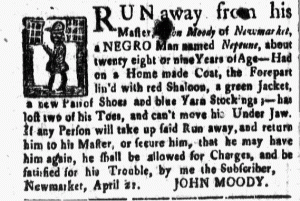
“RUN away from his Master … a NEGRO Man named Neptune.”

John Moody placed this advertisement when “a NEGRO Man named Neptune” – almost certainly not the name bestowed on him by his parents when he was born – ran away. This advertisement stands in stark contrast to the one featured yesterday, though both came from the same issue of the New-Hampshire Gazette. Yesterday’s “ADVERTISEMENT Extraordinary” encouraged readers to put on all kinds of displays upon receiving word that the Stamp Act had been repealed. This advertisement, however, asserted that black bodies should be on display and encouraged readers to take note of any “NEGRO Man” they encountered. Black bodies were figuratively on display in the crude woodcut that could have been any enslaved man. Black bodies were literally on display – scrutinized closely – any time readers attempted to assess if a black man fit the description in the advertisement. “Neptune” could change his clothing, but the fugitive could not disguise certain physical characteristics: “lost two of his Toes, and can’t move his Under Jaw.” Determining if a black man fit this description could require sustained observation; these are not attributes that would necessarily be noticed at a glance. While many colonial Americans engaged in public spectacles to celebrate the end of the Stamp Act, “Neptune” likely did all he could to avoid becoming a public spectacle, but today’s advertisement encouraged colonial Americans to think of all black bodies as some sort of public spectacle to be observed and scrutinized.