What was advertised in a colonial American newspaper 250 years ago today?
New-York Journal (December 3, 1767).
“I advertise this that the Names may be distinguished and my character not stained.”
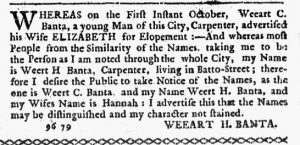
Weert H. Banta, a carpenter, took out an advertisement in the New-York Journal in hopes of resolving a case of mistaken identity and remedying any damage done to his reputation as a result of the confusion.
Banta reported that Weert C. Banta, also a carpenter, had published an advertisement concerning the “Elopement” of his wife, Elizabeth, two months earlier. In that fairly standard runaway wife notice, the other Banta proclaimed that Elizabeth departed “without any cause” and that he was “apprehensive [she] may run me [into] Debt.” To that end, he desired to “warn all Persons, that they do not Trust, harbour or entertain her, on my Account, for I will pay no Debt of her contracting.”
Due to the similarity of their names and their shared occupation, many readers of the New-York Journal and other residents of the city had mistaken Weert H. Banta for Weert C. Banta. The former Banta clarified that he had not placed the advertisement. Furthermore, his wife’s name was Hannah, not Elizabeth. Not only did he seek to sort out the confusion, he implored “that the Names may be distinguished and my character not stained.”
Banta may have also worried about his wife’s reputation, but as a carpenter “noted through the whole City” he expressed primary concern about his own character and what friends, neighbors, and business associates would think of him. Advertisements for runaway wives typically depicted the absent women as the transgressors in marital relationships, but they still did not reflect well on the men who placed such notices in the public prints. That a wife had “eloped” revealed that her husband failed to exercise proper authority or to maintain order in his own household. These advertisements may have been considered a necessary last resort as a means of reining in recalcitrant wives or at least saving husbands money they did not authorize runaway wives to spend, but they did so at the expense of their masculinity. Anxious not to lose face, Weert H. Banta needed his fellow colonists to know that Hannah, his wife, had not run away. Instead, he competently governed his own household.
What was advertised in a colonial American newspaper 250 years ago today?
Pennsylvania Chronicle (August 24, 1767).
“I am obliged to take this public Method to forewarn all Persons from trusting her on my Account.”
“I am obliged to take this method solemnly to declare, that those charges against me have not the least foundation in truth.”
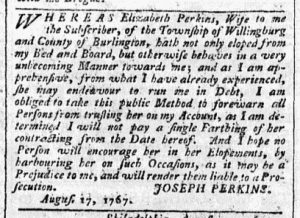
Joseph Perkins’ advertisement concerning the misbehavior of his wife, Elizabeth, made its second appearance in the August 24, 1767, edition of the Pennsylvania Chronicle, having previously appeared in the issue with the same date inserted at the end of the notice, August 17. More elaborate than many “runaway wife” advertisements, this one was particularly notable because it garnered a response in print from its subject. Most such advertisements went unanswered in the newspapers, but occasionally bold women refused to allow their husbands to exercise exclusive control over shaping the narrative presented to the public.
Pennsylvania Chronicle (August 24, 1767).
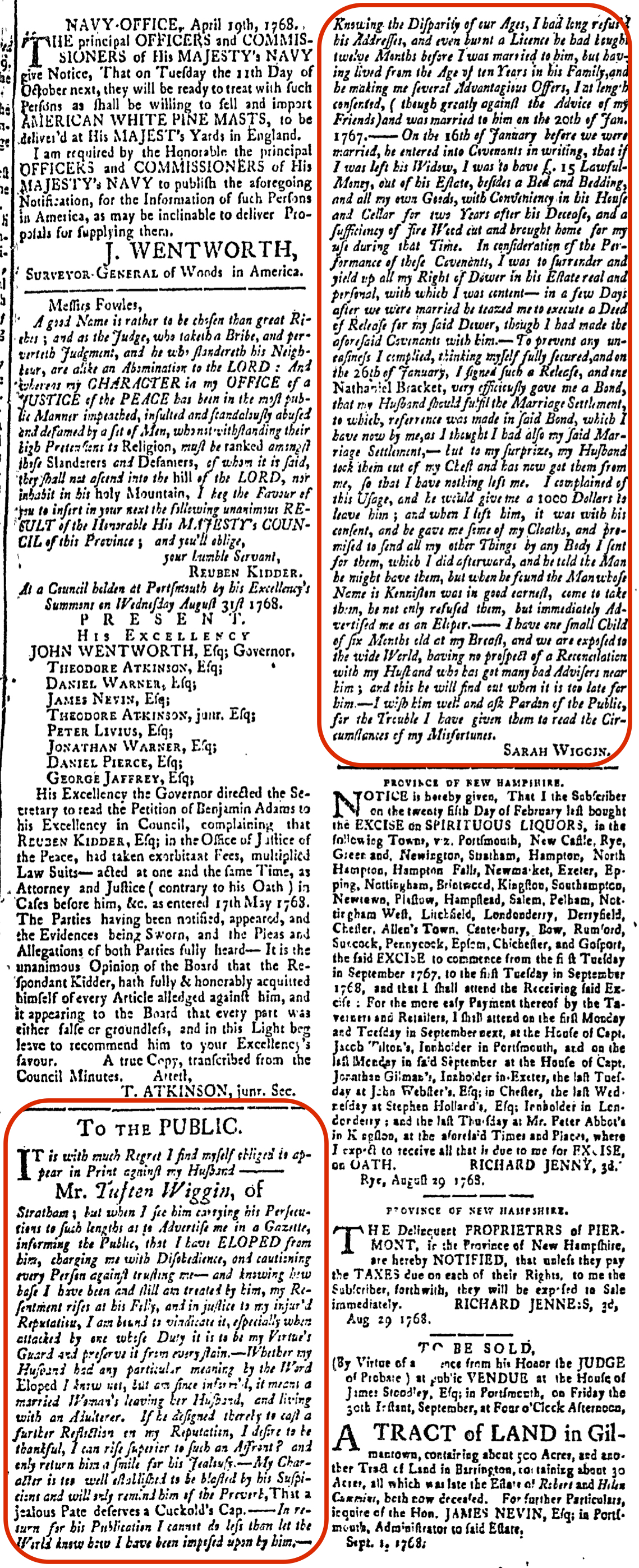
Elizabeth may have anticipated that her husband would publish this sort of advertisement and checked Philadelphia’s newspapers for it. At the very least, she read or heard about it within days of its publication and set about responding to it with her own advertisement, dated August 22. Readers of the Pennsylvania Chronicle could piece together the story, encountering Eliazabeth’s response on the third page and the original notice reprinted on the fourth and final page. (In the next issue, either the editor or compositor made a decision to run the related advertisements one after the other. They appeared as the final two items in the August 31 edition, Joseph’s initial notice first, followed by Elizabeth’s rebuttal. Instead of a series of advertisements unrelated to each other, that issue concluded with a narrative drama.)
Joseph had leveled the usual accusations against his wife: she “behaves in a very unbecoming Manner towards me” and “she may endeavor to run me in Debt.” Elizabeth turned the tables by “solemnly” declaring “that those charges against me have not the least foundation in truth.” She went on to describe “disorderly company” that her husband invited into their home and the “notorious scenes of disorder” his guests created. To underscore the point, she deployed racialized language, asserting that she had been subjected to treatment “that would have shocked a savage of the Ohio.” To escape this abuse, she had taken the only option available to her: she fled to her mother’s house.
Historians of early American often read runaway wife advertisements as evidence of women’s agency. Even though written and published by men, they demonstrate that women did not always bow to the patriarchal order within their households. At the same time, however, the very nature of runaway wife advertisements, especially the warnings not to engage in commercial exchanges with runaway wives, suggest a rather constrained agency in which men continued to exert control over women’s access to credit and consumer goods. That did not have to be the end of the story. Some runaway wives, like Elizabeth Perkins, also turned to the public prints, to offer alternate accounts that further illuminated the circumstances of their departure.
What was advertised in a colonial American newspaper 250 years ago today?
Georgia Gazette (August 19, 1767).
“I will not pay any debts of her contracting.”
Four short lines on the final page of advertisements in the August 19, 1767, issue of the Georgia Gazette alerted residents of Savannah to discord in the Frentz household. John Frentz placed a notice “to forewarn all persons from purchasing effects of any kind from my wife, Margaret Frentz, or crediting her on my account.” He added that he would not “pay any debts of her contracting” after August 4, 1767.
By August 19, regular readers of the Georgia Gazette would have been aware of Frentz’s prohibition already. The notice first appeared two weeks earlier in the August 5 edition and again on August 12. Like many advertisements published during the colonial era, it ran for three weeks before disappearing from the pages of the public prints. The discord between John and Margaret Frentz, however, most likely did not evaporate quite so quickly, not if it had been so substantial as to warrant airing in public in the local newspaper.
Frentz’s advertisement was the only one of its kind in the Georgia Gazette throughout the month of August 1767, but it was not a sort unfamiliar to colonists. In larger ports, weekly newspapers often carried as many as half a dozen such warnings published by husbands targeting absent or recalcitrant wives. Any given issue published in New York or Philadelphia was as likely as not to contain at least one such notice.
Frentz’s notice, however, did differ from most others in one significant way. He did not indicate that Margaret had departed from his household. Similar announcements have collectively become known as “runaway wife” advertisements; they usually included some sort of variation on the wife “eloping” away from husband and home, thus justifying the aggrieved husband no longer assuming responsibility for any debts contracted by an absent and insubordinate wife.
Margaret may not have departed at the time John composed his advertisement, but he still worried about what sorts of mischief she might do to his disadvantage. He attempted to eliminate, or at least curtail, her ability to participate in the marketplace, disavowing any debts she initiated. He also sought to prevent her from selling any sorts of goods, presumably including his own belongings, which may have been a strategy for preventing her from eventually “eloping” once she had accumulated enough cash to have a fair chance of making her escape.
Runaway wife advertisements are often interpreted as evidence of women asserting agency in eighteenth-century America, removing themselves from unhappy marriages and households. That was certainly the case, but they also demonstrate that husbands continued to possess the upper hand, even after wives departed. Women had less access to cash and credit as well as fewer opportunities to participate in the marketplace. In this advertisement, John Frentz used buying and selling goods as a means of curbing the agency of his disobedient wife.
What was advertised in a colonial American newspaper 250 years ago today?
Pennsylvania Journal (January 15, 1767).
“To the PRINTER, WHEREAS a very extraordinary newspaper hath lately appeared in your paper …”
Advertisements for “runaway wives,” women who defied the practices of patriarchy and the laws of coverture by disobeying or abandoning their husbands, frequently appeared in colonial newspapers. On January 15, 1767, alone a total of six such advertisements appeared in Pennsylvania Gazette and the Pennsylvania Journal, alerting residents of Philadelphia and its hinterland not to trust half a dozen women, nor to extend credit to them.
Most advertisements for runaway wives were fairly brief, such as this one that appeared on the first page of the Pennsylvania Journal: “January 15. WHEREAS Catherine the wife of Stephen Wright, of Bristol Township, Bucks county, has absconded and refused to live with him, this is to forewarn all persons from trusting her on my account, as I will pay no debts by her contracted after the date hereof, STEPHEN WRIGHT.” The indigent husband resorted to stock language and formulaic constructions in making this announcement, inserting the appropriate names, dates, and locations.
Charles Tennent, in an advertisement dated January 1, opted for more original language in a much lengthier advertisements that spelled out a variety of charges against his wife, Jane. He reported that she “hath departed from me without my consent, after having extravagantly laid out large sums of money without my knowledge; has threatened to run me much more in debt than she has already done, and not withstanding my frequent earnest, and tender requests to her, she has refused to return to my house and live with me, according to our solemn obligations.” Charles then devoted the second half of his notice to disavowing any debts contracted by Jane.
Its length alone made that advertisement extraordinary, but even more significantly it garnered a response from the runaway wife, a woman who felt she had been defamed by her unjust and unreasonable husband. In an advertisement twice the length of that placed by the disgruntled Charles, Jane defended her reputation and told her side of the dispute “In order to do myself justice, and let the matter in a clearer light to the public than what it has yet been represented.” She made accusations that Charles had “used me extremely ill, and not treated me like a wife.” She also complained that her husband had deprived of her female slave as well as her horse and carriage. To make matters even worse, he had refused to allow her to take a horse when she needed to have a tooth extracted. In turn, she set out on foot and upon returning home discovered that in the interim Charles had placed advertisements about her conduct. Furthermore, she disputed his claims that she spent money extravagantly, arguing that any purchases she made came out of the estate she brought to the marriage. From her perspective, she had been generous in providing clothes for Charles and his children (who may have been from a previous marriage, making them stepchildren to Jane). To make matters worse, Jane stated that she had attempted to return to their household but Charles refused to admit her and was not even willing to meet with her “before any gentlemen in town to talk the matter face to face.” She put up a spirited defense that may have been considered unseemly for a woman yet simultaneously shamed her husband for his poor conduct.
Advertisements for runaway wives demonstrate the agency of colonial women who sought to escape the confines and, in some cases, abuses of patriarchal marriage. In most cases they must be read against the grain because they are accounts written and shaped by men about women. Jane Tennent, however, did not leave it to her friends and neighbors – or historians – to consider her take on the events her husband described. She offered a response that recast her husband as the villain rather than herself as improperly deviating from the ideals of virtuous femininity.
**********
As an aside about another aspect of the history of advertising, note that Jane Tennent reported that her husband “pasted up advertisements round the neighbourhood to the same effect he has done here” in the Pennsylvania Journal. Charles went beyond simply placing an advertisement in the local newspaper. Instead, he contracted a bit of job printing, a separate broadside of unspecified size, that he distributed on his own and strategically placed in places around his own neighborhood. This suggests that pasting up advertisements in colonial cities and towns was fairly common, that residents experienced a visual and textual landscape of advertising in their everyday lives.
What was advertised in a colonial American newspaper 250 years ago today?
Pennsylvania Journal (December 11, 1766).
“Philip Coleman peddler, my husband; for some time past has eloped from me.”
Many colonists experienced geographic mobility during the eighteenth century. Even as some used their ability to move from place to place to seize opportunities and improve their lot in life, others found such mobility problematic, especially in the cases of slaves and indentured servants who ran away from their masters.
While advertisements for unfree laborers constituted the vast majority of runaway advertisements in the eighteenth century, advertisements for wives who had “eloped from” (rather than with) their husbands appeared with such frequency that no one would have considered them extraordinary in any particular way. In the larger urban ports newspapers sometimes featured multiple advertisements concerning runaway wives in a single issue, usually following a set formula announcing that a woman had “eloped from” her husband, that she had behaved poorly before her departure, and, perhaps most importantly, that merchants, shopkeepers, and others were not to extend her credit or otherwise allow her to make purchases on her husband’s account.
Advertisements for runaway husbands, on the other hand, were much more rare. Elizabeth Coleman published her advertisement about “Philip Coleman peddler, my husband,” only after he had “eloped from” her. That would have been bad enough, but he also made efforts to publicly damage her reputation “by inserting in the publick paper an advertisement very much to my prejudice.”
Elizabeth Coleman was not in a position to replicate the standard advertisement for a runaway wife; as a married woman, a feme covert, she could not instruct others not to trust her husband on her account. Instead, she resorted to defending herself in no uncertain terms. She lamented that her husband’s advertisement “scandalously vilified my character.” It presented accusations “contrary to my known character.” As a feme covert, Elizabeth would not have owned property independently of her husband; her reputation – her character – was her most valuable possession. Given the very public aspects of the rupture in the Coleman household, Elizabeth may have needed an unsullied reputation more than ever just for her everyday survival.
Just as her husband had used the power of the press to level accusations against her, Elizabeth Coleman published a counter advertisement as her means of “justifying myself.” Unlike advertisements for runaway wives that relied solely on the word of the husband, Elizabeth relied on her community to affirm her declarations concerning her character and her relationship with her husband. Philip’s advertisement was “villanous and false, which is well know to al- my neighbours.”
N.B. I am examining newspapers printed in Philadelphia in the summer and fall of 1766 in hopes of identifying Philip Coleman’s original advertisement.
What was advertised in a colonial American newspaper 250 years ago today?
Maryland Gazette (August 28, 1766).
“In your Paper of the 15th ult. I Advertised a Conditional SALE of my Houshold Furniture, &c.”
John Evitts packed so much into his open letter to Jonas Green, the printer of the Maryland Gazette, a letter reprinted in its entirety as an advertisement, that it is difficult to know where to start.
Let’s start by having a look at the genre of this advertisement. Although advertisements were not grouped together with other similar advertisements in the eighteenth century (legal notices with other legal notices; runaway slaves with other runaway slaves; consumer goods with other consumer goods), they did fall into several broad categories easily recognizable by readers. Advertisers occasionally played with form and genre by dividing the advertising space they purchased into two sections and submitting copy that pursued two different purposes, but within the distinct sections of such advertisements they usually relied on standard or formulaic wording.
To some extent, John Evitts departs from that practice, perhaps as the result of his advertisement originating as a letter (itself an interesting transformation of genre). His notice combines aspects of standard advertisements for vendue sales with aspects of standard advertisements for runaway wives (although it does not name his wife), but those elements comprised only the last two of four paragraphs. Either or both of the third and fourth paragraphs would not have appeared out of place as standalone advertisements.
Evitt’s letter-cum-advertisement, however, included much more. In the second paragraph he provided details about his ongoing dispute with his wife. While it might have seemed questionable to air private affairs in the public prints, Evitts may have felt that he had nothing to lose. After all, he was certain “that many of yours” were already aware of “the unhappy Difference subsisting between my Wife and me.” Annapolis was not a big town. Word got around. Perhaps Evitts felt he was better served to address gossip directly in the newspaper. It also gave him an opportunity to score some points. Despite the personal embarrassment he may have experienced from making a public acknowledgment about the disharmony in his household, his letter was calculated to diminish the reputation of his wife (at least from his rendition of events, which may or may not have matched what actually happened). Evitts stated that he had “endeavoured for a Reconciliation,” but that his wife “absolutely refused.” Furthermore, she responded with “insulting Language,” hardly becoming of a woman in the eighteenth century. In addition, he ahd been “insulted by her Friends.” Most advertisements for runaway wives were as formulaic as the third paragraph, but Evitts provided more details elsewhere in his advertisement.
It seems that Evitts was preparing to sell his house and his “Houshold Furniture, &c.” as a result of the discord with his wife. He had advertised this sale several weeks earlier, but, unfortunately for him, it “has not succeeded to my Wish and Expectation.” One of the most difficult parts of studying eighteenth-century advertising concerns the reception and effectiveness of commercial notices. Did they work? Very rarely did advertisers give any sort of indication about the results their marketing efforts generated. In this case, however, Evitts did report a rather disappointing result. It was possible that his advertisement was not especially effective, but, given the very public nature of the squabble with his wife, it was also possible that neighbors and other residents did not want to insert themselves into the Evittses’ domestic antagonisms. Whatever the explanation, Evitts retained hope that advertising could yield successful results. He sent the subsequent advertisement, the fourth paragraph of his open letter, desiring that it “may prove more effectual” than the first.
What was advertised in a colonial newspaper 250 years ago today?
New-Hampshire Gazette (June 27, 1766).
“Eloped from me Frances Doyne of Pembrook, my Wife Jerusha Doyne.”
Frances Doyne was an anxious and disgruntled patriarch.
Advertisements for runaway wives were a common feature in eighteenth-century newspapers. Any given issue of a newspaper was likely to carry such an advertisement. On occasion some four-page issues included two or more advertisements for runaway wives. Depending on the town where the newspaper was published, advertisements for runaway wives might appear as often as announcements about other runaways, including slaves, indentured servants, and apprentices. The Adverts 250 Project has previously featured other advertisements for runaway wives, including Robert Hebbard and a response on behalf of his wife Joanna (and further consideration by historian J.L. Bell) and the competing claims of Cornelius M’Carty and Jonathan Remington concerning Lydia M’Carty.
Readers of eighteenth-century newspaper were familiar with the conventions of the runaway wife advertisement. They tended to follow a formula and often used boilerplate language, making them virtually interchangeable except for the names of the husbands and wives. In most instances a husband reported that his wife had departed from their home (often using the phrase “eloped from me” in contrast to “eloped with me” – a very different meaning of eloping than its most common usage today). The husband further warned merchants and shopkeepers not to extend any credit to the disobedient wife because he would not cover any debts for his recalcitrant spouse.
Many scholars have used advertisements for runaway wives to explore the domestic relationships and marital relationships in the eighteenth century. Several have used them as evidence of women making use of informal or extralegal means of expressing agency and pursuing their own best interests in a society that formally excluded them from full participation in the public realm. For a wife reduced by colonial laws to the status of feme covert, running away from an abusive or unpleasant husband was a means of resistance.
Frances Doyne offered an interesting variation at the conclusion of his advertisement warning against his wife, Jerusha. In a nota bene he stated, “If she returns, she will be kindly received upon reasonable Terms.” Most husbands who placed these sorts of advertisements did not address the possibility of the wife returning; most likely assumed that it was the duty of the woman to return and assume her proper place in the household. After all, a runaway wife already undermined her husband’s authority and reputation as a man capable of properly ordering his household. Why seem to be negotiating or pleading with her to return. Doyne, however, presented that as a possibility. While the rest of the advertisement was for all readers, the nota bene was directed at Jerusha Doyne specifically. It very well could have been, however, that Frances and Jerusha had very different notions of what it mean to be “kindly received upon reasonable Terms.”
What was advertised in a colonial newspaper 250 years ago today?
Georgia Gazette (May 28, 1766).
Domestic strife from the M’Carty household found its way into the advertisements that appeared in the Georgia Gazette. Advertisements for runaway wives, warning shopkeepers and others not to extend credit because abandoned and disgruntled husbands refused to pay any charges on their behalf, were quite common in eighteenth-century America. Most were of a similar length as today’s advertisement by Cornelius M’Carty about his wife Lydia.
Georgia Gazette (May 28, 1766).
Responses to such advertisements appeared much less regularly, though they were not unknown. For instance, see an advertisement by Robert Hebbard published in the New-London Gazette in January and a response refuting Hebbard from the next issue. (Intrigued by this exchange, J.L. Bell conducted additional research on the messy marriage of Joanna and Robert Hebbard.) Similarly, Jonathan Remington published an advertisement that explained, at least in part, why Cornelius M’Carty claimed that he “suffered too much” at the hands of Lydia.
It seems that Remington (as well as his wife and children) had been a boarder in the M’Carty household for eighteen months. Cornelius was present for some of that time but apparently away during a portion of it. It sounds as though Cornelius suspected that Remington had an affair with his wife, but the boarder declared that “he has never had, directly or indirectly, any indecent freedom or criminal conversation” with Lydia. He published his advertisement to dispel gossip, having heard “a report … greatly prejudicial to the character and conduct” of Lydia.
Remington defended Lydia’s reputation, but in the process he also defended his own, taking the extraordinary step of appearing before two justices of the peace to swear to the veracity of hic claim’s about Lydia’s character. Remington, a tailor, likely feared the social and economic repercussions of the rift between Cornelius and Lydia M’Carty. This advertisement thus served more than one end by proclaiming publicly that neither Lydia M’Carty nor Jonathan Remington had engaged in any unsavory activities in the absence of Cornelius M’Carty.
A few weeks ago I featured two advertisements that revealed some of the domestic squabbles in the Hebbard household, first a runaway wife notice from Robert Hebbard warning others against “trusting, trading or dealing with” his wife, Joanna, and the other, published a week later, a rejoinder from Aaron Cleaveland testifying to Joanna’s character and excoriating her husband. Certainly these advertisements did not tell the Hebbards’ entire story.
New-London Gazette (January 17, 1766).
J.L. Bell has investigated the lives and times of Robert and Joanna Hebbard in greater detail over the course of the past three days at Boston 1775. I promised to keep my eyes open for further advertisements from or about the Hebbards, but I have not yet turned up any. Bell, however, has used a variety of other sources to flesh out the lives and relationships of members of the Hebbard and Cleaveland families. Follow these links to learn more about Joanna Hebbard and her travails in eighteenth-century America.
What was advertised in a colonial newspaper 250 years ago today?
New-London Gazette (January 24, 1766)
“It appears that his Advertisement was the invidious product of Malice, and not of Prudence.”
A week ago I featured an advertisement for a runaway wife. Robert Hebbard cautioned against “trusting, trading or dealing with” his wife, Joanna. I noted that the advertisement was a little of the ordinary for this project. My intention is to explore advertising used to market consumer goods and services. Still, I included an advertisement for a runaway wife because earlier in the week I had featured another runaway, an indentured servant who had been captured (who was indeed a commodity for the term of his indenture), as well as an advertisement announcing the impending sale of an enslaved woman (another person who was also a commodity, though most likely permanently in this case). Like those two, the advertisement for the runaway Joanna featured a person on the margins being further marginalized in an advertisement bought and paid for by somebody who regularly exercised greater power and authority in colonial society and commercial interactions.
New-London Gazette (January 17, 1766)
Runaway wives appeared frequently in the advertising pages of colonial newspapers. I encountered at least one other while selecting advertisements for the past week. On occasion, such advertisements spark a response, as we see here. The response is much more extensive than the original advertisement, which could perhaps be explained in part by Joanna, as a woman, being at a disadvantage in any sort of public dispute with Robert, the head of household and, according to the laws of coverture, her master in many ways. Sometimes runaway wives published answers to their husband’s notices themselves, but I do not believe that it is inconsequential that Joanna Hebbard deferred to a man to defend her in print. It may have been one thing to exercise such agency in departing from her husband, but quite another to engage him directly in a very public dispute. Aaron Cleaveland makes quite clear that Joanna “now resides in this Town, in good Credit” (which may refer to her character or her ability to engage in commercial exchanges) “and has never contracted the least Debt on his Account” (which certainly refers to the marketplace and Joanna’s capacity for behaving responsibly). Despite Robert Hebbard’s efforts, it doesn’t seem that he was able to obstruct his wife’s ability to make the necessary purchases to support herself independently.
I offer this advertisement for those who were intrigued by Robert Hebbard’s notice last week, as an update and continuation of the story. Will this be the last we hear from the Hebbards? I’m not certain. Starting next Sunday one of my students will begin guest curating. I am leaving the selection of advertisements up to her, but I will be looking through subsequent issues of the New-London Gazette so I can provide further updates if the Hebbards or any of their acquaintances did indeed turn to the public prints to hash out their family affairs.