January 4

What was advertised in a revolutionary American newspaper 250 years ago today?
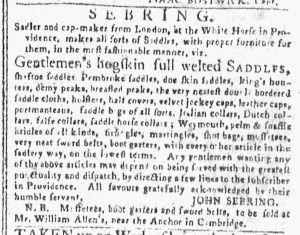
New-England Chronicle (January 4-11, 1776).

“SEBRING, Sadler and cap-maker from London, at the White Horse in Providence.”

After migrating to the colonies from England in the early 1770s, John Sebring occasionally placed advertisements in the Providence Gazette, offering his services as a “Saddler, Chaise and Harness Maker.”  Though he remained in Providence at the beginning of the Revolutionary War, he saw an opportunity to advertise in the New-England Chronicle, printed in Cambridge, in January 1776.  As the siege of Boston continued, he introduced himself to readers as a “Sadler and cap-maker from London.”  Even though it had been more than three years since he left the largest and most cosmopolitan city in the British Empire, he continued to stress his connection to it.  Prospective customers, after all, associated both skill and taste with artisans who had trained in London or gained experience working there.  Sebring also deployed one of the signature elements of his advertisements, using solely his surname rather than his full name as the headline.  That initial proclamation, the mononym “SEBRING,” suggested celebrity and an established reputation.

In this advertisement, Sebring declared that he “Makes all sorts of Saddles, with proper furniture for them, in the most fashionable manner.”  Practical was good, but stylish was even better!  He listed a variety of items that he made “at the White Horse in Providence,” the location featured in his newspaper notices since he first began advertising, and then advised that “Any gentleman wanting any of the above articles may depend on being served with the greatest punctuality and dispatch, by directing a few lines” to him.  Sebring had previously confined his advertisements to the Providence Gazette, but he apparently believed that the disruptions of the war opened new markets to him.  American officers and soldiers gathered in Cambridge and nearby towns, many of them dispatched from distant places.  As they would have been unfamiliar with local artisans, Sebring presented his workshop to supply saddles and other equipment via a mail order system.  In a nota bene at the conclusion of the advertisement, he offered a chance to examine some of his wares before placing orders for customized items.  “Mussetees [or musette bags, lightweight knapsacks used by soldiers], boot garters and sword belts,” Sebring stated, “to be sold at Mr. William Allen’s, near the Anchor in Cambridge.”  Sebring apparently recruited a local agent to help him break into a new market.

**********

Clarification:  Readers of the New-England Chronicle did not encounter this advertisement in the issue distributed on January 4, 1776.  It should not have been the featured advertisement on January 4, 2026.  Here’s how the mistake happened.

The format for the date in the masthead of some colonial newspapers confuses modern readers.  That’s because some newspapers published weekly did not state only the date on which the newspaper was published but instead indicated the week that it covered.  The New-England Chronicle was one of those newspapers.  Rather than giving “January 4, 1776” as the date, the masthead for that issue stated, “From THURSDAY, Decem. 28, 1775, to THURSDAY, January 4, 1776.”  For the issue published on January 11, the masthead stated, “From THURSDAY, January 4, to THURSDAY, January 11, 1776.”

While America’s Historical Newspapers associates the correct publication date with the issues of the vast majority of newspapers in the database, a couple newspapers use the date for the beginning of the week rather than the publication date.  When an undergraduate research assistant downloaded digital copies of all American newspapers published in 1776, I neglected to warn him that was the case for the New-England Chronicle.  I compounded the error by not looking at the masthead closely enough when I consulted the issue for January 4-11 to select an advertisement to feature on January 4.  I only noticed the problem after publishing the entry.

Since advertisements for consumer goods and services typically ran for multiple weeks, I hoped that Sebring’s advertisement also appeared in the December 28 – January 4 issue.  If that had been the case, I would have simply cropped the image from that issue and substituted it in this entry.  However, Sebring’s notice made its first appearance in the January 4-11 issue.

I decided that the next best solution was updating the date in the citation that accompanies the image of Sebring’s advertisement and adding this clarification.  It provides insight into the process of conducting research with digitized sources … and a warning about the importance of attention to detail.  I have more than a decade of experience working with digitized eighteenth-century newspapers.  I initially saw what I expected to see, not what was actually there, and only discovered the error when I took a closer look at the newspapers as I continued production of this project.  Fortunately, I caught the error quickly and updated the filenames for the downloaded newspapers accordingly.  In addition to this clarification, I am also making small adjustments to the Slavery Adverts 250 Project to adhere to the dates advertisements about enslaved people were published in the New-England Chronicle.
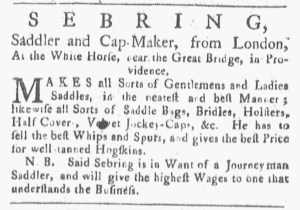
July 9

What was advertised in a colonial American newspaper 250 years ago today?

Providence Gazette (July 9, 1774).

“MAKES all Sorts of Gentlemens and Ladies Saddles, in the neatest and best Manner.”

John Sebring, a “Saddler and Cap-Maker, from London,” once again took to the pages of the Providence Gazette in the summer of 1774.  As had been his practice in the past, he deployed solely his last name as a headline for his advertisement, presumably believing that a mononym gave him greater cachet with prospective customers.  He declared that he “MAKES all Sorts of Gentlemens and Ladies Saddles, in the neatest and best Manner” as well as “all Sorts of Saddle Bags, Bridles, Holsters, Half Covers, Velvet Jockey-Caps,” and other items.  He intended for readers to associate quality with the name Sebring.

In addition to the mononym, Sebring apparently believed that his experience in London enhanced the image he presented to the public, though it had been some time since he resided and worked in that cosmopolitan center of the empire.  When they proclaimed that they were “from London,” artisans often linked those origins to superior training or more intimate knowledge of current styles or both.  Sebring did in his previous newspaper notices.  By the time he placed his advertisement in the July 9, 1774, edition of the Providence Gazette, however, he had been in that town for at least twenty months.  That may have caused him to place less emphasis on his supposed knowledge of London fashions.  In previous advertisements, he used the phrase “newest Fashion” to describe the saddles and other items he made in his workshop “At the White Horse, near the Great Bridge,” implying that his connections to London gave him insight into the latest styles there.  He even included the phrase twice in a notice he ran the previous summer.  In this advertisement, however, he focused on quality instead of (rather than in addition to) fashion.  Perhaps Sebring realized that many prospective customers knew he had not worked in London recently so his familiarity with the styles there came secondhand.  The training and experience he gained in London, however, did not change as time passed, making it worthwhile to continue to remind prospective customers of his origins.

July 21

What was advertised in a colonial American newspaper 250 years ago today?

Pennsylvania Gazette (July 21, 1773).

“At the Hunting Side Saddle.”

Elias Botner, “Sadler and Harness-maker,” ran a workshop “at the Hunting Side Saddle, next door to the London Coffee-house” in Philadelphia in the early 1770s.  In an advertisement in the July 21, 1773, edition of the Pennsylvania Gazette, he informed prospective customers that he made and sold various kinds of saddles for gentlemen and ladies as well as saddlebags, “jockey caps, of all sizes,” holsters, and fire buckets.  He declared that he made his saddles and “saddle-furniture” (or equipment) “in the newest and neatest fashion” to match the tastes of his discerning customers.  In addition, he marketed his fire buckets as the “strongest perhaps made in this city.”  He offered discounts to customers who purchased “a quantity” of fire buckets, while also promising “the lowest terms” for his other merchandise.

To draw attention to these various appeals, Botner adorned his advertisement with a woodcut that depicted a saddle.  That image distinguished his advertisement from the other paid notices in the same issue.  Four of them featured stock images of ships at sea, supplied by the printers, but all of the other advertisements relied solely on text without images.  Botner’s advertisement was the only one with an image commissioned for the exclusive use of that business.  It was not the first time, however, that the saddler deployed the image, though it had been a while since it appeared in the pages of the Pennsylvania Gazette.  More than three years earlier, Botner ran an advertisement in the Postscript Extraordinary to the Pennsylvania Gazette on May 3, 1770, adorning his notice with the woodcut and invoking the sign that marked the location of his shop.  That sign remained a constantly visible marker for residents and visitors who traversed the streets of Philadelphia in the intervening years, even though the woodcut disappeared from the public prints during that time.  Like many other entrepreneurs, Botner utilized visual images to promote his business, but used some, like his shop sign, consistently and others, like his woodcut in his newspaper advertisements, sporadically.  Botner and others experimented with the power of images in their marketing efforts, sometimes assuming additional costs for the advertisements they placed in colonial newspapers.

June 12

What was advertised in a colonial American newspaper 250 years ago today?

Providence Gazette (June 13, 1773).

“MAKES in the newest Fashion, and in the neatest Manner, all Sorts of Men and Womens Saddles.”

In the summer of 1773, John Sebring, a “Saddler, Chaise and Harness-Maker, from London,” once again took to the pages of the Providence Gazette to promote his services.  As he had done in previous advertisements, he used only his last name as a headline for his notice, implying that readers should have been so familiar with his reputation that he did not need to give his full name.  In addition, he asserted that he already established a clientele in the city, expressing “his Thanks to all those who have obliged him with their Custom.”  Anyone in need of saddles and accessories who was not already familiar with the remarkable Sebring, the advertisement suggested, needed to learn more about the saddler from London and his wares.

To underscore that point, Sebring proclaimed that he “MAKES in the newest Fashion, and in the neatest Manner, all Sorts of Men and Womens Saddles … with every other Article in the Saddlery Way.”  In so doing, he deployed common marketing strategies.  He made an appeal to fashion, asserting his familiarity with the latest styles, as well as an appeal to quality and his own skill in producing “Saddles, Portmanteaus, Saddle Bags, Holsters, Half Covers, Velvet Jockey Caps, Leather Caps, Bridles,” and other accessories.  In a nota bene, he reiterated his knowledge of the current trends: “Ladies Hunting Side Saddles made in the newest Fashion.”  In each instance, his London origins bolstered those appeals, suggesting that he had access to the “newest Fashion” in the most cosmopolitan city in the empire and that he received superior training in his trade in that metropolis compared to local competitors.  His clients, however, did not have to pay a premium for those benefits.  Sebring declared that he set prices “on as low Terms as are sold in any Shop in Providence.”

Appropriately, the saddler ran his workshop “at the White Horse.”  He invited current and prospective customers to visit him there to take advantage of the many benefits he outlined in his advertisement, seeking to convince genteel gentlemen and ladies that he was in the best position of any saddlers in Providence to serve their needs.

December 17

What was advertised in a colonial American newspaper 250 years ago today?

Supplement to the Massachusetts Gazette and Boston Weekly Mercury (December 17, 1772).

“Stirrups … immediately disengaged.”

Richard Sharwin placed an advertisement for “the new invented SPRINGS For the Stirrups of Ladies and Gentlemens Saddles” in the December 17, 1772, edition of the Massachusetts Gazette and Boston Weekly News-Letter.  In an advertisement he placed in another newspaper a year and a half earlier, Sharwin described himself as a “Sadler and Jockey Cap-Maker, from LONDON.”  He did not list his occupation or origins in his new advertisement, perhaps believing that he had so sufficiently established his reputation among local consumers that he no longer needed to do so.  Instead, he simply directed prospective customers to “the White Horse in King-Street, BOSTON.”

With the exception of a nota bene that provide a general overview of Sharwin’s services that followed his signature, the saddler devoted his advertisement to those “new invented SPRINGS,” using the word “springs” in capital letters as a headline for the notice.  Sharwin explained that when a rider fell from a horse, the springs “immediately disengaged” from the stirrups and “prevented the Danger of being drag[g]ed.”  In offering assurances about quality, the saddler asserted that his springs “are made as compleat as from the Patentee in London.”  In addition, they “may be fixed to any Lady’s or Gentleman’s Saddle.”  Sharwin could make riding safer for any client.

He was not the only saddler in New England emphasizing safety as a marketing strategy in the final months of 1772.  Three weeks earlier, John Sebring, “Sadler, Chaise and Harness Maker, from London,” inserted an advertisement that included detachable stirrups in the Providence Gazette.  He advised prospective customers that he “makes Men and Womens Saddles on such a Construction, that if the Horse should throw his Rider, and the Foot should hang in the Stirrup, the Stirrup will leave the Saddle before the Horse takes three steps.”  Given that colonial newspaper circulated far beyond the cities and towns where they were printed, both Sharwin and other residents of Boston may have seen Sebring’s advertisement in the Providence Gazette.  Sharwin certainly wanted prospective customers to know that they did not need to order saddles with that feature from artisans in Providence or London.

In marketing their saddles, Sharwin and Sebring combined appeals to safety and innovation, a strategy that became increasingly common as advertising continued to develop in the nineteenth and twentieth centuries.  The saddlers encouraged consumers to acquire new inventions with enhanced safety features rather than settle for products that may have seemed more familiar but lacked such important elements.

November 28

What was advertised in a colonial American newspaper 250 years ago today?

Providence Gazette (November 28, 1772).

“He has had the Advantage of several Years Experience in some of the principal Shops in London.”

John Sebring, a “Saddler, Chaise and Harness Maker,” used solely his last name, “SEBRING,” as the headline for his advertisement that ran in the Providence Gazette in November 1772.  Occasionally advertisers deployed that strategy, perhaps intending to suggest to prospective customers that their reputations were already so well established that they did not need to give their full names.  That did not prevent Sebring from providing plenty of information about his business to refresh the memories of prospective customers who could not quite place him by last name alone.

The saddler listed all sorts of saddles and accoutrements that he made “in the newest Fashion” at his shop.  He also provided details about some of the specialized merchandise that he produced, including “Men and Womens Saddles on such a Construction, that if the Horse should throw his Rider, and the Foot should hang in the Stirrup, the Stirrup will leave the Saddle before the Horse takes three Steps.”  Sebring emphasized safety in marketing his saddles, indicating that his concern for his customers extended beyond the point of sale.

He also highlighted the experience he gained in London, using an appeal often made by artisans who migrated across the Atlantic.  In addition to introducing himself as “from London,” Sebring declared that he “has had the Advantage of several Years Experience in some of the principal Shops in London.”  Artisans often believed that such declarations served as testimonials to their skill and experience, pledging that they would deliver the same quality workmanship to prospective customers in their new towns as they did for former customers in the cosmopolitan center of the empire.  Sebring stated that he “hopes to merit the Approbation of all that may please to favour him with their Custom” by fulfilling their expectations for the saddles, harnesses, and other items he made and sold at his shop.

Sebring’s advertisement contained a lengthy list of his wares, a common element in newspaper advertisements of the era, but the saddler also incorporated elements intended to distinguish him for his competitors.  He used a flashy headline, emphasized his experience in “principal Shops” in London, and featured a saddle with detachable stirrups for the safety of his customers.  Any of those strategies could have piqued the interest of prospective customers, inciting them to visit the saddler’s shop to satisfy their curiosity.

May 1

What was advertised in a colonial American newspaper 250 years ago today?

Massachusetts Gazette and Boston Post-Boy (May 1, 1771).

“Lower Terms than can be at any Shop or Store in the Province.”

Although “Sadler and Jockey Cap-Maker” Richard Sharwin signed his entire name at the end of his advertisement in the April 29, 1771, edition of the Massachusetts Gazette and Boston Post-Boy, he deployed the mononym “SHARWIN” as a headline to draw attention.  The mononym suggested that consumers should already be familiar with his reputation, but he also declared that he was “From LONDON” to further underscore his importance for readers who were not familiar with his work.  Sharwin proclaimed that he made a variety of items, “the several Materials and Workmanship the best of their Kind.”  From “hunting Sadles with Hogskin seat” to “Pelm and Snaffle Bridles with Silver plated Bits” to “Velvet Jockey Caps,” the items he produced in his shop were “as Neat as can be Imported.”  Sharwin assured prospective customers that when they shopped locally, they still acquired goods of the same quality as those that arrived from London.

Sharwin also tended to price in his advertisement, pledging that he sold his wares “upon lower Terms than can be at any Shop or Store in the Province.”  Advertisers commonly asserted their low prices, but not nearly as often did they encourage consumers to compare their prices to those of their competitors.  Sharwin not only did so but also listed prices for welted saddles (“from 8 to 10 Dollars”) and plain saddles (“from 6 to 8 Dollars”), allowing readers to do some comparison shopping without even visiting his shop on King Street.  They could judge for themselves whether he offered bargains.  Merchants, shopkeepers, and artisans provided prices in their advertisements only occasionally, making Sharwin’s invitation to compare prices all the more notable.  Prospective customers could use the prices for welted saddles and plain saddles as a barometer for how much he charged for the dozens of other items listed in his advertisement since Sharwin set prices for “every Article in proportion.”

All in all, Sharwin incorporated several standard elements of eighteenth-century advertising into his own advertisement while also experimenting with less common marketing strategies.  Like many other advertisers, he emphasized consumer choice by listing an assortment of goods, touted his connections to London, and underscored quality and price.  He enhanced his advertisement with a mononym for a headline, stating the prices for some items, and trumpeting that his competitors could not beat those prices.  Sharwin crafted an advertisement that was not merely a rote recitation of the usual appeals made to consumers.

May 3

What advertised in a colonial American newspaper 250 years ago today?

May 3 - 5:3:1770 Pennsylvania Gazette
Postscript Extraordinary to the Pennsylvania Gazette (May 3, 1770).

“The Sign of the Hunting-Side-Saddle.”

A striking image of a saddle embellished Elias Botner’s advertisement in the Postscript Extraordinary to the Pennsylvania Gazette published on May 3, 1770.  The woodcut announced Botner’s occupation before readers had a chance to peruse the advertising copy that described “GENTLEMENS English, hunting, full welted and plain, Hogskin, Buckskin, and Neats Leather, seated SADDLES,” “Ladies hunting Side-Saddles,” and all kinds of accessories.  Inserting this image represented a significant investment for Botner.  He had to commission the woodcut that corresponded to his business and would not be used in any other advertisements, plus he had to pay for the space that it occupied on the printed page.  Eighteenth-century advertisers paid by the amount of space required for their notices, not the number of words.  The image of the saddle nearly doubled the amount of space for Botner’s advertisement.

The saddler quite likely considered it worth the investment.  His saddle was the only visual image on either page of the Postscript Extraordinary, drawing the eye away from the dense text that constituted both news and every other advertisement.  Including an image was itself extraordinary in the various parts of the May 3 edition of the Pennsylvania Gazette.  The standard four-page issue featured only two images, the shield that adorned the masthead on the front page and a generic image of a ship that accompanied a notice about a ship preparing to depart for Bristol.  In the two-page Supplement, another woodcut of a ship appeared in another notice about a ship sailing for Bristol.  Both images of ships belonged to the printer and could be deployed interchangeably in advertisements concerning maritime trade.  Over the course of the eight pages that constituted the standard issue, the Supplement, and the Postscript Extraordinary, readers encountered only four images.  Botner’s saddle was the only one that would have been unique or unexpected.  As a result, it may have been just as effective as (or even more effective than) his description of hjs goods or his promises of customer service in attracting the attention of prospective customers.

December 18

What was advertised in a colonial American newspaper 250 years ago today?

Dec 18 - 12:18:1769 Boston-Gazette
Boston-Gazette (December 18, 1769).

“Will engage to make any Piece of Work as compleat as can be imported.”

In December 1769, Daniel MacNeill, a “Saddler and Cap-maker from DUBLIN,” turned to the Boston-Gazette to advise residents of Boston and its environs that he operated a shop in King Street. He made and sold a variety of items, including “Neat welted and plain Hunting Saddles,” “Pistol Cases & Holsters,” “Portmanteaus and Saddle Baggs,” and “every Article in the Sadlery Branch.” In addition to offering low prices, he assured prospective customers that he served them “with Fidelity and Dispatch.” He also made appeals to quality and fashion, proclaiming that he constructed these items “in the neatest and genteelest Manner.” MacNeill incorporated many of the most common marketing appeals of the eighteenth century into his advertisement.

As a relative newcomer to the city, MacNeill deployed another strategy that often appeared in newspaper notices placed by artisans who migrated across the Atlantic. He provided an overview of his work history as a means of convincing prospective customers of his competence. MacNeill asserted that he “had the Advantage of many Years Practice in the most principal Shops in Dublin and Towns adjacent.” In so doing, he attempted to transfer the reputation he established in one location to another, asking prospective customers to credit him for his years of experience. Although items he made during that time had not circulated for inspection in Boston, MacNeill hoped that his affiliation with “the most principal Shops” in one of the largest cities in the empire testified to his skill and expertise.

To that end, he pledged that he made saddles and other items “as compleat as can be imported.” Realizing that colonists sometimes had a preference for imported goods with an expectation of higher quality or better craftsmanship, MacNeill promised that his clients did not have to fear that they purchased inferior goods from his workshop. This appeal likely resonated with colonists who adhered to the nonimportation agreements and sought “domestic manufactures,” goods produced in the colonies, as alternatives to those transported across the Atlantic. An article on the first page of the December 18, 1769, edition of the Boston-Gazette proposed bringing artisans and their families to the colonies, suggesting that those migrants were much more welcome than imported goods that Parliament taxed. MacNeill’s advertisement reverberated with political implications, even as he made standard appeals to price, quality, and fashion.

May 19

What was advertised in a colonial American newspaper 250 years ago today?

May 19 - 5:19:1767 South-Carolina Gazette and Country Journal
South-Carolina Gazette and Country Journal (May 19, 1767).

“He served his apprenticeship in London, of which city he is a freeman.”

As a standard part of their advertisements, merchants and shopkeepers noted that they sold goods imported from faraway places, especially London. In so doing, they established themselves as conduits who connected their customers to both the quality and fashions associated with goods produced and popularly consumed in the largest city in the British empire. Artisans who made the items they sold in local workshops, however, could not make quite the same claim. Instead, those who had migrated across the Atlantic proudly proclaimed their origins, announcing that they were “FROM LONDON,” as Whiting the saddler did in today’s advertisement.

On occasion, artisans elaborated on the training they had received in workshops in London, demonstrating to potential customers why they should take notice of their origins. Whiting asserted that he was capable of “execut[ing] all the branches of that business in the compleatest manner” precisely because “he served his apprenticeship in London, of which city he is a freeman.” This meant that Whiting belonged to the Worshipful Company of Saddlers, one of the city’s livery companies that originated as trade guilds. These companies oversaw members who practiced their trade; they kept standards high, an early modern version of quality control. To become a member, known as a freeman, an artisan had to serve an apprenticeship under a master of the trade who was already a freeman. Alternately, some joined by patrimony if a parent ad been a freeman or by redemption upon paying a fee. Working within the walls of the City of London required achieving freeman status. This conferred some level of prestige on the artisans, a certain cachet that Whiting suggested could be transferred to those who hired him. Whiting wanted prospective customers to know that he had earned the rank of freeman via servitude rather than patrimony or redemption, that he had honed his skills through an apprenticeship to a master saddler.

Although he was an ocean away from the livery companies that oversaw artisans in the City of London, Whiting called on their privileged position and his membership in their order to advance his own workshop in Charleston. He expected that this would resonate with local residents.