February 8

What was advertised in a colonial American newspaper 250 years ago today?

Feb 8 - 2:8:1768 Newport Mercury
Newport Mercury (February 8, 1768).

“ADVERTISEMENTS, not exceeding Sixteen Lines, are inserted Three Weeks for Three Shillings.”

In addition to the masthead on the first page, most eighteenth-century newspapers also included a colophon that listed publication information on the final page. At the very least the colophon usually indicated the name of the printer and the place of publication, but many printers inserted much more extensive information in their colophons, often transforming them into advertisements for the goods and services they provided. For instance, in the colophon for the February 8, 1768, edition of the New-York Gazette: Or, the Weekly Post-Boy James Parker announced that he accepted “Subscriptions, and Advertisements, &c. for this Paper” at his printing office on Beaver Street. On the same day, Peter Timothy similarly invited readers of the South Carolina Gazette to submit subscriptions and advertisements, but his colophon also stated that “all Kinds of useful Blanks sold, and all Sorts of Printing-Work is done with Accuracy and Dispatch” in his shop.

Like Parker and Timothy, many printers frequently solicited advertisements in their colophons. After all, advertising generated greater revenues than subscriptions. Far fewer printers, however, indicated how much they charged advertisers to have their notices inserted in the newspaper. In the colophon of the Newport Mercury Samuel Hall did publish such rates: “ADVERTISEMENTS, not exceeding Sixteen Lines, are inserted Three Weeks for Three Shillings, lawful Money, and Six Pence for each Week after.” This schedule indicates how much advertisers paid for both space in the newspaper and the time and labor involved in setting the type. Each advertisement required a minimum payment of three shillings (or thirty-six pence). Hall determined that the space taken up by an advertisement was worth six pence per week. Since the original order had to cover three weeks, that meant that eighteen pence went toward the space the advertisement occupied on the page. The remaining eighteen pence then covered the time and labor involved in setting the type. This sort of payment structure was common among printers who revealed advertising rates in their colophons. Once an advertiser made it worth their time to set the type (usually three weeks, but occasionally four), they continued to publish an advertisement for just the cost of the space. Running an advertisement for even a short time often exceeded the cost of a subscription to the newspaper, making paid notices lucrative for printers.

August 12

What was advertised in a colonial American newspaper 250 years ago this week?

Aug 12 - 8:11:1766 Newport Mercury
Newport Mercury (August 11, 1766).

“DIRECTIONS for making calcined or PEARL ASHES.”

Advertisements associated with the potash industry appeared quite regularly in colonial newspapers. Some advertisers wanted to buy it, offering a good price in exchange for potash. Others supplied some of the equipment, such as oversized kettles, necessary for producing potash. Although not necessarily directly involved in potash production, printers also published advertisements that indicated they stood to profit from it all the same. Some sold “Justices Blank Certificates” used in the packing and regulation of potash, while others peddled instruction manuals to those who wanted to participate in the industry or improve on their previous efforts.

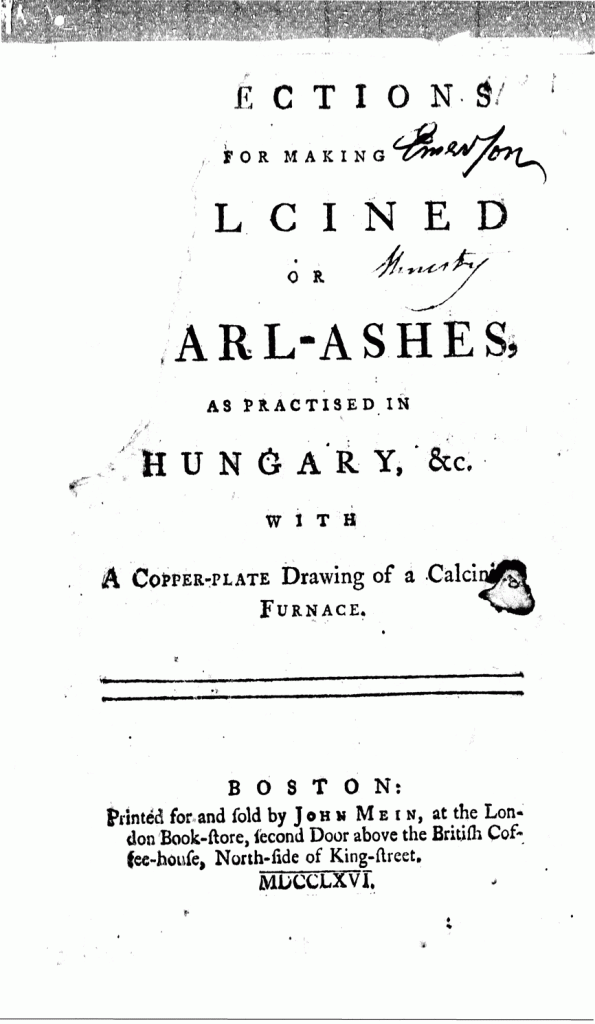
Such was the case with a short pamphlet (less than twenty pages) devoted to “DIRECTIONS for making calcined or PEARL ASHES, As practised in Hungary, &c.” Samuel Hall, the printer of the Newport Mercury, sold the pamphlet at his shop “on the North Side of the Parade,” but the imprint on the pamphlet itself indicated that it was “Printed for and sold by JOHN MEIN, at the London Book-store” in Boston. Both printers (and quite likely others throughout New England that exchanged stock with Mein) looked to make a profit from indirect involvement in the potash trade through the sale of ancillary products.

Aug 12 - Potash Pamphlet
Directions for Making Calcined or Pearl Ashes, as Practised in Hungary, &c. with a Copper-plate Drawing of a Calcining Furnace (Boston:  John Mein, 1766).  Boston Public Library.

Both the advertisement and the title page of the pamphlet underscored that it included “a Copper-Plate Drawing of a calcined Furnace.” This would have certainly increased the expense of producing the pamphlet and, ultimately, the cost to the customer, but such an investment could be readily justified. The accompanying image likely offered valuable insight into the text, making it more comprehensible. Art historian Nancy Siegel has argued that engraved images that accompanied eighteenth-century cookbooks were imperative in demonstrating the meaning of the text to readers. The same would have been true for an instruction manual detailing equipment and processes for producing potash, especially for readers not already well versed in the subject. After all, the directions in the pamphlet were “founded on the most extensive Knowledge of Pearl Ashes—a Knowledge acquired by long Practice, Experience and Success. The advertisement warned readers that this was “the only Means to establish Matters of Fact.” It concluded by jeering that “plausible Theories” were “little better than ingenious Amusements.”

In other words, both the text and the engraved copperplate drawing merited attention from anybody serious about potash production. Both were worth the expense.